Exploring Types of Open Sets in Neutrosophic Over Soft Topological Spaces with an Application to Organic Catalyst Selection
 ,Yamini Parthiban2,3, D. Vidhya4 and G. Muthumari5
1Department of Mathematics, Vel Tech Rangarajan Dr.Sagunthala R and D Institute of Science and Technology, Avadi, Chennai, Tamil Nadu, India.
2Department of Mathematics, SRM Institute of Science and Technology, Ramapuram, Chennai, Tamil Nadu, India
3Department of Mathematics and Science Education, Faculty of Education, Harran University, Sanliurfa, Turkey.
4Department of Mathematics, Mahendra College of Engineering, Minnampalli, Salem, Tamil Nadu, India.
5Department of Mathematics, S.A. Engineering College, Thiruverkadu, Chennai, Tamil Nadu, India
Corresponding Author E-mail: muthumarig@saec.ac.in
DOI : http://dx.doi.org/10.13005/ojc/420239
Download this article as:

Neutrosophic Over Soft Topological Spaces (Nso-topological space) integrate the concepts of softness and neutrosophy , thereby providing a higher-level framework for handling uncertainty in topological structures ; this work extends this existing framework by introducingnew classes of generalized open sets, namely, Nsoα-, Nsoβ-, Nso semi- and Nso pre-open sets, and gives corresponding notions of continuity; many propositions concerning relationships of such types of functions are established, and next approach composition and behavior of such functions in various situations. In this paradigmatic case study, such an application of theoretical advancements turns to considering a numerical example, selecting the most suitable catalyst for a reaction of organic chemistry, revealing the possible role of decision making with the -topological space in complicating environments.
KEYWORDS:Catalyst selection; Generalized continuity; Nsoα-open set, ????-open set, ???-semi open set, ???-pre open set,
Introduction
The introduction of fuzzy sets 28 by Zadeh in 1965 created the foundation for fuzzy set theory, permitting partial membership of elements and thereby inducing a revolution in decision-making and control systems. Zadeh also extended this idea in 1978 by establishing the frame of reference of possibility theory29 as a more intuitive way to deal with uncertainty than probability theory. Then, in 1970, Bellman and Zadeh 3 laid the first applications of fuzzy logic in decision-making environments on these theoretical foundations, giving birth to a host of real-world applications in fields such as economics, engineering, and operations research. In 1995 Bustince and Burillo 5 contributed to uncertainty modeling through the study of interval-valued intuitionistic fuzzy sets, extending the expressive power of fuzzy sets through the inclusion of both membership and non-membership functions with interval-valued arguments. Subsequently, in 1998, Atanassov and Shannon1 expanded the concept of intuitionistic fuzzy logic by introducing logical operations and properties, thereby enlarging its theoretical horizon.
Molodtsov18 introduced in 1999 the soft set theory notion as an innovative mathematical tool capable of fighting against vagueness in situations parameterized with applications where normal models could not be utilized. In parallel, Smarandache23 introduced neutrosophic logic in the same year as a powerful generalization of fuzzy and intuitionistic fuzzy logic, distinguishing between degrees of truth, indeterminacy, and falsity, and thus allowing a more sophisticated approach to modeling uncertainty. Maji et al. in15 in 2003 formalized a soft-set framework into a structured decision-making tool providing the groundwork for more integration with fuzzy and neutrosophic theories. Wang et al.26 extended the entire neutrosophic theory through the introduction of single-valued neutrosophic sets in 2010, where the application of this theory could be better addressed in real-life decision support systems.
Ye27 introduced some innovative single-valued neutrosophic correlation coefficients in 2013. Moreover, he proposed improved decision-making processes that would augment computational tools in dealing with uncertainty. In 2016, Smarandache25 came up with oversets, undersets, and offsets to further develop neutrosophic theory. This expansion gave the theory more ways of structuring itself. Dhavaseelan et al.10, in 2019, introduced the idea of neutrosophic -continuity, adding to the study of generalized continuity in neutrosophic topologies. During the same year, RN Majeed and SA El-Sheikh21 dealt with fuzzy orbit topological spaces offering some new applications in the field of materials science and engineering systems. Correlation measures associated with pythagorean neutrosophic sets were actually put forward by Jansi et al.11 in 2019 giving better decision-making tools for complex uncertainty. Mehmood et al. developed the concept of neutrosophic soft -open sets in 2020,17 marking another important step in soft set and neutrosophic topological theories.
In the same year, 2020, Saeed et al.22 took on medical diagnosis through applications of multi-polar neutrosophic soft sets which reveal the capability of neutrosopholic models in healthcare settings. The same year, Christianto et al.6 investigated some philosophical and scientific implications of neutrosophic logic to encourage its adoption in mainstream physical sciences. Smarandache and Pramanik24 compiled a hefty edited book in 2020, which captures the most recent developments and future directions of neutrosophistic theory. Mallick and Pramanik [16] are also in line, proposing pentapartitioned neutrosophic sets which will accommodate much more assorted forms of uncertainty without extending them from classical partition.
Radha et al.20 in 2021 presented neutrosophic Pythagorean sets with dependent components which improved correlation coefficients and hence considerably boosted the evaluation of such-related similarity in uncertain datasets as well as strengthened decision-making systems. In 2021, Madhumathi and Nirmala Irudayam13,14 introduced neutrosophic orbit topological spaces, and in 2022, orbit continuous mappings, these are new instruments that studies dynamical and parametric uncertainty via topological structures. In 2022, Atanassov established the intuitionistic fuzzy modal topological structure.2, which incorporated modal operators into fuzzy logic and paved the way for new possibilities in reasoning under graded necessity and possibility. Broumi4 has enriched the conceptualization of generalized neutrosophic soft sets in terms of the better analytical formulation.
Kumaravel et al.12 applied fuzzy and neutrosophic cognitive maps for disease diagnosis and COVID variant modeling by Murugesan et al.19 This relevance is highlighted with respect to the real-world issues today. From 2024 to 2025, Devi and Parthiban7-9 have incorporated neutrosophic approach over soft topological constructs in decision making problem.
This study focuses on the extension of Neutrosophic Over Soft Topological Spaces (Nso-spaces) by introducing new generalized open sets, namely Nso α-open, Nso β-open, Nso-semi open, and Nso-pre open sets. Various types of continuity corresponding to these open sets are investigated, including Nso-continuous, Nso α-continuous, Nso β-continuous, semi-continuous, and pre-continuous functions. These enhancements provide a deeper understanding of the structural behavior of Nso-spaces. Additionally, a numerical application related to optimal catalyst selection is presented to demonstrate the effectiveness of the proposed framework. By systematically exploring the interrelationships among the newly defined open sets and their associated continuity types , this study establishes a comprehensive view of their mutual dependencies . Such an investigation reveals how each class of set and function interacts with the others , leading to a clearer understanding of the underlying topological framework . Nevertheless, This integrated perspective strengthens the theoretical foundations of neutrosophic over soft topological spaces and highlights previously unexplored structural properties . As a result , the study contributes to building a more robust and versatile mathematical structure for -spaces.
Preliminaries
This section provides the fundamental concepts and definitions necessary for understanding Neutrosophic Over Soft Set[9] and Neutrosophic Over Soft Topological Spaces[9].
Definition 2.1 [9] Let H be an non-empty set and ∈ be a set of parameter on H. Then Nso-set is defined by a set valued function
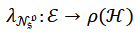
where ρ(H) is an set of all Nso-set on H. Nso-set is an valued function from the set of parameter E on H is defined as

Definition 2.2 [9] A Nso-set ⊳ ={ e,{〈h,0,0,Ω〉:h ∈ H}: e ∈ E} is said to be a Null Nso-set and ▶ = {e, {〈h,Ω,Ω,0〉: h ∈ H}:e ∈ E} is said to be an universal Nso-set.
Definition 2.3 [9] A neutrosophic over soft topology(Nso-topology) τNso on non-empty set H such that
⊳,▶∈τNso.
The union of an arbitrary collection τNso is in τNso.
The finite intersection of subsets τNso is in τNso.
Then H, τNso is called neutrosophic over soft topological space(Nso-topological space). An element of τNso is called an neutrosophic over soft open set(Nso-openset) and complement of τNso neutrosophic over soft closed set(Nso-closedset).
Definition 2.4 [9] An operators of Nso-set J ∈ τNso, then neutrosophic over soft topological closure and interior are clNso (J) and intNso(J) is defined as:

Note: In this paper, the Neutrosophic Over Soft Set is defined initially as
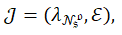
in terms of elements e ∈ E and corresponding maps involving h ∈ H. Yet, in the main work throughout, J is always represented as

emphasizing the basic relations within the framework.
Characterization of Open Set Types in Neutrosophic Over Soft Sets
Definition 3.1 Let be a -topological space and let J be a Nso-set of H then J is said to be
Nsoa-open if J ⊆ intNso(clNso(intNso(J)))
Nso β-open if J ⊆ clNso(intNso(clNso(J)))
Nso-semi open if J ⊆ clNso(intNso(J))
Nso-pre open if J ⊆ intNso(clNso(J))
Proposition 3.2
Every Nso-open set is Nso-open.
Every Nso-open set is Nso-open.
Every Nso-open set is Nso-semi open.
Every Nso-open set is Nso-pre open.
Proof. Let be a Nso-open set in a Nso-topological space.
Since is Nso-open, we have J = intNso (J). Now consider

Hence, J ⊆ intNso(clNso(J)), which implies that J is Nsoa- open.
Since J is Nso-open, as above, we have J = intNso (J). Then

since clNso (J) ⊇ J and intNso (clNso (J)) ⊇ J because J is open. Hence J is Nso β-open.
Since J is Nso-open, then intNso(J) = J and so clNso(intNso(J)) = clNso (J) ⊇ J hence J ⊆ clNso (intNso(J)) which proves J is Nso-semi open.
Similarly, since J = intNso(J), and clNso (J) ⊇ J, we have

Hence J ⊆ intNso(clNso (J)), so J is Nso-pre open.
Therefore, every Nso-open set is also Nsoa-open, Nso β-open, Nso-semi open and Nso-pre open.
Proposition 3.3 Let H,TNso be a Nso-topological space. Then
The union of any family of Nsoa-open sets is Nsoa-open.
The union of any family of Nso β-open sets is Nso β-open.
The union of any family of Nso-semi open sets isNso-semi open.
The union of any family of Nso-pre open sets is Nso-pre open.
Proof. Let {Jλ}λ∈Λ be a family of Nsoa-open sets in a Nso-topological space H,TNso.
By definition of Nsoa-open set, for each λ ∈ Λ, we have:

Now consider the union J =λ∈Λ Jλ.
To prove that J ⊆ intNso(clNso(intNso(J))).
Since the interior and closure operators are monotone and preserve unions over open sets,
we get:
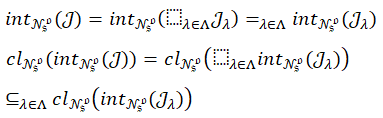
Applying the interior operator again:

Now, since Jλ ⊆ intNso(clNso(intNso(J))). for each λ, we have:

Hence,

Therefore, J is Nsoα-open.
Let {Jλ}λ∈Λ be a family of Nso β-open sets in a Nso-topological space (H, τ Nso).
By definition of Nso β -open sets, for each λ ∈ Λ, we have:

Let J =λ∈Λ Jλ. We want to show:

First, since J =λ∈Λ Jλ, and the closure operator is monotonic and preserves unions:

Applying the interior operator (which is also monotonic):

Now apply closure again:

Therefore:

Hence,

Therefore, J is Nso β -open. For iii and iv It is obviously true.
Proposition 3.4 Let be -topological space then
⊳ and ▶ are Nsoα-open sets.
⊳ and ▶ are Nso β -open sets.
⊳ and ▶ are Nso-semi open sets.
⊳ and ▶ are Nso-pre open sets.
Proof. i. By definition of a Nso-topological space, the Nso null set ⊳ and the Nso universal set ▶ are elements of τ Nso . Hence, they are Nso -open sets.
We now verify whether these sets satisfy the condition for being Nsoα-open. That is, we need to check whether:

for J = ⊳ and J = ▶.
Case 1: Let J = ⊳.
Since ⊳ is open, we have:

(because closure of the empty set is empty in any topological space)

Hence,

Therefore, ⊳ is Nsoα-open.
Case 2: Let J = ▶.
Since ▶ is open, we have:

Hence,

Therefore, ▶ is Nsoα-open.
ii, iii and iv are obviously true.
Proposition 3.5 Every Nsoα-open set is Nso-pre open.
Proof. Let ((H, τNso) be a Nso-topological space and let J be a Nsoα-open set.
By definition of Nsoα-open set, we have:

Let us denote A = intNso(J) .

Since A ⊆ J, it follows that:

Now apply the interior operator on both sides:

From 3.1 and 3.2
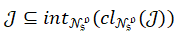
This is precisely the definition of a Nso-pre open set. Hence, every Nsoα-open set is Nso-pre open.
Remark 3.6 Converse of proposition3.5 is need not to be true which is proven by the example 3.7
Example 3.7 Example: Let H = {x1, x2, x3} and define a Nso-topology on H by:
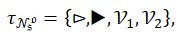
where

Define the neutrosophic over soft set:

where
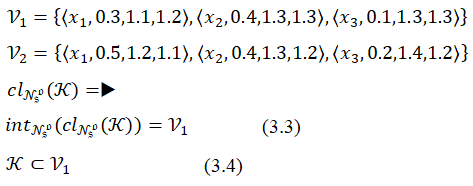
From 3.3 and 3.4
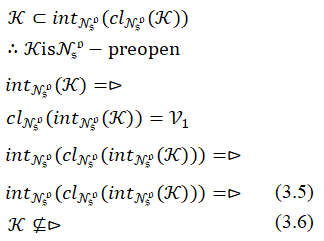
From (3.5) and (3.6)

∴ K is not Nsoα-open
Proposition 3.8 Every Nsoα-open set is Nso-semi open.
Proof. Let (H, τNso ) be a neutrosophic over soft topological space.
Let J be a Nsoα-open set. By definition of Nsoα-open set, we have:
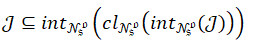
Now let us denote K = intNso (J), which is a Nso-open set since the interior of any set in a topology is open by definition.
So we have:
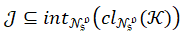
Since K is open, its closure clNso (K) is a superset of K and thus contains all points that are limit points or in K.
The interior of the closure, intNso (clNso (K)), is therefore an open set in τNso that contains J.
Now, recall the definition of a Nso-semi open set: A set J is said to be semi open if
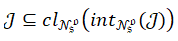
But from the assumption that J is Nsoα-open, we already have:

(because any set is contained in its interior of the closure implies it’s also in the closure itself).
Since K = intNso (J), it follows that:
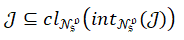
which is the definition of a Nso-semi open set.
Hence, every Nsoα-open set is indeed Nso-semi open.
Example 3.9 Let H = {x1, x2, x3} and define a Nso-topology on H by:

where

Let the neutrosophic over soft set be:

Clearly,

So,

However,

∴ M is Nso-semi open but not Nsoα-open
Proposition 3.10 Every Nsoβ-open set is Nso-semi open.
Proof. Let (H, τNso ) be a Nso-topological space, and let J be a Nsoβ-open set.
By definition of Nsoβ-openness, we have:

Now observe that:

Then,

Since

and from the above inclusion, we conclude that:

This is precisely the condition for J to be Nso-semi open.
Hence, every Nsoβ-open set is Nso-semi open.
Example 3.11 Let {H, τNso} and define a Nso-topology on as:

where

Define the neutrosophic over soft set:

We observe:

Thus,
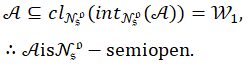
But now consider:

Since

we conclude that

Proposition 3.12 Every -Nsoβ-open set is Nso-pre open.
Proof. Let {H, τNso} be a neutrosophic over soft topological space. Let J be a Nsoβ-open set in this space. By definition of a Nsoβ-open set, we have:

On the other hand, a Nso-pre open set J is defined as:

Since the interior operator is monotonic, meaning that for any sets A ⊆ B, we have

and since closure is extensive, i.e., J ⊆ clNso (J), applying closure and then interior again will only shrink or retain the set:

So if J ⊆ clNso (intNso (clNso (J))), then it follows that
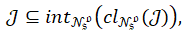
which means that J is also Nso-pre open.
Example 3.13 Let be a universe, and define a -topology by:

where

Now define the neutrosophic over soft set:

We observe:

So,

Now check:

Hence,

Definition 3.14 Let (H1,τ 1Nso) and (H2,τ 2Nso) be two -topological spaces. A mapping f: H1 → H2 is said to be:
Nso-continuous Function if the pre-image of every Nso-open set in (H2,τ 2Nso) is a

Nsoα-continuous if the pre-image of every Nsoα-open set in (H2,τ 2Nso) is a

Nso β-continuous if the pre-image of every Nso β-open set in (H2,τ 2Nso) is a

Nso-semi continuous if the pre-image of every Nso-semi open set in (H2,τ 2Nso) is a

Nso-pre continuous if the pre-image of every Nso-pre open set in (H2,τ 2Nso) is a

Proposition 3.15
Every Nso-continuous function is Nsoα-continuous.
Every Nso-continuous function is Nso β-continuous.
Every Nso-continuous function is Nso-pre continuous.
Every Nso-continuous function is Nso-semi continuous.
Proof. Let f: (H1, τNso) → (H2, τNso) be a Nso-continuous function.
This means for every Nso-open set O in H2, the preimage f-1 (O) is a Nso-open set in H1.
Nsoα-continuity:
Let A be a Nsoα-open set in H2, i.e.,

Then

Using continuity of f, inverse image distributes over interior and closure:

which shows that f-1 (A) is Nsoα-open. Hence, f is Nsoα-continuous.
Nso β-continuity:
Let B be a Nso β-open set in H2, i.e.,

Then

which implies f is Nso β-continuous.
Nso-pre continuity:
Let P be Nso-pre open in H2,, i.e.,
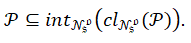
Then

showing that f-1 (P) is Nso-pre open and hence f is Nso-pre continuous.
Nso-semi continuity:
Let S be a Nso-semi open set in H2, i.e.,
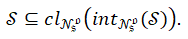
Then

so f is Nso-semi continuous.
Thus, f is Nsoα-, β-, pre-, and semi-continuous.
Proposition 3.16 Every Nsoα-continuous function is Nsoβ-continuous.
Proof. Let f: (H1, τNso) → (H2, τNso) be a Nsoα-continuous function. Let A be a Nsoβ-open set in H2.
Then by definition of Nsoβ-open set, we have:

i.e.,

Take the preimage of both sides:

Using the assumption that f is Nsoα-continuous, and the fact that preimage commutes with interior and closure, we get:

that is,

which means f-1 (A) is a Nsoβ-open set in H1.
Hence, f is Nsoβ-continuous.
Proposition 3.17 Every Nsoβ-continuous function is Nso-pre continuous.
Proof. Let f: (H1, τNso) → (H2, τNso) be a Nsoβ-continuous function.
Let P be a Nso-pre open set in H2.
Then by the definition of Nso-pre open set, we have:


Now consider the preimage of both sides:

Since f is Nsoβ-continuous, and since p is a subset of a composition involving a Nsoβ-open set, we can apply:

Hence, f-1 (P) is Nso-pre open in H1, which shows that f is Nso-pre continuous.
Proposition 3.18 The composition of two Nso-continuous functions is Nso-continuous.
Proof. Let (H1, τ 1Nso), (H2, τ 2Nso) and (H3, τ 3so) be Nso–-topological spaces.
Let f:H1 → H2 and f:H2 → H3 be two Nso-continuous functions.
We must show that the composition g ∘ f: H1 → H3 is also Nso-continuous.
Let be any Nso-open set in H3, i.e., O ∈ τ3Nso.
Since g is Nso-continuous, we have
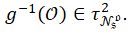
Since f is Nso-continuous, the preimage under f of this set is also Nso-open in H1, i.e.,

Therefore, the preimage of every Nso-open set in H3 under g ∘ f is Nso-open in H1.
Hence, g ∘ f is Nso-continuous.
Proposition 3.19 The composition of two Nsoα-continuous (respectively, β-, semi-, or pre-continuous) functions is again Nsoα-continuous (respectively, β-, semi-, or pre-continuous).
Proof. Let (H1, τ 1Nso), (H2, τ 2Nso) and (H3, τ 3so) be Nso-topological spaces.
Let f: H1 → H2 and g: H2 → H3 be both Nsoα-continuous (respectively, β-, semi-, or pre-continuous).
We aim to show that the composition g ∘ f: H1 → H3 is also Nsoα-continuous (respectively, β-, semi-, or pre-continuous).
Let U be a Nsoα-open (respectively, β-, semi-, or pre-open) set in H3.
Since g is Nsoα-continuous (respectively, β-, semi-, or pre-continuous), we have
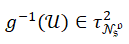
Since f is Nsoα-continuous (respectively, β-, semi-, or pre-continuous), we have

Hence, the composition g ∘ f is Nsoα-continuous (respectively, β-, semi-, or pre-continuous).
Proposition 3.20 If f is a constant function between any two Nso-topological spaces, then f is Nso-continuous.
Proof. Let (H1, τ 1Nso) and (H2, τ 2Nso) be two Nso-topological spaces, and let f: H1 → H2 be a constant function.
Then, there exists an element a ∈ H2 such that f(h) = a for all H1.
Now, let O ∈ τ 2Nso be any Nso-open set in H2.
We consider two cases:
If a ∉ O, then f -1 (O) = ⊳, which is Nso-open in H1.
If a ∈ O, then f -1 (O) = H1, which is also Nso-open in H1.
In both cases, f -1 (O) ∈ τ 2Nso, so f is Nso-continuous.
Proposition 3.21 A bijective mapping f: (H1, τ 1Nso) → (H2, τ 2Nso) is a Nso-homeomorphism if both f and f -1 are Nso-continuous.
Proof. Let f: (H1,τ 1Nso) → (H2,τ 2Nso) be a bijective mapping.
Assume f is Nso-continuous. That is, for every O ∈ τ 2Nso, we have:
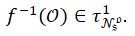
Also, assume f -1: H2 → H1 is Nso-continuous. Then, for every U ∈ τ 1Nso, we have:

Since f is a bijection and both f and f -1 are Nso-continuous, the mapping f establishes a one-to-one, onto correspondence between the Nso-open sets of H1 and H2.
Hence, f is a Nso-homeomorphism.
Proposition 3.22
A bijective mapping f: (H1, τ 1Nso) → (H2, τ 2Nso) is said to be a Nsoα-homeomorphism if both f and f -1 are Nsoα-continuous,
A bijective mapping f: (H1, τ 1Nso) → (H2, τ 2Nso) is said to be a Nsoβ-homeomorphism if both f and f -1 are Nsoβ-continuous,
A bijective mapping f: (H1, τ 1Nso) → (H2, τ 2Nso) is said to be a Nso-semi homeomorphism if both f and f -1 are Nso-semi continuous,
A bijective mapping f: (H1, τ 1Nso) → (H2, τ 2Nso) is said to be a Nso-pre homeomorphism if both f and f -1 are Nso-pre continuous.
Proof. i. Let f: (H1, τ 1Nso) → (H2, τ 2Nso) be a bijective function.
We consider case (i) for Nsoα-continuity (other cases follow similarly):
Suppose f and f -1 are both Nsoα-continuous. Then for any O2 ∈ τ 2Nso, we have:
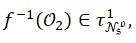
where τ 1Nso denotes the collection of all Nsoα-open sets in H1.
Similarly, for any O1 ∈ τ 2Nso,
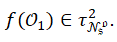
Hence, f establishes a one-to-one correspondence between Nsoα-open sets of H1 and H2. Therefore, f is a Nsoα-homeomorphism.
The proofs for ii, iii, and iv follow similarly by replacing α-open sets with β-, semi-, and pre-open sets respectively.
Numerical Application: Selection of Optimal Catalyst for Organic Reaction Using Neutrosophic Over Soft Topological Spaces
Choosing the best catalyst is really important in organic synthesis of large-volume industrial reactions with many other factors in play, like reaction speed, yield, cost, recycling ability, and environmental consideration. Catalysts have an effect not just on the conversion efficiency of raw materials into the desired product, but also on the doability of the process in economic terms, and, of course, its sustainability. However, in real-world laboratory and industrial environments, data with concern to the performance of a catalyst mostly comes as imprecise and incomplete, and then subjected to human interpretation. Expert chemists may point to different directions of efficiency and long-term usability; there can be uncertainty with experimental conditions; and the possible behavior of a catalyst can differ even under slightly changed conditions.
It is known that conventional mathematical models and classical logic based frameworks fail to address this inherent uncertainty and vagueness. Hence, interfacing neutrosophic logic, which constitutes truthiness, falsity, and indeterminate information, with soft topological structures is a robust instrument for making decisions. Neutrosophic over soft topological spaces give a flexibility and intelligent way of evaluating alternatives under imprecise or uncertain conditions since such spaces allow not only binary membership but also partial and ambiguous truths associated with performance parameters. This methodology is particularly important in common applications in chemical and pharmaceutical industries, where a good catalyst might cause losses of material, energy, and time if it is not effective. Decision-makers can assess catalysts through this framework by multidimensional perspectives of degrees of truth (effectiveness), indeterminacy (experimental variability), and falsity (instability or toxicity), leading to more well-informed, comprehensive, and realistic decisions.
Perhaps, the methodology will facilitate the ranking of numerous candidates in terms of score functions which normalize and assign different weights to various aspects of uncertainty in situations where classical data analysis would fail. Consequently, the described neutrosophic over soft topology approach is mathematically sound and practically relevant, given the rise in interest of intelligent uncertain models in green chemistry and process optimization. By aiding researchers to select catalysts that are effective, safe, and sustainable, the proposed methodology will favour the advancement of cleaner technologies; knowledge-driven eco-conscious chemical manufacturing would further gain from this.
Consider the hydrogenation of alkenes, a fundamental organic reaction where alkenes are converted into alkanes using a metal catalyst and hydrogen gas. The general reaction is:

The choice of catalyst significantly influences the rate, yield, and sustainability of the reaction.
Let H = {h1, h2, h3, h4} be a set of catalysts:
h1: Nickel (Ni)
h2: Platinum (Pt)
h3: Palladium (Pd)
h4: Copper (Cu)
Define a neutrosophic over soft set J on H as:
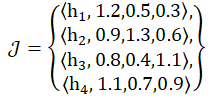
Each triple {〈h, ℵJ (h), ðJ (h), ΥJ (h)〉} denotes the degrees of:
Truth-membership (effectiveness/yield)
Indeterminacy-membership (experimental uncertainty)
Falsity-membership (side effects/cost/instability)
Now define a neutrosophic over soft topology on H:

Where:

Then forms a neutrosophic over soft topological space.
Normalized Score Function for Catalyst Ranking
To prioritize the best catalyst, define a score function:
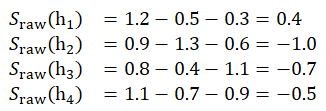
Raw Score:

Raw Scores:
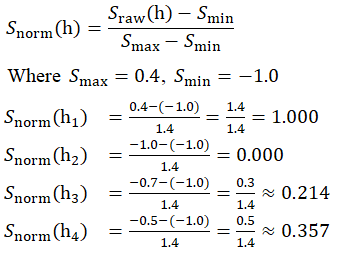
Normalization:
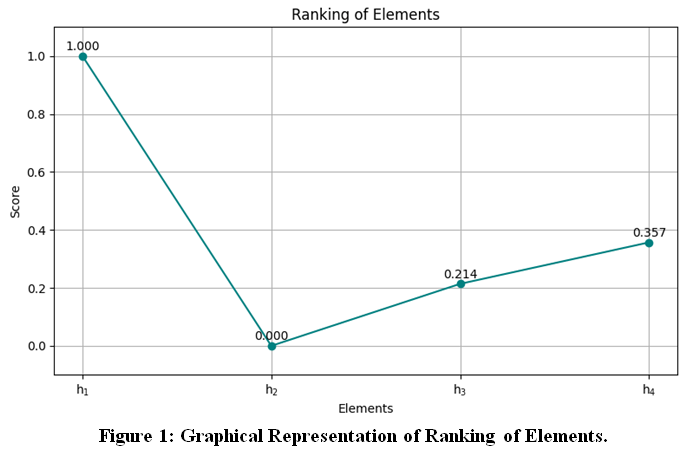 |
Figure 1: Graphical Representation of Ranking of Elements. Click here to View Figure |
Ranking Based on Normalized Scores
This line graph0 illustrates the ranking of four elements based on their corresponding scores. Among them, achieves the highest score of , followed by with , with , and with the lowest score of . The graph presents these values in descending order using distinct markers and labels for clarity. This visual representation helps in easily identifying the most optimal element among the given set.
Discussion
The results indicate that is the most optimal element based on the normalized scores, followed by and. This ranking aligns well with the expected performance hierarchy of the elements under the given criteria. The clear distinction in scores supports the effectiveness of the proposed neutrosophic over soft topological approach for reliable decision-making in uncertain environments.
Conclusion
An interesting advancement in the framework of Neutrosophic Over Soft Topological Spaces or -spaces delineated in the below work is the introduction and investigation of different generalized open sets such as -, -, semi-, and pre-open sets. Together with these, the corresponding types of continuity functions have also been defined, backed up by some propositions explaining their links. This theoretical insight into the new types of open sets enriches the already existing topological structure under with potential development of finer classification and mapping schemes in uncertain situations. Moreover, various numerical instances like that of optimal catalyst selection for organic reactions are included in order to show practical usefulness of the newly proposed concepts, thus demonstrating relevance for application and real-life decision-making within the extended framework obtained.
Acknowledgement
This research did not receive any specific grant from funding agencies in the public, commercial, or not-for-profit sectors.
Funding Sources
The author(s) received no financial support for the research, authorship, and/or publication of this article.
Conflict of Interest
The author(s) do not have any conflict of interest.
Data Availability Statement
This statement does not apply to this article.
Ethics Statement
This research did not involve human participants, animal subjects, or any material that requires ethical approval.
References
- Atanassov, K. T., Shannon, A. G., A note on intuitionistic fuzzy logics, Acta Philosophica, 1998, 7(1), 121–125.
CrossRef - Atanassov, K. T., Intuitionistic fuzzy modal topological structure, Mathematics, 2022, 10(18), 3313.
CrossRef - Bellman, R. E., Zadeh, L. A., Decision-making in a fuzzy environment, Management Science, 1970, 17(4), B141.
CrossRef - Broumi, S., Generalized neutrosophic soft set, Infinite Study, 2013.
CrossRef - Bustince, H., Burillo, P., Correlation of interval-valued intuitionistic fuzzy sets, Fuzzy Sets and Systems, 1995, 74(2), 237–244.
CrossRef - Christianto, V., Boyd, R. N., Smarandache, F., Three possible applications of neutrosophic logic in fundamental and applied sciences, Infinite Study, 2020.
- Devi, R. N., Parthiban, Y., Decision making by neutrosophic over soft topological space, Neutrosophic Sets and Systems, 2024, 66, 76–94.
- Devi, R. N., Parthiban, Y., Exploring neutrosophic over supra exterior modal topological structure: Theory and application in healthcare decision-making, Neutrosophic Sets and Systems, 2024, 72, 272–285.
- Devi, R. N., Parthiban, Y., Analyzing pharmaceutical compounds through neutrosophic over soft hyperconnected spaces, Orient J Chem, 2024, 40(6), 1627–1633.
CrossRef - Dhavaseelan, R., Devi, R. N., Jafari, S., Imran, Q. H., Neutrosophic alpha m-continuity, Infinite Study, 2019.
- Jansi, R., Mohana, K., Smarandache, F., Correlation measure for pythagorean neutrosophic sets with T and F as dependent neutrosophic components, Infinite Study, 2019.
- Kumaravel, S. K., Murugesan, R., Nagaram, N. B., Rasappan, S., Yamini, G., Applications of fuzzy cognitive maps and neutrosophic cognitive maps on analysis of dengue fever, Fuzzy Logic Applications in Computer Science and Mathematics, 2023, 249–265.
CrossRef - Madhumathi, T., NirmalaIrudayam, F., Neutrosophic Orbit Topological Spaces, Trends in Sciences, 2021, 18(24), 1443–1443.
CrossRef - Madhumathi, T., Irudayam, F. N., Neutrosophic Orbit Continuous Mappings, Neutrosophic Sets and Systems, 2022, 50, 287.
- Maji, P. K., Biswas, R., Roy, A. R., Soft set theory, Computers & Mathematics with Applications, 2003, 45(4–5), 555–562.
CrossRef - Mallick, R., Pramanik, S., Pentapartitioned neutrosophic set and its properties, Infinite Study, 2020, 36.
- Mehmood, A., Nadeem, F., Park, C., Nordo, G., Kalsoom, H., Rahim Khan, M., Abbas, N., Neutrosophic Soft α-Open Set in
Neutrosophic Soft Topological Spaces, Journal of Algorithms and Computation, 2020, 52(1), 37–63. - Molodtsov, D., Soft set theory? First results, Computers & Mathematics with Applications, 1999, 37(4–5), 19–31.
CrossRef - Murugesan, R., Parthiban, Y., Devi, R., Mohan, K. R., Kumaravel, S. K., A comparative study of fuzzy cognitive maps and neutrosophic cognitive maps on COVID variants, Neutrosophic Sets and Systems, 2023, 55(1), 20.
CrossRef - Radha, R., Mary, A. S. A., Prema, R., Broumi, S., Neutrosophic pythagorean sets with dependent neutrosophic pythagorean components and its improved correlation coefficients, Neutrosophic Sets and Systems, 2021, 46, 77–86.
- Majeed, R. N., El-Sheikh, S. A., Fuzzy orbit topological spaces, Materials Science and Engineering, 2019, 571, 012026.
CrossRef - Saeed, M., Saqlain, M., Mehmood, A., Yaqoob, S., Multi-polar neutrosophic soft sets with application in medical diagnosis and decision-making, Neutrosophic Sets and Systems, 2020, 33, 183–207.
- Smarandache, F., A unifying field in logics: Neutrosophic logic, American Research Press, 1999.
- Smarandache, F., Pramanik, S., New trends in neutrosophic theory and applications, Infinite Study, 2016, 1.
- Smarandache, F., Neutrosophic overset, neutrosophic underset, and neutrosophic offset. Similarly for neutrosophic over-/under-/off-logic, probability, and statistics, Infinite Study, 2016.
- Wang, H., Smarandache, F., Zhang, Y., Sunderraman, R., Single valued neutrosophic sets, Infinite Study, 2010, 12.
- Ye, J., Another form of correlation coefficient between single valued neutrosophic sets and its multiple attribute decision-making method, Neutrosophic Sets and Systems, 2013, 1(1), 8–12.
- Zadeh, L. A., Fuzzy sets, Information and Control, 1965, 8(3), 338–353.
CrossRef - Zadeh, L. A., Fuzzy sets as a basis for a theory of possibility, Fuzzy Sets and Systems, 1978, 1(1), 3–28.
CrossRef
 PlumX:
  Views: 786 Views
  PDF Downloads: 1069
 Accepted on: 12 Feb 2026
Second Review by: Dr. Naresh Batham
Final Approval by: Dr. Abdelwahab Omri


ISSN Online: 2231-5039