Spectrophotometric Analysis of Corn Oil

University of Bucharest, Faculty of Chemistry, Department of Physical Chemistry, Elisabeta Blvd, Bucharest, Romania
Corresponding Author E-mail: istanciu75@yahoo.com
DOI : http://dx.doi.org/10.13005/ojc/420340
Download this article as:

This research investigates the oxidative behavior of corn oil exposed to controlled heating conditions through spectrophotometric measurements. Samples of corn oil were maintained at temperatures of 100 °C and 110 °C for periods of 5 and 10 hours, reflecting conditions commonly encountered during food preparation and industrial processing. Oxidative changes were assessed by recording absorbance at 490 nm and 590 nm, wavelengths associated with the generation of conjugated dienes and trienes, which serve as markers of primary and secondary lipid oxidation. The analysis revealed a progressive increase in absorbance as both temperature and heating duration increased. When heated at 110 °C, the oil underwent gradual oxidative deterioration, with more evident changes detected after 10 hours of treatment. These results suggest the continued formation and accumulation of hydroperoxide compounds. In contrast, exposure to 100 °C led to a markedly faster oxidation process, reflected by considerably higher absorbance values after only 5 hours. Prolonged heating at this temperature for 10 hours resulted in substantial formation of secondary oxidation products, indicating an advanced stage of lipid degradation. Due to its elevated concentration of polyunsaturated fatty acids, corn oil exhibited a greater tendency toward thermal oxidation than oils characterized by a higher proportion of monounsaturated fatty acids. Overall, the study demonstrates that oxidative stability is strongly affected by both heating temperature and exposure time. Furthermore, spectrophotometric determination proved to be a practical and efficient approach for tracking oxidation-related changes and evaluating oil quality during thermal treatment.
KEYWORDS:Analysis; Corn Oil; Hydroperoxide compounds; Spectrophotometric
Introduction
Spectrophotometry is an optical method for determining the concentrations of constituents in a given sample.
Spectrophotometry represents an analytical technique used to determine quantitatively the interaction between electromagnetic radiation and matter by measuring the amount of radiation absorbed or emitted by a substance. Compounds that absorb light within the visible region of the electromagnetic spectrum exhibit characteristic colors, complementary to the absorbed wavelengths. The intensity of absorbed radiation is directly related to the concentration of the absorbing species, allowing the concentration of compounds in solution to be determined.
The principle of spectrophotometric analysis involves directing a beam of electromagnetic radiation through a sample. As the radiation passes through the medium, its intensity decreases due to absorption by the chemical species present in the sample. The magnitude of this decrease depends on both the nature and concentration of the absorbing compounds.
Spectroscopy encompasses a broad range of experimental methods employed to investigate the absorption, emission, or scattering of energy by atoms, ions, molecules, or other chemical species. These techniques provide valuable information regarding the composition, molecular structure, and dynamic behavior of the analyzed material. In qualitative analysis, spectroscopic methods are used to identify substances based on their characteristic spectral features, whereas quantitative applications rely on the relationship between spectral intensity and analyte concentration.
Spectrophotometry is a specific branch of molecular spectroscopy focused on the study of absorption phenomena in the ultraviolet and visible regions of the electromagnetic spectrum (UV–Vis). It is widely applied for the qualitative and quantitative examination of organic and inorganic compounds in solution. Since many substances do not exhibit highly distinctive absorption maxima in the UV–Vis range, spectrophotometry is generally more useful for quantitative determinations than for unequivocal identification of compounds.
Instruments such as spectrophotometers and colorimeters measure the transmission of light through a solution and use this information to calculate the concentration of dissolved substances. To obtain wavelength-specific information, electromagnetic radiation is dispersed using optical components such as prisms or diffraction gratings. This separation of radiation into individual wavelengths allows the detection of spectral characteristics associated with particular atoms, ions, radicals, or molecules.
For qualitative investigations, the wavelengths observed in the recorded spectra are compared with reference spectra in order to identify the analyzed species. In quantitative applications, the concentration of a substance is determined by evaluating the relationship between absorbance and analyte concentration.
When a beam of radiation with an initial intensity (I0) passes perpendicularly through an absorbing medium, part of the incident energy is reflected (Iᵣ), another fraction is absorbed by the sample (Iₐ), and the remaining portion is transmitted through the medium (Ia). Consequently, the transmitted radiation possesses a lower intensity than the incident beam.
Spectrophotometric methods applied in food analysis are based on the Beer–Lambert law, which establishes a proportional relationship between the attenuation of light intensity and both the concentration of the absorbing species and the optical path length. According to this law, the reduction in transmitted radiation increases as either the concentration of the analyte or the thickness of the absorbing layer becomes greater.
Two parameters are commonly used to express the interaction between light and matter in spectrophotometric measurements: transmittance (T), which represents the fraction of incident light that passes through the sample, and absorbance or extinction (E), which quantifies the amount of radiation absorbed by the medium.
Light exhibits a dual nature. During propagation, it behaves as an electromagnetic wave characterized by specific wavelengths and frequencies. In processes involving absorption and emission of energy, however, light displays particle-like properties and can be considered as a stream of discrete energy packets known as photons.
Photons originate from microscopic particles such as atoms, ions, or molecules, each emitted energy quantum corresponding to a specific electronic transition. The absorption or emission of a photon occurs when a particle moves between two distinct energy levels. For such a transition to take place, the energy of the photon must exactly match the energy difference between the initial and final states.
These electronic transitions are governed by selection rules that determine which changes between energy levels are permitted. Furthermore, the interaction between radiation and matter occurs only under specific quantum mechanical conditions, ensuring that absorption and emission processes follow well-defined physical principles.
In chemistry and physics, different types of spectrophotometers cover wide ranges of the electromagnetic spectrum: ultraviolet (UV), visible light, infrared (IR), or microwave. UV spectrophotometry is particularly useful in the detection and quantification of colorless substances in solution.
In this article, we determined the transmittance spectra for 5- and 10-hour oxidized and unoxidized corn oil at temperatures of 100ºC and 110ºC.
Material and Methods
Refined corn oil was selected as the material for the experimental investigation. All reagents and solvents used throughout the study were of analytical purity. Cyclohexane (or alternatively iso-octane) served as the extraction and dilution solvent for spectrophotometric determinations because of its negligible absorption in the ultraviolet region. Absorbance measurements were performed using quartz cuvettes with an optical path length of 1 cm.
To evaluate the effect of thermal treatment on oxidative stability, the corn oil samples were separated into four experimental batches. The samples were heated at two different temperatures, 100 °C and 110 °C, for exposure periods of 5 and 10 hours. Identical volumes of oil were transferred into open glass containers to facilitate contact with atmospheric oxygen and reproduce conditions similar to those encountered during food preparation processes. Thermal treatment was carried out in a laboratory oven equipped with temperature control, ensuring that the selected temperatures were maintained within a tolerance of ±1 °C. No antioxidant additives were incorporated into the samples during heating.
Upon completion of the designated heating intervals, the oils were allowed to cool to ambient temperature under dark conditions. Subsequently, they were stored in amber-colored glass containers to limit additional oxidative reactions before spectrophotometric examination.
Spectral measurements were conducted using a T60V visible spectrophotometer. The instrument operated with a constant spectral bandwidth of 2 nm and covered a wavelength interval between 325 and 1100 nm. The T60V model is designed for measurements within the visible spectral region and is powered by a switched-mode power supply compatible with input voltages ranging from 95 to 240 V AC. Depending on analytical requirements, the system can be equipped with either a universal variable-path-length cell holder or a standard eight-position fixed-path-length cell changer. The instrument combines reliable analytical performance with high measurement precision, making it suitable for routine spectrophotometric applications.
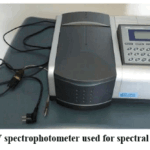 |
Figure 1: T60V spectrophotometer used for spectral measurements. Click here to View Figure |
The extent of oxidation in the corn oil samples was determined by ultraviolet-visible (UV–Vis) spectrophotometric analysis. Prior to measurement, each sample was appropriately diluted with cyclohexane to ensure that the recorded absorbance values remained within the instrument’s linear operating range. Absorbance readings were collected at wavelengths of 490 nm and 590 nm, which are commonly associated with the presence of conjugated dienes and conjugated trienes, indicators of primary and secondary lipid oxidation processes, respectively.
For instrument calibration and baseline adjustment, a solvent blank containing only cyclohexane was analyzed under identical conditions. To improve the reliability and precision of the results, each determination was performed three times, and the average value of the measurements was used for further evaluation.
The specific extinction coefficients, K232 and K270, were determined from the absorbance data by applying the corresponding calculation equations and considering the dilution factors used during sample preparation. The obtained values were subsequently compared among the various thermal treatment groups in order to investigate the effects of heating temperature and exposure time on the oxidative stability of corn oil.
In addition, statistical analyses were performed to identify significant differences between the experimental groups and to evaluate the influence of the applied thermal conditions on the degree of oil oxidation.
Results and Discussion
Corn oil samples were subjected to thermal oxidation at temperatures of 100 °C and 110 °C for exposure periods of 5 and 10 hours. The transmittance spectra obtained for the samples treated at 100 °C for both heating durations are illustrated in Figure 2.a.
Analysis of the recorded spectra indicates that thermal treatment produced only minor modifications in the transmittance behavior of the oil when compared with the untreated sample. The spectra corresponding to oils heated for 5 and 10 hours remained largely similar to that of fresh corn oil, suggesting limited changes in optical properties under these conditions.
The most noticeable spectral variations were observed within the wavelength interval of approximately 490–590 nm, where differences in transmittance became more evident. Outside this region, the spectral profiles showed only slight deviations from those of the non-oxidized oil, indicating that the thermal treatment induced relatively modest changes in the absorption characteristics of the samples.1–5
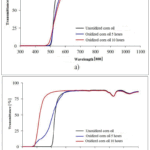 |
Figure 2: Transmittance spectra of corn oil samples oxidized at different temperatures and heating times. of 100ºC (a) and 110 ºC (b) Click here to View Figure |
When the oxidation temperature was increased from 100 °C to 110 °C (Figure 2.b), noticeable modifications in the transmittance spectra became evident throughout the visible region. These alterations were observed for samples heated for both 5 and 10 hours, indicating that even a relatively small increase in temperature can substantially accelerate the oxidative deterioration of corn oil under the applied experimental conditions.16–18
The present investigation focused on evaluating the spectral behavior of refined corn oil before and after thermal oxidation using UV–Vis spectrophotometry. To reproduce conditions frequently encountered during food preparation and industrial processing, oil samples were exposed to controlled heating at temperatures between 100 °C and 110 °C for periods of 5 and 10 hours. The study aimed to determine how thermal exposure affects the optical characteristics of corn oil and to assess the suitability of spectrophotometric techniques for monitoring oxidation-related changes.
The obtained results showed that both heating temperature and treatment duration significantly influenced the transmittance properties of the oil. Progressive decreases in transmittance were recorded as the severity of thermal treatment increased, reflecting the gradual development of oxidation reactions. These spectral modifications are associated with the generation and accumulation of oxidation products, including hydroperoxides, aldehydes, ketones, and high-molecular-weight polymerization compounds. The presence of these substances modifies the chemical composition and molecular arrangement of the oil, leading to enhanced absorption of light and consequently lower transmittance values.
A comparison between untreated and thermally oxidized samples revealed distinct differences in their spectral profiles. Fresh corn oil maintained relatively stable transmittance characteristics, whereas oxidized samples displayed marked variations throughout the analyzed wavelength range. The magnitude of these changes increased with the degree of oxidation, demonstrating the ability of spectrophotometric measurements to detect both initial and advanced stages of lipid degradation.
The influence of heating duration was also evident from the comparative evaluation of samples treated for 5 and 10 hours. Longer exposure times resulted in more pronounced spectral alterations, confirming that oxidation progresses continuously during thermal treatment. This behavior highlights the cumulative effect of heating time on the deterioration of corn oil and indicates that prolonged exposure promotes the formation of larger quantities of oxidation products.
Temperature proved to be another critical factor affecting oil stability. Samples exposed to 130 °C exhibited substantially greater changes in transmittance than those heated at 110 °C for the same period. These findings suggest that increasing temperature accelerates oxidation kinetics and intensifies the degradation of lipid components, thereby reducing the overall stability of the oil.
Overall, the study confirms that UV–Vis spectrophotometric analysis is an efficient and reliable tool for evaluating oxidative changes in corn oil. The technique offers a rapid and non-destructive means of assessing oil quality and provides valuable information regarding the relationship between thermal treatment conditions and the extent of oxidative degradation. Consequently, spectrophotometric monitoring may be successfully employed in quality assurance programs and in the evaluation of edible oils during processing, storage, and culinary applications.
Conclusions
Changes in the transmittance of oxidized corn oil at 5 and 10 hours compared to unoxidized oil were observed. If the oxidation temperature increases over a period of time, we can observe changes in the transmission spectra of corn oil. As the parameters increase with the oxidation of corn oil, the color differences for the oxidized corn oil samples also increase. In conclusion, the findings confirm that both heating time and temperature significantly affect the transmittance spectra and oxidative stability of corn oil. Spectrophotometric analysis proves to be a valuable analytical tool for evaluating thermal oxidation and oil quality. Future studies may focus on correlating spectrophotometric results with conventional chemical indices of oxidation to further validate and enhance the practical application of this technique in the food industry.
Funding Sources
The author(s) received no financial support for the research, authorship, and/or publication of this article.
Conflict of Interest
The author(s) do not have any conflict of interest.
Data Availability Statement
This statement does not apply to this article.
Ethics Statement
This research did not involve human participants, animal subjects, or any material that requires ethical approval.
References
- Zgherea, Gh., Analize Fizico – Chimice, Ed. Fundaţiei Universitare “Dunărea de Jos” Galaţi, pp. 74-80, 88-94, 2002.
- Sancez-Gimeno, A.C., Negueruela, A.I., Benito, M., Vercet, A., Oria, R., 2008, Some physical changes in Banjo Aragon extra virgin olive oil during the frying process, Food Chemistry, 110, pp. 654-658.
CrossRef - Şolea, L.C., Creţu, R., Spectrophotometric and rheological study on oxidized soybean oils, The Annals of „Dunărea de Jos” University of Galati, Fascicle XIV, Mechanical Engineering, ISSN 1224 – 5615, Galati University Press, 2013 – trimisă spre publicare.
- van der Vaart, K., Depypere, F., Graef, V. D., Schall, P., Fall, A., Bonn, D., & Dewettinck, K., 2013, Dark chocolate’s compositional effects revealed by oscillatory rheology, European Food Research and Technology, 236(6), 931-942.
CrossRef - Stanciu I., 2019, Rheological behaviour of biodegradable lubricant, Journal of Science and Arts, 3(48), 703-708.
- Stanciu I., 2019, Rheological investigation of soybean oil from soya beans, Journal of Science and Arts, 4(49), 938-988.
- Stanciu I., 2011, Modeling the temperature dependence of dynamic viscosity for rapeseed oil Journal of Science and Arts, 1, 55-58.
- Stanciu I., 2018, Rheology behavior of soybean oil Journal of Science and Arts, 2(43), 453-458
- Meneghetti S.M.P., Meneghetti M.R., Wolf C.R., Silva E.C., Lima G.E., Coimbra M.D. A., … & Carvalho, S.H.,2006, Journal of the American oil chemists’ society, 83(9), 819-822.
CrossRef - Penciu S., Beldescu A., Studiul potenţialului de export al României: Uleiuri Vegetale, Centrul Român pentru Promovarea Comerţului şi Investiţiilor Străine, 2012.
- Sheibani A., Ghotbaddini-Bahraman, N. A. S. E. R., & Sadeghi, F. A. T. E. M. E. H., 2014, Oriental Journal of Chemistry, 30(3), 1205-1209.
CrossRef - Stanciu I. 2023. Some methods for determining the viscosity index of hydraulic oil, Indian Journal of Science & Technology, 16(4), 254-258
CrossRef - Stanciu 2023, Rheological behavior of corn oil at different viscosity and shear rate, Oriental Journal of Chemistry, 39(2), 335-339
CrossRef - Stanciu I. 2023, Rheological characteristics of corn oil used in biodegradable lubricant, Oriental Journal of Chemistry, 39(3), 592-595
CrossRef - Stanciu I. 2023, Effect of temperature on rheology of corn (Zea mays) oil, Oriental Journal of Chemistry, 39(4), 1068-1070
CrossRef - Stanciu I., 2021, Study Rheological Behavior of Rapeseed oils Compared to Mineral oil Oriental Journal of Chemistry, 37(1), 247-249
CrossRef - Stanciu I., 2021, Influence of Temperature on the Rheological Behavior of Orange Honey Oriental Journal of Chemistry, 37(2), 440-443
CrossRef - Stanciu I., 2021, Rheological Study of Orange Honey with Influence on Concentration, Oriental Journal of Chemistry, 37(4), 864-867.
CrossRef
 PlumX:
  Views: 591 Views
  PDF Downloads: 872
 Accepted on: 18 May 2026


ISSN Online: 2231-5039