Synthesis of New [4-(R-phenyl)-thiazole-2-yl]-(R-phenyl)-amines Derivatives as Potential Antimicrobial Agents
 , Dyaneshwar D. Gaikwad 2, Devendra S. Wagare1, Sangita P. Pawar1*
1Vivekananda Arts Sardar Dalip Singh Commerce and Science College, Chh. Sambhajinagar, Maharashtra, India
2BPHE Society Ahmednagar College, Ahilyanagar, Maharshtra, India
Corresponding Author E-mail: sangeetapawarvca@mail.com
Download this article as:
ABSTRACT:A series of ten novel of [4-(R-phenyl)-thiazole-2-yl]-(R-phenyl)-amines was prepared via cyclocondensation of thiourea (1) with substituted phenacyl bromide (2) in PEG-400 as a solvent. Five newly synthesized 2-Aminothiazoles (3a-e) derivatives were verified using IR, 1HNMR, 13CNMR and MS Characterization, while the reported compounds were identified by comparison with the literature. The antibacterial efficiency of the compounds (3a-j) was examined under in vitro conditions opposed to B.subtilis (NCIM 2063), S. mutans (NCIM 2660), S.aureus (NCIM 976), and was assessed for antifungal potential under in vitro conditions against Fusarium spp (MCC 1131). The significant antimicrobial potential of the synthesized 2-aminothiazole series (3a-j) suggested their possible application as lead structure in the design of novel antimicrobial agents. The results indicated such scaffolds could be utilized in developing of lead molecules for the treatment of microbial infections. The utilization of PEG-400 as a green solvent system not only minimizes environmental impact compared to conventional organic solvents but also promotes enhanced reaction efficiency, higher product yields, and improved selectivity by supporting effective mass transfer and stabilization of transient intermediates.
KEYWORDS:2-Aminothiazole; Antimicrobial activity; Polyethylene glycol (PEG-400); Thiourea
Introduction
The thiazole scaffold is widely recognized as a significant component of numerous pharmacologically active substances. This structural framework has been widely employed in medicinal chemistry programs focused on managing allergic diseases, blood-pressure abnormalities, inflammatory disorders and infections caused by bacteria and HIV.1 2-aminothiazole derivatives are recognized as estrogen receptors for ligands, also represent a new identified class of antagonists targeting adenosine receptors.2 Due to their biological significance, various strategies for the synthesizing of novel 2-aminothiazole-Based compounds have been developed, as reported in earlier studies. The Hantzsch cyclization carried out between α-halocarbonyl substrates and thioureas or thioamides represents an effective approach for the preparation of thiazole derivatives.3 Poly(ethylene glycol) (PEG), a biocompatible polymer widely employed in drug delivery systems and bioconjugation for diagnostic applications, has also been utilized as an efficient solvent system for a broad range of multiple organic modification. In recent years, ionic liquids shown attracted considerable attention in chemical research, resulting in numerous publications and review articles. Although ionic liquids provide certain advantages, their complex preparation procedures, along with concerns regarding the environmental safety of both the solvents and their raw materials, remain subjects of debate. In comparison with PEG, information related to the toxicity and environmental impact of ionic liquids is largely insufficient. Moreover, ionic liquids are generally more costly than PEG, which limits their practical applicability.4
The incorporation of two or more pharmacologically active scaffolds into a single molecular structure gives impactful results for discovery towards new drug candidates. Nitrogen-based heterocyclic scaffolds remain central to ongoing efforts in medicinal chemistry and drug development.5 The thiazole core is found in both synthetic molecules and naturally occurring compounds, exhibiting notable structural and functional characteristics. Owing to their broad spectrum of pharmacological activities, thiazole derivatives have remained an important focus of research, exhibiting wide range of activities.6
Materials and Methods
Experimental
The solvents and chemicals employed have been of sigma Aldrich and Merck refined according to reported previous procedures. Reaction progress has been verified by thin layer chromatography employing silica gel 60F plates from Merck. All melting points have been recorded without correction. The IR spectra have been certified on a Shimadzu FTIR. 1H NMR spectra and 13C NMR spectra has been acquired on a Bruker Avance Neo 500 MHz spectrometer. TMS used as reference of chemical shifts which recorded in ppm. MS has been collected on a MALDI-TOF-TOF mass instrument.
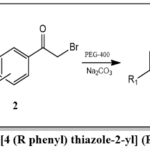 |
Scheme 1: synthesis of [4 (R phenyl) thiazole-2-yl] (R phenyl)-amines (3a-j). Click here to View Scheme |
General procedure for the synthesis of [4-(R phenyl)-thiazole-2-yl]-(R phenyl)-amines (3a-j)
Thoiurea [1] (1.0mmol), phenacyl bromide [2] (1.0mmol) as well as sodium carbonate (1.0mmol) were added to PEG-400 (10ml). The Reaction maintained under with constant stirring reflux for one hour (TLC- Check).A normal extracting workup with diethyl ether gave crude products. The residual PEG phase has been isolated and employed again for subsequent reaction cycles. The collected organic extracts have been volatiles have been removed using vacuum evaporation. Column chromatography has been performed using composite of silica gel and petroleum ether: ethyl acetate (4:3) as an eluting solvent used for the purification of the crude product for the corresponding compounds (3a-j).
Table 1: Solvent Effect
|
Entry |
Solvent | Reaction Time (h) | Yield (%) |
| 1 | MeCN | 5 |
80 |
|
2 |
EtOH | 4 | 85 |
| 3 | PEG-400 | 1 |
94 |
The impact of the solvent on progress and yield of reaction was tested with CH3CN, EtOH and PEG-400. From table 1 it is remarked that PEG-400 found to be the suitable solvent for the above methodology.
Table 2: Preparation for 2-aminithiazole 3a-j using PEG-400
|
Entry |
Compound | R1 | R2 | Yield (%) | M.P.
(0C) |
Physical Nature (Solids) |
| 1 | 3a | 4-OMe | 3-NO2 | 94 | 148-150 |
Yellow |
|
2 |
3b | 4-OMe | 4-Ome | 90 | 203-205 | Off-White |
| 3 | 3c | 4-OMe | 4-F, 3-CF3 | 87 | 101-103 |
White |
|
4 |
3d | 4-OMe | 3-Br | 92 | 132-134 | Pale-Brown |
| 5 | 3e | 4-OMe | 4-Cl | 89 | 140-142 |
White |
|
6 |
3f | 4-Cl | 4-Br | 91 | 176-178 | Pale-Brown |
| 7 | 3g | H | 4-Cl | 88 | 194-196 |
White |
|
8 |
3h | H | 4-Ome | 89 | 158-160 | Off-White |
| 9 | 3i | H | 4-F | 90 | 156-158 |
White |
|
10 |
3j | H | 2-Cl | 92 | 188-190 |
White |
Table 3: Antimicrobial Activities inside the Inhibition zone (mm) of prepared 2-aminothiazoles 3a-j
|
Entry |
Compound | Bs* | Sa* | Sm* | Fs* |
| 1 | 3a | 9 | 9 | 9 |
10 |
|
2 |
3b | 9.3 | 9 | 9 | 9.3 |
| 3 | 3c | 9.3 | 9 | 9 |
9.6 |
|
4 |
3d | 10 | 9 | 9 | 9.3 |
| 5 | 3e | 9 | 9 | 9 |
9.6 |
|
6 |
DMSO(Negative Control) | 7 | 7 | 7 | 7 |
| 7 | Steptomycine(Positive Control) | 27 | 28.6 | 18 |
36 |
Bs* :- B. subtilis (NCIM 2063) Sa* :- S. aureus (NCIM 976)
Sm* :- S. mutans (NCIM 2660) Fs* :- F. spp (MCC 1131)
Result and Discussion
In depicted Scheme, the applicability spectrum of the substrates of cyclocondensation reaction between thiourea (1) and a series of substituted phenacyl bromides (2) in PEG-400 was systematically examined. Under conventional conditions using organic solvents including acetonitrile and ethanol, the synthesis of 2-aminothiazole derivatives (3a-j) required prolonged reflux . In sharp contrast, conducting the reaction in PEG-400 at 800C temperature enabled completion within 1 h while affording markedly enhanced product output (Table 1). The reaction has been performed smoothly under reflux in the assisted by sodium carbonate, the resulting desired 2-aminothiazole derivatives (3a-j) in high yield. Observed result of these reactions is summarized in (Table 2).
The newly synthesized [4-(R-phenyl)-thiazole-2-yl]-(R-phenyl)-amines (3a-j) derivatives were evaluated for antimicrobial7 and antifungal activities8 against B. subtilis (NCIM 2063), S. aureus (NCIM 976), S. mutans (NCIM 2660), and F. spp (MCC 1131) species. Streptomycin and dimethyl sulfoxide (DMSO) have been employed as positive control and negative controls, respectively9. Solutions of all test samples were made in DMSO at 1000 μg/mL, and 80 μL of each sample has been introduced into the wells. The antimicrobial and antifungal activities, expressed as zones of inhibition (mm), are summarized in Table 3. The antimicrobial screening results revealed that most of the compounds (3a-j) exhibited average to good biological activity against Bacillus subtilis and Fusarium species, whereas comparatively lower activity was observed against Staphylococcus aureus and Streptococcus mutans. Among the ten derivatives, five compounds (3a-e) exhibited significant biological activity. Some Synthesized derivatives (3f-j) were not evaluated antimicrobial activity. Compounds 3c and 3d showed notable activity against Bacillus subtilis, while compounds 3b and 3e demonstrated good antimicrobial effects against Staphylococcus aureus. Compound 3a displayed promising activity against Streptococcus mutans, and effective antifungal activity was observed against Fusarium species.
The PEG-400 reaction medium can be readily recovered after product extraction and reused in subsequent cycles without any noticeable loss of efficiency. To conclude, highly effective protocol has been prepared with the aim of synthesizing of 2-aminothiazole derivatives employing PEG 400 acted as the solvent phase during the reaction. The key advantages of these methodologies include an enhanced kinetic efficiency, low-severity reaction conditions, and high yield formation. This protocol also afforded significant environmentally benign chemistry benefits including the elimination of dangerous organic solvents and toxic catalytic agents, coupled with lower waste production, as well as the facile recovery and recyclability of to the solvent system.
Spectral data (3a-j)
[4-(3-Nitrophenyl)-thiazole-2-yl]-(4-methoxyphenyl)-amine (3a); Colour : Yellow Solid, Yield; 94%, MP; 148-1500C.IR (cm-1, KBr): 3180, 3103, 2941, 2843, 1667, 1512, 1347, 1245, 1029, 820. 1H NMR (500 MHz – DMSO-d6) : 12.43 (S, 1H, ), 9.12 (d, J=2.0 HZ, 1H), 8.33(dd, J=8.5,2.0 Hz, 2H), 8.27(d, J=8.5 Hz,1H), 8.12-8.09(m, 3H), 7.73(d, J=8.5Hz,2H), 4.83 (S, 3H), 13C NMR(500 MHz – DMSO-d6) : 164.26, 154.29, 148.22, 147.57, 134.33, 136.01, 134.33, 131.69, 130.14, 121.90, 118.89, 114.22, 55.13. HRMS (ESI) m/z : Calculated for C16H13N3SO3, [M + H]+ 328.07; Found 328.0751.
[4-(4-methoxyphenyl)-thiazole-2-yl]-(4-methoxyphenyl)-amine(3b); Colour: Off-White Solid, Yield; 90%, MP; 203-2050C. IR (cm-1, KBr): 3223, 3109, 2953, 2835,2050, 1610, 1508, 1343, 1236, 1028, 823. 1H NMR (500 MHz, DMSO-d6): 10.00 (S, 1H), 7.84 (d, J=8.5 HZ, 2H), 7.63(d, J=8.5 Hz, 2H), 7.06(m,1H), 6.99(d, J=8.5, 2H), 6.94(d, J=8.5Hz,2H), 3.78 (S, 3H), 3.73 (S, 3H). 13C NMR (500 MHz, DMSO-d6): 163.53, 158.66, 153.94, 149.77, 134.70, 127.43, 126.84, 118.47, 114.13, 113.84, 99.86, 55.09, 55.00. HRMS(ESI) m/z: Calculated for C17H16N2SO2, [M + H] + 313.39; Found 313.3819.
[4-(3-trifluromethyl, 4-flurophenyl)-thiazole-2-yl]-(4-methoxyphenyl)-amine (3c); Colour: White Solid, Yield; 87%, MP; 101-1030C. IR (cm-1, KBr):3110, 2941, 2841,2049, 1595, 1510, 1348, 1235, 1029, 904. 1H NMR (500 MHz, DMSO-d6): 10.14 (S, 1H), 8.27 (d, J=8 Hz, 2H), 7.61-7.55(m, 3H), 7.49(d, J=8 Hz, 1H), 6.97-6.94(m, 2H), 3.78 (S, 3H). 13C NMR (500 MHz, DMSO-d6): 164.24, 158.90, 156.88, 154.25, 147.28, 134.36, 131.90, 123.77, 121.45, 118.85, 117.59, 116.80, 114.18, 103.70, 55.10. HRMS(ESI) m/z; Calculated for C17H12N2SOF3, [M + H] + 369.35; Found 369.3497.
[4-(3-Bromophenyl)-thiazole-2-yl]-(4-methoxyphenyl)-amine (3d); Colour: Pale- Brown Solid, Yield; 92%, MP; 132-1340C. IR (cm-1, KBr): 3110, 2938, 2838,2049, 1594, 1509, 1348, 1236, 1028, 830.1H NMR (500 MHz, DMSO-d6): 10.10 (S, 1H, ), 8.09 (d, J=2.0 HZ, 1H), 7.93(dd, J=8.5,2.0 Hz,2H),7.50(d, J=8.5Hz,1H), 7.48-7.37(m, 3H), 6.96(d, J=8.5Hz,2H), 3.74 (S, 3H). 13C NMR (500 MHz, DMSO-d6): 163.88, 154.13, 148.22, 136.76, 134.44, 130.67, 129.99, 127.94, 124.49, 121.96, 118.68, 114.18, 103.70, 55.10. HRMS (ESI) m/z: Calculated for C16H13N2SOBr, [M + H] + 361.25; Found 361.2469.
[4-(4-Chlorophenyl)-thiazole-2-yl]-(4-methoxyphenyl)-amine (3e); Colour: White Solid, Yield; 89%, MP; 140-1420C. IR (cm-1,KBr): 3207, 3112, 2928, 2835,2049, 1596, 1509, 1348, 1244, 1028, 828. 1H NMR (500 MHz, DMSO-d6): 10.07 (S, 1H), 7.93 (d, J=8.5 HZ, 2H), 7.63(d, J=8.5 Hz, 2H), 7.49(d, J=8.5, 2H), 7.32(m,1H), 6.95(d, J=8.5Hz,2H), 3.74 (S, 3H). 13C NMR (500 MHz, DMSO-d6): 163.79, 154.05, 148.68, 134.51, 133.35, 131.75, 128.48, 127.20, 118.59, 114.15, 102.90, 55.09. HRMS (ESI) m/z: Calculated for C16H13N2SOCl, [M + H]+ 317.81; Found 317.8138.
[4-(4-Bromo-phenyl)-thiazole-2-yl]-(4-chloro-phenyl)-amine (3f)10; Colour: Pale- Brown Solid, Yield; 91%, MP; 176-1780C.
[4-(4-Chlorophenyl)-thiazole-2-yl]phenyl-amine (3g)10; Colour: White Solid, Yield; 88%, MP; 194-1960C.
[4-(4-Methoxy-phenyl)-thiazole-2-yl]phenyl-amine (3h)10; Colour: Off-White Solid, Yield; 89%, MP; 158-1600C.
[4-(4-Fluoro-phenyl)-thiazole-2-yl]phenyl-amine (3i)10; Colour: White Solid, Yield; 90%, MP; 156-1580C.
[4-(2-Chloro-phenyl)-thiazole-2-yl]phenyl-amine (3j)10; Colour: White Solid, Yield; 92%, MP; 188-1900C.
Conclusion
In conclusion, a new series of [4-(R-phenyl)-thiazole-2-yl]-(R-phenyl)-amines (3a-j) derivatives was successfully synthesized and structurally characterized using spectral method of analysis, such as IR spectroscopy,1H NMR spectroscopy, 13C NMR spectroscopy and Mass spectrometry. The prepared derivatives have been further analyzed for their antimicrobial response. The finding revealed that the prepared derivatives possess considerable antimicrobial potential. Furthermore, the developed synthetic protocol provided products with high yield and purity. The method also offers several advantages, including shorter reaction time, operational simplicity, and improved efficiency, making it a useful approach for the preparation of biologically active 2-aminothiazole derivatives.
Acknowledgement
The authors sincerely express their gratitude to the principal, Vivekanand, Arts Sardar Dalipsingh Commerce and Science college, Chh. Sambhajinagar and BPHE Society Ahmednagar college , Ahilyanagar, For Supporting our study endeavour by making available a central research facility.
Funding Sources
The author(s) received no financial support for the research, authorship, and/or publication of this article.
Conflict of Interest
The author(s) do not have any conflict of interest.
Data Availability Statement
This statement does not apply to this article.
Ethics Statement
This research did not involve human participants, animal subjects, or any material that requires ethical approval.
References
- Lin P.Y.; Hou R.S.; Wang H.M.; Kang I.J.; Chen L.C. Efficient Synthesis of 2‐Aminothiazoles and Fanetizole in Liquid PEG‐400 at Ambient Conditions. Chin. Chem. Soc. 2009; 56(3):455-8. https://doi.org/10.1002/jccs.200900068
CrossRef - Fink B.E.; Mortensen D.S.; Stauffer S.R.; Aron Z.D.; Katzenellenbogen J.A. Novel structural templates for estrogen-receptor ligands and prospects for combinatorial synthesis of estrogens. Biol. 1999; 6(4):205-19. https://doi.org/10.1016/S1074-5521(99)80037-4
CrossRef - El K. S.; Berteina R. S.; Mouaddib A.; Guillaumet G.; Solid support synthesis of 2, 4-disubstituted thiazoles and aminothiazoles. lett. 2002; 43(17):3193-6. https://doi.org/10.1016/S0040-4039(02)00471-9
CrossRef - Chen J.; Spear S.K.; Huddleston J.G.; Rogers R.D. Polyethylene glycol and solutions of polyethylene glycol as green reaction media. Green Chem. 2005; 7(2):64-82. https://doi.org/10.1039/B413546F
CrossRef - Nandurkar Y.; Shinde A.; Bhoye M.R.; Jagadale S.; Mhaske P.C. Synthesis and Biological Screening of New 2-(5-Aryl-1-phenyl-1 H-pyrazol-3-yl)-4-aryl thiazole derivatives as potential Antimicrobial agents. ACS omega. 2023; 8(9):8743-54. https://doi.org/10.1021/acsomega.2c08137
CrossRef - Das D.; Sikdar P.; Bairagi M. Recent developments of 2-aminothiazoles in medicinal chemistry. J. Med. Chem. 2016; 109:89-98. https://doi.org/10.1016/j.ejmech.2015.12.022
CrossRef - El-Subbagh H.I.; Al-Obaid A.M. 2, 4-Disubstituted thiazoles II. A novel class of antitumor agents, synthesis and biological evaluation. J. med. chem. 1996; 31(12):1017-21. https://doi.org/10.1016/S0223-5234(97)86181-8
CrossRef - Khalifa M.E.;Recent Developments and Biological Activities of 2-Aminothiazole Derivatives. Acta Chim. Slov. 2018; 65(1):1-13. https://doi.org/10.17344/acsi.2017.3547
CrossRef - Özbek O.; Gürdere M.B. Synthesis and anticancer properties of 2-aminothiazole derivatives. Phosphorus Sulfur Silicon Relat. Elem. 2021; 196(5):444-54. https://doi.org/10.1080/10426507.2020.1871347
CrossRef - Jangid D.K.; Dhadda S. Phenacyl bromide: an organic intermediate for synthesis of five-and six-membered bioactive heterocycles. InHeterocycles Synth. Biol. Act.( IntechOpen) 2019. https://doi.org/10.5772/intechopen.88243
CrossRef
Accepted on: 25 Jul 2026
Second Review by: Dr. Naresh Batham
Final Approval by: Dr. Luigi Campanella


ISSN Online: 2231-5039