Degradation of Methylene Blue by using Green Nanoparticle Synthesized using River Grass (Paspalum paniculata)
 , Shashank Singh Rathore2 and Arun Kumar Kashyap3*
1Department of Chemistry, Govt. S.P.M. College, Sitapur, Surguja (C.G.), India
2Department of Chemistry, Veerangana Rani Durgawati Govt. Girls College, Takhatpur, Bilaspur (C.G.), India.
3Department of Biotechnology, Govt. E Raghavendra Rao PG. Science College, Bilaspur (C.G.) India
Corresponding Author E-mail:akkbiotech@gmail.com
Download this article as:
ABSTRACT:An environmentally friendly, sustainable, and cost-efficient method was employed to synthesize silver nanoparticles using leaf extract from Paspalum paniculata (denoted as PPAgNP). The resulting nanoparticles, with sizes ranging between 30 and 50 nm, were characterized through various analytical techniques, including powder Fourier transform infrared spectroscopy (FT-IR), X-ray diffraction (PXRD), and transmission electron microscopy (TEM). The successful formation of PPAgNP nanoparticles was initially confirmed via UV–visible spectrophotometry. The analystical techniques confirmed the formation of green nanoparticle of the plant. Methylene blue (MB), a common organic pollutant found in aquatic environments, was selected to evaluate the catalytic performance of PPAgNP. The degradation of dye MB was enhanced with both reducing agent and PPAgNP nanoparticles significantly enhanced the degradation of MB dye. The reaction kinetics indicated a pseudo-first-order model, with rate constants of 0.0155 min⁻¹ in the absence of PPAgNP (over 21 minutes), and 0.0299 min⁻¹ when 25 mg of PPAgNP was used (over 24 minutes). These findings highlight the effectiveness and rapid catalytic activity of the biosynthesized PPAgNP in reducing MB dye.
KEYWORDS:Bioremediation; Methylene blue; Paspalum paniculata; Silver Nanoparticle
Introduction
The rapid pace of industrialization has undeniably propelled economic growth, but it has also introduced significant environmental challenges, notably the contamination of freshwater systems with synthetic dyes. These dyes are extensively utilized in industries such as textiles, paper, leather, cosmetics, and food processing due to their vibrant hues, chemical stability, and cost-effectiveness.1 Once discharged into water bodies, their complex aromatic structures and resistance to degradation make them persistent pollutants.2
Among these dyes, methylene blue (MB) is frequently employed as a model pollutant in degradation studies. While MB is less toxic than some industrial dyes, prolonged exposure can lead to health issues such as methemoglobinemia, nausea, and skin irritation.3 In aquatic environments, MB can impede light penetration, disrupting photosynthesis and affecting aquatic life.4
Traditional methods for dye removal, including chemical oxidation, activated carbon adsorption, and coagulation-flocculation, often fall short in completely degrading dyes and may result in secondary pollution or high operational costs.5 These limitations have spurred interest in advanced oxidation processes (AOPs) and nanotechnology-driven catalytic degradation as alternative solutions.6
Nanoparticles (NPs), owing to their high surface area and reactivity, have shown promise in accelerating the degradation of organic pollutants like methylene blue through photocatalytic or redox mechanisms.7 Synthesis of NPs by conventional method are detrimental to health and environment due to use of hazardous chemicals and energy intensive processes.8 To address these challenges, researchers have turned to green synthesis approaches for nanoparticle fabrication, utilizing plant extracts, microbes, or natural polymers as stabilizing and reducing agents. This method follows the principles of green chemistry and sustainability, avoiding toxic reagents and producing biocompatible nanoparticles.9
Plant-mediated nanoparticle synthesis has garnered attention due to its simplicity, cost-effectiveness, and scalability. Plants are rich in metabolites such as alkaloids, phenolics, flavonoids, tannins and terpenoids, which are important for reducing metal ions and stabilizing nanoparticles.10 Various studies have described the successful synthesis of silver, gold, zinc oxide, and iron oxide nanoparticles using plant-based methods.11
However, most research has focused on well-known medicinal plants, leaving aquatic and semi-aquatic grasses largely unexplored. In this context, the current study uses a novel approach by utilizing Paspalum paniculata, commonly known as River Grass, for the green synthesis of metal nanoparticles. Paspalum paniculata is a fast-growing, low-maintenance grass widely distributed in riparian and wetland ecosystems of tropical and subtropical regions.12 Preliminary phytochemical screenings suggest that this plant contains significant levels of phenolic compounds, flavonoids, and saponins—compounds known to be effective in nanoparticle biosynthesis.13
The primary objective of this research is to assess the potential of Paspalum paniculata extract in synthesizing eco-friendly nanoparticles and to assess their efficiency in degrading methylene blue dye from aqueous solutions. The study focuses on three major objectives: (i) synthesizing and characterizing metal nanoparticles using Paspalum paniculata extract, (ii) investigating their catalytic potential in breaking down methylene blue under various environmental conditions, and (iii) exploring the feasibility of this green synthesis method as a sustainable wastewater treatment strategy.
Characterization of the synthesized nanoparticles is critical for understanding their structure-function relationship. Advanced techniques such as UV-Visible spectroscopy (for nanoparticle formation and optical properties), Scanning Electron Microscopy (SEM), Fourier Transform Infrared Spectroscopy (FTIR) (for identifying functional groups) and X-ray Diffraction (XRD) (for crystal structure) were employed.14 To validate practical applications, degradation experiments were performed under varying operational parameters— like pH levels, dye concentrations, and nanoparticle dosages—to determine optimal conditions for maximum dye degradation. Reaction kinetics were analyzed using pseudo firstorder and pseudo secondorder models, providing insights into the mechanism and efficiency of the degradation process.15 Reusability studies were also performed to assess the durability and stability of the nanoparticles over multiple cycles, essential for real-world wastewater treatment applications.16
The originality of this research lies in its use of an underutilized, sustainable biomass—Paspalum paniculata — to develop an eco-friendly, efficient, and scalable method for dye degradation. While previous works have explored nanoparticle synthesis using plants like Azadirachta indica, Ocimum sanctum, and Aloe vera,17 few studies have investigated the potential of aquatic grasses. By valorizing a fast-growing, naturally abundant grass, this research not only presents a new source for green nanoparticle synthesis but also aligns with the broader goals of circular economy and green chemistry.18
This study aims to bridge gaps in current dye degradation research by introducing a novel green synthesis route for nanoparticles using Paspalum paniculata. Given the urgent need for low-cost, sustainable, and effective methods of treating dye-contaminated water, this approach offers a promising step toward environmentally responsible nanotechnology and water purification solutions
Material and Method
Preparation of nanoparticle and its characterization
River Grass (Paspalum paniculata) was collected from mahanadi river basin In this study, only high-purity, analytical-grade chemicals and reagents were used. Silver nitrate (AgNO₃, 99.90%) and sodium hydroxide (NaOH, 99%) were applied without any further purification. The synthesis of silver nanoparticles (AgNPs) followed previously reported procedures19,20. To ensure the removal of any surface contaminants or dust, the leaves of Paspalum paniculata were carefully cleaned first with tap water and then washed again using double distilled water. The leaves were used as the primary plant material after being roughly chopped into pieces measuring approximately 4–5 mm. A portion of 5 grams of fresh leaves was boiled in 50 mL of double distilled water at 50 °C until the volume was reduced by half. The resulting mixture was then filtered through Whatman filter paper No. 42 to obtain a clear extract. This extract was stored at 5 °C for later use in nanoparticle synthesis and other experimental procedures. To synthesize PPAgNP nanoparticles, 6 mL of the Paspalum paniculata leaf extract was combined with 14mL of a 1mM silver nitrate solution, adjusted to a pH of 9.0. The mixture was stirred continuously at 630 revolutions per minute (rpm) for 3 hours at room temperature. A noticeable color shift from light brown to dark brown and the SPR peak of 429 nm indicated the successful formation of PPAgNP nanoparticles. To further purify the synthesized nanoparticles, the mixture underwent high-speed centrifugation. The resulting PPAgNP nanoparticle residue was thoroughly washed several times with double-distilled water to eliminate any remaining impurities, followed by an additional rinse with 0.01% acetic acid to ensure greater purity.
Photo catalytic degradation of methylene Blue
To check the catalytic activity of PPAgNPs in reduction of methylene blue, 10mg of biosynthesized PPAgNPs added to the dye solution (10mg/1000mL DDW). Then the suspension was mixed for 30 Minute with magnetic stirrer. Further, the mixture was light exposed from morning to evening. At constant interval 2mL of suspension was taken and used for analysis by UV–Vis spectrophotometer at 660nm.
The amount of dye degradation was calculated by following formula:
% Degradation R = [(C₀ − Cₜ)/C₀] × 100
Ct is the absorbance at given time and Co is the absorbance at start.
Result and Discussion
Silver nanoparticle synthesis and Characterization
The initial indication of silver nanoparticle formation was a change in color from a pale yellow to a distinct brown colour (Figure 1). This transformation is a well-known sign of nanoparticle synthesis, caused by the interaction of light with the surface of newly formed silver nanoparticles.
To confirm this visually observed change, UV-Visible spectroscopy was performed. The analysis showed a clear absorption peak at 435nm, which corresponds to the SPR of silver nanoparticles as figure 1. This peak further authenticated the successful formation of AgNPs in the solution.
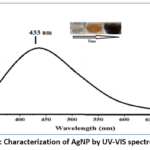 |
Figure 1: Characterization of AgNP by UV-VIS spectroscopy. Click here to View Figure |
FTIR Analysis of PPAgNp
FT-IR spectroscopy was employed to recognize the functional groups present in the molecules of Populus ciliata leaf extract (Figure 2). Distinct absorption bands were found at 623, 1022, 1093, 1381, 1612, 2958, 3438cm⁻¹. The broad band at 3438cm⁻¹ is indicative of hydroxyl groups typically found in alcohols or phenolic compounds. The peak at 2958 cm⁻¹ corresponds to C–H stretching vibrations associated with –CH₂ and –CH₃ groups. An absorption band at 1381 cm⁻¹ suggests the presence of nitrate (NO₃⁻) groups. The band at 1612 cm⁻¹ is attributed to the carbonyl (C=O) stretch of tertiary amides. These findings suggest that functional groups such as hydroxyls play a crucial role in nanoparticle stabilization.
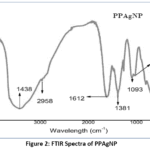 |
Figure 2: FTIR Spectra of PPAgNP Click here to View Figure |
X-Ray Diffraction (XRD) Analysis:
XRD was used to identify the crystalline nature of the synthesized nanoparticle. In XRD the diffraction pattern showed peaks at 111, 200 and 220 as shown in figure 3 which correspond to
planes of face centered cubic (fcc) silver. These peaks were observed at approximately 2θ values of 34.1°, 46.3°, and 28.5°, respectively. The sharp and intense nature of these peaks indicates the high crystallinity of the AgNPs.
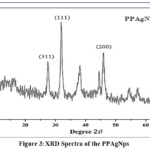 |
Figure 3: XRD Spectra of the PPAgNps Click here to View Figure |
Photocatalytic Degradation of Methylene Blue
A photocatalytic reaction occur under the combine effect of light and photocatalyst. The process have advantage over other method that it is environment friendly , have no contamination and cause total degradation of pollutants. In present study NaBH4 has been taken as a reducing agent, in reference to that the effect of Nanoparticle on degradation of Methylene blue was studied. In presence of NaBH4 the absorption spectra of methylene blue was taken with or without nanoparticle. Methylene blue (MB) showed a distinctive absorption peak near 664nm in UV-visible spectrum, attributed to lower-energy n→π* electronic transitions. When sodium borohydride (NaBH₄) was introduced, a slight decrease in absorbance intensity was observed, indicating partial reduction and stabilization of MB (Figure 4A). However, with the addition of 20 mg of PPAgNP nanoparticles, the absorbance intensity decreased steadily, demonstrating enhanced catalytic reduction of MB (Figure 4B). This indicates that methylene blue (MB) is converted to its reduced form, leuco methylene blue, in the presence of PPAgNP nanoparticles. In this reaction, PPAgNP NPs act as an effective catalyst, while sodium borohydride (NaBH₄) functions as the reducing agent. The efficiency of MB degradation by PPAgNP nanoparticles can be assessed using the formula:
R = [(C₀ − Cₜ)/C₀] × 100
where C₀ is the initial absorbance of dye at start and Cₜ is the absorbance at a any time t. To determine the reaction rate constant for the degradation process, the first-order kinetic equation is applied:
ln(Cₜ/C₀) = −kt,
where k represents the rate constant and t is the elapsed time. Figure 4C displays a plot of ln(Cₜ/C₀) versus time (t), which demonstrates a linear relationship. These linear plots indicate the degradation of methylene blue follows pseudo first order kinetics. In the absence of PPAgNP nanoparticles, the rate constant (k) is 0.01455 min⁻¹, corresponding to a degradation time of 21 minutes. However, with 20 mg of PPAgNP nanoparticles present, the rate constant increases to 0.03144 min⁻¹, and the degradation time extends to 24 minutes. PPAgNP nanoparticles facilitate the reduction of methylene blue (MB) by transferring electrons from the sodium borohydride (BH₄⁻) species, which acts as an electron donor, to the excited MB molecules, which serve as the electron acceptor. The PPAgNP nanoparticles play a key role in acquiring and transferring electrons between the donor and acceptor, thereby catalyzing the degradation of the dye. the presence of PPAgNP NPs stimulates the decomposition of MB.
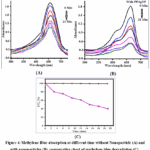 |
Figure 4: Methylene Blue absorption at different time without Nanoparticle (A) and with nanoparticles (B). comparative chart of methylene blue degradation (C). |
Conclusion and Discussion
The present study demonstrates the effective catalytic degradaon of methylene blue (MB) dye using AgNPs synthesized via an ecofriendly green synthesis route employing river grass (Paspalum paniculata) extract. The degradation process was accelerated by the presence of sodium borohydride (NaBH4), a strong reducing agent, along with green synthesized PPAgNPs, serving as a catalyst. This synergy enabled the rapid reduction and decolorization of MB within a short timeframe of 0 to 21 minutes, underscoring the potential application of such biogenic nanoparticles in wastewater treatment. The role of NaBH₄ in this catalytic system is crucial as it acts as an electron donor, supplying the electrons needed for the reduction of MB molecules. However, the reaction between NaBH₄ and MB is kinetically slow without a catalyst, as direct electron transfer is limited due to the repulsive interactions between the negatively charged NaBH₄ and dye molecules. The introduction of AgNPs synthesized using Paspalum paniculata bridges this gap by facilitating electron transfer from NaBH₄ to MB molecules through their high surface area and active sites, resulting in a dramatic increase in degradation rate. This mechanism aligns well with previous findings reported in the literature. For example, Singh et al. (2023)21 reported green-synthesized AgNPs using Trigonella foenum-graecum leaf extract that achieved degradation of MB within approximately 20 minutes with NaBH₄ acting as a reducing agent. The nanoparticles’ catalytic efficiency was attributed to their small size and the presence of phytochemicals on their surface, which also aid in stabilizing the particles and enhancing electron transfer efficiency. Similarly, Bonnia et al. (2016)22 proved the biosynthesis of silver nanoparticles using Polygonum hydropiper extract and observed complete degradation of MB in around 15 minutes under UV irradiation and NaBH₄ reduction conditions. These results are comparable to our findings, suggesting that green synthesis using different plant extracts produces nanoparticles with similar catalytic efficacy, validating the robustness of plant-mediated synthesis methods. The choice of Paspalum paniculata for nanoparticle synthesis offers several advantages. This aquatic plant is readily available and rich in bioactive molecules such as flavonoids and phenolics, which serve as natural reducing agents and capping agents. These compounds prevent nanoparticle aggregation, ensuring a stable colloidal system with a high surface-to-volume ratio, which is essential for catalytic activity. Further supporting this, studies using other plant extracts for nanoparticle synthesis, such as Terminalia catappa (Nguyen et al., 2024)23 and Raphanus sativus (Hasna et al., 2024)24, have also demonstrated significant photocatalytic and catalytic degradation of MB dye. This highlights the universality of plant extract-mediated synthesis and its importance in developing sustainable catalytic materials. The kinetics of MB degradation in this study followed pseudo-first-order reaction kinetics, a common behavior observed in many nanoparticle-catalyzed dye degradation systems. The rate constants observed were consistent with or superior to those reported in comparable systems, indicating the high catalytic efficiency of the AgNPs synthesized from Paspalum paniculata. In conclusion, the integration of NaBH₄ as a reducing agent with green-synthesized AgNPs from river grass extract proves to be an effective, environmentally friendly approach for the rapid degradation of MB dye. The biogenic nanoparticles offer a promising alternative to conventional chemical catalysts, combining sustainability with efficiency.
Acknowledgement
We acknowledge the FTIR facility of Guru Ghasidas University, Bilaspur for the help.
Funding Sources
The authors received no financial support for the research, authorship, and/or publication of this article.
Conflict of Interest
The authors do not have any conflict of interest.
Data Availability Statement
This statement does not apply to this article.
Ethics Statement
This research did not involve human participants, animal subjects, or any material that requires ethical approval.
References
- Forgacs, E.; Cserháti, T.; Oros, G. Removal of synthetic dyes from wastewater: A review. Environment International 2004, 30(7), 953–971. https://doi.org/10.1016/j.envint.2004.02.001.
CrossRef - Crini, G. Non-conventional low-cost adsorbents for dye removal: A review. Bioresource Technology 2006, 97(9), 1061–1085. https://doi.org/10.1016/j.biortech.2005.05.001
CrossRef - Garg, Vinod K.; Kumar, R.; Gupta, R. Removal of malachite green dye from aqueous solution by adsorption using agro-industry waste: A case study of Prosopis cineraria. Dyes and Pigments 2004, 62(1), 1–10. https://doi.org/10.1016/j.dyepig.2003.10.004
CrossRef - Rauf, M. A.; & Ashraf, S. Fundamental principles and application of heterogeneous photocatalytic degradation of dyes in solution. Chemical Engineering Journal 2009, 151(1-3), 10–18. https://doi.org/10.1016/j.cej.2009.02.007
CrossRef - Gupta, V. K.; Suhas. Application of low-cost adsorbents for dye removal: A review. Journal of Environmental Management 2009, 90(8), 2313–2342. https://doi.org/10.1016/j.jenvman.2008.11.017
CrossRef - Yagub, M. T.; Sen, T. K.; Afroze, S.; Ang, H. Dye and its removal from aqueous solution by adsorption: A review. Advances in Colloid and Interface Science 2014, 209, 172–184. https://doi.org/10.1016/j.cis.2014.04.002
CrossRef - Sharma, V. K.; Siskova, K. M.; Zboril, R.; Gardea-Torresdey, J. L. Organic-coated iron oxide nanoparticles for removal of heavy metals from wastewater. Environmental Science & Technology 2015, 49(5), 3012–3020. https://doi.org/10.1021/es505076d
- Iravani, S.; Korbekandi, H. M. S. V.; Zolfaghari, B. Synthesis of silver nanoparticles: Chemical, physical and biological methods. Research in Pharmaceutical Sciences 2014, 9(6), 385–406. [PMID: 25561892]
- Ahmed, S.; Ahmad, M.; Swami, B. L; Ikram, S. A review on plants extract mediated synthesis of silver nanoparticles for antimicrobial applications: A green expertise. Journal of Advanced Research 2016, 7(1), 17–28. https://doi.org/10.1016/j.jare.2015.02.007
CrossRef - Iravani, Seid. Green synthesis of metal nanoparticles using plants. Green Chemistry 2016, 13(10), 2638–2650. https://doi.org/10.1039/C1GC15386B
CrossRef - Mittal, A. K.; Chisti, Y.; Banerjee, Ujjwala, C. Synthesis of metallic nanoparticles using plant extracts. Biotechnology Advances 2013, 31(2), 346–356. https://doi.org/10.1016/j.biotechadv.2013.01.003
CrossRef - Lazarides, Michael. A revision of the genus Paspalum L. in Australia. Canberra, Australia: CSIRO Publishing 2002.
- Bhalerao, S. A.; Patil, M. B.; Deshmukh, R. S. Preliminary phytochemical analysis and antioxidant activity of Paspalum paniculatum. International Journal of Botany Studies 2002, 6(2), 45–50.
- Narayanan, K.; Sakthivel, N. Biological synthesis of metal nanoparticles by microbes. Advances in Colloid and Interface Science 2010, 156(1-2), 1–13. https://doi.org/10.1016/j.cis.2010.02.001
CrossRef - Ho, Y.; & McKay, G. Pseudo-second order model for sorption processes. Process Biochemistry 1999, 34(5), 451–465. https://doi.org/10.1016/S0032-9592(98)00112-5
CrossRef - Anjali, P.; & Sharma, M. Adsorption of methylene blue from aqueous solution using treated sawdust: Kinetics, equilibrium and thermodynamics. Desalination and Water Treatment 2010, 24(1-3), 263–271. https://doi.org/10.5004/dwt.2010.1627
- Ahmad, A.; Mukherjee, P.; Senapati, S.; Mandal, D.; Khan, M. I.; Kumar, R.; Sastry, M. Extracellular biosynthesis of silver nanoparticles using the fungus Fusarium oxysporum. Colloids and Surfaces B: Biointerfaces 2003, 28(4), 313–318. https://doi.org/10.1016/S0927-7765(02)00174-1
CrossRef - Anastas, P.T.; & Warner, J. C. Green Chemistry: Theory and Practice. Oxford University Press, New York 1998.
- Daniel, M.; Astruc, D. Gold nanoparticles: Assembly, supramolecular chemistry, quantum-size-related properties, and applications toward biology, catalysis, and nanotechnology. Chemical Reviews 2004, 104(1), 293–346. https://doi.org/10.1021/cr030698+
CrossRef - Singh, P. K.; Youngjin, Z. D.; & Yang, D. C. Biological synthesis of nanoparticles from plants and microorganisms. Trends in Biotechnology 2016, 34(7), 588–599. https://doi.org/10.1016/j.tibtech.2016.02.006.
CrossRef - Moond, M.; Sushila, S.; Seema, S. Savita, R.; Anuradha, B.; Jyoti, R.; Anita, K.; Indu, R.; Parvesh D. “Phytofabrication of Silver Nanoparticles Using Trigonella foenum-graecum Leaf and Evaluation of Its Antimicrobial and Antioxidant Activities.” International Journal of Molecular Sciences 2023, 24, no. 4: 3480. https://doi.org/10.3390/ijms24043480
CrossRef - Bonnia, N. N.; Kamaruddin, M. S.; Nawawi, M. H.; Ratim, S.; Azlina, H. N.; Ali, E. S. “Green Biosynthesis of Silver Nanoparticles Using Polygonum hydropiper and Study Its Catalytic Degradation of Methylene Blue.” Procedia Chemistry 2016, 19: 594–602. https://doi.org/10.1016/j.proche.2016.03.058
CrossRef - Nguyen, T. H. P.; Nguyen, T. P.; Nguyen, T. A. T., Nguyen, Van Q.; Nguyen, Van Dung. Terminalia catappa leaf extract as a bio-reducing agent to synthesize Cu₂O nanoparticles for methylene blue photodegradation. Discover Applied Sciences 2024, 6, 309. https://doi.org/10.1007/s42452-024-05990-3SpringerLink
CrossRef - Hasna, M. Y. F., Santhiran, Anuluxan, Prabagar, Subramaniam, De Silva, R. Chinthaka L., Perera, R. M. N., Kularatne, R. Photocatalytic degradation of methylene blue dye using silver nanoparticles prepared from Raphanus sativus. Journal of Environmental Chemical Engineering 2024, 12(5), 109876. https://doi.org/10.1016/j.jece.2024.109876
Accepted on: 01 Oct 2026


ISSN Online: 2231-5039