Computational Discovery of Ketopioglitazone as a Potential PPAR-γ Agonist for Diabetes Management: Insights from Molecular Docking, Dynamics, and ADMET Analysis
 , Kadirvel Devi 2, Parameswaran Sudarshan 1, Jagruthi Kanaparthi1, Rhamsha S Khan1
1Department of Pharmacology, Sri Ramachandra Faculty of Pharmacy, Sri Ramachandra Institute of Higher Education & Research (SRIHER), Chennai, Tamil Nadu, India.
2Department of Pharmaceutics, School of Pharmaceutical Sciences, Vels Institute of Science, Technology and Advanced Studies (VISTAS), Chennai, Tamil Nadu, India.
Corresponding Author Email:nithya.s@sriramachandra.edu.in
Download this article as:
ABSTRACT:Background: Peroxisome Proliferator-Activated Receptors (PPARs), commonly referred to as glitazone receptors enhances the insulin sensitivity and influences pancreatic β cells in lowering the blood sugar levels. Nevertheless, in need of safer and more effective anti-diabetic therapies which addresses insulin resistance, minimise the adverse effects and explore novel molecular scaffolds. Objective: Computational analysis was used to investigate the potential of ketopioglitazone as a PPAR-γ agonist for T2D (Type 2 diabetes) treatment. This study aimed to predict the binding constants and stability of ketopioglitazone with PPAR-γ and evaluate its drug-likeness properties using in-silico tools. Methods: The binding affinity of ketopioglitazone to PPAR-γ was predicted using AutoDock Vina, with a scoring function optimized for docking. Molecular dynamics simulations with Desmond v5.3 were used to evaluate the stability of the complex. The drug-likeness properties were assessed using DruLiTo and Swiss ADME tools, evaluating logP, molecular weight, and other parameters. Results and Discussion: Molecular dynamics simulations revealed that the 4EMA-ketopioglitazone complex exhibited stability with low RMSD values, indicating that the ligand remained bound to the protein throughout the simulation. In contrast, the 5Y2O-ketopioglitazone complex displayed instability, characterized by higher RMSD values. The study also assessed the drug-likeness properties of ketopioglitazone using DruLiTo and Swiss ADME tools. The results indicated that ketopioglitazone satisfied Lipinski's rule of five and exhibited good oral bioavailability and drug-like properties. Conclusions: The binding affinity of Ketopioglitazone to PPAR-γ and drug-like properties make it a promising candidate for T2D treatment. Molecular docking and dynamics simulations revealed strong interactions with critical residues, and ADME analysis confirmed good oral bioavailability and drug- like properties. These findings support the potential of ketopioglitazone as a therapeutic agent for T2D treatment, and its development as a PPAR-γ agonist deserves further investigation.
KEYWORDS:ADMET analysis; Ketopioglitazone; Molecular docking; Molecular dynamics; PPAR-γ; Type 2 diabetes treatment
Introduction
Diabetes mellitus is a chronic metabolic disorder of millions of people worldwide. Type 1 diabetes (T1D) is due to autoimmune destruction of pancreatic β-cells, leading to absolute insulin deficiency, whereas type 2 diabetes (T2D) accounts for 90–95% of diabetes and is due to insulin resistance and relative insulin deficiency.1 The prevalence of diabetes mellitus increases day by day representing as a critical global health challenge, currently affecting nearly 500 million individuals. Studies indicate that by 2045, the worldwide diabetic count surge by an alarming 51%, underscoring the urgent need for effective interventions.2 The growing prevalence of diabetes not only ranks among the leading causes of mortality but also places a significant financial strain on healthcare systems, driven by the high costs of treatment and the wide array of associated complications.3 Type 2 diabetes mellitus (T2D) is a persistent metabolic disorder characterized by insulin resistance and impaired insulin secretion, resulting in sustained hyperglycemia.4 It is frequently accompanied by dysfunction across multiple organ systems and is strongly correlated with cardiovascular conditions, particularly atherosclerosis.5 People across Asia are more likely to develop diabetes at a younger age and with less obesity compared to those in other parts of the world. They also tend to experience prolonged complications and face earlier mortality due to the disease. Meanwhile, childhood obesity has risen sharply, and type 2 diabetes has escalated to epidemic proportions in the region. This growing health crisis poses a serious threat to the capacity and sustainability of regional healthcare systems.6 Contributing factors such as inflammation in adipose tissue and disruptions in gut microbiota exacerbate insulin resistance, while dysfunctional pancreatic β-cells fail to maintain glycemic control.7,8 The pathophysiology of T2D is thus intricately linked to metabolic dysregulation and inflammatory mechanisms, with inflammation serving as a central driver.9 Notably, inflammatory activity within pancreatic islets can critically diminish β-cell performance in individuals with T2D.10 These inflammatory pathways are increasingly viewed as promising targets for improving strategies in diabetes prevention and therapeutic intervention.11
Thiazolidinediones (TZDs) are antidiabetic drugs primarily used for the treatment of T2D due to their insulin-sensitizing effect.12 TZDs work by activating peroxisome proliferator-activated receptor gamma (PPAR-γ), a nuclear receptor that regulates metabolic pathways.13,14 Activation of PPAR-γ enhances glucose intake in muscle and adipose tissues, inhibits gluconeogenesis in the liver, and reduces hepatic glucose production.15 Further, it enhances insulin sensitization by enhancing glucose uptake and inhibiting the release of hepatic glucose.16 Additional studies are needed to ensure their maximum clinical application.17,18 Nitrogen and sulphur containing heterocyclic compounds are pivotal in drug discovery due to their advantageous pharmacokinetic and pharmacodynamic profiles.19 These structural motifs enhance solubility, bioavailability, and safety. Among them, the thiazolidin-2,4-dione (TZD) core has emerged as a versatile scaffold in medicinal chemistry, yielding compounds with diverse therapeutic potential including antidiabetic, anticancer, antimicrobial, anti-inflammatory, antimalarial, and antioxidant activities.20,21 Clinically approved TZDs pioglitazone is widely used in managing type 2 diabetes mellitus (T2D), primarily by improving insulin sensitivity in adipose tissue, skeletal muscle, and liver.22 Notably, these agents do not induce hypoglycaemia when administered as monotherapy and are suitable for patients with renal impairment. Beyond glycaemic regulation, TZDs have demonstrated hepatoprotective effects in individuals with non-alcoholic steatohepatitis.23-27
Their therapeutic action is mediated through activation of the nuclear receptor PPAR-γ, which orchestrates gene expression related to glucose and lipid metabolism. This activation upregulates adiponectin and GLUT4 while downregulating pro-inflammatory cytokines such as TNF-α, thereby enhancing glucose uptake and insulin responsiveness29 PPAR-γ agonism is also associated with broader clinical benefits, including induction of cancer cell apoptosis, attenuation of vascular remodeling, and improved cardiovascular outcomes.30
Computational strategies hold a central role in studying the PPAR-γ and the ligand-binding interactions. Molecular docking and molecular dynamics simulation permit the anticipation of binding affinity, accelerating drug development compared with the traditional approaches31,18 They enable scientists to design and develop novel antidiabetic agents quickly at low expenses and time.19 Complementation of both experimental and computational approaches enhances identification of safer and effective diabetes treatment. This study aims in designing ketopioglitazone as anti-diabetic, evaluated through computational approaches including molecular docking, ADME profiling, and molecular dynamics simulations. Ketopioglitazone were intended to engage PPAR-γ in a manner that induces favourable conformational shifts, reduces binding free energy, and facilitates coactivator recruitment and transcriptional activation. The predominant goal was to screen TZD-based ketopioglitazone for its efficacy and safety, addressing the limitations of existing therapies and offering improved options for managing insulin resistance and T2D.
Materials And Method
Protein Preparation
Three-dimensional structures of the PPAR-γ protein complexed with rosiglitazone (PDB ID:4EMA, 4EM9); lobeglitazone (PDB ID: 5Y2T); and pioglitazone (PDB ID: 5Y2O) were retrieved from the Protein Data Bank. These structures were generated by docking simulations with hydrogen atom addition, structure optimization and active site identification. Molecular visualization was done using PyMOL and proteins were converted to PDBQT format followed by docking parameter configurations.32
Ligand Preparation
The 3D Structure of Ketopioglitazone (CID: 5201446) in. AutoDock Vina converted the sdf format to PDBQT. We set up a docking grid around the target protein’s binding site by specifying the centre and size of the grid box and carried out the docking simulation to the prepared ligand and target protein. Binding affinities and molecular interactions of ketopioglitazone and target protein were determined by analysing results.33
Molecular Docking
To prepare the target receptors for molecular docking with AutoDock Vina, the 3D structures of the target receptors (PDB IDs: 5Y2O, 5Y2T, 4EM9, 4EMA) were downloaded from the Protein Data Bank and had unnecessary parts deleted. Hydrogen atoms were added, receptors were prepared, and active sites were determined to establish the docking search space. Ketopioglitazone (CID: 5201446) was downloaded in MGL 4.5 format, converted to PDBQT, and docking parameters were established before simulating. Ligand-receptor interaction analysis supports drug discovery and molecular modelling progress.34
Molecular Dynamics
Desmond v5 from the Schrödinger suite was utilized for MD simulations with the NPT ensemble for 250 ns at 300 K and 1.01325 bar using the OPLS5 force field. Protein-ligand complexes were solvated with TIP4P water, counter-ions, and 0.15 M NaCl, and long-range electrostatics were treated with Ewald’s particle-mesh. RMSF and RMSD analyses were used to understand system stability and protein-ligand interactions in physiological conditions.35
Drug-Likeness Property
DruLiTo is an open-source offline tool used to assess drug-likeness based on Lipinski’s rule of five [13]. It predicts properties like MW, log P, HBA, HBD, TPSA, and others essential for drug evaluation. Ligand structures are built, and drug-like features are analyzed using rules like BBB, CMC-50, Veber’s, and Lipinski’s, emphasizing molecular size, polarity, and folding for therapeutic potential.36,37
ADME Properties
The Swiss ADME web server, available at http://www.swissadme.ch/, was utilized to estimate the ADME characteristics. Physicochemical descriptors, ADME parameters, pharmacokinetic characteristics, drug-like nature, and medicinal chemistry compatibility can all be estimated using this website.36
Toxicity Estimation
The Toxicity Estimation Software Tool (TEST) facilitates the quick QSAR-based chemical toxicity prediction.38 TEST estimated the LC50 threshold based on an overall average of component models, with predictions from methods such as group contribution, consensus, single-model, and hierarchical approaches.39
Importing from an MDL mol file;
Using the molecular structure sketching tool; and
Searching by name, CAS number, or SMILES
Results
Active site of PPAR-γ
Figures 1A, 1B, and 1C present 2D and 3D interaction patterns of rosiglitazone, a potent and highly selective PPAR-γ agonist. Our study determined the PPAR-γ active site in the ligand-binding domain, with important hydrogen bond interactions with TYR_327 and TYR_473. These interactions, along with the water-filled inner pocket and hinge region, are critical for ligand binding and activation of PPAR-γ.
Hydrogen bonding by rosiglitazone at TYR_327 and TYR_473 is crucial for the activation of PPAR-γ, paving the way for targeted therapy. Recently, these interactions have been shown to be critical determinants of PPAR-γ activation and inhibition.40
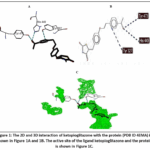 |
Figure 1: The 2D and 3D interaction of ketopioglitazone with the protein (PDB ID 4EMA) is shown in Figure 1A and 1B. The active site of the ligand ketopioglitazone and the protein is shown in Figure 1C. |
Molecular Docking
Molecular docking experiments with AutoDock Vina included protein and ligand preparation, grid creation, and docking. The study was conducted with the co-crystallized human PPAR-γ complex with target PDB IDs: 4EMA (Figure 2A), 5Y2O (Figure 2B), 5Y2T (Figure 2C), and 4EM9 (Figure 2D). Protein preparation included adherence to standard software protocols.
Based on docking results, the protein candidates with the highest scores were considered for further study, as they showed an acceptable level of binding. The pioglitazone compound’s docking scores are displayed in Table 1. The scores obtained are -6.45, -7.20, -6.91 and – 6.61.
An analogous molecular docking study was conducted on the identical target protein using the standard chemical Ketopioglitazone. The docking scores are presented in Table 2. The scores received were -12, -9.2, -8.01, and -6.25. Thus, these ratings show the re-purposing capability of drug. It is noticeable that the common amino acid residues involved in interactions are TYR (tyrosine), CYS (cysteine), and HIS (histidine) refer Figure 1B. Based on these docking scores, the top two proteins, 4EMA and 5Y2O, were selected for molecular dynamic simulations to evaluate the primary interactions and ensure the stability of the protein-ligand complex.41
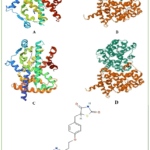 |
Figure 2: Protein structure of 2A. 4EMA, 2B. 5Y2O, 2C. 5Y2T, 2D. 4EM9 and 2E. 2D structure of ketopioglitazone Click here to View Figure |
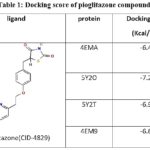 |
Table 1: Docking score of pioglitazone compound Click here to View Table |
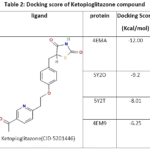 |
Table 2: Docking score of Ketopioglitazone compound. Click here to View Table |
Molecular Dynamics
RMSD quantifies atomic displacement differences to examine protein-ligand complex stability. The 4EMA-ketopioglitazone complex was stable with high ligand and protein RMSD values of 2.4 Å and 2.6 Å, respectively (Figure 3A). In contrast, the 5Y2O-ketopioglitazone complex was unstable with ligand and protein RMSD values of 4.4 Å and 2.8 Å, indicating weak interaction in simulation (Figure 3B).
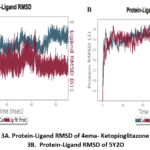 |
Figure 3: 3A. Protein-Ligand RMSD of 4ema- Ketopioglitazone complex, 3B. Protein-Ligand RMSD of 5Y2O Click here to View Figure |
Protein RMSF
RMSF quantifies the flexibility of residues by tracking their motion during a simulation, identifying key amino acids that influence molecular movement. It helps to analyse structural changes in the target protein when it binds to a ligand, providing information about protein dynamics and stability.
From the figure 4A which is given below we can understand the examined 4EMA-Ketopioglitazone complex, the amino acid residues showed major fluctuations at 20 ns, 40 ns, 210 ns, and 230 ns throughout the entire simulation. This indicates that ligand binding did not cause the protein’s flexibility to change significantly, like wise from the figure 4B we can understand that, the 5Y20-Ketopioglitazone complex, the amino acid residues showed major fluctuations at 30 ns, 50 ns, and 210 ns throughout the entire simulation.
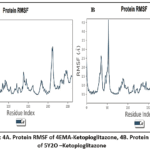 |
Figure 4: 4A. Protein RMSF of 4EMA-Ketopioglitazone, 4B. Protein RMSF of 5Y2O –Ketopioglitazone Click here to View Figure |
Protein-Ligand Contacts (PLCs)
In simulation, the interactions between ligands and proteins were observed. The simulation interactions diagram panel explains the subtypes of each interaction. Hydrogen bonding, hydrophobic contacts, ionic or polar interactions, and water bridges are the four types under which these contacts occur.
Protein-ligand contacts for 4EMA with ketopioglitazone were examined, revealing hydrogen bonds (H-bonds) and water bridges. Specifically, TYR327 exhibited H-bonds, water bridges, and hydrophobic contacts, while TYR473 showed contacts through H-bonds, water bridges, and hydrophobic interactions, as shown in Figure 5A. TYR327 demonstrated a 35% contact rate with the ligand ketopioglitazone, as shown in the Figure 5B.
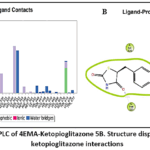 |
Figure 5: 5A. PLC of 4EMA-Ketopioglitazone 5B. Structure displaying protein-ketopioglitazone interactions Click here to View Figure |
Protein-ligand contacts for 5Y2O with ketopioglitazone were further examined, revealing hydrogen bonds (H-bonds) and water bridges. Precisely, TYR327 exhibited H-bonds, water bridges, and hydrophobic contacts, while TYR473 showed contacts through H-bonds and water bridges interactions, as shown in the Figure 6A. TYR327 demonstrated an 88% contact rate with the ligand ketopioglitazone, as shown in the Figure 6B.
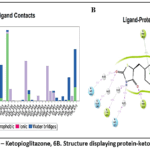 |
Figure 6: 6A. PLC of 5Y2O – Ketopioglitazone, 6B. Structure displaying protein-ketopioglitazone interactions. Click here to View Figure |
Drug-likeness and ADME properties
Ketopioglitazone meets all five of Lipinski’s drug-likeness criteria, with good ADME characteristics that make it a promising candidate for drug development. In this graphic depiction, the pink area inside the hexagon represents the optimal range for bioactive compounds, as shown in the Figure 7A. Saturation (SATU), consisting of polar surface area (POLAR) TPSA between 20 and 130 Ų, molecular weight between 150 and 500 g/mol, rotatable bonds (FLEXI) not more than 9, XLOGP3 between -0.7 and +5.0, and a fraction of carbons in sp3 hybridization not less than 0.25. are the recommended ranges for a drug-like molecule.
Based on information obtained by DruLiTo and Swiss ADME software, ketopioglitazone also met the requirements of the BBB similarity rule, Veber’s rule, and Ghose filter. Its strong gastrointestinal absorption is accompanied by a lack of blood-brain barrier (BBB) penetration, which suggests constraints for applications involving the central nervous system (CNS), refer Table 3.42-44 Ketopioglitazone is a promising drug-like molecule and helpful therapeutic agent, according to all of the above study.
Table 3: Drug-likeness and ADME properties of ketopioglitazone
|
Property |
ketopioglitazone |
|
Molecular weight (g/mol) |
370.42 g/mol |
|
Hydrogen bond donors |
1 |
|
Hydrogen bond acceptors |
5 |
|
Rotatable bonds |
7 |
|
Log P (Partition coefficient, Predicted value) |
2.44 |
|
Molar refractivity |
102.59 |
|
Fraction Csp3 |
0.26 |
|
Topological polar surface area in Å2 |
110.66 Ų |
|
Lipinski’s rule of five |
yes |
|
Ghose filter |
yes |
|
Veber’s rule |
yes |
|
BBB likeness rule |
yes |
|
GI absorption |
High |
|
BBB Permeability |
no |
|
Bioavailability score |
0.55 |
In addition, BOILED-Egg is a tool within the SwissADME software that graphically represents the predicted passive intestinal absorption and brain penetration of a molecule, evaluating its pharmacokinetic properties. In the figure 7B, the bioactive substance ketopioglitazone showed improved absorption in the gastrointestinal system, which is present in the albumin (white region). This region indicates that the molecule is likely to be well absorbed by the gastrointestinal tract (GI).45-46
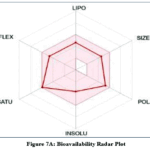 |
Figure 7A: bioavailability radar plot Click here to View Figure |
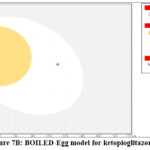 |
Figure 7B: BOILED-Egg model for ketopioglitazone Click here to View Figure |
Toxicity Estimation
Oral rodent LD50 of ketopioglitazone was evaluated using five various methodologies comparing limits of toxicity (Table 4). More than 0.5 indicates toxicity. Ames mutagenicity assays testified that ketopioglitazone is non-mutagenic to TEST software prediction.47-50 Toxicity was also evaluated in fathead minnows (96h), Daphnia magna (48h), and T. pyriformis IGC (48h) using five methodologies for comparative study.
Table 4: Toxicity profile of ketopioglitazone
|
Method |
Endpoint |
Ketopioglitazone |
|
Consensus |
Fathead minnow (96h) | – |
| Daphnia magna (48h) |
4.66 |
|
|
T.pyriformis IGC (48h) |
– | |
| Oral rat LD50 |
– |
|
|
Developmental toxicity |
0.66 | |
| mutagenicity |
0.07 |
|
|
Hierarchical clustering |
Fathead minnow (96h) |
– |
| Daphnia magna (48h) |
4.42 |
|
|
T.pyriformis IGC (48h) |
– | |
| Oral rat LD50 |
– |
|
|
Developmental toxicity |
0.97 | |
| mutagenicity |
-0.20 |
|
|
Single model |
Fathead minnow (96h) |
– |
| Daphnia magna (48h) |
4.47 |
|
|
T.pyriformis IGC (48h) |
– | |
| Oral rat LD50 |
N/A |
|
|
Developmental toxicity |
0.85 | |
| mutagenicity |
N/A |
|
|
Group contribution |
Fathead minnow (96h) |
– |
| Daphnia magna (48h) |
5.15 |
|
|
T.pyriformis IGC (48h) |
– |
|
| Oral rat LD50 |
N/A |
|
|
Developmental toxicity |
N/A | |
| mutagenicity |
N/A |
|
|
Nearest neighbor |
Fathead minnow (96h) |
6.72 |
| Daphnia magna (48h) |
4.61 |
|
|
T.pyriformis IGC (48h) |
5.23 | |
| Oral rat LD50 |
2.05 |
|
|
Developmental toxicity |
0.33 | |
| mutagenicity |
0.33 |
Discussion
The global prevalence of diabetes is rising rapidly, increasing healthcare costs.51,52 Insulin resistance, gender, life style modification greatly influences the diabetes mellitus.53-55 Selective activation of PPARγ holds promise for maintaining insulin sensitivity with reduced side effects, utilizing post-translational modifications effectively.56 PPARγ plays a crucial role in enhancing insulin sensitivity and glucose metabolism by promoting fatty acid uptake, triglyceride formation, and storage in lipid droplets. It also exerts antiatherogenic and anti-inflammatory effects on vascular walls and immune cells. Clinically, activation of PPARγ with glitazones and PPARα with fibrates decreases insulin resistance and dyslipidemia, individually. PPARs act as master switches in cardiac energy metabolism, impacting conditions like heart failure and diabetic cardiomyopathy.57 Current treatments include insulin, GLP-1 agonists, and others, while new targets like PPAR, GIP, and FFA1 show potential for innovative therapies.58
The results of this study underscore the potential of in silico approaches for identifying and optimizing new PPAR-γ agonists for diabetes management. By leveraging computational techniques, we can gain deeper insights into the molecular interactions and dynamic behaviours of protein-ligand complexes, which are critical for drug discovery and development.59,60 Molecular docking studies revealed that ketopioglitazone, a repurposed compound, exhibited higher binding affinities to PPAR-γ compared to pioglitazone, a standard PPAR-γ agonist. The docking scores for ketopioglitazone were significantly lower, indicating stronger binding interactions. These findings were further corroborated by molecular dynamics simulations, which provided a comprehensive analysis of the stability and flexibility of the protein-ligand complexes.61-63
The 4EMA-ketopioglitazone complex demonstrated remarkable stability, as evidenced by low RMSD values for both the ligand and protein. This suggests that ketopioglitazone maintains a stable interaction with PPAR-γ over time, which is crucial for its efficacy as a therapeutic agent. In contrast, the 5Y2O-ketopioglitazone complex showed higher RMSD values, indicating a less stable interaction. This variability highlights the importance of selecting appropriate protein targets for molecular docking and dynamics studies.64,65
Ketopioglitazone exhibited favourable drug-likeness and ADME properties, adhering to Lipinski’s rule of five and other drug-likeness guidelines. The compound illustrated high gastrointestinal absorption and acceptable bioavailability, although it lacked blood-brain barrier penetrability. This characteristic limit its application in central nervous system (CNS) disorders but is advantageous for targeting peripheral tissues involved in diabetes.
The strong ADME profile of ketopioglitazone supports its potential as a viable therapeutic candidate for diabetes management. The compound’s physicochemical properties, such as molecular weight, hydrogen bond donors and acceptors, and topological polar surface area, fall within the optimal range for bioactive molecule resembling outcomes from other reported studies.66-74 The integration of in silico methods in drug discovery provides a powerful toolkit for the identification and optimization of new therapeutic agents. This study demonstrates that computational approaches can effectively predict the binding affinities, stability, and drug- likeness of potential drug candidates, thereby accelerating the drug development process as similar to earlier study.75 Future research should focus on expanding the chemical space of potential PPAR-γ agonists through virtual screening of larger compound libraries. Additionally, combining in silico methods with in vitro and in vivo experiments will provide a more comprehensive understanding of the pharmacological and toxicological profiles of these compounds.
In the context of diabetes management and the search for new PPAR-γ agonists, these findings provide a foundational understanding of the biological activity of ketopioglitazone. Further research is necessary to explore the therapeutic window, optimize dosing strategies, and assess the long-term effects of ketopioglitazone in vitro and in vivo.
Conclusion
Ketopioglitazone possesses the potential to be a therapeutic medication that is successful in treating type 2 diabetes (T2D). Molecular docking studies revealed positive interactions between ketopioglitazone and PPAR-γ receptor, with docking scores indicating interaction a strong relationship.
Molecular dynamics simulations provided additional evidence that the ketopioglitazone-PPARγ complex, particularly for the 4EMA protein structure, where the ligand displayed low RMSD values and maintained close contact with the protein in the simulation. Analysis of protein-ligand contacts highlighted key hydrogen bonding and hydrophobic interactions involving critical residues such as TYR327 and TYR473 with 35% contact rate, which are known to be important for PPAR-γ activation.
In contrast, the 5Y2O structure showed high RMSD values for the ligand, indicating instability in the protein-ligand complex during the simulation. Despite the high contact rate of 88% between the ligand and critical residues TYR327 and TYR473, the instability persisted, suggesting that high contact rates alone do not guarantee complex stability.
Furthermore, ketopioglitazone was found to have good drug-like properties, conforming to Lipinski’s rule of five and other ADME criteria, indicating good oral bioavailability and drug- like properties These data together indicate that ketopioglitazone in T2D is an affirmative candidate for further development as a therapeutic PPAR-γ agonist.
The computational approaches used in this study, including molecular docking, molecular dynamic simulations, and prediction of ADME properties, regarding their advantages in rapid drug discovery and identification of potential copper drug targets on PPAR-γ receptors These in silico strategies presented can be comprehensively used to refine the pharmacokinetic and safety profile of PPAR-γ agonists such as ketopioglitazone, ultimately leading to therapeutic migration effective and safe management of type 2 diabetes emerged.
Acknowledgment
The authors would like to express their gratitude to the Head of the Faculty of Pharmacy at Sri Ramachandra Institute of Higher Education and Research (DU) in Chennai for providing valuable facilities and insightful suggestions for the manuscript.
Funding Sources
The author(s) received no financial support for the research, authorship, and/or publication of this article.
Conflict of Interest
The author(s) do not have any conflict of interest.
Data Availability Statement
This statement does not apply to this article.
Ethics Statement
This research did not involve human participants, animal subjects, or any material that requires ethical approval.
Author Contributions
SN conceived and designed the study, analysed and interpreted the data. KD conducted the investigation and wrote the manuscript. PS contributed for methodology. JK contributed for validation and RK assisted with manuscript editing. All authors contributed to the article and approved the submitted version.
References
- Kosmas, C.E.; Bousvarou, M.D.; Kostara, CE.; Papakonstantinou, EJ.; Salamou, E.; Guzman, E. Insulin resistance and cardiovascular disease., J Int Med Res., 2023, 51, doi: 10.1177/03000605231164548. PMID: 36994866.
CrossRef - Saeedi, P.; Petersohn, I.; Salpea, P.; Malanda, B.; Karuranga, S.; Unwin, N.; Colagiuri, S.; Guariguata, L.; Motala, A.A.; Ogurtsova, K.; Shaw, J.E.; Bright, D.; Williams, R. IDF Diabetes Atlas Committee. Global and regional diabetes prevalence estimates for 2019 and projections for 2030 and 2045: Results from the International Diabetes Federation Diabetes Atlas, 9th Diabetes Res Clin Pract., 2019, 157, 107843. doi: 10.1016/j.diabres.2019.107843. PMID: 31518657.
CrossRef - Liu, G.; Li, Y.; Pan, A.; Hu, Y.; Chen, S.; Qian, F.; Rimm, E.B.; Manson, J.E.; Stampfer, M.J.; Giatsidis, G.; Sun, Q. Adherence to a Healthy Lifestyle in Association With Microvascular Complications Among Adults With Type 2 Diabetes., JAMA Netw Open., 2023, 6, doi: 10.1001/jamanetworkopen.2022.52239. PMID: 36701156.
CrossRef - Lv, C.; Sun, Y.; Zhang, Z.Y.; Aboelela, Z.; Qiu, X.; Meng, Z.X. β-cell dynamics in type 2 diabetes and in dietary and exercise interventions., J Mol Cell Biol., 2022, 14, mjac046. doi: 10.1093/jmcb/mjac046. PMID: 35929791.
CrossRef - Marx, N.; Davies, M.J.; Grant, P.J.; Mathieu, C.; Petrie, J.R.; Cosentino, F.; Buse, J.B. Guideline recommendations and the positioning of newer drugs in type 2 diabetes care., Lancet Diabetes Endocrinol., 2021, 9, 46-52. doi: 10.1016/S2213-8587(20)30343-0. Erratum in: Lancet Diabetes Endocrinol., 2021, 9:e1. doi: 10.1016/S2213-8587(20)30407-1. PMID: 33159841.
CrossRef - Yoon, K.H.; Lee, J.H.; Kim, J.W.; Cho, J.H.; Choi, Y.H.; Ko, S.H.; Zimmet, P.; Son, H.Y. Epidemic obesity and type 2 diabetes in Asia., Lancet., 2006, 368, 1681-8. doi: 10.1016/S0140-6736(06)69703-1. PMID: 17098087.
CrossRef - Li, X.Q.; Jia, S.S.; Yuan, K.; Jin, S.H. Hypoglycemic Effect of the N-Butanol Fraction of Torreya grandisLeaves on Type 2 Diabetes Mellitus in Rats through the Amelioration of Oxidative Stress and Enhancement of β-Cell Function., Biomed Res Int., 2022, 2022, doi: 10.1155/2022/5648896. PMID: 36619301.
CrossRef - Gu, J.C.; Wu, Y.G.; Huang, W.G.; Fan, X.J.; Chen, X.H.; Zhou, B.; Lin, Z.J.; Feng, X.L. Effect of vitamin D on oxidative stress and serum inflammatory factors in the patients with type 2 diabetes., J Clin Lab Anal., 2022, 36, e24430. doi: 10.1002/jcla.24430. PMID: 35403296.
CrossRef - García-Aguilar, A.; Guillén, C. Targeting pancreatic beta cell death in type 2 diabetes by polyphenols., Front Endocrinol (Lausanne)., 2022, 13, doi: 10.3389/fendo.2022.1052317. PMID: 36465657.
CrossRef - Volpe, C.M.; Abreu, L.F.; Gomes, P.S.; Gonzaga, R.M.; Veloso, C.A.; Nogueira-Machado, J.A. The production of nitric oxide, IL-6, and TNF-alpha in palmitate-stimulated PBMNCs is enhanced through hyperglycemia in diabetes. Oxid Med Cell Longev., 2014, 2014, 479587. doi: 10.1155/2014/479587. PMID: 24803982.
CrossRef - Hong, S.W.; Lee, J.; Cho, J.H.; Kwon, H.; Park, S.E.; Rhee, E.J.; Park, C.Y.; Oh, K.W.; Park, SW, Lee WY. Pioglitazone Attenuates Palmitate-Induced Inflammation and Endoplasmic Reticulum Stress in Pancreatic β-Cells., Endocrinol Metab (Seoul)., 2018, 33, 105-113. doi: 10.3803/EnM.2018.33.1.105. PMID: 29589392.
CrossRef - Wagner, N.; Wagner, K.D. Pharmacological Utility of PPAR Modulation for Angiogenesis in Cardiovascular Disease., Int J Mol Sci., 2023, 24, 2345. doi: 10.3390/ijms24032345. PMID: 36768666.
CrossRef - Chiarelli, F.; Di Marzio, D. Peroxisome proliferator-activated receptor-gamma agonists and diabetes: current evidence and future perspectives., Vasc Health Risk Manag., 2008, 4, 297-304. doi: 10.2147/vhrm.s993. PMID: 18561505.
CrossRef - Mudaliar, S.; Henry, R.R. PPAR agonists in the treatment of diabetes., International Textbook of Diabetes Mellitus., 2015, 17, 657-672.
CrossRef - Miglioli, A.; Canesi, L.; Gomes, I.D.L.; Schubert, M.; Dumollard, R. Nuclear Receptors and Development of Marine Invertebrates., Genes (Basel)., 2021, 12, 83. doi: 10.3390/genes12010083. PMID: 33440651.
CrossRef - Nagarajan, S.R.; Cross, E.; Sanna, F.; Hodson, L. Dysregulation of hepatic metabolism with obesity: factors influencing glucose and lipid metabolism., Proc Nutr Soc., 2022, 81, 1-11. doi: 10.1017/S0029665121003761. PMID: 34726148.
CrossRef - Balestra, E.; Barbi, E.; Ceconi, V.; Di Maso, V.; Conversano, E.; Pennesi, M. Pioglitazone, a PPAR-y agonist, as one of the new therapeutic candidates for C3 glomerulopathy., Pediatr Nephrol., 2024, 39, 309-314. doi: 10.1007/s00467-023-06088-5. PMID: 37493956.
CrossRef - Okoh, O.S.; Yakubu, A.; Adegboyega, A.E.; Uti, D.E.; Obeten, U.N.; Agada, S.A.; Oluwaloni, F.; Johnson, G.I.; Mela, L.P.; Asomadu, R.O.; Iwaloye, O.; Johnson, T.O.; Orji, O.U. Identification of some bioactive compounds from Trignonella foenumgraecum as possible inhibitors of PPARϒ for diabetes treatment through molecular docking studies, pharmacophore modelling and ADMET profiling: An in-silico study., PLoS One., 2023, 18, e0284210. doi: 10.1371/journal.pone.0284210. PMID: 37200359.
CrossRef - Maltarollo, V.G.; Kronenberger, T.; Windshugel, B.; Wrenger, C.; Trossini, G.H.G.; Honorio, K.M. Advances and Challenges in Drug Design of PPARδ Ligands., Curr Drug Targets., 2018, 19, 144-154. doi: 10.2174/1389450118666170414113159. PMID: 28413978.
CrossRef - Hu, J.; Wang, Y.; Wei, X.; Wu, X.; Chen, G.; Cao, G.; Shen, X.; Zhang, X.; Tang, Q.; Liang, G.; Li, X. Synthesis and biological evaluation of novel thiazolidinone derivatives as potential anti-inflammatory agents., Eur J Med Chem., 2013, 64, 292-301. doi: 10.1016/j.ejmech.2013.04.010. PMID: 23644212.
CrossRef - El-Naggar, M.; Eldehna, W.M.; Almahli, H.; Elgez, A.; Fares, M.; Elaasser, M.M, Abdel-Aziz, H.A. Novel Thiazolidinone/Thiazolo[3,2-a]Benzimidazolone-Isatin Conjugates as Apoptotic Anti-proliferative Agents Towards Breast Cancer: One-Pot Synthesis and In Vitro Biological Evaluation., Molecules., 2018, 23, doi: 10.3390/molecules23061420. PMID: 29895744.
CrossRef - Miyazaki, Y.; DeFronzo, R.A. Rosiglitazone and pioglitazone similarly improve insulin sensitivity and secretion, glucose tolerance and adipocytokines in type 2 diabetic patients., Diabetes Obes Metab., 2008, 10, 1204-1211. doi: 10.1111/j.1463-1326.2008.00880.x. PMID: 18476983.
CrossRef - Snyder, H.S.; Sakaan, S.A.; March, K.L.; Siddique, O.; Cholankeril, R.; Cummings, C.D. Non-alcoholic Fatty Liver Disease: A Review of Anti-diabetic Pharmacologic Therapies., J Clin Transl Hepatol., 2018, 6, 168-174. doi: 10.14218/JCTH.2017.00050.
CrossRef - Chang, E.; Park, C.Y.; Park, S.W. Role of thiazolidinediones, insulin sensitizers, in non-alcoholic fatty liver disease., J Diabetes Investig., 2013, 4, 517-524. doi: 10.1111/jdi.12107. PMID: 24843703.
CrossRef - Lange, N.F.; Graf, V.; Caussy, C.; Dufour, J.F. PPAR-Targeted Therapies in the Treatment of Non-Alcoholic Fatty Liver Disease in Diabetic Patients., Int J Mol Sci., 2022, 23, doi: 10.3390/ijms23084305. PMID: 35457120.
CrossRef - Wang, Z.; Du, H.; Zhao, Y.; Ren, Y.; Ma, C.; Chen, H.; Li, M.; Tian, J.; Xue, C.; Long, G.; Xu, M.; Jiang, Y. Response to pioglitazone in non-alcoholic fatty liver disease patients with vs. without type 2 diabetes: A meta-analysis of randomized controlled trials., Front Endocrinol (Lausanne)., 2023, 14, doi: 10.3389/fendo.2023.1111430. PMID: 37065735.
CrossRef - Papaetis, G.S.; Picolos, M.K.; Sacharidou, A. Pioglitazone with SGLT2 inhibitors or GLP-1 receptor agonists in patients with type 2 diabetes and non-alcoholic fatty liver disease: could the combinations of an old friend with new players yield better outcomes? Arch Med Sci Atheroscler Dis., 2025, 14, 10:e1-e15. doi: 10.5114/amsad/202298. PMID: 40620743.
CrossRef - More, G.K.; Nkobole, N.; Twala, C.; Machedi, S.; Moswetsa, T.A.; Chokwe, R.C. Evaluation of in-vitro and in-silico antidiabetic potential, glucose metabolism, antioxidant, cytotoxicity and phytochemical content of Ipomoea bolusiana Schinz and Ipomoea crassipes Hook tubers., Phytomedicine Plus., 2025, 5, 100735. doi:1016/j.phyplu.2025.100735.
CrossRef - Hu, J.; Wang, Y.; Wei, X.; Wu, X.; Chen, G.; Cao, G.; Shen, X.; Zhang, X.; Tang, Q.; Liang, G.; Li, X. Synthesis and biological evaluation of novel thiazolidinone derivatives as potential anti-inflammatory agents., Eur J Med Chem., 2013, 64, 292-301. doi: 10.1016/j.ejmech.2013.04.010. PMID: 23644212.
CrossRef - Stalin, A.; Lin, D.; Josephine Princy, J.; Feng, Y.; Xiang, H.; Ignacimuthu, S.; Chen, Y. Computational analysis of single nucleotide polymorphisms (SNPs) in PPAR gamma associated with obesity, diabetes and cancer., J Biomol Struct Dyn., 2022, 40, 1843-1857. doi: 10.1080/07391102.2020.1835724. PMID: 33089758.
CrossRef - Kim, B.Y.; Ahn, J.B.; Lee, H.W.; Kang, S.K.; Lee, J.H.; Shin, J.S.; Ahn, S.K.; Hong, C.I.; Yoon, S.S. Synthesis and biological activity of novel substituted pyridines and purines containing 2,4-thiazolidinedione., Eur J Med Chem., 2004, 39, 433-447. doi: 10.1016/j.ejmech.2004.03.001. PMID: 15110969.
CrossRef - Sarkar, A.; Concilio, S.; Sessa, L.; Marrafino, F.; Piotto, S. Advancements and novel approaches in modified AutoDock Vina algorithms for enhanced molecular docking., Results Chem., 2024, 7, 101319.
CrossRef - Singh, K.; Tripathi, P.K.; Singh, V.K.; Patel, A.K.; Srivastava, O.N.; Singh, S.K.; Kayastha, A.M. In Silico Analysis of New Potent Anti-hyperglycemic Molecule for Diabetes Type 2 Management., J. Pept. Res. Ther., 2020, 26, 1031-1042.
CrossRef - Riyaphan, J.; Pham, D.C.; Leong, M.K.; Weng, C.F. In Silico Approaches to Identify Polyphenol Compounds as α-Glucosidase and α-Amylase Inhibitors against Type-II Diabetes., Biomolecules., 2021, 11, doi: 10.3390/biom11121877. PMID: 34944521.
CrossRef - Vellur, S.; Pavadai, P.; Babkiewicz, E.; Ram Kumar Pandian, S.; Maszczyk, P.; Kunjiappan, S. An In Silico Molecular Modelling-Based Prediction of Potential Keap1 Inhibitors from Hemidesmus indicus(L.) R.Br. against Oxidative-Stress-Induced Diseases., Molecules., 2023, 28, doi: 10.3390/molecules28114541. PMID: 37299017.
CrossRef - Walters, W.P. Going further than Lipinski’s rule in drug design., Expert Opin Drug Discov., 2012, 7, 99-107. doi: 10.1517/17460441.2012.648612. PMID: 22468912.
CrossRef - Wei, W.; Cherukupalli, S.; Jing, L.; Liu, X.; Zhan, P. Fsp3: A new parameter for drug-likeness., Drug Discov Today., 2020, 25, 1839-1845. doi: 10.1016/j.drudis.2020.07.017. PMID: 32712310.
CrossRef - Jia, C.Y.; Li, J.Y.; Hao, G.F.; Yang, G.F. A drug-likeness toolbox facilitates ADMET study in drug discovery., Drug Discov Today., 2020, 25, 248-258. doi: 10.1016/j.drudis.2019.10.014. PMID: 31705979.
CrossRef - Weyrich, A.; Joel, M.; Lewin, G.; Hofmann, T.; Frericks, M. Review of the state of science and evaluation of currently available in silico prediction models for reproductive and developmental toxicity: A case study on pesticides., Birth Defects Res., 2022, 114, 812-842. doi: 1002/bdr2.2062.
CrossRef - Zhou, L.; Fan, D.; Yin, W.; Gu, W.; Wang, Z.; Liu, J.; Xu, Y.; Shi, L.; Liu, M.; Ji, G. Comparison of seven in silico tools for evaluating of daphnia and fish acute toxicity: case study on Chinese Priority Controlled Chemicals and new chemicals., BMC Bioinformatics., 2021, 22, 151. doi: 10.1186/s12859-020-03903-w. PMID: 33761866.
CrossRef - Nandy, A.; Roy, K.; Saha, A. A Comparative Study on Selective PPAR Modulators through Quantitative Structure-activity Relationship, Pharmacophore and Docking Analyses., Curr Comput Aided Drug Des., 2018, 14, 54-67. doi: 10.2174/1573409913666170609094145. PMID: 28595521.
CrossRef - Joshi, T.; Joshi, T.; Sharma, P.; Pundir, H.; Chandra, S. In silicoidentification of natural fungicide from Melia azedarach against isocitrate lyase of Fusarium graminearum., J Biomol Struct Dyn., 2021, 39, 4816-4834. doi: 10.1080/07391102.2020.1780941. PMID: 32568603.
CrossRef - Singh, S.; Verma, E.; Mishra, A.K. In silico molecular docking analysis of cancer biomarkers with GC/MS identified compounds of Scytonema sp., Netw Model Anal Health Inf Bioinform., 2020, 9, 1–14. doi:10.1007/s13721-020-00235-w.
CrossRef - Abdelazeem, N.M.; Aboulthana, W.M.; Hassan, A.S.; Almehizia, A.A.; Naglah, A.M.; Alkahtani, H.M. Synthesis, in silicoADMET prediction analysis, and pharmacological evaluation of sulfonamide derivatives tethered with pyrazole or pyridine as anti-diabetic and anti-Alzheimer’s agents., Saudi Pharm J., 2024, 32, doi: 10.1016/j.jsps.2024.102025. PMID: 38550332.
CrossRef - Qais, F.A.; Alomar, S.Y.; Imran, M.A.; Hashmi, M.A. In-Silico Analysis of Phytocompounds of Olea europaeaas Potential Anti-Cancer Agents to Target PKM2 Protein., Molecules., 2022, 27, 5793. doi: 10.3390/molecules27185793. PMID: 36144527.
CrossRef - Raju, L.; Lipin, R.; Eswaran, R. Identification, ADMET evaluation and molecular docking analysis of Phytosterols from Banaba (Lagerstroemia speciosa()Pers) seed extract against breast cancer., In Silico Pharmacol., 2021, 9, 43. doi: 10.1007/s40203-021-00104-y. PMID: 34367875.
CrossRef - Lu, Z.; Huang, M.; Lin, H.; Wang, G.; Li, H. Network pharmacology and molecular docking approach to elucidate the mechanisms of Liuwei Dihuang pill in diabetic osteoporosis., J Orthop Surg Res., 2022, 17, 314. doi: 10.1186/s13018-022-03194-2. PMID: 35701780.
CrossRef - Devi, K.; Shanmugarajan, T.S.; Ravichandiran, V. 7-Hydroxyflavone Mitigates Osteoporosis Via Key Signaling Pathways in a Dexamethasone-induced Rat Model., Curr Top Med Chem., 2025, 25, 2513-2532. doi: 10.2174/0115680266387622250519052501. PMID: 40415321.
CrossRef - de Los Monteros-Silva, N.E.; Martínez-Palacios, K.; Jiménez, A.M.; Ochoa-Ocampo, M.; Garzón, T.; Carrillo-Vásconez, T.; Radice, M.; Yánez, E.V.; Rea-Martínez, J.; Niño-Ruiz, Z.; Dieguez-Santana, K.; Mogollón, N.G.S. Unlocking the Ilex guayusaPotential: Volatile Composition, Antioxidant, Antidiabetic, and Hemolytic Activities, with In Silico Molecular Docking and ADMET Analysis of Hydroethanolic Extracts., Molecules., 2025, 30, doi: 10.3390/molecules30193885. PMID: 41097306.
CrossRef - Zhang, J.; Liu, X.; Wang, S.Q.; Fu, J.W.; Xu, W.R.; Cheng, X.C, Wang, R.L. Identification of Novel PPARα/γ Dual Agonists by Virtual Screening of Specs Database., Comb Chem High Throughput Screen., 2016, 19, 644-655. doi: 10.2174/1386207319666160615013027. PMID: 27316369.
CrossRef - Alam, S.; Hasan, M.K.; Neaz, S.; Hussain, N.; Hossain, M.F.; Rahman, T. Diabetes Mellitus: Insights from Epidemiology, Biochemistry, Risk Factors, Diagnosis, Complications and Comprehensive Management., Diabetology., 2021, 2, 36–50.
CrossRef - Khan, M.A.B.; Hashim, M.J.; King, J.K.; Govender, R.D.; Mustafa, H.; Al Kaabi, J. Epidemiology of Type 2 Diabetes – Global Burden of Disease and Forecasted Trends., J Epidemiol Glob Health., 2020, 10, 107-111. doi: 10.2991/jegh.k.191028.001. PMID: 32175717.
CrossRef - Williamson, R.T. Diabetes Mellitus and its Treatment., Br Med J., 1898, 2, PMCID: PMC2434006.
CrossRef - Ciarambino, T.; Crispino, P.; Leto, G.; Mastrolorenzo, E.; Para, O.; Giordano, M. Influence of Gender in Diabetes Mellitus and Its Complication., Int J Mol Sci., 2022, 23, 8850. doi: 10.3390/ijms23168850. PMID: 36012115.
CrossRef - Campbell, M.D.; Sathish, T.; Zimmet, P.Z.; Thankappan, K.R.; Oldenburg, B.; Owens, D.R.; Shaw, J.E.; Tapp, R.J. Benefit of lifestyle-based T2DM prevention is influenced by prediabetes phenotype., Nat Rev Endocrinol., 2020, 16, 395-400. doi: 10.1038/s41574-019-0316-1. PMID: 32060416.
CrossRef - Ji, X.; Zhang, W.; Yin, L.; Shi, Z.; Luan, J.; Chen, L.; Liu, L. The Potential Roles of Post-Translational Modifications of PPARγ in Treating Diabetes., Biomolecules., 2022, 12, doi: 10.3390/biom12121832. PMID: 36551260.
CrossRef - Montaigne, D.; Butruille, L.; Staels, B. PPAR control of metabolism and cardiovascular functions., Nat Rev Cardiol., 2021, 18, 809–823. doi:10.1038/s41569-021-00569-6.
CrossRef - Dhankhar, S.; Chauhan, S.; Mehta, D.K.; Nitika Saini, K.; Saini, M.; Das, R.; Gupta, S.; Gautam, V. Novel targets for potential therapeutic use in Diabetes mellitus., Diabetol Metab Syndr., 2023, 15, 17. doi: 10.1186/s13098-023-00983-5. PMID: 36782201.
CrossRef - Vergoten, G.; Bailly, C. In silico analysis of the antidiabetic terpenoid acankoreagenin binding to PPARγ., In Silico Pharmacol., 2021, 9, 32. doi: 10.1007/s40203-021-00091-0. PMID: 33936928.
CrossRef - Bitew, M.; Desalegn, T.; Demissie, T.B.; Belayneh, A.; Endale, M.; Eswaramoorthy, R. Pharmacokinetics and drug-likeness of antidiabetic flavonoids: Molecular docking and DFT study., PLoS One., 2021, 16, e0260853. doi: 10.1371/journal.pone.0260853. PMID: 34890431.
CrossRef - Tanchuk, V.Y.; Tanin, V.O.; Vovk, A.I.; Poda, G. A New, Improved Hybrid Scoring Function for Molecular Docking and Scoring Based on AutoDock and AutoDock Vina., Chem Biol Drug Des., 2016, 87, 618-625. doi: 10.1111/cbdd.12697. PMID: 26643167.
CrossRef - Seeliger, D.; de Groot, B.L. Ligand docking and binding site analysis with PyMOL and Autodock/Vina., J Comput Aided Mol Des., 2010, 24, 417-422. doi: 10.1007/s10822-010-9352-6. PMID: 20401516.
CrossRef - Munaò, G.; Pizzirusso, A.; Kalogirou, A.; De Nicola, A.; Kawakatsu, T.; Müller-Plathe, F.; Milano, G. Molecular structure and multi-body potential of mean force in silica-polystyrene nanocomposites., Nanoscale., 2018, 10, 21656-21670. doi: 10.1039/c8nr05135f. PMID: 30256374.
CrossRef - Belal, A. Drug likeness, targets, molecular docking and ADMET studies for some indolizine derivatives., Pharmazie., 2018, 73, 635-642. doi: 10.1691/ph.2018.8061. PMID: 30396381.
CrossRef - Toropov, A.A.; Toropova, A.P.; Raska, I.; Jr Leszczynska, D.; Leszczynski, J. Comprehension of drug toxicity: software and databases., Comput Biol Med., 2014, 45, 20-25. doi: 10.1016/j.compbiomed.2013.11.013. PMID: 24480159.
CrossRef - Momin, Y.H.; Yeligar, V.C.; Saralaya, M.G.; Dharmamoorthy, G.; Mallikarjuna, B.P.; Jadhav, S.T.; Das, K.; Almuqbil, M.; Ahmad, F.; Rabbani, S.I.; Asdaq, S.M.B. Computational investigation of 2, 4-Di Tert Butyl Phenol as alpha amylase inhibitor isolated from Coccinia grandis (L.) Voigt using molecular docking, and ADMET parameters., Comput Biol Chem., 2024, 110, 108087. doi: 10.1016/j.compbiolchem.2024.108087. PMID: 38718496.
CrossRef - Mehra, A.; Mittal, A.; Vishwakarma, P.K. Prediction of Protein-Drug Interactions, Pharmacophore Modeling, and Toxicokinetics of Novel Leads for Type 2 Diabetes Treatment., Curr Drug Metab., 2024, 25, 355-380. doi: 10.2174/0113892002321919240801065905. PMID: 39108115.
CrossRef - Roney, M.; Issahaku, A.R.; Huq, A.K.M.M.; Sapari, S.; Abdul Razak, F.I.; Wilhelm, A.; Zamri, N.B.; Sharmin, S.; Islam, M.R.; Mohd Aluwi, M.F.F. In Silico Exploration of Isoxazole Derivatives of Usnic Acid: Novel Therapeutic Prospects Against α-Amylase for Diabetes Treatment., Cell Biochem Biophys., 2024, 82, 3351-3366. doi: 10.1007/s12013-024-01419-1. Erratum in: Cell Biochem Biophys., 2025, 83, doi: 10.1007/s12013-024-01482-8. PMID: 39020086.
CrossRef - Musfiroh, I.; Ifaya, M.; Sahidin, I.; Herawati, D.M.D.; Tjitraresmi, A.; Abdurrahman, S.; Muchtaridi, M.; Khairul Ikram, N.K. Isolation of phenolic compound from Lawsonia inermisand its prediction as anti-diabetic agent using molecular docking and molecular dynamic simulation., J Biomol Struct Dyn., 2024, 42, 11415-11424. doi: 10.1080/07391102.2023.2262595. PMID: 37776010.
CrossRef - Riyaphan, J.; Pham, D.C.; Leong, M.K.; Weng, C.F. In Silico Approaches to Identify Polyphenol Compounds as α-Glucosidase and α-Amylase Inhibitors against Type-II Diabetes., Biomolecules., 2021, 11, doi: 10.3390/biom11121877. PMID: 34944521.
CrossRef - Choudhury, A.A. Computational analysis of potential drug-like compounds from Solanum torvum– A promising phytotherapeutics approach for the treatment of diabetes., J Biomol Struct Dyn., 2025, 43, 2073-2091. doi: 10.1080/07391102.2023.2293279. PMID: 38116744.
CrossRef - Khan, F.; Shah, A.A.; Kumar, A.; Akhtar, S. In Silico Investigation against Inhibitors of Alpha-Amylase Using Structure-based Screening, Molecular Docking, and Molecular Simulations Studies., Cell Biochem Biophys., 2024, 82, 2873-2888. doi: 10.1007/s12013-024-01403-9. Erratum in: Cell Biochem Biophys., 2025, 83, doi: 10.1007/s12013-024-01490-8. PMID: 38982021.
CrossRef - Akinyede, K.A.; Oyewusi, H.A.; Hughes, G.D.; Ekpo, O.E.; Oguntibeju, O.O. In Vitro Evaluation of the Anti-Diabetic Potential of Aqueous Acetone Helichrysum petiolareExtract (AAHPE) with Molecular Docking Relevance in Diabetes Mellitus., Molecules., 2021, 27, 155. doi: 10.3390/molecules27010155. PMID: 35011387.
CrossRef - Francis Xavier, T.; Sabitha, R.; Freeda Rose, A.K.; Balavivekananthan, S.; Kariyat, R.; Ayyanar, M.; Vijayakumar, S.; Prabhu, S.; Amalraj, S.; Shine, K.; Thiruvengadam, M. Phytochemical composition, anti-microbial, anti-oxidant and anti-diabetic effects of Solanum elaeagnifolium leaves: in vitroand in silico assessments., J Biomol Struct Dyn., 2025, 43, 3688-3714. doi: 10.1080/07391102.2023.2300124. PMID: 38180058.
CrossRef - Srinivasa, M.G.; Pujar, K.G.; Prabhakaran, P. Design, synthesis, and antidiabetic evaluation of thiazolidinedione derivatives as potent PPAR-γ Agonists: Insights from molecular docking, MD simulations and invitro studies., J Mol Struct., 2025, 1328, doi:10.1016/j.molstruc.2025.141324.
CrossRef
Accepted on: 28 Jul 2026


ISSN Online: 2231-5039