A Divergent Industrial Synthesis of an Uricosuric Agent Probenecid with a New Polymorph Form
 , Sriram Chandra Sirugubattula1 and Poojitha Sirugubattula2
1DR SVEN laboratories Pvt Ltd, Samba bole, Jaganguda, Mudichintalapalli (M), Medchel malkajigiri (D), Hyderabad, Telangana, India,
2Mediciti institute of medical sciences (MIMS), Ghanpur (V), Medchal, Hyderabad, Telangana, India
Corresponding Author E-mail:drsvenlaboratories@gmail.com
Download this article as:
ABSTRACT:Commercial synthesis of probenecid is presented in this research article by incorporating domestically available Key starting material 4-Nitro benzoic acid and with a very basic thionyl chloride. This technology provides Nitrasomamine (NDMA) risk free anti gout drug substance. The developed novel polymorph is more authentic for formulation than other polymorph. All genotoxic impurities studied and presented to deliver safety active pharmaceutical ingredient. A new polymorph was developed for the probenecid and it will help for formulation research, to develop a commercial non-infringement drug product to the market.
KEYWORDS:Evolution of possible genotoxic impurities; Characterization; Industrial Synthesis; Introduction of new key starting material; Novel polymorph
Introduction
The synthesis of Probenecid was first reported by Dayton P.G. and Perel J.M from key starting material 4-Methylbenzenesulfonyl chloride in 1971 (scheme-1) at Annals of the New York Academy of Sciences1-3 and the route metabolite formation studied by Robert L. Ellsworth etal in 19785 at Journal of labelled compounds and radio pharmaceuticals by Merck Sharp & Doh Research Laboratories and first ANDA was filed by MERCK AND CO INC with application number N007898 and it was prior approved in 1982 with brand name BENEMID.
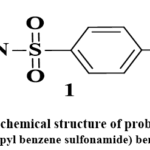 |
Figure 1 : chemical structure of probenecid /4-(N,N-Propyl benzene sulfonamide) benzoic acid Click here to View Figure |
Initially It was used to increase penicillin plasma concentration, later research it was approved as a drug substance under urisoric therapeutic category and still it is safe and effective. In recent studies of carcinogenic Nitrasomamine evaluation studies among some anti-gout drug substances Allopurinol, Febuxostat, Colchicine and Pegloticase; It was proven that Probenecid will be the more safety drug substance because it contains only one tertiary amine and it has no secondary amine to form potential Nitrasomamine impurities.
The further synthetic routes proposed by various journals and patents as mentioned in scheme-2 and scheme-3 from different key starting materials like 4-cynobenzenesulfonyl chloride 6 US260507 and Para amino benzoic acid, in this patent he used same kind of diazo Sulfonation with sulfur dioxide gas CN 1036135217, Our main invention is diazotization with thionyl chloride is achieved and novel polymorphism has developed for easy ness of formulation research with non-infringement process.
Prior Art Literature Route of Synthesis
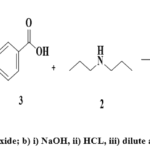 |
Scheme 1: a) Chromic trioxide; b) i) NaOH, ii) HCL, iii) dilute alcohol; Overall yield:75% Click here to View Scheme |
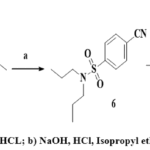 |
Scheme 2: a) Pyridine, HCL; b) NaOH, HCl, Isopropyl ether; overall yield: 50% Click here to View Scheme |
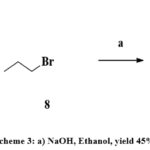 |
Scheme 3: a) NaOH, Ethanol, yield 45% Click here to View Scheme |
Proposed improved route of synthesis
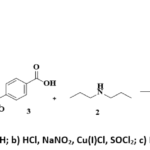 |
Scheme 4: a) Zn/ACOH; b) HCl, NaNO2, Cu(I)Cl, SOCl2; c) MDC, H2O; Yield: 90% Click here to View Scheme |
Experimental
Materials and Methods
The key starting material 4-Nitrobenzoic acid purchased from commercial source Maven laboratories, the reagents Zinc, Acetic acid, Hydrochloric acid, sodium nitrite, copper(I) chloride, thionyl chloride purchased from commercial supplier AKR chemicals, Hyderabad and N, N-dipropyl amine purchased from Ottava commercials. Lab grade chemicals sourced from AVRA synthesis Pvt Ltd, SRL LTD.
Analytical column, reagents procured from LCGC solutions, the instrument used for purity is Agilent 1260 infinite with PDA detector. PerkinElmer instrument used for IR spectrum and NMR spectra recorded on Bruker 400mhz and Mass spectra achieved on Thermo scientific QP instrument.
Experimental Procedures
Stage-I
Synthesis of 4-Amino benzoic acid (10): 800 ML glacial acetic acid was taken in a clean and dry three neck 3L round bottom flask equipped with reflux glass condenser and thermometer placed at thermo pocket at room temperature under gentle stirring with overhead mechanical stirrer. To this solution it was Added 250 gms of 4-Nitro benzoic acid (9) followed by 100 grams of Zinc dust (reducing agent) portion wise at room temperature, a slight exothermic reaction is observed during addition of reducing agent. After 30 minutes the reaction mass temperature was slowly raised to 80 deg C in a 45 minutes’ duration and maintain the reaction for 4 hours under heating till the Nitro group converted into Amine. Once thin layer chromatography complies, the reaction mass monitor on HPLC in process control to see the rate of conversation and it recorded as 98.0% conversion on chromatography. Then it subjected for work up like filtration of excess oxidized zinc dust through high flow filtration and followed by the obtained mother liquor was quenched in demineralized (DM) water (1000 ML) upon a light brown color solid was precipitated and it was filtered on 250 gm Buckner funnel and two times water wash was given to solid bed and dried on vacuum oven. The obtained dried 4-Amino benzoic acid (10) purity was 99.2% and its yield is 92.0%; 1H NMR (DMSO-D6): Mass: FTIR: Polymorph:
Stage-II
Synthesis of 4-(chlorosulfonic) benzoic acid (3): This reaction proceeds through two step synthesis, the first step involves preparation of sulfonyl chloride to introduce on to benzene ring by replacing diazo group. To prepare this solution it was taken 2L clean and Dry three neck round bottom flask one neck with thermometer pocket, 250 ML additional funnel with went and center neck was fitted with mechanical stirrer. To a cool solution of 0.75 gm of copper(II) chloride in 800 ML of de-mineralized water added 426.2 gm of thionyl chloride drop wise under gentle stirring with temperature not exceeded above 5 deg C and once addition completed the entire mass is allowed for maintenance for 8 hours under stirring. In another 3L three neck pot 100gm of 4-Amino benzoic acid was taken in a dilute hydrochloric acid (900 Ml), added (58 gms in 60 mL of water) of sodium nitrite solution drop wise under controlled stirring condition to avoid frothing formation. The reaction mass was maintained for 30minutes after addition of Nitrite solution and the resulting in-situ diazo compound (10a) solution was added to first step solution in a drop wise manner under stirring temperature below 10 deg C and the whole reaction mixture was allowed for 4 hour’s maintenance. Once thin layer chromatography passed, sample sent to in-process control by HPLC and the result of conversion more than 80% and then it was proceeded for work up by diluting the entire reaction mass with 200 Ml of Water under gentle stirring the obtained white color solid was filtered and dried under vacuum. The yield obtained is 65%. Characterization data: Bruker 400MHz 1H NMR (DMSO-D6): δ value 13.961 (S, 1H), 7.908-7.88 (d,2H), 7.682-7.702 (d,2H)
Stage-III
Synthesis of 4- (N, N-dipropylsulfamoyl) benzoic acid (1): In a 2L Clean & Dry round bottom flask added 800 Ml of methylene dichloride solvent under slow stirring condition, then slowly added 100 gm of compound (3) portion wise. After 15 minutes added 230 gms of compound (2) dropwise at room temperature with continuous stirring and allowed the reaction mixture for 4 hours, remove the sample for in-process control testing and once conversion result passed, the reaction mass allowed for workup by quench with 500ml of water. The resulting two layers was separated, the organic layer was washed with brine (50 Ml) and dried over anhydrous sodium sulfate. The obtained mass after evaporation of dried organic layer was taken into 150 Ml of n-Hexane and Isolated the Pure probenecid compound (1) with purity 99.9%, yield of 86.0%. Characterization data: Bruker 400MHz 1H NMR (DMSO-D6): δ value 13.47 (S, 1H), 8.10-8.13 (dd,2H), 7.89-7.91 (dd,2H),3.01-3.04 (t, 2H),1.39-1.49(q, 4H), 0.76-0.79(t, 6H); 13C NMR(DMSOD6):166.24,143.21,134.29,130.25,127.04,49.62,21.62,10.95; Mass: M(+):285.36, M-1: 284.2 (-Ve scan, carboxylic acid); FTIR (C-1): 1687.43(C=O),1344.66,1286.65,1155.60(O=S=O); Novel Polymorph: 2theta at 4.799 (d value 18.400 A)and 9.605 (D value 9.200 A)
Results and Discussion
The experimental study in all stages is unique because all the stages established with common raw materials, economic in costing and easier handle. In the first stage it was chosen Zinc dust for reduction instead of catalytical reagents like Raney-Nickel, Palladium on Carbon and Iron HCl to avoid cost burden, pressure reaction conditions and clumsy work up. Hence it was opted with Zinc dust and made easier the process in an economic manner.
Meerwein arylation was adopted from OPRD4 for Stage-II of the process with minute changes and it was opted with thionyl chloride and copper (II) chloride in aqueous phase reaction to avoid high temperature aromatic Sulfonation followed by chlorination with corrosive acid chlorides like Phosphorous pentachloride and trichlorides. In this research it was opted an environmental friendly reaction with safer handling process of economic route.
The final stage was developed without external base was used for coupling in a suitable organic solvent. No inorganic base was used and No external organic base was used to save the economy of the process and to reduce atom efficiency of entire Industrial process.
It was tried several bases, moles and mole ratios as feasibility study, the obtained results were not upto the mark as shown as in the table-1: by keeping methylene dichloride as constant
Table 1: Note: Solvent constant as Methylene dichloride and mole ratio is constant
| Sr. No | Base Reagent Used | Temperature in oC | % of Conversion |
|
01 |
Tri ethyl amine | 0-5 | 25 |
| 25-30 | 30 | ||
| 35-40 | 45 | ||
| 02 | Sodium carbonate | 0-5 | 2 |
| 25-30 | 15 | ||
| 35-40 | 30 | ||
| 03 | Sodium Hydroxide | 0-5 | 60 |
| 25-30 | 50 | ||
| 35-40 | 30 | ||
| 04 | N,N-Di-isopropyl amine | 0-5 | 78 |
| 25-30 | 89 | ||
| 35-40 | 86 |
Different solvents like Toluene, N, N-Dimethyl formamide, Ethyl acetate, Acetone was tried during its feasibility in the place of Methylene dichloride but no solvent was yielded well and even N, N-Dimethyl formamide given good results like Methylene dichloride it was not taken under consideration to avoid work up complications and process economy.
Eventually, after all strategic product development protocol of feasibility, optimization and validations approaches an excellent commercial Industrial manufacturing process was established by this entire research.
The Nitrasomamine risk assessment was done, it was concluded that it is free of Nitrasomamine due to its les no of amines present in the structure of Probenecid compare to its same class of drug substance Allopurinol. The final outcome of this research given us a safe and economic drug substance with free of Nitrasomamine impurities including process related.
Polymorphism
The new polymorph was achieved through this research in n-Hexane isolation after exploring all the solvents and their combinations. The polymorph validation also done and successfully commercialized. The respective pictogram details have incorporated in supplementary data.
Nitrasomamine
The possible Nitrasomamine was synthesized and characterized, the respective impurities absence was studied, confirmed by HPLC spike study on ppm level. The unknown, unpredictable impurities also been well controlled with our newly developed validated technology, which are controlled by corrective and preventive methods were adopted in the work up procedure.
Genotoxic Impurities
The possible process related genotoxic impurities were studied, and shown the absence by genotoxic evaluation study protocol.
Conclusion
Synthesis of probenecid was achieved with novel, stable polymorphic form by improving some reaction conditions and validated industrial commercial process was established with impurity profile data and their characterization with spike study. It will be the best Industrial process for commercialization of Probenecid. This active pharmaceutical ingredient is safer than Allopurinol as per as Nitrasomamine risk factor is concern.
Acknowledgement
The Author thank full to DR SVEN Laboratories Pvt Ltd for giving this opportunity to do this entire full research work and special thanks to our Director S Naga Prasanna Kumari for her entire support though out this project.
Funding Sources
DR SVEN Laboratories Pvt Ltd management Prasanna Sirugubattula has funded to this entire research
Conflict of Interest
The author(s) do not have any conflict of interest.
Data Availability Statement
This statement does not apply to this article.
Ethics Statement
This research did not involve human participants, animal subjects, or any material that requires ethical approval.
References
- Dayton P.G. and Perel J.M., The metabolism of probenecid in man, Ann. N.Y. Acad. Sci. 1971, 179: 399; org/10.1111/j.1749-6632.1971.tb46916.x
CrossRef - Perel, J.M., Dayton, P.G., Yü, T.F. et al. Studies of the renal excretion of probenecid acyl glucuronide in man. Eur J Clin Pharmacol 1971, 3, 106–112. org/10.1007/BF00619303
CrossRef - Conway W.D. and Srikumaran M. – J. Pharm. Sci. lo: Dayton P.G., Perel J. M., Cunningham R.F., Israili S.H. and Weiner I.M. – Drug Metab. Dispos. 1: 399, 1971 1551; 1974, 742 1973
CrossRef - Philip J. Hogan* and Brian G. Cox AstraZeneca PR&D, Aqueous Process Chemistry: The Preparation of Aryl Sulfonyl Chlorides Organic Process Research & Development 2009, 13, 875–879; org/10.1021/op9000862
CrossRef - Robert l. Ellsworth etal: “Synthesis of p-(di-n-propylsulfamylbenzoic-1-(ring)-14C acid and p-(di-n-propylsulfamyl)benzoic-acid-14C(probenecid-14C)”, journal of labelled compounds and radiopharmaceuticals, vol. 15, 31st October, 1978
CrossRef - Miller, and assigned to Sharp & Dohme, US 260507 (1952)
- Chi Jindong, Yue Tao, Water-phase synthetic method of probenecid, CN 103613521A (2013)
- Fang B. Synthesis and antimicrobial l activity of the hybrid molecules between amoxicillin and derivatives of benzoic acid. Drug Dev Res. 2020;1–9. https://doi.org/10.1002/ddr.21739
CrossRef
Accepted on: 27 Jun 2026
Second Review by: Dr. Vikram Pathak
Final Approval by: Dr. Fozia Z. Haque


ISSN Online: 2231-5039