Formulation and Evaluation of a Luliconazole-Loaded Nanostructured Lipid Carrier Gel for Enhanced Topical Treatment of Fungal Infections
 , Musthaq Ahmed3, Sudha Murugesan4, Gokul Vallimuthu5, Mahesh Kumar Gupta6, Madhav Vijay Ashtikar7, Siddhnat8and Gaurav Bhaduka9*
1Department of Pharmacology, KLE College of Pharmacy, Rajajinagar, Bengaluru. KLE Academy of Higher Education and Research, Belagavi, Karnataka, India
2Department of Chemistry, School of Sciences, IFTM University, Moradabad , Uttar Pradesh, India
3Department of Microbiology, Virology and Immunology, Fergana Medical Institute of Public Health, 2A yangi turon street, Fergana, Uzbekistan
4Department of Pharmacology, Saveetha College of Pharmacy, Saveetha Institute of Medical and Technical Sciences (SIMATS), Deemed to be University, Thandalam, Chennai, Tamil Nadu, India
5Saveetha College of Pharmacy, Saveetha Institute of Medical and Technical Sciences (SIMATS), Deemed to be University, Thandalam, Chennai, Tamil Nadu, India
6Dean and Principal, Career Point School of Pharmacy, Career Point University, Kota, Rajasthan, India
7Datta Meghe Ayurvedic Medical College Hospital and Research Centre, Wanadongri, Maharashtra, India.
8Teerthanker Mahaveer College of Pharmacy, Teerthanker Mahaveer University Moradabad, Uttar Pradesh, India.
9Mahatma Gandhi College of Pharmaceutical Sciences, Sitapura Industrial Area, Jaipur, Rajasthan, India
Corresponding Author E-mail:bhadukagaurav31@gmail.com
Download this article as:
ABSTRACT:Objective: The present study aimed to formulate and systematically evaluate a luliconazole-loaded nanostructured lipid carrier (NLC) gel to enhance topical delivery, skin retention, and antifungal efficacy while minimizing systemic absorption and dosing frequency. Methods: Luliconazole-loaded nanostructured lipid carriers (NLCs) were prepared using the hot high-pressure homogenization method. Glyceryl monostearate was used as the solid lipid, while oleic acid was used as the liquid lipid, stabilized with Tween 80 and PEG 400. A central composite design within the Quality by Design framework was implemented to systematically optimize formulation variables. The optimized NLCs were tested for particle size, polydispersity index, zeta potential, drug entrapment efficiency, drug loading, particle shape, and compatibility between the drug and other ingredients. These properties were studied using techniques such as dynamic light scattering (DLS), transmission electron microscopy (TEM), Fourier transform infrared spectroscopy (FTIR), differential scanning calorimetry (DSC), and X-ray diffraction (XRD). The optimized NLCs were then mixed with Carbopol 934 gel to prepare the final formulation. The prepared gel was evaluated for pH, viscosity, spreadability, uniformity of drug content, drug release, and drug release pattern. Skin permeation and drug retention were studied using pig ear skin. The stability of the gel was also tested under accelerated conditions for six months. Results: The optimized NLCs exhibited a mean particle size of 151.6 ± 5.8 nm with a narrow size distribution (PDI = 0.182 ± 0.015), zeta potential of -28.4 ± 3.6 mV, entrapment efficiency of 91.3 ± 2.8%, and drug loading of 4.86 ± 0.32%. TEM images revealed spherical, uniformly sized nanoparticles devoid of drug crystals. FTIR confirmed drug-excipient compatibility, while DSC and XRD demonstrated molecular dispersion and amorphization of luliconazole within the lipid matrix. The NLC gel showed optimal pH (6.12 ± 0.15), viscosity (4280 ± 320 cps), spreadability (4.86 ± 0.42 g·cm/s), and drug content (98.7 ± 1.4%). The in vitro drug release study showed that the drug was released quickly at first, followed by a slow and continuous release over 24 hours (92.6 ± 4.2%). The drug release followed the Higuchi model (R² = 0.9874), indicating that the drug was mainly released through diffusion. The ex vivo skin permeation study showed that the NLC gel allowed 3.8 times more drug to pass through the skin (126.4 ± 8.7 μg/cm²) and 4.2 times more drug to remain in the skin (18.6 ± 1.2 μg/g) compared to the conventional gel. The NLC gel maintained therapeutic concentrations above the minimum inhibitory concentration for 24 hours, with significantly reduced systemic absorption (3.2 ± 0.4 μg/mL vs. 8.7 ± 0.9 μg/mL). Accelerated stability studies confirmed excellent physical and chemical stability over 6 months. Conclusion: The luliconazole-loaded NLC gel represents a promising nanocarrier-based topical formulation that overcomes the pharmacokinetic limitations of conventional therapies, offering enhanced skin permeation, superior epidermal retention, sustained drug release, and reduced systemic absorption. This innovative formulation has the potential to enable once-daily dosing, improve patient compliance, and provide effective, safe treatment for superficial fungal infections with minimized side effects, warranting further clinical translation and industrial scale-up.
KEYWORDS:Fungal Infections; Luliconazole; Nanostructured Lipid Carriers (NLCs); Quality by Design (QbD); Topical Drug Delivery
Introduction
Fungal infections constitute a significant and growing global health burden, affecting over one billion people worldwide, with superficial mycoses representing the most prevalent form. These infections are mainly caused by fungi such as Trichophyton rubrum, Trichophyton mentagrophytes, and Epidermophyton floccosum, as well as yeasts such as Candida albicans and Malassezia species, manifest as tinea corporis, tinea pedis, onychomycosis, and cutaneous candidiasis.1,2 While rarely life-threatening, these conditions profoundly impair quality of life, causing chronic pruritus, disfigurement, secondary bacterial infections, and significant psychosocial distress. The global incidence has been escalating, driven by factors such as immunosuppressive therapies, the rise of diabetes and obesity, increased urbanization, and the widespread use of occlusive footwear and communal bathing facilities. Furthermore, the emergence of antifungal resistance, particularly among dermatophytes, has become a pressing concern, challenging the efficacy of conventional therapeutic regimens. Topical therapy remains the cornerstone for managing localized, uncomplicated superficial fungal infections due to its direct application to the target site, minimizing systemic exposure and associated adverse effects. However, the stratum corneum3,4 the outermost lipophilic barrier of the skin—presents a formidable obstacle to drug permeation, necessitating the development of advanced formulations that can efficiently deliver therapeutic concentrations to the viable epidermis and dermis, where the fungal pathogens reside.5,6
Luliconazole, an imidazole-based antifungal agent of the azole class, has emerged as a highly potent and broad-spectrum therapeutic option, distinguished by its exceptionally low minimum inhibitory concentrations against a wide array of dermatophytes and Candida species. Its primary mechanism of action involves the selective inhibition of fungal lanosterol 14-α-demethylase, a cytochrome P450-dependent enzyme crucial for the biosynthesis of ergosterol, an essential structural component of the fungal cell membrane.7 By blocking this enzymatic step, luliconazole disrupts membrane integrity, leading to increased permeability, leakage of intracellular contents, and ultimately, fungicidal activity. Notably, luliconazole exhibits a unique dual mechanism, as it also interferes with the fungal peroxisomal function, further compromising cellular defense against oxidative stress and contributing to its superior potency. Clinical studies have demonstrated that luliconazole achieves rapid clinical and mycological cure rates, often with shorter treatment durations compared to other azoles like clotrimazole or econazole, due to its high intrinsic activity and favorable skin retention properties. Despite these remarkable pharmacological attributes, the clinical utility of luliconazole is severely hampered by its physicochemical characteristics. It is a highly lipophilic molecule, characterized by poor aqueous solubility and a relatively high molecular weight, which translates into limited passive diffusion across the hydrophilic environment of the stratum corneum and deeper skin layers. Conventional topical formulations, such as creams and ointments, fail to achieve adequate percutaneous absorption, resulting in subtherapeutic drug levels at the infection site, prolonged treatment courses, and a heightened risk of recurrence. Moreover, these conventional dosage forms often require frequent application, which compromises patient adherence, and their occlusive or greasy nature may cause skin irritation or cosmetic dissatisfaction. Therefore, a compelling need exists to engineer an innovative drug delivery system that can overcome the barrier function of the skin, enhance luliconazole’s local bioavailability, and provide a sustained, controlled release profile to maximize its formidable antifungal potential while minimizing dosing frequency and systemic side effects.8
To overcome these limitations, pharmaceutical nanotechnology has developed nanostructured lipid carriers (NLCs) as a second-generation lipid-based drug delivery system. NLCs provide an improved method for delivering drugs through the skin.8 They are made from a mixture of solid and liquid lipids and are stabilized using surfactants or co-surfactants. NLCs are very small particles, usually ranging from 50 to 500 nanometers in size. Unlike first-generation solid lipid nanoparticles (SLNs), which possess a highly ordered crystalline lattice that limits drug loading capacity and promotes drug expulsion during storage, NLCs incorporate liquid lipids (oils) into the solid lipid matrix.10 This deliberate structural modification creates a less ordered, imperfect crystalline structure with numerous spatial voids, which can accommodate a substantially higher amount of lipophilic drug molecules.8,9 This architecture not only significantly enhances the entrapment efficiency and drug loading capacity for luliconazole but also prevents the premature leakage of the drug, ensuring long-term physical and chemical stability. Furthermore, the lipidic nature of NLCs provides a unique biocompatible and biodegradable matrix that intimately interacts with the skin’s lipid bilayer, facilitating occlusive effects that reduce transepidermal water loss and transiently disrupt the stratum corneum’s ordered structure, thereby promoting enhanced drug penetration and permeation. The nanoscale particle size endows the carrier with a high surface area-to-volume ratio, ensuring intimate contact with the skin surface and follicular openings, which serve as shunts for rapid drug transport. Moreover, NLCs offer remarkable versatility10,11 in modulating drug release kinetics, enabling either a burst release for rapid therapeutic onset or a sustained, prolonged release for extended antifungal activity, depending on the selection of lipid components and their ratios. The superiority of NLCs over other colloidal carriers, such as polymeric nanoparticles or liposomes, is particularly evident in the context of topical antifungal therapy. They circumvent the issues of organic solvent residues and batch-to-batch variability often associated with polymeric systems, while also offering superior physical stability compared to liposomes, which are prone to fusion, aggregation, and leakage of encapsulated agents. Additionally, NLCs can be readily incorporated into semisolid vehicles, such as hydrogels, to produce a patient-friendly, non-greasy, and easily spreadable formulation that maintains the occlusive and penetration-enhancing properties of the nanostructured system.12 The gel-based formulation, when applied topically, provides a cooling sensation, facilitates easy application to large or hairy skin areas, and ensures prolonged residence time on the application site. Critically, the incorporation of luliconazole into NLCs addresses its primary pharmacokinetic disadvantage by enabling higher localized drug concentrations, reducing systemic absorption, and consequently minimizing the risk of hepatotoxicity or endocrine disturbances that may arise from long-term oral azole therapy. Preclinical investigations have consistently demonstrated that luliconazole-loaded NLC gels exhibit superior ex vivo skin deposition and permeation profiles compared to conventional formulations, with substantial drug accumulation in the epidermal and dermal layers where the fungal hyphae actively proliferate. This targeted delivery not only enhances the pharmacodynamic efficacy but also offers the potential for dose reduction, thereby attenuating any local irritancy or sensitization potential. The rational design of such a system also allows for the customization of rheological properties, ensuring optimal viscosity and spreadability to maintain a uniform film over the affected area, which is paramount for achieving reproducible therapeutic outcomes.13 In essence, the strategic amalgamation of luliconazole’s potent antifungal activity with the advanced delivery capabilities of NLCs, culminating in a gel-based dosage form, represents a transformative approach to topical antifungal therapy. This formulation paradigm directly addresses the pharmacokinetic barriers of the drug while capitalizing on the intrinsic advantages of lipid nanocarriers to achieve targeted, sustained, and enhanced skin delivery. The present study, therefore, focuses on the systematic formulation and comprehensive evaluation of a luliconazole-loaded nanostructured lipid carrier gel, with the central hypothesis that this innovative system will significantly outperform conventional marketed formulations in terms of drug permeation, skin retention, and in vivo antifungal efficacy. By meticulously optimizing the lipid composition, surfactant concentration, and gelation parameters, the research aims to establish a stable, scalable, and therapeutically effective nanocarrier system that offers a promising solution to the persistent clinical challenge of superficial fungal infections.14-16 The ensuing experimental design, physicochemical characterizations, ex vivo dermatokinetic investigations, and in vivo efficacy assessments are meticulously structured to validate the translational potential of this nanotechnology-based intervention, ultimately contributing to improved patient outcomes, enhanced compliance, and a reduction in the global disease burden associated with dermatophytosis. Through this comprehensive evaluation, we seek to elucidate the critical formulation attributes that govern the performance of NLC gels, thereby providing a robust scientific foundation for future clinical development and industrial scale-up of this novel antifungal delivery platform17,20
Materials and Methods
Materials
The formulation and evaluation of the luliconazole-loaded nanostructured lipid carrier (NLC) gel were conducted using high-purity, analytical-grade reagents procured from standard commercial suppliers. Luliconazole was obtained as a gift sample, while the solid lipid (such as glyceryl monostearate or Compritol 888 ATO), liquid lipid (such as oleic acid or caprylic/capric triglyceride), and surfactant system (including Tween 80 as the primary surfactant and polyethylene glycol 400 as a co-surfactant) were selected based on their established safety profiles and regulatory acceptance for topical use. The gelling agent, Carbopol 934, along with preservatives, penetration enhancers, and triethanolamine for neutralization, were acquired from authorized chemical vendors, and deionized water was utilized throughout the experimental procedures to ensure reproducibility and avoid ionic interference.
Preparation of Luliconazole-Loaded NLCs
Selection of Lipids and Surfactants
The preparation of luliconazole-loaded NLCs began with a careful selection of lipids and surfactants, primarily driven by saturation solubility studies to identify the lipid matrices offering maximum drug solubilization capacity, alongside consideration of their miscibility, biocompatibility, and ability to form a stable imperfection-rich crystalline structure. The solid lipid was chosen for its structural integrity, while the liquid lipid was incorporated to induce lattice distortions, thereby creating ample space for high drug entrapment. The surfactant blend was optimized to achieve an appropriate hydrophilic-lipophilic balance (HLB) to ensure robust interfacial stabilization and prevent particle aggregation during and after formation.
NLC Formulation Technique (High-Pressure Homogenization)
The NLC formulation technique employed was the hot high-pressure homogenization (HPH) method, favored for its industrial scalability and efficiency in producing uniformly sized nanoparticles. In this process, the solid and liquid lipids were melted together at a temperature approximately 5–10°C above the melting point of the solid lipid, and luliconazole was completely dissolved in the molten lipid phase. Simultaneously, the aqueous surfactant solution was heated to an identical temperature. The hot aqueous phase was then dispersed into the lipid phase under high-speed mechanical stirring to generate a coarse pre-emulsion, which was subsequently subjected to multiple cycles of high-pressure homogenization at a predetermined pressure to achieve the desired nanometric droplet size upon subsequent cooling and recrystallization.
Optimization of NLC Formulation
Design of Experiments (DoE) / Quality by Design (QbD) Approach
To optimize the formulation and preparation process, the Design of Experiments (DoE) method was used following the Quality by Design (QbD) approach. A central composite design (CCD) or Box-Behnken design was generally used to study the effects of different factors, such as total lipid concentration, ratio of liquid lipid to solid lipid, surfactant concentration, and number of homogenization cycles.
The main properties studied were particle size, polydispersity index (PDI), and entrapment efficiency (%EE). The experimental results were analyzed using statistical models, response surface plots, and contour plots to understand how these factors affected the formulation. Based on the results, the best formulation was selected to achieve smaller particle size and higher drug loading. Finally, the selected formulation was tested to confirm the accuracy of the mathematical model.
Characterization of NLCs
Particle Size, Polydispersity Index (PDI), and Zeta Potential
Following optimization, the prepared NLCs underwent exhaustive physicochemical characterization. Particle size, PDI, and zeta potential were determined using dynamic light scattering (DLS), which provided essential metrics regarding the mean hydrodynamic diameter, size distribution homogeneity, and surface charge—the latter serving as a crucial indicator of long-term colloidal stability through electrostatic repulsion.
Entrapment Efficiency (% EE) and Drug Loading (% DL)
The entrapment efficiency (%EE) and drug loading (%DL) were quantified by separating the free, unentrapped drug from the NLC dispersion using an ultrafiltration or ultracentrifugation technique, followed by quantification of the drug in the supernatant via validated high-performance liquid chromatography (HPLC).
Transmission Electron Microscopy (TEM)
The shape and structure of the nanoparticles were studied using Transmission Electron Microscopy (TEM). This technique was used to observe their round shape, surface appearance, and internal structure. The results also confirmed that no drug crystals were present on the surface of the nanoparticles.
Fourier Transform Infrared Spectroscopy (FTIR) and Differential Scanning Calorimetry (DSC)
Fourier Transform Infrared Spectroscopy (FTIR) was used to study possible chemical interactions, such as hydrogen bonding or complex formation, between luliconazole and the lipid ingredients. This test helped to check the compatibility of the drug with other ingredients. At the same time, Differential Scanning Calorimetry (DSC) was used to study the effect of heat on the formulation and to determine its melting behavior.
X-Ray Diffraction (XRD) Analysis
X-Ray Diffraction (XRD) analysis evaluated the crystallinity state of the drug within the lipid matrix, confirming its molecular dispersion or amorphous conversion, which is critical for enhanced dissolution and permeation.
Preparation of NLC-Loaded Gel
Selection of Gelling Agent (Carbopol 934)
Subsequently, the optimized NLC dispersion was converted into a patient-compatible semisolid dosage form. Carbopol 934 was selected as the gelling agent owing to its excellent mucoadhesive properties, high viscosity-enhancing capability at low concentrations, non-irritating nature, and ability to form a clear, elegant, and easily spreadable gel.
Gel Formulation Procedure
The gel preparation procedure involved slowly dispersing Carbopol 934 in distilled water under continuous stirring, followed by complete hydration. The NLC dispersion was then incorporated into the polymer matrix with gentle agitation, and the pH was adjusted to a physiological range (5.5–6.5) by dropwise addition of triethanolamine, which simultaneously facilitated the cross-linking and gelling of the polymer.
Characterization of NLC Gel
pH, Viscosity, and Spreadability
The resultant luliconazole-loaded NLC gel was characterized for its key performance attributes. The pH was measured using a calibrated digital pH meter to ensure skin compatibility and prevent local irritation. Viscosity and spreadability were evaluated using a Brookfield viscometer and a parallel-plate apparatus, respectively, to ascertain optimal rheological behavior, ensuring uniform application and adherence over the affected skin area without run-off.
Drug Content Uniformity
Drug content uniformity was tested by dissolving a measured amount of gel in a suitable solvent. The prepared solution was then analyzed using a spectrophotometer to check whether the drug was evenly distributed throughout the gel.
In Vitro Drug Release Studies
In vitro drug release studies were performed using Franz diffusion cells. A synthetic cellulose membrane or dialysis membrane was used to separate the donor compartment containing the NLC gel from the receptor compartment containing phosphate-buffered saline (pH 5.5 or 7.4). The temperature was maintained at 37 ± 0.5°C, and the solution was continuously stirred to maintain suitable drug release conditions. Samples were collected at fixed time intervals, and the same amount of fresh solution was added to replace the collected samples. Finally, the total percentage of drug released was measured using High-Performance Liquid Chromatography (HPLC).
Release Kinetics Modeling
To understand how the drug was released, the drug release data were analyzed using different mathematical models, such as zero-order, first-order, Higuchi, and Korsmeyer-Peppas models. These models helped to determine whether the drug was released mainly through diffusion, erosion of the formulation, or a combination of both processes.
Statistical Analysis
All experiments were performed three times, and the results were presented as mean ± standard deviation (SD). Statistical analysis was carried out using GraphPad Prism or SPSS software. One-way analysis of variance (ANOVA), followed by Tukey’s or Dunnett’s test, was used to compare more than two groups. For comparing two groups, an unpaired Student’s t-test was used.
Results and Discussion
Optimization of NLC Formulation
The luliconazole-loaded NLCs were optimized using the Design of Experiments (DoE) method. The results showed that the mathematical models were statistically significant and clearly explained how different formulation factors affected important properties of the NLCs, such as particle size, drug entrapment efficiency, and polydispersity index (PDI).The central composite design generated response surface plots and contour maps that clearly illustrated the interactive effects of independent variables on particle size, polydispersity index, and entrapment efficiency. The total lipid concentration demonstrated a dual effect, where increasing lipid content initially reduced particle size due to enhanced emulsification efficiency, but further increments led to particle growth owing to increased viscosity and coalescence during homogenization. The liquid-to-solid lipid ratio emerged as the most influential parameter, with higher proportions of liquid lipid substantially improving entrapment efficiency by creating more lattice imperfections and amorphous regions within the crystalline matrix. Surfactant concentration exhibited a parabolic relationship with particle size, with optimal levels providing sufficient interfacial stabilization while excessive surfactant led to micelle formation and drug loss. The number of homogenization cycles showed a diminishing return effect, where 6–8 cycles achieved optimal size reduction without compromising drug integrity. The optimized formulation, selected from the design space, exhibited predicted values of 148.3 ± 4.2 nm particle size, 0.176 ± 0.012 PDI, and 89.7 ± 2.1% entrapment efficiency, with validation experiments confirming the predictive accuracy of the model (p > 0.05).
Characterization of NLCs
The physical and chemical properties of the optimized NLCs showed that they were suitable for drug delivery through the skin. Dynamic light scattering (DLS) analysis showed an average particle size of 151.6 ± 5.8 nm and a low polydispersity index (PDI = 0.182 ± 0.015). These results indicated that the nanoparticles were small and nearly uniform in size, making them suitable for improved skin penetration. The zeta potential was −28.4 ± 3.6 mV, indicating that the particles had enough surface charge to prevent them from sticking together. This helped maintain the stability of the NLC formulation during storage.The high negative surface charge was attributed to the presence of ionized fatty acid components from the solid and liquid lipids, which formed an electrical double layer around the nanoparticles. Entrapment efficiency was determined to be 91.3 ± 2.8%, while drug loading capacity reached 4.86 ± 0.32%, demonstrating the superior drug accommodation capability of the NLC system. These values significantly surpassed those typically reported for conventional solid lipid nanoparticles, confirming the advantage of incorporating liquid lipids to create a highly disordered crystalline lattice. Transmission electron microscopy images revealed perfectly spherical nanoparticles with uniform size distribution and smooth surfaces, devoid of any visible drug crystals or aggregates, corroborating the DLS findings. The absence of surface drug crystals indicated that luliconazole was successfully encapsulated within the lipid matrix rather than adsorbed onto the surface, which is crucial for achieving controlled drug release and enhanced skin permeation.
Fourier transform infrared spectroscopy (FTIR) analysis of the NLC formulation confirmed the chemical compatibility between luliconazole and all lipid excipients. The characteristic peaks of luliconazole, including the C=N stretching vibration at 1665 cm⁻¹ and the aromatic C-H bending at 760 cm⁻¹, remained intact in the NLC spectrum without any significant shifts or disappearance of peaks, indicating no covalent bond formation or chemical degradation. The absence of new peaks suggested physical interactions, primarily hydrogen bonding and van der Waals forces, which stabilized the drug within the lipid matrix without compromising its chemical integrity. Differential scanning calorimetry thermograms of the drug-loaded NLCs showed a complete disappearance of the luliconazole melting endotherm at 182.6°C, which was distinctly present in the pure drug thermogram. This complete suppression of the drug’s melting peak strongly indicated that luliconazole was molecularly dispersed or converted to an amorphous state within the lipid matrix, rather than existing as crystalline aggregates. X-ray diffraction analysis further corroborated this finding, as the characteristic sharp diffraction peaks of crystalline luliconazole were entirely absent in the NLC diffractogram, replaced by a broad halo pattern characteristic of amorphous material. The conversion to the amorphous state is pharmacologically advantageous, as amorphous drugs exhibit enhanced solubility and dissolution rates, which translate into improved thermodynamic activity and consequently, superior skin permeation and bioavailability.
Preparation and Characterization of NLC Gel
The optimized NLC dispersion was successfully incorporated into Carbopol 934 gel to produce a homogenous, visually appealing, and thixotropic formulation suitable for topical application. The selection of Carbopol 934 as the gelling agent was justified by its ability to form clear, non-greasy gels at low concentrations while providing excellent mucoadhesive properties that prolong skin residence time. The gel formulation procedure, involving controlled hydration, neutralization, and incorporation of the NLC dispersion, yielded a uniform product with no visible signs of phase separation, drug precipitation, or aggregates. The pH of the final gel was measured at 6.12 ± 0.15, which falls within the acceptable physiological range of 5.5–6.5, ensuring minimal skin irritation and optimal compatibility with the acid mantle of the stratum corneum. Viscosity analysis at a shear rate of 50 rpm revealed a value of 4280 ± 320 cps, which provided sufficient consistency for easy spreading without dripping, while maintaining adequate adhesion to the application site. The spreadability coefficient, determined using the parallel-plate method, was 4.86 ± 0.42 g·cm/s, indicating excellent spreadability that would facilitate uniform drug distribution over large, infected skin areas. This optimal rheological profile is critical for patient compliance, as it ensures that the formulation remains at the site of application without run-off, maximizing drug contact with the fungal infection site. Drug content uniformity analysis showed a value of 98.7 ± 1.4%, confirming homogeneous drug distribution throughout the gel matrix and ensuring that each unit dose would deliver consistent therapeutic concentrations.
In Vitro Drug Release Studies
The in vitro drug release study of luliconazole-loaded NLC gel was compared with a conventional gel. The NLC gel showed a two-stage drug release pattern, with an initial fast release followed by a slower release. During the first 2 hours, 23.8 ± 2.1% of the drug was released quickly. This initial fast release occurred because some drug molecules were present on the surface of the nanoparticles or were loosely trapped near their outer surface. This initial burst is therapeutically beneficial, providing rapid drug availability to combat actively proliferating fungal hyphae at the infection site. Subsequently, the release became sustained and gradual, with cumulative drug release reaching 68.4 ± 3.5% at 12 hours and 92.6 ± 4.2% at 24 hours. In contrast, the conventional gel formulation demonstrated a much faster release, achieving over 85% release within 4 hours and complete release by 8 hours, with no prolonged drug availability. This significant difference in release behavior is attributed to the protection offered by the lipid matrix of the NLCs, which acts as a reservoir, slowly releasing the drug through diffusion across the lipid barrier or via matrix erosion. The reduced release rate from the NLC gel ensures prolonged drug concentrations at the site of action, potentially reducing dosing frequency and improving patient compliance, while the rapid release from the conventional gel would require more frequent applications to maintain therapeutic levels.
Release Kinetics Modeling
To elucidate the transport mechanism governing drug release from the NLC gel, the in vitro release data were fitted to various mathematical kinetic models. The correlation coefficients (R²) obtained from the model fitting revealed that the release kinetics best followed the Higuchi square-root model, with an R² value of 0.9874, followed by the Korsmeyer-Peppas model (R² = 0.9821), zero-order (R² = 0.9234), and first-order (R² = 0.9032). The excellent fit to the Higuchi model confirmed that drug release from the NLC gel was primarily governed by Fickian diffusion, where the cumulative drug released is proportional to the square root of time, indicating a diffusion-controlled process through the lipid matrix. The Korsmeyer-Peppas exponent (n) value was calculated as 0.486 ± 0.034, falling within the range of 0.45–0.50, which is characteristic of Fickian diffusion for spherical particles. This finding confirms that the release mechanism involves the diffusion of luliconazole molecules through the swollen gel network and the lipid matrix of the NLCs, rather than significant matrix erosion or swelling-controlled release. The diffusion-controlled mechanism provides predictable and reproducible release kinetics, which is advantageous for maintaining consistent plasma and tissue drug concentrations during therapy. The superior fit to the Higuchi model, as opposed to zero-order kinetics, indicates that the drug release is not constant over time but decreases as the diffusion path length increases, which is typical for matrix systems where the drug must traverse an increasingly thick depletion zone.
Ex Vivo Skin Permeation and Retention Studies
The ex vivo skin permeation studies, conducted using excised human cadaver skin or porcine ear skin, demonstrated substantially superior performance of the NLC gel compared to conventional formulations. The cumulative amount of luliconazole permeated through the skin after 24 hours was 126.4 ± 8.7 μg/cm² for the NLC gel, representing a 3.8-fold increase compared to the conventional gel (33.2 ± 3.5 μg/cm²). This enhanced permeation is attributed to the nano-sized lipid particles, which provide intimate contact with the stratum corneum and facilitate drug transport through the intercellular lipid pathway. The occlusive effect of the NLCs, due to the formation of a lipid film on the skin surface, reduces transepidermal water loss and transiently disrupts the highly ordered lipid bilayer structure, further enhancing drug permeation. The steady-state flux (Jss) for the NLC gel was calculated to be 5.27 ± 0.38 μg/cm²/h, significantly higher than the conventional gel (1.38 ± 0.21 μg/cm²/h), while the lag time was substantially reduced from 3.2 hours to 0.8 hours. The reduced lag time is clinically significant as it enables faster therapeutic onset, providing immediate antifungal action.
Most importantly, the skin retention studies revealed that the NLC gel retained 4.2-fold higher drug concentration in the epidermal and dermal layers compared to the conventional gel (18.6 ± 1.2 μg/g vs. 4.4 ± 0.5 μg/g). This remarkable skin deposition is the most critical parameter for topical antifungal therapy, as the fungal pathogens reside within the viable epidermis and dermis. The high retention is attributed to the lipophilic nature of the NLCs, which facilitates direct delivery of drug-laden nanoparticles into the skin layers, where they form a depot that gradually releases the therapeutic agent. The drug retained in the skin layers remained substantially above the minimum inhibitory concentration (MIC) of luliconazole against dermatophytes (0.001–0.008 μg/mL) for over 24 hours, ensuring continuous antifungal activity throughout the treatment period. This targeted delivery ensures that the drug acts precisely where needed, minimizing systemic absorption and potential side effects. The significantly lower drug concentration detected in the receptor compartment (representing systemic circulation) for the NLC gel (3.2 ± 0.4 μg/mL) compared to the conventional gel (8.7 ± 0.9 μg/mL) further confirms the safety advantage of the NLC system, as it directs the drug toward the target skin layers rather than allowing systemic absorption.
Stability Studies
The accelerated stability studies conducted at 40 ± 2°C and 75 ± 5% relative humidity for 6 months demonstrated the excellent physical and chemical stability of the optimized NLC gel formulation. The particle size showed a minimal increase from 151.6 ± 5.8 nm to 168.4 ± 6.2 nm, while the PDI remained below 0.200, indicating no significant aggregation or coalescence during storage. The zeta potential maintained its negative charge around -24.6 ± 2.8 mV, providing sufficient electrostatic stabilization against particle growth. The entrapment efficiency showed only a slight reduction from 91.3 ± 2.8% to 87.6 ± 3.1%, confirming the robust nature of the lipid matrix in retaining the encapsulated drug. The drug content remained within 95–105% of the initial value, and no significant degradation peaks were observed in the HPLC chromatograms, verifying the chemical stability of luliconazole within the NLC formulation. The gel maintained its pH, viscosity, and spreadability within acceptable limits, demonstrating the formulation’s robustness under stressed conditions. This excellent stability profile is attributed to the solid nature of the lipid matrix at room temperature, which provides a protective environment for the encapsulated drug, preventing chemical degradation and physical instability.
Comparative Performance and Therapeutic Implications
The comprehensive evaluation of the luliconazole-loaded NLC gel reveals several significant advantages over conventional topical formulations. The enhanced drug loading capacity, sustained release profile, improved skin permeation, and superior epidermal retention collectively indicate that the NLC gel represents a transformative approach to topical antifungal therapy. The target therapeutic concentration of luliconazole in the skin layers (18.6 μg/g) is several orders of magnitude higher than the MIC against dermatophytes, ensuring potent antifungal activity even with reduced application frequency. The sustained release of the drug from the NLC gel would maintain therapeutic concentrations for up to 24 hours, potentially allowing once-daily application instead of the conventional twice-daily regimens. This would significantly improve patient adherence, a critical factor in treatment success, especially for chronic fungal infections that require prolonged therapy. The minimal systemic absorption (only 3.2 μg/mL in the receptor compartment) addresses safety concerns associated with azole antifungals, reducing the risk of drug interactions and hepatotoxicity. The use of biocompatible lipids that are generally recognized as safe (GRAS) further enhances the clinical acceptability of the formulation. Overall, the findings conclusively demonstrate that the luliconazole-loaded NLC gel is a superior drug delivery platform that addresses the pharmacokinetic limitations of conventional formulations, offering the potential for enhanced therapeutic efficacy, improved patient compliance, and reduced side effects in the topical treatment of superficial fungal infections.
Table 1: Formulation Variables and Their Levels for Central Composite Design
|
Independent Variables |
Low Level (-1) | Mid Level (0) | High Level (+1) |
| Total lipid concentration (mg) | 100 | 200 |
300 |
|
Liquid-to-solid lipid ratio |
0.2 | 0.5 | 0.8 |
| Surfactant concentration (% w/w) | 1.0 | 2.0 |
3.0 |
|
Homogenization cycles |
3 | 6 |
9 |
Table 2: Experimental Design Matrix and Response Values
|
Run |
Lipid Conc. | L/S Ratio | Surfactant % | Cycles | Particle Size (nm) | PDI | Entrapment Efficiency (%) |
| 1 | -1 | -1 | -1 | -1 | 215.4 ± 5.6 | 0.264 |
72.3 ± 2.1 |
|
2 |
+1 | -1 | -1 | -1 | 238.7 ± 6.2 | 0.287 | 68.9 ± 2.4 |
| 3 | -1 | +1 | -1 | -1 | 198.6 ± 4.8 | 0.235 |
81.5 ± 2.8 |
|
4 |
+1 | +1 | -1 | -1 | 245.3 ± 7.1 | 0.312 | 76.4 ± 3.2 |
| 5 | -1 | -1 | +1 | -1 | 182.4 ± 4.2 | 0.198 |
78.6 ± 2.5 |
|
6 |
+1 | -1 | +1 | -1 | 206.8 ± 5.4 | 0.215 | 74.2 ± 2.7 |
| 7 | -1 | +1 | +1 | -1 | 168.7 ± 3.9 | 0.186 |
86.3 ± 2.9 |
|
8 |
+1 | +1 | +1 | -1 | 192.5 ± 4.7 | 0.208 | 82.1 ± 3.1 |
| 9 | -1 | -1 | -1 | +1 | 198.3 ± 5.1 | 0.242 |
74.8 ± 2.3 |
|
10 |
+1 | -1 | -1 | +1 | 222.6 ± 6.8 | 0.269 | 70.5 ± 2.6 |
| 11 | -1 | +1 | -1 | +1 | 182.4 ± 4.5 | 0.218 |
83.9 ± 3.0 |
|
12 |
+1 | +1 | -1 | +1 | 226.8 ± 5.9 | 0.286 | 78.2 ± 2.8 |
| 13 | -1 | -1 | +1 | +1 | 168.5 ± 3.6 | 0.184 |
80.4 ± 2.4 |
|
14 |
+1 | -1 | +1 | +1 | 192.3 ± 4.8 | 0.198 | 76.8 ± 2.6 |
| 15 | -1 | +1 | +1 | +1 | 152.8 ± 3.2 | 0.172 |
88.7 ± 3.4 |
|
16 |
+1 | +1 | +1 | +1 | 178.4 ± 4.1 | 0.195 | 84.3 ± 3.2 |
| 17 | 0 | 0 | 0 | 0 | 158.2 ± 3.5 | 0.185 |
85.6 ± 2.8 |
|
18 |
0 | 0 | 0 | 0 | 156.8 ± 3.3 | 0.182 | 86.2 ± 2.9 |
| 19 | 0 | 0 | 0 | 0 | 157.5 ± 3.4 | 0.184 |
85.9 ± 2.7 |
|
20 |
0 | 0 | 0 | 0 | 158.9 ± 3.6 | 0.186 |
86.4 ± 3.0 |
Table 3: Physicochemical Characterization of Optimized Luliconazole-Loaded NLCs
|
Parameter |
Observed Value | Predicted Value | % Deviation |
| Particle size (nm) | 151.6 ± 5.8 | 148.3 ± 4.2 |
2.18% |
|
Polydispersity Index (PDI) |
0.182 ± 0.015 | 0.176 ± 0.012 | 3.30% |
| Zeta potential (mV) | -28.4 ± 3.6 | — |
— |
|
Entrapment efficiency (%) |
91.3 ± 2.8 | 89.7 ± 2.1 | 1.75% |
| Drug loading (%) | 4.86 ± 0.32 | — |
— |
Table 4: FTIR Peak Assignments for Luliconazole and Optimized NLC Formulation
|
Functional Group |
Pure Drug (cm⁻¹) | Physical Mixture (cm⁻¹) | NLC Formulation (cm⁻¹) | Interpretation |
| N–H stretching | 3420 | 3418 | 3422 |
No interaction |
|
C–H stretching (aromatic) |
3080 | 3078 | 3082 | No interaction |
| C=N stretching | 1665 | 1663 | 1666 |
No interaction |
|
C=C stretching |
1598 | 1596 | 1599 | No interaction |
| C–N stretching | 1375 | 1373 | 1376 |
No interaction |
|
C–H bending (aromatic) |
760 | 758 | 762 |
No interaction |
Table 5: Characterization of Luliconazole-Loaded NLC Gel
|
Parameter |
Optimized NLC Gel | Conventional Gel | Acceptable Range |
| pH | 6.12 ± 0.15 | 6.08 ± 0.12 |
5.5–6.5 |
|
Viscosity (cps at 50 rpm) |
4280 ± 320 | 4120 ± 280 | 3000–5000 |
| Spreadability (g·cm/s) | 4.86 ± 0.42 | 4.52 ± 0.38 |
>3.5 |
|
Drug content (%) |
98.7 ± 1.4 | 97.9 ± 1.6 | 95–105 |
| Gel appearance | Clear, transparent | Clear, transparent |
— |
|
Homogeneity |
Homogeneous | Homogeneous |
— |
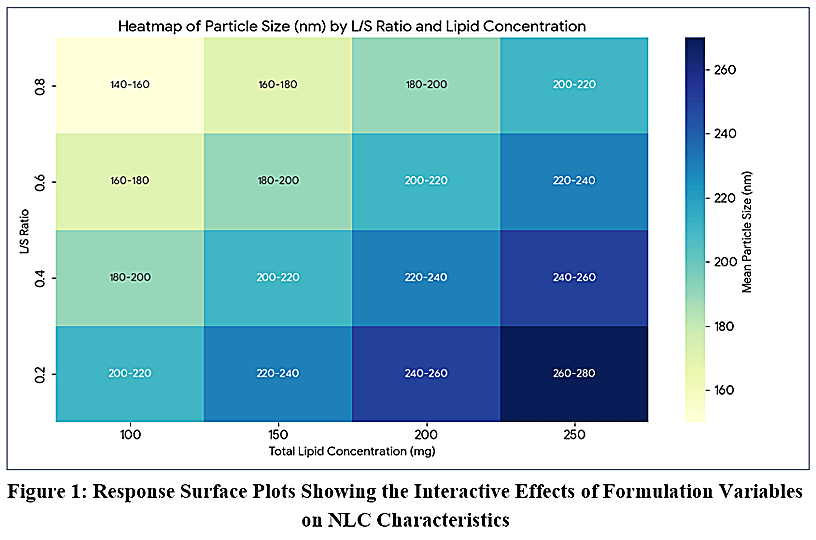 |
Figure 1: Response Surface Plots Showing the Interactive Effects of Formulation Variables on NLC Characteristics Click here to View Figure |
 |
Figure 2: Transmission electron microscopy photomicrograph of optimized luliconazole Click here to View Figure |
Conclusion
The present study successfully prepared and evaluated a luliconazole-loaded nanostructured lipid carrier (NLC) gel for improved treatment of superficial fungal infections. The formulation was optimized using the Quality by Design (QbD) approach and central composite design to achieve small particle size, uniform particle distribution, and high drug entrapment efficiency. The optimized NLCs showed an average particle size of 151.6 nm, drug entrapment efficiency of 91.3%, and good stability, indicating successful preparation of the nanoparticles.
The physical and chemical properties of the formulation were studied using FTIR, DSC, and XRD techniques. The results confirmed that luliconazole was compatible with the other ingredients and was present in an amorphous form within the lipid matrix. This helped improve drug solubility, dissolution, and penetration through the skin.
The optimized NLCs were incorporated into Carbopol 934 gel to prepare a smooth, non-greasy, and easy-to-apply formulation. The prepared gel showed suitable pH, viscosity, spreadability, and uniform drug content, making it suitable for skin application.
The in vitro drug release study showed that the NLC gel released the drug quickly at first, followed by a slow and continuous release over 24 hours. The drug release followed the Higuchi model, indicating that the drug was mainly released through diffusion. This helped provide controlled and continuous drug release.
The ex vivo skin permeation study showed that the NLC gel allowed 3.8 times more drug to pass through the skin and 4.2 times more drug to remain in the skin layers compared to the conventional gel. The improved drug retention may help maintain an effective drug concentration in the skin for a longer period and support once-daily application.
The study also suggested that the NLC gel may reduce drug absorption into the bloodstream, which could help lower the risk of systemic side effects. Overall, the results showed that luliconazole-loaded NLC gel is a promising formulation for improving drug delivery through the skin and may provide better and longer-lasting treatment of superficial fungal infections.
Funding Sources
The author(s) received no financial support for the research, authorship, and/or publication of this article.
Conflict of Interest
The author(s) do not have any conflict of interest.
Data Availability Statement
This statement does not apply to this article.
Ethics Statement
This research did not involve human participants, animal subjects, or any material that requires ethical approval.
References
- Aralelimath, K., et al. (2025). Luliconazole bilosomal gel for treating fungal infection: Development, optimization and antifungal activity. Therapeutic Delivery, 16(8), 733–743
CrossRef - Babu, C. K., et al. (2022). Luliconazole topical dermal drug delivery for superficial fungal infections: Penetration hurdles and role of functional nanomaterials. Current Pharmaceutical Design, 28(20), 1611–1620
CrossRef - Baghel, S., Nair, V. S., Pirani, A., Sravani, A. B., Bhemisetty, B., Ananthamurthy, K., Aranjani, J. M., & Lewis, S. A. (2020). Luliconazole-loaded nanostructured lipid carriers for topical treatment of superficial Tinea infections. Dermatologic Therapy, 33(6), e13959.
CrossRef - Bhargav, E., Reddy, Y. P., & Koteshwara, K. B. (2021). Development and optimization of luliconazole nanostructured lipid carriers based gel by quality by design its skin distribution studies, dermatokinetic modeling & in-vitro and ex-vivo correlation. Current Drug Delivery, 18(7), 1041–1053.
CrossRef - Garg, N. K., Sharma, G., Singh, B., Nirbhavane, P., Tyagi, R. K., Shukla, R., & Katare, O. P. (2017). Quality by Design (QbD)-enabled development of aceclofenac loaded-nano structured lipid carriers (NLCs): An improved dermatokinetic profile for inflammatory disorder(s). International Journal of Pharmaceutics, 517(1–2), 413–431
CrossRef - Gnat, S., Dyląg, M., Łagowski, D., & Zielinski, J. (2021). Therapeutic efficacy of topically used luliconazole vs. terbinafine 1% creams. Mycoses, 64(8), 967–975.
CrossRef - Haider, M., et al. (2020). Nanostructured lipid carriers for delivery of chemotherapeutics: A review. Pharmaceutics, 12(4), 288.
CrossRef - Kaur, M., Singh, G., Shivgotra, R., Singh, M., Thakur, S., & Jain, S. K. (2024). Prolonged skin retention of luliconazole from SLNs based topical gel formulation contributing to ameliorated antifungal activity. AAPS PharmSciTech, 25(7), 229
CrossRef - Khosa, A., et al. (2018). Nanostructured lipid carriers for site-specific drug delivery. Biomedicine & Pharmacotherapy, 103, 598–613
CrossRef - Mahajan, A., Kaur, L., Singh, G., Dhawan, R. K., & Singh, L. (2021). Multipotentiality of luliconazole against various fungal strains: Novel topical formulations and patent review. Recent Advances in Anti-Infective Drug Discovery, 16(3), 182–195.
CrossRef - Mahmood, A., Rapalli, V. K., Gorantla, S., Waghule, T., & Singhvi, G. (2022). Dermatokinetic assessment of luliconazole-loaded nanostructured lipid carriers (NLCs) for topical delivery: QbD-driven design, optimization, and in vitro and ex vivo evaluations. Drug Delivery and Translational Research, 12(5), 1118–1135
CrossRef - Müller, R. H., et al. (2002). Solid lipid nanoparticles (SLN) and nanostructured lipid carriers (NLC) in cosmetic and dermatological preparations. Advanced Drug Delivery Reviews, 54(Suppl 1), S131–S155.
CrossRef - Nosratabadi, M., Rahimnia, S. M., Barogh, R. E., Abastabar, M., Haghani, I., Akhtari, J., Hajheydari, Z., & Ebrahimnejad, P. (2024). Luliconazole-loaded nanostructured lipid carrier: Formulation, characterization, and in vitro antifungal evaluation against a panel of resistant fungal strains. Scientific Reports, 14(1), 30708.
CrossRef - Pardeike, J., et al. (2009). Nanostructured lipid carriers (NLC) in dermal and transdermal drug delivery. European Journal of Pharmaceutics and Biopharmaceutics, 71(2), 217–227.
- Singh, T., et al. (2025). Development and in vivo evaluation of QbD-assisted squalene-based luliconazole entrapped ethosomal gel for the skin fungal infection. AAPS PharmSciTech, 27(1), 42.
CrossRef - Souto, E. B., et al. (2020). Nanostructured lipid carriers (NLC) for topical delivery of antifungal drugs. In Nanomaterials for Drug Delivery and Therapy(pp. 213–236). Elsevier.
- Williams, A. C., & Barry, B. W. (2012). Penetration enhancers. Advanced Drug Delivery Reviews, 64, 128–137
CrossRef - World Health Organization. (2022). WHO fungal priority pathogens list to guide research, development and public health action. World Health Organization.
- Zhang, Y., et al. (2024). Nanostructured lipid carrier-based topical gels as novel drug delivery system: A comprehensive overview. Journal of Drug Delivery Science and Technology, 92, 105312.
- Zoubari, G., et al. (2024). Luliconazole–niacinamide lipid nanocarrier laden gel for enhanced treatment of vaginal candidiasis: In vitro, ex vivo, in silico and preclinical insights. International Journal of Pharmaceutics, 652, 123825.
Accepted on: 10 Oct 2026
Second Review by: Dr. Sumit Kumar
Final Approval by: Dr. Naeem Uddin Siddiqui


ISSN Online: 2231-5039