Color Analysis of Vegetable Oils

University of Bucharest, Faculty of Chemistry, Department of Physical Chemistry, Elisabeta Blvd, Bucharest, Romania
Corresponding Author E-mail:istanciu75@yahoo.com
Download this article as:
ABSTRACT:A vegetable oil is a triglyceride extracted from a plant. In general, substances that are liquid at room temperature are defined as “vegetable oils”, and those that are solid at room temperature as “vegetable fats”.The color properties of vegetable oils were studied using the “Tristimulus Colorimetry” method. In this article, we determined the color properties of four vegetable oils (soybean, corn, rapeseed and olive) and concluded that soybean and corn oils show the largest color differences, indicating a high degree of oxidation of these oils. In the case of olive oil, and especially rapeseed oil, much smaller values of color differences are observed.
KEYWORDS:Analysis; Color; Oil; Vegetable
Introduction
Vegetable oil can transform a bland meal into a delicious one. A vegetable oil is a triglyceride extracted from a plant. In general, substances that are liquid at room temperature are defined as “vegetable oils,” and those that are solid at room temperature as “vegetable fats.” Vegetable oils are composed of triglycerides, unlike waxes, which lack glycerin. Although oil can be extracted from various parts of a plant, in practice it is extracted mainly from the seeds.
Vegetable oils are consumed directly or indirectly as ingredients in food products, and those that have a high decomposition point can be heated and used to cook other foods. Vegetable oils can be classified in several ways, for example:
by origin: because most vegetable oils are extracted from the fruits or seeds of plants, classification can be done by grouping them according to the type of plant from which they are obtained; by use:
Edible oils (for cooking);
Oils used as fuel;
Oils used in cosmetics;
Oils used in medicine;
Oils used as food supplements.1-4
Oil is used in the kitchen in many ways, from salads, where it is added raw, to deep-fried dishes, to soups or stews where it is added for extra flavor.
The most commonly used types of cooking oil are: sunflower oil, olive oil, rapeseed oil, palm oil, coconut oil, corn oil.
It is also used in salads, for marinating meat or for dishes from international cuisines and special oils, such as: grape seed oil, sesame oil, peanut oil, walnut oil, almond oil.
At the same time, cooking oil can also be classified according to the way it is obtained. Depending on this criterion, it can be:
Chemically extracted oil – less and less applied in industrial conditions, it is obtained by treating seeds with solvents (e.g. hexane). It has a long shelf life, but it is a lower quality oil, emptied of nutrients; another extraction option, more expensive but free of toxicity, is that with liquid carbon dioxide.
Mechanically extracted oil – by pressing or cold pressing of seeds (sunflower, olive, peanut, etc.) with a mechanical press. Pressing generates heat due to friction, so that nutrients can be lost. In controlled environments, the temperature is maintained at a low enough level so that nutrients are not lost. For this reason, cold-pressed oil is considered to be of higher quality.
Refined/processed oil – the refining process removes impurities from the crude oil and dulls overly strong aromas, which results in the loss of many nutrients from the oil. It can be done using chemicals, or by exposing the oil to high temperatures, but also by methods that do not affect the qualities of the oil – using natural substances or at lower temperatures.
Unrefined/unprocessed oil – natural oil, which after being obtained does not go through the refining process and therefore has more nutrients.
Extra virgin oil – first-press oil, with a maximum concentration of 0.8% oleic acid; considered the healthiest type.
Virgin oil – obtained from the material remaining after the first press, superior to refined oil, but inferior to extra virgin oil in terms of nutrients. Both virgin and extra virgin oil have a stronger aroma than the other types.5-9
Organic/bio/ecological oil – obtained from raw materials not treated with pesticides or other substances used in conventional agriculture. The labels of these oils must include a mention of EU certification (the source has been controlled and meets the growing criteria imposed by the European Union regarding bio/organic/ecological products). Nowadays, more than ever, people have become more interested in healthy food, and the oil used in the kitchen, as well as the way it is used, are important aspects when it comes to healthy eating.
Materials and Methods
The color properties of vegetable oils have been studied using the “Tristimulus Colorimetry” method. Its use provides an objective measurement of the color of vegetable oils because it is based on determinations in the visible spectrum and allows obtaining real chromatic images. Trichromatic colorimetry, which renders trichromatic coordinates, is a fast and relatively easy-to-apply method used to measure the color of many foods.10
Results and Discussion
To highlight the changes in the transmittance spectra of the oils after forced oxidation, the Tristimulus Colorimetry method was used. Starting from the known transmittance values corresponding to the wavelengths of: 445, 495, 550 and 625 nm, the following chromatic parameters were determined: the degree of yellowness (b*), the brightness parameter (L*) and the color differences (ΔE*) recorded between the oxidized and the reference (non-oxidized) samples.11-18
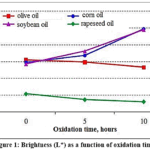 |
Figure 1: Brightness (L*) as a function of oxidation time Click here to View Figure |
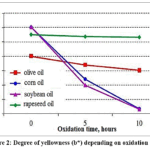 |
Figure 2: Degree of yellowness (b*) depending on oxidation time Click here to View Figure |
Comparing the calculated chromatic parameters for each oil oxidized at 110ºC and oxidation periods of 5 hours and 10 hours, respectively, a tendency for the brightness parameter (L*) to increase is observed in the case of soybean and corn oils (fig. 1). The increase is accentuated in the case where the oils were oxidized for 10 hours. The two oils record approximately equal brightness values, except for the values determined for the oils oxidized for 5 hours, when a clear differentiation between the two oils appears. In the case of olive and rapeseed oils, brightness decreases with increasing oxidation time.
Soybean and corn oils record a very large decrease in the degree of yellowness with increasing oxidation time (fig. 2). If after a period of 5 hours of oxidation, the yellowness values between the two oils can be clearly differentiated, after 10 hours of oxidation the two oils have almost identical values of yellowness and brightness.
The yellowness of olive and rapeseed oils decreases with increasing oxidation time, but the decrease is not as pronounced as that recorded in the case of soybean and corn oils.
Very large color differences are observed for soybean and corn oils (figure 3), this indicates a high degree of oxidation of these oils. In the case of olive oil, and especially rapeseed oil, much smaller values of color differences are observed, these oils therefore undergoing a less intense oxidation process than in the case of soybean and corn oils.
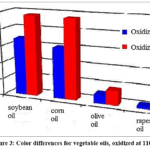 |
Figure 3: Color differences for vegetable oils, oxidized at 110ºC Click here to View Figure |
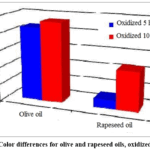 |
Figure 4: Color differences for olive and rapeseed oils, oxidized at 130ºC Click here to View Figure |
Oxidizing olive and rapeseed oils at 130ºC for 5 hours and 10 hours respectively, smaller color differences are observed for rapeseed oil, which undergoes a less intense oxidation process than olive oil (figure 4).
Conclusions
Soybean and corn oils show the largest color differences, indicating a high degree of oxidation of these oils. In the case of olive oil, and especially rapeseed oil, much lower values of color differences are observed.
Oxidizing olive and rapeseed oils at a temperature of 130ºC, for 5 hours and 10 hours respectively, smaller color differences are observed for rapeseed oil, which undergoes a less intense oxidation process than olive oil.
Funding Sources
The author received no financial support for the research, authorship, and/or publication of this article.
Conflict of Interest
The author do not have any conflict of interest.
Data Availability Statement
This statement does not apply to this article.
Ethics Statement
This research did not involve human participants, animal subjects, or any material that requires ethical approval.
References
- Zgherea, Gh., Analize Fizico – Chimice, Ed. Fundaţiei Universitare “Dunărea de Jos” Galaţi, pp. 74-80, 88-94, 2002.
- Sancez-Gimeno, A.C., Negueruela, A.I., Benito, M., Vercet, A., Oria, R., 2008, Some physical changes in Banjo Aragon extra virgin olive oil during the frying process, Food Chemistry, 110, pp. 654-658.
CrossRef - Şolea, L.C., Creţu, R., Spectrophotometric and rheological study on oxidized soybean oils, The Annals of „Dunărea de Jos” University of Galati, Fascicle XIV, Mechanical Engineering, ISSN 1224 – 5615, Galati University Press, 2013 – trimisă spre publicare.
- van der Vaart, K., Depypere, F., Graef, V. D., Schall, P., Fall, A., Bonn, D., & Dewettinck, K., 2013, Dark chocolate’s compositional effects revealed by oscillatory rheology, European Food Research and Technology, 236(6), 931-942.
CrossRef - 5. Stanciu I., 2019, Rheological behaviour of biodegradable lubricant, Journal of Science and Arts, 3(48), 703-708.
- Stanciu I., 2019, Rheological investigation of soybean oil from soya beans, Journal of Science and Arts, 4(49), 938-988.
- Stanciu I., 2011, Modeling the temperature dependence of dynamic viscosity for rapeseed oil Journal of Science and Arts, 1, 55-58.
- Stanciu I., 2018, Rheology behavior of soybean oil Journal of Science and Arts, 2(43), 453-458
- Meneghetti S.M.P., Meneghetti M.R., Wolf C.R., Silva E.C., Lima G.E., Coimbra M.D. A., … & Carvalho, S.H.,2006, Journal of the American oil chemists’ society, 83(9), 819-822.
CrossRef - Penciu S., Beldescu A., Studiul potenţialului de export al României: Uleiuri Vegetale, Centrul Român pentru Promovarea Comerţului şi Investiţiilor Străine, 2012.
- Stanciu I. 2023. Some methods for determining the viscosity index of hydraulic oil, Indian Journal of Science & Technology, 16(4), 254-258
CrossRef - McNicholas, H. J., 1935, “The Color and Spectral Transmittance of Vegetable Oils,” Oil & Soap, 12(8), 167–178. https://doi.org/10.1007/BF02636620.
CrossRef - Salmerón, J. F., Gómez-Robledo, L., Carvajal, M. Á., Huertas, R., Moyano, M. J., Gordillo, B., Palma, A. J., Heredia, F. J., & Melgosa, M., 2012, “Measuring the Colour of Virgin Olive Oils in a New Colour Scale Using a Low-Cost Portable Electronic Device,” Journal of Food Engineering, 111(2), 247–254. https://doi.org/10.1016/j.jfoodeng.2012.02.025.
CrossRef - Domenici, V., Ancora, D., Cifelli, M., Serani, A., Veracini, C. A., & Zandomeneghi, M., 2014, “Extraction of Pigment Information from Near-UV Vis Absorption Spectra of Extra Virgin Olive Oils,” Journal of Agricultural and Food Chemistry, 62(38), 9317–9325. https://doi.org/10.1021/jf503818k.
CrossRef - Brühl, L., 2021, “Precise Color Communication by Determination of the Color of Vegetable Oils and Fats in the CIELAB 1976 (Lab*) Color Space,” European Journal of Lipid Science and Technology, 123(7), Article 2000329. https://doi.org/10.1002/ejlt.202000329.
CrossRef - Daun, J. K., 2012, “Spectrophotometric Analysis of Chlorophyll Pigments in Canola and Rapeseed Oils,” Lipid Technology. https://doi.org/10.1002/lite.201200204.
CrossRef - “Smartphone-Based Method for the Determination of Chlorophyll and Carotenoid Contents in Olive and Avocado Oils: An Approach with Calibration Transfer,” 2021, Journal of Food Composition and Analysis, 104, Article 104164. https://doi.org/10.1016/j.jfca.2021.104164.
CrossRef - “Rapid Estimation of Natural Pigments in Olive and Avocado Oils Using a Colorimetric Sensor,” 2025, Journal of Food Composition and Analysis, 145, Article 107773. https://doi.org/10.1016/j.jfca.2025.107773
CrossRef
Accepted on: 29 Sep 2026
Second Review by: Dr. Rashim Mohhamad
Final Approval by: Dr. Tawkir Sheikh


ISSN Online: 2231-5039