Spectrophotometric Analysis of Rapeseed Oil

University of Bucharest, Faculty of Chemistry, Department of Physical Chemistry, Elisabeta Blvd, Bucharest, Romania
Corresponding Author E-mail:istanciu75@yahoo.com
DOI : http://dx.doi.org/10.13005/ojc/420433
Download this article as:

In this study, the oxidation behavior of rapeseed oil was evaluated. The analysis aimed investigate the changes occurring in the optical properties of the oil as a result of oxidative conditions. Spectrophotometric results indicate that the absorption spectrum of rapeseed oil oxidized for 5 hours remains largely similar to that of fresh, unoxidized oil. The overall spectral profile is preserved, suggesting that the structural modifications induced by oxidation at this stage are relatively limited. However, noticeable differences can be observed in the ultraviolet region of the spectrum, where oxidation-related compounds formed during thermal treatment contribute to changes in absorbance. These variations are associated conjugated molecular structures that absorb strongly in the UV range. Furthermore, in both the oxidized and unoxidized samples, a distinct and pronounced absorption peak is observed at approximately 670 nm. The persistence of this peak suggests the presence of pigments or other chromophoric compounds that remain detectable despite the oxidative processes occurring during heating. The intensity and position of this absorption band may provide useful information regarding the stability of naturally occurring constituents in rapeseed oil under thermal stress. Overall, the findings demonstrate that thermal oxidation primarily affects the ultraviolet absorption characteristics of rapeseed oil, while the visible spectral features remain relatively unchanged after 5 hours of oxidation.
KEYWORDS:Analysis; Rapeseed Oil; Spectrophotometer; Temperature
Introduction
The quantitative measurement of the transmission, absorption, and reflection of electromagnetic radiation by a material as a function of wavelength. The term specifically refers to techniques that employ radiation in the ultraviolet (UV), visible (VIS), and infrared (IR) regions of the electromagnetic spectrum, making spectrophotometry an important component of electromagnetic spectroscopy.
The technique is based on the ability of chemical compounds to absorb or transmit light at specific wavelength. As a result, spectrophotometry is widely used for both qualitative and quantitative analyses. Qualitatively, it enables the identification of substances present in a sample, while quantitatively, it allows the determination of their concentrations. In addition, spectrophotometric methods can be employed to determine equilibrium constants in chemical systems.
Although both reactions continue to proceed, no net change in concentration is observed. This condition is referred to as dynamic equilibrium. From a spectrophotometric perspective, the concentrations of reactants and products at equilibrium can be determined by measuring the amount of light transmitted through or absorbed by the solution.
Since every chemical compound interacts with electromagnetic radiation by absorbing, transmitting, or reflecting light within characteristic wavelength ranges, these interactions can be used for analytical purposes. The instruments used to perform such measurements are known as spectrophotometers.
A spectrophotometer is designed to accurately measure the intensity of light before and after it passes through a sample. By determining the amount of absorbed radiation, the concentration of a substance can be calculated indirectly according to established absorption laws. Depending on the spectral region employed, spectrophotometry can be classified into two main categories:
UV–Visible (UV/VIS) spectrophotometry, which utilizes wavelengths ranging from approximately 185–400 nm in the ultraviolet region and 400–750 nm in the visible region.
Infrared (IR) spectrophotometry, which operates within the wavelength range of approximately 750 nm to 1000 μm.
These techniques are extensively applied in chemistry, biochemistry, environmental monitoring, food analysis, and pharmaceutical research due to their accuracy, sensitivity, and versatility.
UV/VIS spectrophotometry is most frequently
Solutions containing transition metal cations, most of which are colored (absorb electromagnetic radiation from the visible spectrum) due to electrons on d-type orbitals that can be easily excited and thus caused to perform quantum transitions. The color of solutions containing such cations can, however, be affected by the presence of anions or ligands. For example, the light blue CuSO4 solution can be intensified with ammonia, which can change the absorption maximum.
Organic compounds, especially those that exhibit a high degree of conjugation (systems with p orbitals in which single and multiple bonds alternate and which, in general, decrease the total energy of the molecule, thus increasing its stability). For example, DNA, RNA and proteins absorb electromagnetic radiation mainly from the UV spectrum and very rarely from the visible spectrum. For these determinations, ethanol is most often used as a solvent because it absorbs much less than water
The calibration of a spectrophotometric method for a specific substance is typically carried out in two distinct stages:
The absorption maximum of the substance in question is determined by scanning the wavelengths in accordance with its color. If the substance is colorless, a specific color reaction is identified and the colored product is analyzed.
The relationship between the concentration of the substance taken in the analysis (or of the resulting product if it is a color reaction) and absorption is determined. This determination is made at the wavelength corresponding to the absorption maximum determined in step 1. The identification of the wavelength that exhibits maximum absorption must be carried out on a sample whose concentration does not determine an absorption greater than 1 at this wavelength. Convenient values for absorption are between 0.1 and 1. Above this value, the shadowing effect of the particles can modify the correctness of the results. This situation involves concentrations that are too high in which the component particles of the solution, being too close, can be located one behind the other and do not contribute to the absorption. Therefore, for a given substance, the identification of this concentration is done by tests.1-9
Material and Methods
The spectroscopic analysis of rapeseed oil was performed using a T60V spectrophotometer,. The T60V spectrophotometer is supplied as standard with either a universal variable path-length cell holder or an eight-cell fixed path-length changer, providing flexibility for different analytical applications. Combining high measurement accuracy with user-friendly operation, the T60V offers many of the capabilities of advanced spectrophotometric systems while maintaining a cost-effective design. These characteristics make it a suitable instrument for the spectroscopic characterization and quality assessment of rapeseed oil samples.
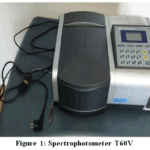 |
Figure 1: Spectrophotometer T60V. Click here to View Figure |
Results and discussion
The results showed that samples exhibited transmittance spectra with shapes similar to those of the unoxidized samples. No significant alterations in the spectral profiles were observed; however, hypochromic shifts, characterized by a decrease in transmittance intensity, were detected throughout the spectra.10-18 These findings suggest that thermal oxidation at 110°C primarily affects the intensity of the transmitted radiation rather than causing substantial modifications to the overall spectral pattern.
Increasing the oxidation temperature, from 110ºC to 130ºC, no significant changes in the shape of the transmittance spectrum of rapeseed oil oxidized for 5 hours (fig. 2.b). Notable changes occur in the case of oil oxidized for 10 hours, in which case a shift of the transmittance spectrum towards the ultraviolet range is observed.
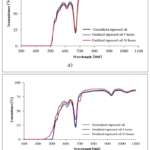 |
Figure 2: Dependence transmittance vs. wavelength for rapeseed oils, oxidized at temperatures of 110ºC (a) and 130 ºC (b). Click here to View Figure |
Spectrophotometric method after thermal treatment at 110 °C, 120 °C, and 130 °C for periods, reveal significant insights into the thermal degradation and oxidative processes occurring in the oil. The results clearly demonstrate that heating duration and temperature strongly influence the optical properties of rapeseed oil, primarily due to chemical alterations in its molecular structure during oxidation.
For the unoxidized rapeseed oil samples, high transmittance values were observed across the visible region before heating, indicating the initial clarity and purity of the oil. Upon heating for 5 hours, a gradual decrease in transmittance was noted, particularly in the shorter wavelength region (below 450 nm), which corresponds to conjugated dienes. These compounds absorb more strongly, reducing light transmission. After 10 hours of heating, this reduction became more pronounced, suggesting the progression of the oxidation process and the generation of secondary products such as aldehydes, ketones, and polymers.
In contrast, oxidized rapeseed oil exhibited significantly lower transmittance values even before the heating process, confirming that previous oxidative exposure had already produced substantial molecular changes. With continued heating, particularly at 120 °C and 130 °C, the transmittance spectra showed a marked decline with time, reflecting further decomposition of unsaturated fatty acids and an increase in chromophoric compounds responsible for color darkening. The characteristic spectral behavior—shifts in absorption peaks and overall transmittance reduction—indicates structural rearrangements and the accumulation of degradation products. Such spectral changes align with visual observations of increased oil browning and viscosity, which are common indicators of advanced oxidation.
Comparing the unoxidized and oxidized oils under identical heating conditions also underscores the accelerating effect of prior oxidation on thermal degradation. Pre-oxidized samples exhibited faster transmittance decline and more intense absorption changes, suggesting that once oxidative reactions have commenced, subsequent thermal stress amplifies degradation at a much higher rate. This phenomenon can be attributed to the presence of pre-existing free radicals and peroxides that catalyze further oxidation.
Overall, the study demonstrates that spectrophotometric transmittance analysis is an effective method for monitoring the oxidative stability and quality deterioration of rapeseed oil under heat stress. The systematic decrease in transmittance with longer heating times and higher temperatures indicates progressive oxidation and molecular fragmentation of unsaturated components. The results emphasize the importance of controlling storage and processing temperatures to maintain oil quality and oxidative stability. Moreover, the marked differences between unoxidized and oxidized samples highlight the irreversible nature of oxidative damage once it has begun.
Conclusions
The transmittance spectra provide a sensitive, non-destructive means of assessing the extent of oxidation in rapeseed oils. Prolonged heating, especially at temperatures above 120 °C, significantly accelerates oxidative degradation, leading to decreased optical clarity and potential reductions in nutritional and sensory quality. Proper temperature management and antioxidant addition are therefore crucial to prolonging the shelf life and preserving the functional properties of rapeseed oil.
Funding Sources
The author(s) received no financial support for the research, authorship, and/or publication of this article.
Conflict of Interest
The author(s) do not have any conflict of interest.
Data Availability Statement
This statement does not apply to this article.
Ethics Statement
This research did not involve human participants, animal subjects, or any material that requires ethical approval.
References
- Zgherea, Gh., Analize Fizico – Chimice, Ed. Fundaţiei Universitare “Dunărea de Jos” Galaţi, pp. 74-80, 88-94, 2002.
- Sancez-Gimeno, A.C., Negueruela, A.I., Benito, M., Vercet, A., Oria, R., 2008, Some physical changes in Banjo Aragon extra virgin olive oil during the frying process, Food Chemistry, 110, pp. 654-658.
CrossRef - Şolea, L.C., Creţu, R., Spectrophotometric and rheological study on oxidized soybean oils, The Annals of „Dunărea de Jos” University of Galati, Fascicle XIV, Mechanical Engineering, ISSN 1224 – 5615, Galati University Press, 2013 – trimisă spre publicare.
- van der Vaart, K., Depypere, F., Graef, V. D., Schall, P., Fall, A., Bonn, D., & Dewettinck, K., 2013, Dark chocolate’s compositional effects revealed by oscillatory rheology, European Food Research and Technology, 236(6), 931-942.
CrossRef - Stanciu I., 2019, Rheological behaviour of biodegradable lubricant, Journal of Science and Arts, 3(48), 703-708.
- Stanciu I., 2019, Rheological investigation of soybean oil from soya beans, Journal of Science and Arts, 4(49), 938-988.
- Stanciu I., 2011, Modeling the temperature dependence of dynamic viscosity for rapeseed oil Journal of Science and Arts, 1, 55-58.
- Stanciu I., 2018, Rheology behavior of soybean oil Journal of Science and Arts, 2(43), 453-458
- Meneghetti S.M.P., Meneghetti M.R., Wolf C.R., Silva E.C., Lima G.E., Coimbra M.D. A., … & Carvalho, S.H.,2006, Journal of the American oil chemists’ society, 83(9), 819-822.
CrossRef - Penciu S., Beldescu A., Studiul potenţialului de export al României: Uleiuri Vegetale, Centrul Român pentru Promovarea Comerţului şi Investiţiilor Străine, 2012.
- Sheibani A., Ghotbaddini-Bahraman, N. A. S. E. R., & Sadeghi, F. A. T. E. M. E. H., 2014, Oriental Journal of Chemistry, 30(3), 1205-1209.
CrossRef - Stanciu I. 2023. Some methods for determining the viscosity index of hydraulic oil, Indian Journal of Science & Technology, 16(4), 254-258
CrossRef - Stanciu I. 2023, Rheological behavior of corn oil at different viscosity and shear rate, Oriental Journal of Chemistry, 39(2), 335-339
CrossRef - Stanciu I. 2023, Rheological characteristics of corn oil used in biodegradable lubricant, Oriental Journal of Chemistry, 39(3), 592-595
CrossRef - Stanciu I. 2023, Effect of temperature on rheology of corn (Zea mays) oil, Oriental Journal of Chemistry, 39(4), 1068-1070
CrossRef - Stanciu I., 2021, Study Rheological Behavior of Rapeseed oils Compared to Mineral oil Oriental Journal of Chemistry, 37(1), 247-249
CrossRef - Stanciu I., 2021, Influence of Temperature on the Rheological Behavior of Orange Honey Oriental Journal of Chemistry, 37(2), 440-443
CrossRef - Stanciu I., 2021, Rheological Study of Orange Honey with Influence on Concentration, Oriental Journal of Chemistry, 37(4), 864-867
CrossRef
 PlumX:
  Views: 317 Views
  PDF Downloads: 87
 Accepted on: 25 Jul 2026


ISSN Online: 2231-5039