Synthesis, Characterization and Evaluation of Antioxidant and Anti-anxiety Action of Pyrazoline Derivatives

Rajiv Gandhi Institute of Pharmacy, Faculty of Pharmaceutical Science and Technology AKS University
Corresponding Author E-mail: rgipsatna@yahoo.co.in
DOI : http://dx.doi.org/10.13005/ojc/420323
Download this article as:

The present work was undertaken with an aim to obtain novel pyrazoline compounds and assess the antioxidant and anti-anxiety activity of the compounds. The pyrazoline derivatives (XI-XV) were synthesized in four sequential steps involving synthesis of dihyropyrimidine nucleus, followed by hydrazination of the carboethoxy group. The various chalcone molecules were prepared in the third step via claisen Schmidt condensation and finally the chalcone were cyclo-condensed to yield the pyrimidine-pyrazoline compounds (XI-XV). The antioxidant property of the pyrazolines was measured by DPPH inhibition assay whereas tail suspension test (TST) was used for assessing the anti-anxiety activity. The prepared derivatives had IC50 for DPPH inhibition from 36.23 µg to 132.22 µg. The observation of TST lead to the inference that compounds XII and XIII with substituents strong electron withdrawing substituents in comparison to other were able to reduce the immobility time exhibiting an increase in alertness in the animals.
KEYWORDS:Antioxidant; Anti-Anxiety; Dihydropyrimidine; Pyrazoline; Schmidt Condensation
Introduction
Anxiety disorders represent the most prevalent mental ailment globally, impacting around 301 million individuals in 2019. Anxiety disorders are more common in women than men, and are most prevalent during midlife with 80–90% of cases manifesting before age 351. The wide variety of biological potentials of heterocyclic molecules makes them very important in medicinal chemistry. A cornerstone of organic and medicinal chemistry, the pyrazoline scaffold is also an essential component of heterocyclic chemistry.
Pyrazoline is a dihydro derivative of pyrazole, characterized by the presence of one endocyclic double bond. The pyrazoline class includes many compounds with medicinal properties; some examples are the uricosuric sulfinpyrazone, the anti-inflammatory oxyphenbutazone, and the analgesic and antipyretic aminophenazone, phenazone, and methampyrone. A wide variety of pyrazoline derivatives have been developed through structural modifications. Similarly, it will aid in the creation of safer and more effective pharmaceuticals by researchers. Previously attempts have been made to prepare a few 2-pyrazoline derivatives as potential monoamino oxidase inhibitors to counter several diseases and disorders including neurological disorders2-13. Pyrimidine based compounds like methylphenobarbital have been long used in treatment of anxiety disorders. Considering the vast pharmacological potential of these two scaffolds, it was hypothesized that linking of these two might be able to render potential compounds for neurological conditions. Herein, we have endeavored synthesizing new 2-pyrazoline compounds containing pyrimidine nucleus attached to the pyrazoline ring and assess their antioxidant as well as anti-anxiety action.
Materials and Methods
A few novel pyrimidine containing pyrazoline derivatives were synthesized using the steps reported by Mishra et al14, Padhy et al15 and Tok et al16 (Scheme 1).
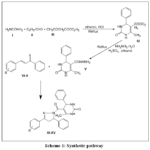 |
Scheme 1: Synthetic pathway Click here to View Scheme |
The synthesis has been achieved into 4 steps involving synthesis of dihydropyrimidine in the first step, followed by is hydrazination in the second step; the third step involved the synthesis of chalcone derivatives and finally cyclization to form pyrazoline in the fourth step.
Step 1. 4-phenyl-5-carboethoxy-6-methyl-3, 4-dihydropyrimidine-2- one, IV
The 3, 4-dihydropyrimidine was synthesized utilizing benzaldehyde, urea, and ethylacetoacetate through Biginelli condensation. Within 25 millilitres of ethanol, urea (I, 0.5 mol), ethylacetoacetate (III, 0.75 mol), and benzaldehyde (II, 0.5 mol) were combined. The mixture was refluxed until the reaction was complete, which took around three hours, after adding five drops of strong hydrochloric acid, which is considered a catalytic quantity. The product IV was obtained by filtering and recrystallizing a solid that separated during cooling with the help of ethanol.
Step 2. 4- phenyl -5-carboxyhydrazide-6-methyl-3, 4-dihydropyrimidine-2-one, V
Step 1’s product was treated with hydrazine hydrate in ethanol and a catalytic quantity of concentrated sulfuric acid to synthesis the hydrazide derivative of the dihydropyrimidine-2-one. Hydrazine hydrate was added to product IV, 0.1 mol in 20 mL of ethanol. A little amount of highly concentrated sulfuric acid was added to the mixture for catalytic purposes. Refluxing the mixture continued until the reaction was finished, which took around 2 hours. The product V was obtained by recrystallizing a solid that had detached from the ethanol as it cooled.
Step 3. Synthesis of chalcone derivatives, VI-X
A few chalcone compounds (VI-X) were prepared using acetophenone and substituted benzaldehydes in acetic acid and catalytic amount of sulfuric acid using Claisen-Schmidt condensation. To a solution of corresponding aldehyde (0.0054 mol) and acetophenone (0.0054 mol) in acetic acid (10 mL) was added conc. H2SO4 (0.3 mL) and stirred at 10-20°C until the completion of reaction (≈72 h). The precipitated product was filtered and recrystallized using acetic acid.
Step 4. Synthesis of pyrazoline molecules (XI-XV)
The pyrazoline compounds were prepared by cyclization reaction of the carbohydrazide pyrimidine with the prepared chalcone compounds. To a stirred mixture of 0.001 mol chalcone compound in 15 ml acetic acid was added 0.002 mol of the carbohydrazide pyrimidine and reflux was carried out for 6 hours. Monitoring of the reaction was done by thin layer chromatography. After that, it was put onto ice, rinsed with distilled water, filtered, and dried in ethanol till crystallization.
DPPH Scavenging Assay for antioxidant action
A radical scavenging assay called 2,2-Diphenyl-1-picrylhydrazyl (DPPH) was used to determine the antioxidant effect of the compounds that were produced17,18. We used the stable radical DPPH to evaluate the hydrogen-donating and radical-scavenging capabilities of the produced compounds as a measure of their free radical scavenging activity. The 100 𝜇L test samples, with concentrations ranging from 100 to 500 µg/ml, were first produced in DMSO. They were then mixed with 1.0 ml of DPPH solution and topped up with 4 ml of methanol. A visible spectrophotometer was utilized for measuring the absorbance of the test sample mixture at 517 nm. The reference compound utilized was ascorbic acid. Lower absorbance values for the reaction mixture were indicative of more effective free radical scavenging. The fraction of free radicals suppressed by the sample was utilized to quantify its radical scavenging activity by the following formula:

𝐴o represents absorbance of the control and 𝐴𝑡 represents absorbance of test samples.
Acute Toxicity Study
Three rats were administered a single oral dose of 2000 mg/kg for each chemical. Animals were observed individually at least once during the initial 30 minutes following treatment, intermittently during the first 24 hours, and daily thereafter for a period of 14 days. Daily assessments were performed to evaluate changes in skin and fur, ocular and mucous membranes (nasal), respiratory rate, circulatory parameters (heart rate and blood pressure), autonomic responses (salivation, perspiration, urinary incontinence, and defecation), and central nervous system symptoms (drowsiness, tremors, and convulsions). Death of animal, if any, was also noticed over the study duration.
Tail Suspension Test
The produced compounds and fluoxetine were dissolved in DMSO and administered intraperitoneally (0.05 mL per 20 g body weight) 30 minutes before the test. To assess the impact of the test substance, mice were suspended by their tails using a clamp positioned 2 cm from the tail tip, within a box measuring 25 × 25 × 30 cm, with their heads 5 cm above the bottom. The test was conducted in a dark environment with minimal background noise. The overall duration of suspending animals by their tails was 6 minutes, with the period of inactivity recorded during the final 4 minutes of the experiment. Animals were deemed immobile when they remained entirely motionless19.
Results and Discussion
The pyrazoline derivatives (XI-XV) were synthesized in four sequential steps involving synthesis of dihyropyrimidine nucleus, followed by hydrazination of the carboethoxy group. The various chalcone molecules were prepared in the third step via claisen Schmidt condensation and finally the chalcone were cyclo-condensed to yield the pyrimidine-pyrazoline compounds (XI-XV). The synthesized conjugates were characterized by determining the practical yield, melting point, solubility (Table 1) and spectral studies (Table 2). All the compounds were soluble in chloroform and insoluble in water and DMSO.
Table 1: Properties of synthesized pyrazolines
|
Compound code |
Yield (%) | Color | Melting Temperature (°C) |
| XI | 67 | Brown |
241-243 |
|
XII |
72 | Dark Yellow | 228-230 |
| XIII | 63 | Brown |
219-221 |
|
XIV |
65 | Brown | 248-250 |
| XV | 70 | Dark Yellow |
256-258 |
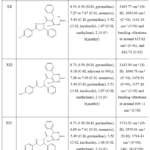 |
Table 2: Spectral features of the synthesized pyrazolines Click here to View Table |
The stretching vibrations for amine, carbonyl, imine, and bending vibrations for C-N ring deformation were present in the FT-IR spectra of the conjugates. In the 1HNMR spectra the peaks at chemical shift value (δ, ppm) of 8.73 and 5.68 (δ, ppm) corresponding to the proton of pyrimidine nitrogen (N-H), 2.13 corresponding to the proton of methyl group and 7.1 to 7.6 corresponding to the protons of the aromatic rings were present in all the conjugates.
Antioxidant action
The antioxidant efficacy of the synthesized pyrazoline compounds was assessed using the DPPH scavenging assay. The absorbance of the control (DPPH + methanol) and various concentrations of the test solution was measured at 517 nm using a UV-visible spectrophotometer, and the percentage of DPPH inhibition was determined (Table 3, Figure 1).
Table 3: Absorbance of samples and % inhibition of DPPH
|
Concentration |
XI | XII | XIII | XIV | XV |
| 10 | 0.753 [11.61 ± 0.343] | 0.646 [24.12 ± 0.548] | 0.559 [34.37 ± 0.719] | 0.834 [2.10 ± 0.720] |
0.814 [4.45 ± 0.709] |
|
20 |
0.706 [17.16 ± 0.0.193] | 0.613 [27.99 ± 0.689] | 0.510 [40.16 ± 0.574] | 0.804 [5.62 ± 0.677] | 0.791 [7.15 ± 0.696] |
| 30 | 0.654 [23.26 ± 0.302] | 0.578 [32.10 ± 0.854] | 0.458 [46.13 ± 0.554] | 0.766 [10.08 ± 0.681] |
0.760 [10.79 ± 0.678] |
|
40 |
0.632 [25.85 ± 0.271] | 0.523 [38.59 ± 0.466] | 0.402 [52.75 ± 0.408] | 0.7389 [13.41 ± 0.620] | 0.722 [15.21 ± 0.633] |
| 50 | 0.608 [28.63 ± 0.041] | 0.482 [43.36 ± 0.639] | 0.355 [57.95 ± 0.673] | 0.697 [18.22 ± 1.242] |
0.687 [19.31 ± 1.061] |
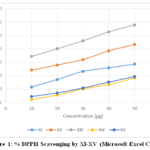 |
Figure 1: % DPPH Scavenging by XI-XV (Microsoft Excel Chart) Click here to View Figure |
The IC50 value for each test chemical in inhibiting DPPH radicals was derived from the graph (Table 4).
Table 4: IC50 for DPPH scavenging by test compounds
| XI | XII | XIII | XIV | XV | |
| IC50 | 97.16 µg | 64.16 µg | 36.23 µg | 130.21 µg |
132.22 µg |
Acute Toxicity Study
None of the animals presented any symptom of toxicity or mortality and therefore a dose of 2000 mg/kg was found to be harmless for the test subjects. A 1/20th dose (50 mg/kg) was considered for determination of CNS action in rodent.
Anti-anxiety Action
The results of TST (Figure 2) lead to the inference that compounds XII and XIII with substituents strong electron withdrawing substituents in comparison to other were able to reduce the immobility time exhibiting an increase in alertness in the animals.
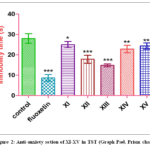 |
Figure 2: Anti-anxiety action of XI-XV in TST (Graph Pad, Prism chart) Click here to View Figure |
Conclusion
The primary objective of the work was synthesize novel pyrazoline derivatives for CNS activity. The objective was achieved by attaching the pyrimidine nucleus to the pyrazoline ring and assess their antioxidant as well as anti-anxiety action. The compounds were able to assess significant anti-oxidant and anti-anxiety action in the comparison to the control groups.
Acknowledgement
The authors are thankful to AKS University, Satna & RB Science, Bhopal for their support in completing the work and interpretation of results.
Funding Sources
The author(s) received no financial support for the research, authorship, and/or publication of this article.
Conflict of Interest
The author(s) do not have any conflict of interest.
Data Availability Statement
This statement does not apply to this article.
Ethics Statement
This research did not involve human participants, animal subjects, or any material that requires ethical approval.
References
- https://www.who.int/news-room/fact-sheets/detail/anxiety-disorders
- H, Farad.; D, Jagdale.; Design, GIS. Sci. J. 2023, 10(4), 1736-1745 https://www.researchgate.net/publication/371491506.
- Ekawati, L.; Nurohman, BA.; Syahri, J.; Purwono, B, Sains. Malays. 2022, 51(10). 3215-3236
CrossRef - Nair, A.S.; Oh, J.-M.; Koyiparambath, V.P.; Kumar, S.; Sudevan, S.T.; Soremekun, O.; Soliman, M.E.; Khames, A.; Abdelgawad, M.A.; Pappachen, L.K, Mol. 2021, 26, 3264 https:// doi.org/10.3390/molecules26113264
CrossRef - Kumar, A.; Kumar, P; Raju Shetty, C.; Puthenveettil, J., James, P.J.; Shetty, H.C, I.J.P.E.R. 2021, 55(2), 574-580 DOI: 10.5530/ijper.55.2.96
CrossRef - Payne, M.; Bottomley, A.L.; Och, A.P; Asmara, E.J.; Harry, A.T, Med. Chem. 2021, 48, 116401. https://doi.org/10.1016/J.BMC.2021.116401.
CrossRef - Asad, M.; Arshad, M.; Oves, M.; Khalid, M.; Khan, S.A..; Asiri, A.M.; Rehan, M.; Dzudzevic-Cancar, Bioorg. Chem. 2020, 99. 103842 https://doi.org/10.1016/j.bioorg.2020.103842
CrossRef - Celik, G.; Arslan, T.; Senturk, M.; Ekinci, D., Arch. Pharm. 2020, 353(3), 1900292 https://doi.org/10.1002/ardp.201900292
CrossRef - Nurkenov, O.A.; Ibraev, M.K.; Schepetnik, I.A.; Khlebnikov, A.I.; Seilkhanov, T.M.; Arinova, A.E.; Isabaeva, M.B, Russ. J. of Gen. Chem. 2019, 89 (7), 1360–1367 https://doi.org/10.1134/S1070363219070028.
CrossRef - Unsal-Tan, O.; Küçükkılınç, T.; Ayazgok, B.; Balkan, A, Med. Chem. Comm. 2019, 10, 1018-1026 https://doi.org/10.1039/C9MD00030E
CrossRef - Wahyuningsih, T.; Adnin, Tri.; Suma, A.; Astuti E, J. Appli. Pharm. Sci. 2019, 9(3), 14-20 DOI: 10.7324/JAPS.2019.90303
CrossRef - A,Usta.; N, Baltas.; Ozkan, M, Rev. Roum. J. Chemi. 2018, 63(12), 1097–1105
- Turki, A.A.; Sabah, H.H.; Abbas, A.F, J.C.M.R. 2017, 9(8), https://core.ac.uk/download/pdf/234667046.pdf.
- Mishra, R.; Mishra, B.; Hari Narayana Moorthy, N.S, Trends. Appl. Sci. Res. 2008, 3,203-208
- Padhy, A. K.; Bardhan, M.; Panda, C. S., Ind. Chem. 2003, 42B, 910-915
- Tok, F.; Dogan, MO.; Gurbuz, B.; Bedia, KK.; J. pharm. Res. 2022, 26(5), 1453-1460
CrossRef - Mishra, N.; Jain, P.; Mishra, B, Pharmacol. Biomed. 2017, 1(3), 94-102
- Ruksar, A.; Chaurey, M, Pharmacol. Biomed. 2021, 5(3), 312-318
- Malviya, M.; Mishra, B.; Korde, B, Pharmacol. Biomed. 2021, 5(2), 286-94
 PlumX:
  Views: 696 Views
  PDF Downloads: 995
 Accepted on: 13 Sep 2026


ISSN Online: 2231-5039