Green Synthesis of Silver Nanoparticles: Exploring Characterization Studies and Biological Activity
 , R. Murali2, Deepthi B.V1, Aathira W.V1 and Ajina W.S1
1Department of Chemistry, Affiliated to Manonmaniam Sundaranar University, Abishekapatti, Tirunelveli, Tamil Nadu, India.
2Department of Chemistry, Nanjil Catholic College of Arts and Science, Kaliyakkavilai, Tamil Nadu, India.
Corresponding Author E-Mail: jsangelmaryjane@gmail.com
DOI : http://dx.doi.org/10.13005/ojc/420303
Download this article as:

Several techniques can be used to create silver nanoparticles (AgNPs) with antibacterial activity and spectrum behaviour. The green synthesis approach can be applied in this study. Silver nanoparticles can be made from betel leaf extract. Among other things, this extract can help with wound healing, digestive support, and oral health. Moreover, this study also makes use of cinnamic acid. When creating silver nanoparticles, cinnamic acid has been employed as a protective ligand and reducing agent. This research,included UV-visible, FT-IR, XRD, SEM, and EDAX spectra, was used to characterize the synthesized AgNPs. Two gram-positive and two gram-negative bacteria were used to evaluate the antibacterial activity. Because of the antimicrobial and dermatological qualities of organic molecules derived from plants, AgNPs made through green synthesis using medicinal plants are used to promote wound healing.
KEYWORDS:Antimicrobial; EDAX; FT-IR; SEM; Silver Nanoparticles; XRD
Introduction
Due to their prospective uses as antibacterial and biocidal agents in wound care, orthopaedic implants, food preservation, protective apparel, and cosmetics, silver nanoparticles have drawn a lot of attention recently.1–14 One of the most valuable and noble metals is silver. Ag nanoparticles’ broad antibacterial spectrum and high biocidal effectiveness make them a powerful antimicrobial agent. Moreover, the problem of bacterial resistance, which is addressed by widely used antibiotics in the fight against bacterial infections for biomedical applications, may be solved using Ag nanoparticles. Ag nanoparticles’ efficacy against a wide range of harmful bacteria and fungi is linked to environmental toxicity. With the formula C6H5CH=CHCOOH, cinnamic acid is an aromatic carboxylic acid that is found naturally in plants. Cinnamic acid, which is generated from ester derivatives, has a wide range of biological activities, including antibacterial and anticancer properties, low in toxicity.15-21 Since it is the most effective lipoxygenase inhibitor, it is also employed in medication development.
As silver discovers new applications, especially in the medical, plastic, and textile sectors, as well as in surgical and dental instruments, coated water filters, sanitisers, detergents, soap, and wound dressings, the silver market is anticipated to grow.22-29 As they spread throughout the global economy, these items and technologies are altering the pattern of silver emission because they are used in healthcare to treat mental illness, convulsions, drug addiction, and sexually transmitted diseases like gonorrhoea and syphilis.30-39 Usually ranging in size from 1 to 100 nm, AgNPs are silver nanoparticles with unique electrical, optical, and magnetic properties that have a wide range of uses.40 Biotechnology is a novel approach to biological AgNPs production. Furthermore, due to their larger surface area, magnetic nanoparticles have a lot of antibacterial potential and can be utilised to treat increased microbial resistance to a range of medications and antibiotics.41-49
Since the green synthesis process is extremely environmentally friendly, we are using it in this study to create silver nanoparticles. This concept is highly helpful for reducing the material in both ecological and economic processes. Identify the absorbance wavelength and functional grouping that are present in the nanoparticles using the UV-visible and FTIR spectroscopy experiments. The presence of AgNPs has been confirmed by SEM, XRD, and EDAX tests. Additionally, determine the synthesized nanoparticle’s antibacterial activity in this study. Cinnamic acid has been investigated for the synthesis of AgNPs to increase the antibacterial activity of Ag nanomaterials while minimizing their toxicity.
Materials and Methods
Silver nitrate and cinnamic acid were acquired from Sigma Chemical Company in Kanyakumari, Tamil Nadu. The suppliers of all the other chemicals were Labchem Products in Chennai, Tamil Nadu.
Preparation of AgNPs
A 50 mL flask with a round bottom was filled with 0.0282g of pure cinnamic acid. For 15 minutes, 50 mL of pure distilled water and cinnamic acid are combined in a water bath set at 50°C. The solution will be fully dissolved after fifteen minutes. A 50 mL volumetric flask was filled with the dissolved solution. 0.1g of AgNO3 solution should be added, along with betel leaf extract. Concentrated ammonia is added to this solution to bring its pH down to 9.0. This solution was poured into an autoclave lined with Teflon, which was then placed in an oven set to 140°C for four hours. The yield from the reaction will be used for additional research.50-57
Characterization studies
In the characterization study,UV, FTIR,XRD, SEM and EDAX technique were used.
Results and Discussions
UV-visible Spectroscopy
A very practical and trustworthy method for the initial characterisation of synthesised nanoparticles, this spectroscopy is also utilized to track the stability and synthesis of AgNPs. Using a Shimadzu-UV 1800 UV-visible spectrometer, the absorbance spectra of the colloidal sample was obtained in the 200–800 nm region. UV-vis spectroscopy is also used for the colloidal suspensions of synthesized nanoparticles.58-63 AgNPs absorption is influenced by the chemical environment, dielectric medium, and particle size. According to the UV absorption data, the 0.01M solution of cinnamic acid utilising AgNPs showed a high absorption band peak at 300–350 nm.
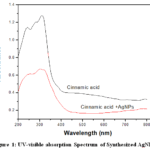 |
Figure 1: UV-visible absorption Spectrum of Synthesized AgNPs Click here to View Figure |
FT-IR Spectroscopy
The generation of very pure AgNPs was confirmed by FTIR analysis of green synthesised AgNPs, which showed a powerfulband at 1386 cm-1and peaks at 563 cm-1that can be attributed to Ag vibrations. The existence of –OH, C–C, and C=O stretching of hydroxyl groupslikealkenes, and alkanes are indicated by the bands at approximately 3296, 1698, and 2377 cm-1, respectively. The stretching of the carboxyl groups is responsible for the significant absorption at 1698cm-1, and the stretching of the aromatic ring’s C=C group was proved by the absorption bands at 1698cm-1, 1574 cm-1, and 1558cm-1. As the absorption strength increases, the adsorption band in the CA-AgNPs FTIR spectra that corresponds to the hydroxyl stretching shifts to 3296cm-1. Furthermore, the carboxyl groups’ corresponding adsorption band shifts to 1698cm-1. These findings demonstrated that the cinnamic acid carboxyl groups were present on the AgNPs’ surface and that they interacted strongly with the Ag atoms there.64-71
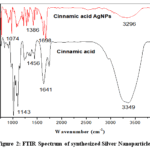 |
Figure 2: FTIR Spectrum of synthesized Silver Nanoparticles Click here to View Figure |
XRD Spectroscopy
Powder XRD is used to characterise the nanoparticles created using this process to verify that they are silver and to determine their structural details. The synthesised nanoparticle’s XRD spectrum is displayed in Figure 3. The (110), (-111), (200), (−202), (020), (202), (−113), and (022) planes were identified as the respective intensity peaks at 2θ of 32.82, 35.72, 38.50, 48.27, 53.95, 58.41, 61.95, and 66.07, according to XRD analysis.72-77 No further phases were detected, and all of the intensity peaks potentially classified as typical monoclinic in structure. JCPDS card no. 801268 verified that the peak positions showed the monoclinic structure of AgNPs.
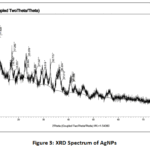 |
Figure 3: XRD Spectrum of AgNPs Click here to View Figure |
Scanning Electron Microscope
SEM was used to examine the shape and surface structure of the produced AgNPs; the resulting micrograph is displayed in Fig. 4. ImageJ software was used to determine the average particle size, which came out to be 59.99 nm.78-80
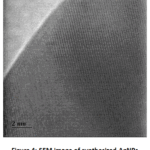 |
Figure 4: SEM image of synthesized AgNPs Click here to View Figure |
Energy Dispersive X-Ray (EDAX/EDX) Technique
Three peaks that are closely associated with Ag in the tested material are shown in the EDAX/EDX studies of Figure 5. According to the data, the reaction product is made up of very pure CA-AgNPs, which is consistent with the XRD result (Figure 4). Ag (76.63%) and Cl (23.37%) were the weight compositions determined by EDAX/EDX analysis of the normalised spectra. Nonstoichiometric CA-AgNP synthesis was also detected by EDAX/EDX.81-84
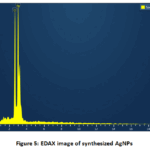 |
Figure 5: EDAX image of synthesized AgNPs Click here to View Figure |
Antimicrobial Activity
By the report of (NCCLS), the agar used disc diffusion method was used to examine the samples’ antibacterial activity. The following table displays the results. The antibacterial efficacy of biologically produced CA-AgNPs against Escherichia coli is demonstrated in Figure 4. However, the study revealed that compared to Staphylococcus aureus and Bacillus cereus (Gram-positive bacteria), Escherichia coli and Pseudomonas aeruginosa (Gram-negative bacteria) were less sensitive to antibiotics and antibacterial agents. The effects are more noticeable when gram-positive bacteria (Bacillus cereus) have an inhibition diameter of 16 mm and gram-negative bacteria (Pseudomonas aeruginosa) have an inhibition diameter of 18 mm.85
Two different types of bacteria were effectively inhibited the CA-AgNPs. However, compared to Gram-positive Staphylococcus aureus, it had greater antibacterial action againstE coli and P aeruginosa. Gram-positive bacterial strains were less sensitive to the biosynthesized CA AgNPs than Gram-negative strains, according to the study’s findings.86 Therefore, adding antibacterial Ag NPs to the aforementioned nanoparticle can help with several biomedical uses as well as environmental remediation, particularly in wastewater treatment. Table 1 and Figure 6 both referenced the antibacterial activity results.
Table 1: Antimicrobial activity results for synthesized AgNPs
|
Sample |
E coli | P aeruginosa | S aureus | B cereus |
| CA-AgNPs | 13 | 18 | 13 |
16 |
|
Antibiotics |
30 | 23 | 34 |
30 |
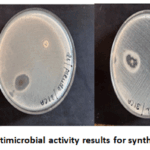 |
Figure 6: Antimicrobial activity results for synthesized AgNPs Click here to View Figure |
Conclusion
UV, FTIR, XRD, SEM, EDAX, and antibacterial activity were used to characterise the synthesised AgNPs. The findings showed that the discussion section provides a detailed explanation of the generated AgNPs capped by cinnamic acid. AgNPs inhibited Pseudomonas aeruginosa and Staphylococcus aureus, according to antimicrobial testing. It is anticipated that the AgNPs produced in this investigation will become effective antibacterial agents. The process is simple to follow in any laboratory setting, the use of harmful reagents is eliminated, and the study is pollution-free, readily available, affordable, and environmentally beneficial.
Acknowledgement
The authors are thankful to Nanjil Catholic College, Kaliyakavilai, Kanyakumari India and Manonmaniam Sundaranar University, Tirunelveli, India for furnishing necessary provision and support for this work.
Funding Sources
The author(s) received no financial support for the research, authorship, and/or publication of this article.
Conflict of Interest
The author(s) do not have any conflict of interest.
Data Availability Statement
This statement does not apply to this article.
Ethical approval
When preparing this article, we perform the experiments contain UV, FTIR, XRD, SEM, EDAX instrumentations and antibacterial activity.
Author’s Contribution
The authors (Angel Mary Jane J. S, Dr. R. Muraliand Deepthi B V) have contributed equally to writing and reviewing the manuscript.
References
- Klaus, T.J., Proc Natl Acad Sci USA, 1999, 96, 13611-13614.
CrossRef - Chernousova, S., Chem. Int. Ed, 2013, 52, 1636–1653.
CrossRef - Congcong., Nanocomposites,2012, 15, 95-101.
- Wilkinson LJ., J Wound Care, 2011, 20, 543–549.
CrossRef - Saravanan M., Elsevier, 2021, 12, 101–122.
CrossRef - Gurunathan., Int. J. Nanomed, 2015, 10, 2951–2969.
CrossRef - Sapsford., Anal. Chem, 2011, 83, 4453–4488.
CrossRef - Sergeev., Mendeleev Commun, 1999, 4, 130–132.
CrossRef - Mafuné,F., Phys. Chem. B2000, 104, 9111–9117.
CrossRef - Hulteen., J. Phys. Chem. B1999, 103, 3854–3863.
CrossRef - Zhu., Mater. Lett. 2001, 49, 91–95.
CrossRef - Abid, Commun. 2002, 7, 792–793.
CrossRef - Talebi, J. J. Sci. 2010, 45, 3318–3324.
CrossRef - Hosseinpou. Mater. Lett.2014, 130, 259–262.
CrossRef - Zhang, J. Am. Chem. Soc. 2011, 133, 18931–18939.
CrossRef - Ganaie, S.U Technol. 2015, 33, 638–644.
CrossRef - Carlson, C. J. Phys. Chem. B2008, 112, 13608–13619.
CrossRef - Mullen, Environ. Microbiol. 1989, 55, 3143–3149.
CrossRef - Klaus,T.; Natl. Acad. Sci.1999, 96, 13611–13614.
CrossRef - Nair, Growth Des. 2002, 2, 293–298.
CrossRef - Kalimuthu, Colloid Surface B2008, 65, 150–153.
CrossRef - Gurunathan, Colloids Surf. B Biointerfaces2009, 74, 328–335.
CrossRef - Kalishwaralal, Colloids Surf. B Biointerfaces2010, 77, 257–262.
CrossRef - Gurunathan, S, Nanoscale Res. Lett.2014, 9, 373.
CrossRef - Thakkar., Nanomedicine2010, 6, 257–262.
CrossRef - Murdock, R.C., Sci. 2008, 101, 239–253.
CrossRef - Sapsford, K.E., Chem.2011, 83, 4453–4488.
CrossRef - Krolikowska., Surf Sci.2003; 532:227-232.
CrossRef - Zhao G, Biometals. 1998; 11:27.
CrossRef - Jiang H., J Appl Polym Sci. 2004; 93:1411-1422.
CrossRef - Okafor F., Int. J. Environ. Res. Public Health. 2013; 10:5221-5238.
CrossRef - Amarendra DD., Colloid Surface A. 2010; 369(3):27-33.
- Pal S L., Journal of Applied Pharmaceutical Science. 2011; 1, 228-234
- VJ Mohanraj., Journal of Pharmaceutical Research”. 2006; 5 (1):561-573
- Horikoshi S And Serpone N. Introduction to Nanoparticles
- Xu., Chemical Engineering Science. 2006; 61:1027-1040.
CrossRef - M Ramya., J. Pharm. Med. & Bio. Sc. 2012; 1.
- Drake., Ann Occup Hyg, 2005; 49:575-585.
- Prabhu S., International Nano Letters. 2012; 2:32
CrossRef - Klaus., Proc Natl Acad Sci USA. 1999; 96:13611-13614.
CrossRef - Sahayaraj K., Nanoscale Research Letters. 2018 (54); 6-7.
- Zhi Zhang., Nanoscale Research Letters. 2018 (54); 6-7.
- Sastry, M., Phys. Chem. B1998, 102, 1404–1410.
CrossRef - Huang., Nanomed. Lond. 2007, 2, 681–693.
CrossRef - Leung., Appl. Opt. 2006, 45, 2186–2190.
CrossRef - Tomaszewska., J. Nanomater. 2013, 2013, 313081.
CrossRef - Link., Rev. Phys. Chem. 2003, 54, 331–366.
CrossRef - Noginov, M., Phys. B2007, 86, 455–460.
CrossRef - Nath, S.S., Nano Trends2007, 2, 20–28.
- Taleb, A., Phys. Chem. B1998, 102, 2214–2220.
CrossRef - He, R., Mater. Chem. 2002, 12, 3783–3786.
CrossRef - Lin, P.C., Adv. 2014, 32, 711–726.
CrossRef - Shang, L., Langmuir 2007, 23, 2714–2721.
CrossRef - Perevedentseva., Quantum Electron. 2010, 40, 1089–1093.
CrossRef - Das, R., Nanotechnol. 2009, 5, 1–6.
- Waseda, Springer Verlag: Berlin, Germany, 2011.
- Ivanisevic., J. Pharm. Sci. 2010, 99, 4005–4012.
CrossRef - Cabral., Environ. Technol. 2013, 34, 1283–1295.
CrossRef - Dey, A., Therm. Spray Technol. 2009, 18, 578–592.
CrossRef - Ananias, D., Microporous Mesoporous Mater. 2013, 166, 50–58.
CrossRef - Singh, D.K.; Exp. Nanosci. 2013, 8, 567–577.
- Sapsford, K.E., Chem. 2011, 83, 4453–4488.
CrossRef - Cantor, San Francisco, CA, USA, 1980.
- Zawrah, Des. 2013, 46, 485–490.
CrossRef - Yazdian., Adv. Powder Technol. 2013, 24, 106–112.
CrossRef - Wu, H., New J. Chem. 2011, 35, 2902–2909.
CrossRef - Vaia, R.A., J. Polym. Sci. Part B Polym. Phys. 2002, 40, 1590–1600.
CrossRef - Ray, S.S., Polym. Sci. 2003, 28, 1539–1641.
CrossRef - Pavlidou, Polym. Sci. 2008, 33, 1119–1198.
CrossRef - Kou, T., Adv.2012, 2, 12636–12643.
CrossRef - Khan, A., Part B Eng. 2013, 45, 1486–1492.
CrossRef - , Powder Technol. 2013, 233, 208–214.
CrossRef - Aghili, S.E., Manuf. Process. 2012, 27, 1348–1353.
CrossRef - Das, R., Adv. Mater. Sci. 2014, 38, 95–109.
- Pawley., Scanning 1997, 19, 324–336.
- Wang, Z.L., Phys. Chem. B2000, 104, 1153–1175.
CrossRef - Yao, H., Formatex Research Center: Badajoz, Spain, 2007; pp. 568–575.
- Joshi., J. Fiber Text. Res. 2008, 33, 304–317.
CrossRef - Williams., Springer Verlag: New York, NY, USA, 2009.
- Hinterdorfer., Acc. Chem. Res.2012, 45, 327–336.
CrossRef - Koh, A., Ultramicroscopy2008, 108, 1490–1494.
CrossRef - Mavrocordatos., Water Sci. Technol. 2004, 50, 9–18.
CrossRef - Picas, L. Chem. Phys. Lipids 2012, 165, 845–860.
CrossRef - Song., ACS Appl. Mater. Interfaces2013, 5, 11563–11568.
CrossRef - Sova M., Rev Med Chem. 2012;12(8):749–767.
CrossRef - Juan., Molecules. 2014; 19:19292–19349.
CrossRef
 PlumX:
  Views: 1027 Views
  PDF Downloads: 1144
 Accepted on: 22 Nov 2025
Second Review by: Dr. Anandhu C S
Final Approval by: Dr. Ayssar Nahle


ISSN Online: 2231-5039