RP-HPLC Strategies for The Quantification of Linezolid: A Review
 , Madhav. B2and R. Gandhimathi*
Department of Pharmaceutical Chemistry and Analysis, School of Pharmaceutical Sciences, Vels Institute of Science, Technology and Advanced Studies, Chennai, Tamil Nadu, India.
Corresponding Author E-mail: gandhimathi.sps@velsuniv.ac.in
DOI : http://dx.doi.org/10.13005/ojc/420205
Download this article as:

This review will discuss the mechanisms, resistance patterns and clinical use of Linezolid, which is the first oxazolidinone antibiotic. Among the important approaches is the analysis of the ability of Linezolid to inhibit the synthesis of bacterial proteins targeting the 23S rRNA of the 50S subunit of the ribosome, thus interfering with the initiation of the protein synthesis process. It further reviews the evolution of Linezolid resistance with specific regard to mutation of 23S rRNA and uL3 and uL4 protein, which undermines the activity of the drug despite these elements being physically far apart. Key outcomes include the clinical application of Linezolid in the intensive care unit in managing the infection that is caused by methicillin-resistant Staphylococcus aureus as well as vancomycin-resistant enterococci. These are hospital-acquired infections that are normally resistant to various antibiotics. Linezolid is a very important treatment alternative, especially in eliminating hospital-acquired infections, especially the ones that are resistant to other medicines. The review highlights the need to keep track of resistance patterns and make the best of using Linezolid to ensure its effectiveness in clinical practice.
KEYWORDS:Gram-positive; Intensive Care Units; Linezolid; Oxazolidinone; Pneumonia
Introduction
Linezolid is a synthetic oxazolidinone antibiotic and is mostly useful in the treatment of infections brought about by Gram-positive bacteria. Although its pharmacological characteristics are well-established, the analytical issues connected with its quantification and regulatory compliance are also not trivial. Since it is a critical part of the treatment of multi-resistant infections, it is of great importance that its quality, safety, and efficacy are ensured through a precise and accurate analysis.
Among the primary issues with Linezolid analytical testing is the necessity to have trustworthy and consistent ways of determining the concentration of Linezolid in the pharmaceutical formulation. High-Performance Liquid Chromatography (RP-HPLC) is commonly known as the useful analytical method used in the quantification of Linezolid. RP-HPLC is a technique that has high specificity and sensitivity and it is applicable in both the qualitative and quantitative analysis of analogous pharmaceutical matrices. Nevertheless, optimization of the method demands close attention to other parameters like the choice of the stationary phase, composing the mobile phase and flow rate.
Such regulatory agencies as FDA focus on strict quality control measures, and such measures demand the use of strong analytical tools to guarantee the therapeutic efficacy of pharmaceutical products. These agencies require that all formulations should go through stringent testing in order to satisfy established standards of purity, potency and stability. Therefore, RP-HPLC is an important testing procedure in the pharmaceutical sector to make sure that Linezolid products meet these requirements, thus, protecting the health of the population.Linezolid is a synthetic antibiotic, which suppresses the synthesis of bacterial proteins by binding to the 50S ribosomal subunit, preventing the formation of the initiation complex and reducing the further formation of peptide chains. This special mode of action makes it different among all other protein synthesis inhibitors and also adds to its effectiveness against multi-resistant Gram-positive bacteria.
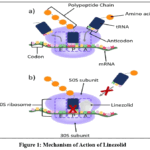 |
Figure 1: Mechanism of Action of Linezolid Click here to View Figure |
(Source: Strategies to Improve the Potency of Oxazolidinones towards Bacterial Biofilms – Scientific Figure on ResearchGate. Available from: https://www.researchgate.net/figure/Linezolids-mode-of-action-aDuring-the-translation-of-mRNA-the-ribosome-moves-along-the_fig2_359590087 [accessed 10 Jun 2025])
Method Development and Validation
|
Method/Author |
Column Type | Mobile Phase | Detection | LOD / LOQ | Linearity | Precision / Accuracy | Sample Type / Notes |
|
Vijayakumar et al., 2021 |
Li Chrospher 100, RP18e | 60:40 ACN:Water + 0.1% formic acid, isocratic, 1 mL/min | UV PDA, 254 nm | ND | ND | ND |
Standard RP-HPLC method |
| BhaskarravMakwana et al., 2014 | Symmetric C18 | 50:50 ACN:0.1 M acetic acid, 1.2 mL/min, isocratic | UV, 254 nm | ND | 100–140 ppm | Retention 3.3 min; ICH validated |
Linezolid fast assay |
|
M. El-Gamal et al., 2013 |
Chromolith Speed ROD RP-18, 50×4.6 mm | 10% n-propanol in 0.02M H₃PO₄ + 0.3% TEA + 0.15M SDS, pH 6.0 | UV | ND | ND | ND | Simultaneous LNZ and Rifampicin |
| GeofferyPeng et al., 2012 | C8, 4.6×150 mm, 5 μm | 20% ACN in water, SPE extraction | UV, 251 nm | 0.01 μg/mL | 0.01–20 μg/mL | CV <10%; accuracy <10% |
Animal plasma (dog, rat, mouse, rabbit) |
|
FriederikeTraunmüller et al., 2010 |
Microbore ODS | ACN:Ammonium acetate buffer (84:16), pH 4.4, 0.5% w/v | UV, 251 nm | ND | 0.05–40 mg/L | ND | Plasma (20 µL) |
| Craig R. Rayner et al., 2003 | ND | ND | UV, internal standard eperezolid | ND | 0.05–16 mg/L | RSD <8.3%, recovery ~100% |
BHI broth |
|
HimaniAgrawal et al., 2003 |
TLC, Silica gel 60F-254 | Acetone:Toluene 5:5 v/v | Densitometry, 254 nm | ND | ND | Compact spots, Rf=0.29 | Bulk & formulations |
| Klaus Borner et al., 2001 | RP-HPLC | Aqueous buffer | UV, 250 nm | 0.07 mg/L | 20 mg/L | Recovery 99–102%, CV 1.8–9.3% |
Human serum & urine |
|
K. Kummerer et al., 2001 |
RP-HPLC | ND | UV, 260 nm | 0.3 mg/mL serum, 0.5 mg/mL urine | ND | ND | Serum & urine, direct injection |
| LejoannaSzymura-Oksiak et al., 2013 | RP-HPLC, UV & DAD | ND | UV & DAD | 0.1 μg/mL | 0.5–30 μg/mL | Intra-day CV <5.42%; recovery good |
Human serum |
| Dina Shokry et al., 2012 | RP-HPLC / Derivative UV | ZORBAX-C18, MeOH:ACN:KH₂PO₄ (60:20:20), pH 3.0 | UV | ND | 2–24 μg/mL | ND | Pharmaceutical dosage forms |
| Lories I. Bebawy et al., 2007 | HPLC / Colorimetric | ND | UV, 557 & 627 nm | ND | ND | ND | Degradation studies, bulk & formulations |
Result and Discussion
The analytical techniques reported in the literature for the quantification of linezolid were carefully evaluated and compared based on chromatographic conditions, detection methods, sensitivity, and validation parameters. The comparative data summarized in the table demonstrate that Reverse Phase High Performance Liquid Chromatography (RP-HPLC) remains the most widely adopted analytical technique for the determination of linezolid in pharmaceutical formulations and biological matrices.
Most of the reported analytical methods utilized C18 or C8 reversed-phase columns due to their high separation efficiency and compatibility with moderately polar pharmaceutical compounds.For instance, the method reported by Bhaskarrav Makwana et al. employed a symmetric C18 columnwith an acetonitrile and acetic acid mobile phase, achieving rapid separation with a retention time ofapproximately 3.3 minutes. Such rapid analytical performance highlights the suitability of RP-HPLCmethods for routine pharmaceutical analysis. Mobile phase composition plays a crucialrole in determining chromatographic performance. In several studies, mixtures of acetonitrile ormethanol with aqueous buffers were used to obtain optimal peak symmetry and resolution. The use of acidic modifiers such as formic acid or phosphoric acid improved peak shape and reduced tailing,thereby enhancing analytical reliability. Additionally, variations in mobile phase composition allowed the simultaneous determination of linezolid with other compounds, as demonstrated inthe work of El-Gamal et al., where linezolid and rifampicin were analyzed simultaneously.Detection wavelengths for linezolid analysis generally ranged between 250 and 260 nm, corresponding to the maximum UV absorption of the compound. UV detection remains themost commonly applied detection technique due to its simplicity, cost-effectiveness, and adequate sensitivity for routine quality control analysis. In some advanced analytical approaches,diode array detection (DAD) and derivative UV spectrophotometry have also been utilized toenhance selectivity and analytical accuracy. Sensitivity parameters such as limit ofdetection (LOD) and limit of quantification (LOQ) varied among the reported methods depending onthe instrumentation and sample matrix. For example, the HPLC method developed by Geoffrey Peng et al. demonstrated a very low detection limit of 0.01 μg/mL, indicating the high sensitivity of RP-HPLC techniques when applied to biological samples such as animal plasma. Similarly, several validated methods demonstrated excellent precision with coefficient of variation values typically below 10%, confirming the reproducibility of these analytical procedures. Another important aspect highlighted by the reviewed studies is the application of linezolid determination in different matrices including pharmaceutical formulations, human plasma, serum, urine, and microbiological culture media. The ability of RP-HPLC methods to accurately quantify linezolid across diverse matrices demonstrates their robustness and versatility in both pharmaceutical quality control and pharmacokinetic studies. Overall, the reviewed analytical strategies demonstrate that RP-HPLC provides reliable, accurate, and sensitive quantification of linezolid. However, future research should focus on developing greener analytical methods that reduce solvent consumption, improve environmental sustainability, and maintain high analytical performance. Additionally, coupling chromatographic techniques with advanced detectors such as mass spectrometry may further enhance sensitivity and selectivity for complex biological samples.
Conclusion
Developing and validating a stability-indicating method for linezolid is an essential part of ensuring the drug’s safety, quality, and efficacy. By carefully optimizing chromatographic conditions and validating the method according to ICH guidelines, pharmaceutical companies can ensure that linezolid remains effective and free of harmful impurities or degradation products throughout its shelf life. For the examination of linezolid and related compounds, HPLC has proven to be a dependable method, frequently used in conjunction with UV or MS detection. In conclusion, analysts and knowledgeable formulators will soon endeavor to develop LIN estimate methods that are less harmful to the environment and employ fewer dangerous solvents.
Acknowledgement
The administration of Vels Institute of Science, Technology and Advanced Studies (VISTAS), Pallavaram, Chennai – 600 117, Tamil Nadu, India, is acknowledged by the authors for providing facilities and assistance for the study. I would want to thank my wonderful mentor for her Assistance.
Funding Sources
The author(s) received no financial support for the research, authorship, and/or publication of this article.
Conflict of Interest
The author(s) do not have any conflict of interest.
Data Availability Statement
This statement does not apply to this article
Ethics Statement
This research did not involve human participants, animal subjects, or any material that requires ethical approval.
References
- Norrby, R.; Expert Opin. Pharmacother.,2001, 2(2), 293–302.
CrossRef - Ament, P. W.; Jamshed, N.; Horne, J. P.; Fam. Physician., 2002, 65(4), 663–671.
- Shinabarger, D. L.; Marotti, K. R.; Murray, R. W.; Lin, A. H.; Melchior, E. P.; Swaney, S. M.; Dunyak, D. S.; Demyan, W. F.; Buysse, J. M.; Agents Chemother.,1997, 41, 2562–2570.
CrossRef - Fu, J.; Ye, X.; Chen, C.; Chen, S.; PLoS One, 2013, 8(3), e58240.
CrossRef - Shokry, D. S.; Waters, L. J.; Parkes, G. M.; Mitchell, J. C.; Snowden, M. J.; Pharm. Sci., 2019, 108(1), 279–287.
CrossRef - Senneville, E.; Legout, L.; Valette, M.; Yazdanpanah, Y.; Giraud, F.; Beltrand, E.; Obert, G.; Dubreuil, L.; Migaud, H.; Mouton, Y.; Antimicrob. Chemother.,2004, 54(4), 798–802.
CrossRef - Watkins, R. R.; Lemonovich, T. L.; File, T. M.; Core Evid.,2012, 7, 131–143.
CrossRef - Batts, D. H.; Oncology, 2000, 14(8 Suppl 6), 23–29.
CrossRef - Ament, P. W.; Jamshed, N.; Horne, J. P.; Fam. Physician., 2002, 65(4), 663–671.
- Zurenko, G. E.; Gibson, J. K.; Shinabarger, D. L.; Aristoff, P. A.; Ford, C. W.; Tarpley, W. G.; Opin. Pharmacol.,2001, 1(5), 470–476.
CrossRef - Poce, G.; Cocozza, M.; Consalvi, S.; Biava, M.; J. Med. Chem., 2014, 86, 335–351.
CrossRef - Faella, F.; Pagliano, P.; Fusco, U.; Attanasio, V.; Conte, M.; Microbiol. Infect.,2006, 12(4), 391–394.
CrossRef - Zhang, X.; Falagas, M. E.; Vardakas, K. Z.; Wang, R.; Qin, R.; Wang, J.; Liu, Y.; Thorac. Dis., 2015, 7(4), 603.
- Ford, C. W.; Zurenko, G. E.; Barbachyn, M. R.; Drug Targets Infect. Disord.,2001, 1(2), 181–199.
CrossRef - Barbachyn, M. R.; Toops, D. S.; Grega, K. C.; Hendges, S. K.; Ford, C. W.; Zurenko, G. E.; Hamel, J. C.; Schaadt, J. D.; Stapert, D.; Yagi, B. H.; Buysse, J. M.; Med. Chem. Lett., 1996, 6(9), 1009–1014.
CrossRef - MacGowan, A. P.; Antimicrob. Chemother.,2003, 51(suppl_2), ii17–ii25.
- Rho, J. P.; Sia, I. G.; Crum, B. A.; Dekutoski, M. B.; Trousdale, R. T.; Mayo Clin. Proc., 2004, 79(7), 927–930.
CrossRef - Vijayakumar, A.; Sudha, V.; Alffenaar, J. W.; Jeyakumar, S. M.; Hemanth Kumar, A. K.; Appl. Bioanal., 2021, 7, e21008.
CrossRef - Patel, E. J.; Patel, D. J.; Desai, S. A.; Meshram, D. B.; J. Pharm. Qual. Assur., 2016, 7, 17–23.
- Kotadiya, R. M.; Patel, F. N.; Pharm. Anal., 2021, 17(8), 983–999.
CrossRef - Crass, R. L.; Cojutti, P. G.; Pai, M. P.; Pea, F.; Agents Chemother.,2019, 63(8), 10–128.
CrossRef - Traunmüller, F.; Schintler, M. V.; Spendel, S.; Popovic, M.; Mauric, O.; Scharnagl, E.; Joukhadar, C.; J. Antimicrob. Agents, 2010, 36(1), 84–86.
CrossRef - Birmingham, M. C.; Rayner, C. R.; Meagher, A. K.; Flavin, S. M.; Batts, D. H.; Schentag, J. J.; Infect. Dis., 2003, 36(2), 159–168.
CrossRef - Agrawal, H.; Mahadik, K. R.; Paradkar, A. R.; Kaul, N.; Drug Dev. Ind. Pharm., 2003, 29(10), 1119–1126.
CrossRef - Borner, K.; Borner, E.; Lode, H.; J. Antimicrob. Agents, 2001, 18(3), 253–258.
CrossRef - Ehrlich, M.; Trittler, R.; Daschner, F. D.; Kümmerer, K.; Chromatogr. B: Biomed. Sci. Appl., 2001, 755(1-2), 373–377.
CrossRef - Bebawy, I. L.; Lett.,2003, 36(6), 1147–1161.
CrossRef - Ba, B. B.; Nso, B. B.; Quentin, C.; Saux, M. C.; Chromatogr. B., 2007, 854(1–2), 104–108.
CrossRef - Guerrero Molina, L.; Martínez-Olondris, P.; RigolMuxart, M.; Esperatti, M.; EsquinasLópez, C.; LuqueChipana, N. A.; Piñer, R.; Torres Martí, A.; Soy Muner, D.; Chem. Lab. Med., 2010, 48(3), 391–398.
CrossRef
 PlumX:
  Views: 1078 Views
  PDF Downloads: 1178
 Accepted on: 29 Mar 2026
Second Review by: Dr. V. S Rajput
Final Approval by: Dr. Ioana Stanciu


ISSN Online: 2231-5039