A Comprehensive Review on Computational and Spectroscopic Analysis of Biological Molecules

Department of Physics, Devi CharanBaruah Girls' College, Jorhat, Assam, India
Corresponding Author Email:m2nerist@gmail.com
DOI : http://dx.doi.org/10.13005/ojc/420233
Download this article as:

There are different methods to analyze the biomolecules. Among them, vibrational spectroscopic method is a suitable tool to analyze the detailed spectroscopic behavior in the infrared region. In this review, we have mainly focused on the progress of Raman and infrared technique as an analytical tool in biomolecular analysis. The combined Raman and IR studies provide complementary information of a system. Surface Enhanced Raman spectroscopy (SERS) is also an indispensable Raman technique which is used to detect the biomolecule adsorbed on rough metallic surfaces. The weak Raman peaks get enhances in the SERS measurements. Different researchers have used these spectroscopic methods to study in forensic sciences, in identification of drug components and impurities and cancer cell analysis to find out the active region affected cells. Several researchers have combined theoretical works as well as experimental works to validate their experimental findings. The works as a whole gives exact pictures of interactive regions as well as spectroscopic fingerprints of biomolecules which are important aspects for drug design using molecular dockings.
KEYWORDS:Biomolecule; Cancer; FTIR; Raman; SERS
Introduction
Biomolecules are the molecules which are produced by living organisms. The major types of biomolecules are proteins, lipids, carbohydrates and nucleic acids. The schematic diagrams of some major biomolecules are given in Figure 1.1
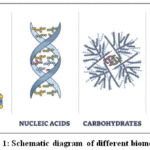 |
Figure 1: Schematic diagram of different biomolecules.1 |
The spectroscopic analysis of biomolecules is a helpful tool in order to find out the active-inactive functional groups of molecules. The comparison of experimental and theoretical spectral data provides information regarding the hydrogen bonding interactions as well as different environmental effects. The transitions of energy in a molecular system are mainly studied using vibrational spectroscopy. This technique not only provides the nature of bonding between the elements but also gives important information regarding the intermolecular interactions between the atoms of the molecule. The spectroscopic analysis of the cells of different syndromes is helpful to design the drug in order to destroy the functional groups of the disease. The spectroscopic analysis is also helpful to find out to disorder of the cells in the body. In this review we have discussed the recent application of vibrational spectroscopy in biomolecular system.
A spectroscopic study is important for developing fundamental theories of science.2-3 Spectroscopic methods are highly sensitive to the electromagnetic radiation. Spectroscopic technique covers a region of the electromagnetic spectrum. There are different spectroscopic methods depending on the wavelength region of the electromagnetic spectrum. In vibrational spectroscopy the primary aim is to study infrared region of electromagnetic spectrum.4 It is primarily associated with absorption spectroscopy. The Raman and infrared techniques together are termed as vibrational spectroscopy. Raman spectroscopy is widely used the characteristics of different molecules.5-10
Discussion
Raman Spectroscopic method
Raman spectroscopic method is inelastic scattering. This technique is used to record the vibrational and rotational modes of a system.11 This technique provides a structural fingerprint of a species. This spectroscopic method was discovered by Raman, C.V.; and Krishnan, K.S.;12 At the same time this effect was also observed by G. Landsberg and L. Mandelstam. [13] Raman and co-workers [12] had observed this phenomenon in liquids, while G. Landsberg and his team13 noticed the inelastic scattering mechanism in crystals. In 1923, A. Smekal had given the first theoretical prediction on the Raman Effect.14 When light scattered from matter, most of the photons processes same energy and wavelengths as that of incoming radiationwhichis termed as elastic scattering. They had observed that a small fraction of the photons scattered with a different energy than the incident radiation.15 This is due to the absorption or emission of energy by the atoms or molecules. The later phenomenon is termed as inelastic or Raman scattering of radiation. The energy level diagram16 of Raman and Rayleigh scattering is shown in Figure 2.
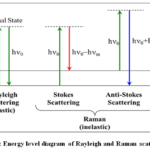 |
Figure 2: Energy level diagram of Rayleigh and Raman scattering 16 |
Raman spectroscopy is a suitable method for spectroscopic analysis. This spectroscopic method is used in Chemist, Biologist and Physicist in order to identify the types of molecules, biomolecular interactions, vibrational assignment and interacting environment in that system. The vibrational spectra provide the spectral fingerprint of a molecule 17 and the Raman spectral fingerprint is necessity to identify the molecular system.18 In Nano science it is used to analyse and understand the structures of nanowires. This spectroscopic method also has a broad field of in biological applications19-26 medicines and bio minerals.The application of this method in different fields is shown in Figure. 3.27
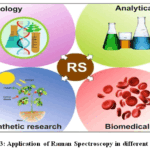 |
Figure 3: Application of Raman Spectroscopy in different fields27 |
Surface Enhanced Raman Scattering (SERS)
The cross section ofRaman scattering in biomolecular system is inherently weak and hence a very poor number of scattered photons can be detected. SERS is a surface sensitive technique where the weak signals of molecules adsorbed on rough metallic surface get enhanced.28 SERS method gives almost 1010– 1011 times enhances Raman signal, which is the greatest advantage of this technique.29-30 The technique may also detect single molecules.31-33 The most common Nano particles are silver and gold for the SERS measurements. The large enhancement in the Raman signal is observed due to the absorption of molecules at the surface of the enhanced field.
Researchers have investigated the exact mechanism of SERS which is still a matter of debate. Basically there are two mechanisms of SERS.
Electromagnetic theory and b) Chemical theory.
Electromagnetic enhancement theory
This theory assumes the enhancement of the Raman spectra due to the amplification of light by the excited localize surface Plasmon resonances (LSPR). The localized surface plasmons (LSP) of the nanoparticles are excited by the time‐varying field of the incoming light. In noble metals, plasmons are resonantly excited by the visible region of the electromagnetic spectrum.34-35 The enhancement factor is found to be highest when frequency of incident radiation surface plasmons are is in resonance with each other. In order to get the Raman scattering, the metallic surface should be in perpendicular with the oscillations of the surface plasmons, otherwise there would not be any scattering. Because, the roughened surfaces in SERS experiments provides an area to occur localized collective oscillations.36-37
Chemical enhancement theory
For chemical enhancement of a sample, the sample should keep in contact with the surface of the Nano particles. [38] In this theory it is assumed that there should be charge transfer mechanism to increase the Raman cross section between the Nano particles and the sample. The SERS enhancement is achieved due to broadening and shifting of the electronic level arises from the Nano particles and the sample.39
Shell Isolated Nanoparticle Enhanced Raman spectroscopy (SHINERS)
In this measurement we get enhance Raman signal, although it has several limitations. For a molecule to be SERS active the substrate must be Nano clusters and the SERS substrate is always roughened. These problems can be overcome by adding ultrathin silica or alumina shell gold nanoparticles which is active of SERS. [40]It spread over the surface of any specimen and commonly known as SHINERS. This kind of Nano particle with Au core provide large enhancement and the dielectric shell spreads over the surface and prevents the core from interacting with sample.41
Fluorescence Spectroscopy
This spectroscopic method is broadly used in order to find out structure at different infrared region of molecule by measuring the frequencies of emitted light. In fluorescence spectra a fixed difference in wavenumber appears relative to the wavenumber of excitation. In fluorescence spectroscopy the excitation spectrum of emission appears at a constant wavenumber. It is a useful analytical method in biophysics and material science. It is also used to investigate fluorophores within biological samples.42 This spectroscopic method becomes popular in medical science as different drugs shows intense fluorescence peaks in biological environment.43-44 The behavior of non-fluorescence drugs can also be investigated using different fluorogenic labeling techniques. [45] The presence of aromatic rings in the anti-cancer drug results strong fluorescence peaks. Researcher had studied the mechanism of interactions of different anti-cancer drugs with biological media like DNA, RNA etc.46-47
Fourier Transform Infrared (FTIR) Spectroscopy
Fourier Transform Infrared (FTIR) Spectroscopy deals with the study of interaction of matter with infrared radiation. Here we record the spectra of a particular sample by allowing to pass a infrared beam through it.48 It is a modern from infrared spectroscopy. Over a wide spectral range the interferometer of an FTIR can collects high resolution data.49 In FTIR, the recorded numerical data is converted to spectrum by the mathematical process known as Fourier transform.
Raman and IR spectroscopy in pharmaceutical research
Vibrational spectroscopic techniques have a great deal of interest in pharmaceutical research. It can be used to gain information of the interaction between drugs and the cells. It also provides the nature of biochemical changes in the target cells with the application of drugs; hence vibrational spectroscopic methods have been used for drug screening purposes.50 In order to relief from the affected cells High throughput screening (HTS) is used to gain information of the immediate action of drugs on the target cells.51 The vibrational spectroscopic screening produces the biochemical changes in the spectrum. It has greater deal of interest than the HTS methods as it produces the toxic effects of the drugs in terms of peaks. The homogenous distribution of the Active Pharmaceutical Ingredient (API) nanoparticles over the tablet can be achieved from the Raman chemical imaging method.52 The Raman chemical imaging provides innovative complex drugs with highly ordered structures.53 The Raman spectroscopic method had been used by J. Chen and et al. to characterize Nano sized pegylated reduced oxide of graphene.54 It is used during tumor therapy as a carrier for drug delivery system. Raman and IR spectroscopy is broadly used in order to study the vibrational spectra of biomolecules. The vibrational spectroscopic investigations using Raman and IR methods are helpful to build spectral databank. Table 1 shows some of the stretching vibrational modes of biomolecules due to the absorption of infrared radiation.55-57
There are different drugs for different types of cancer. The action of the drugs with the cancer cell causes cancer cell to die. The drugs are manufactured in such ways that, its effect on normal cells are less and healthy cells also recover faster. In Table 258-59 we have shown the types of drugs for the treatment of various kind of cancer. The cancer cell lines of Henrietta Lacks human cervix carcinoma and human bladder carcinoma were investigated using FTIR spectroscopy by E. P. U. Otero and et al. 60 They had calculated the spectral differences using chemometrical and the principal component analysis (PCA) statistical method. The FTIR method gave them useful information regarding the compositions of the cancer cells, which is helpful to design drugs. H. Alireza61 had investigated malignant cancer before and after irradiating of synchrotron radiation by different spectroscopic methods. He had observed that this kind of cancer cells transformed to benign human cancer cells under synchrotron radiation gradually. He used different cancer cells of more than one hundred thousand cancer patients found almost similar results.
1Table 1: Characteristics absorption region of biomolecules in the IR region.55-57
|
Absorption |
Group | Compound | IR Intensity |
Raman Intensity |
|
3700-3584 |
OH str. | alcohol | M | W |
| 3550-3200 | OH str. | alcohol | S |
W |
|
3500-3400 |
NH str. | primary amine | M | M |
| 3400-3250 | NH str. | aliphatic primary amine | M |
M |
|
3300-2500 |
OH str. | carboxylic acid | S | W |
| 3200-2700 | OH str. | alcohol | W |
W |
|
3333-3267 |
CH str. | alkyne | S | W |
| 3100-3000 | CH str. | alkene | M |
W |
|
3000-2840 |
CH str. | alkane | M | S |
| 2830-2695 | CH str. | aldehyde | M |
S |
|
2600-2550 |
SH str. | thiol | W | S |
| 1740-1720 | CO str. | aldehyde | S |
M |
|
1840-1800 |
CO str. | anhydride | W | W |
| 1780-1740 | CO str. | anhydride | S |
M |
|
1750-1720 |
CO str. | ester | S | M |
| 1745-1715 | CO str. | ketone | S |
M |
|
1700-1500 |
CO str. | amide | S | M |
| 1680-1600 | CC str. | alkene | W |
S |
|
1600-1400 |
CC str. | aromatic | W |
S |
1 Characteristics absorption region of biomolecules in the IR region
(str –stretching vibration, S-strong, M-Medium, W-weak
2Table 2: Types of drugs for different types of cancer.58-59
|
Cancer |
Name of drug | Cancer |
Name of drug |
|
Breast cancer |
Avastin, Afinitor | Melonoma | PEG-Intron |
| Chronic Lymphocytic Leukemia | Treanda, Bendeka, Arzerra | Non-small cell lung cancer |
Xalkori |
|
Follicular Lymphoma |
Rituxan | Pancreatic neuroendocrine tumor | Afinitor |
| Glioblastoma | Avastin | Ph- positive chronic myeloid leukemia |
Sprycel, Tasigna |
|
Indolent non- Hodgkin Lymphoma |
Treanda | Renal cell carcinoma | Inlyta, Afinitor, Votrient |
| Medullary thyroid cancer | Cabometyx, Cometriq | Soft tissue sarcoma |
Votrient |
2 Types of drugs for different types of cancer
Raman and IR spectroscopy in herbal medicine
The Raman and IR techniques have a broad field of applications in herbal medicine. The presence of some valuable compounds in herbal medicine is main reason to use for treatment of different disease. Sometimes the presence of some harmful chemical causes serious side effects. Vibrational spectroscopic techniques have been widely used as a fingerprint method for authentication of herbs.
The authentication of Chrysanthemum was carried out by H. X. Liu and et al.62 using FTIR spectroscopy. They had extracted and differentiated of the origins of Chrysanthemum for principle component analysis from different places. They had observed some differences in peak intensities in the fingerprint region of the vibrational modes. H. G. Edward and et al.63 had used Raman spectroscopic technique to distinguish different types of ginseng material in accordance to the country of origin. Ginseng plant has great benefits for the human body. It is used to control the blood sugar, reduce stress, boost energy and control cholesterol level. Due to its medicinal benefits, the international trading of this specimen is not legally permitted different countries due to its medicinal benefits. They had used Raman techniques to discriminate between restricted and permitted imports. Several researchers had assigned the vibrational modes of gerbil medicines using Raman spectroscopy.64-66
Conclusion
In this report, we have mainly aimed on the application of vibrational spectroscopy in biomolecular system. Raman and IR techniques are mainly used to record the fingerprint absorption spectra in the infrared region. The spectral data gives the useful information regarding the active-inactive properties of the functional groups. The vibrational spectroscopy has a considerable importance in cancer research. The Raman and IR spectra of cancer cells provide valuable information’s in order to design drugs. The comparison of experimental and theoretical vibration spectra gives information of hydrogen bonding interactions as well as environmental effects. The effect of a biomolecule on another molecule can be observed by observing the vibration spectra of their interaction system. We have also reported the advantage of SERS technique over normal Raman method. The Raman spectra of biomolecule is inherently weak, thus the enhanced SERS spectra provides clear picture of scattered radiation from the biomolecules adsorbed on rough metallic surfaces.
Acknowledgement
The author (M.M. Borah) is thankful to Devi Charan Baruah Girls’ College, India for supporting during this work.
Funding Sources
The author(s) received no financial support for the research, authorship, and/or publication of this article.
Conflict of Interest
The author(s) do not have any conflict of interest.
Data Availability Statement-
This statement does not apply to this article.
Ethics Statement
This research did not involve human participants, animal subjects, or any material that requires ethical approval.
References
- https://www.istockphoto.com/vector/biomolecules-or-biological-molecules-type-collection-in-outline-diagram-gm1339953933-420152361.
- Kavipriya,R.; Kavitha,H.P.; Karthikeyan,B.; Vennila,J.P.; Rhyman,L.; Ramasami,P.;Physical Sciences Reviews2021, 6,2019-0003.
- Tampieri, A.; Szabo,M.; Medina,F.; Gulyas,H.;Physical Sciences Reviews2021, 6, 2019-0086.
- Reichenbacher,M.; Popp, J.; Challenges in Molecular Structure Determination, Springer, 2012.
CrossRef - Emin, A.; Hushur, A.; Mamtimin, T.; AIP Advances2020, 10,
CrossRef - Emin, A.; Li, J.; Song, X.; Fu, Y.; He, D.; Li, Y.; Journal of Power Sources2022, 551, 232185.
CrossRef - Emin, A.; Li, J.; Dong, Y.; Fu, Y.;He, D.;Li, Y.; Journal of Energy Storage2023, 65, 107340.
CrossRef - Emin, A.;Song, X.; Du, Y.; Chen, Y.; Yang, M.; Zou, S.; Fu, Y.; Li, J.;Li, Y.; He, D.; Journal of Energy Storage2022, 50, 104667.
CrossRef - Emin, A.; Hushur, A.; Kojima, S.; Ferroelectrics2022, 601, 167-178.
CrossRef - Emin, A.; Gong, B.; Jiang, H.; Rare Metals2025, 10.1007/s12598-025-03455-z.
- Gardiner,D. J.; Practical Raman spectroscopy, Springer,(1989).
CrossRef - Raman,C.V.;Current Science1998, 74, 382–386.
- Landsberg, G.;Mandelstam,L.;Naturwissenschaften1928, 16,557-558.
- Smekal,A.;Naturwissenschaften1923, 11, 873–875.
CrossRef - Harris,D.C.; Bertolucci,M.D.; Symmetry and Spectroscopy: An Introduction to Vibrational and Electronic Spectroscopy, Dover Publications,(1989).
- http://bwtek.com/raman-theory-of-raman-scattering.
- Clark, J.; The fingerprint region of an infra-red spectrum, Chemguide, (2000).
- Khanna,R.K.; Stranz,D.D.; Donn, B.; Journal of Chemical Physics1981, 74, 2108-2115.
CrossRef - Butler,H.J.; Ashton,L.; Bird, B.; Cinque,G.; Curtis,K.; Dorney,J.; White,K.E.; Fullwood,N.J.; Gardner,B.; Hirsch,P.L.M.; Walsh,M.J.; McAinsh,M.R.; Stone,N.; Martin, F.L.; Nature Protocols2016,11, 664-687.
CrossRef - Chou, K.C.; Chen,N.Y.;Scientia Sinica1977, 20,447–457.
- Urabe,H.; Tominaga,Y.; Kubota,K.;Journal of Chemical Physics1983, 78, 5937–5939.
CrossRef - Chou, K.C.;Biochemical Journal1983, 215, 465–469.
CrossRef - Chou, K.C.;Biochemical Journal1984, 221, 27–31.
CrossRef - Urabe, H.; Sugawara,Y.; Ataka, M.; Rupprecht,A.;Biophys J. 1998, 74, 1533–1540.
CrossRef - Chou, K.C.;Biophysical Chemistry1988, 30, 3–48.
CrossRef - Chou, K.C.;Trends in Biochem. Scienes1989, 14, 212–213.
CrossRef - Allakhverdiev, E.S.; Khabatova, V.V.; Kossalbayev, B.D.; Zadneprovskaya, E.V.; Rodnenkov, O.V.; Martynyuk, T.V.; Maksimov, G.V.; Alwase, S.; Tomo, T.; Allakhverdiev, S.I.; cells2022, 386, 1-25.
CrossRef - Xu, X.; Li,H.; Hasan,D.; Ruoff,R.S.; Wang,A.X.; Fan,D.L.;Adv. Funct. Mater2013, 35, 4273-4385.
CrossRef - Blackie,E.J.; Ru,E.C.L.; Etchegoin,P.G.;J. Am. Chem. Soc.2009, 131, 14466–14472.
CrossRef - Blackie,E.J.; Ru,E.C.L.; Etchegoin,P.G.;J. Phys. Chem. C2007, 111, 13794–13803.
CrossRef - Nie,S.; Emory, S.R.;Science1997, 275, 1102–1106.
CrossRef - Ru,E.C.L.; Meyer,M.; Etchegoin, P.G.; J. Phys. Chem. B2006, 110, 1944–1948.
CrossRef - Sharma, B.; Frontiera,R.; Henry,A.; Ringe,E.; Duyne,E.R.V.; Materials Today2012, 15, 16-25.
CrossRef - Aroca,R.; Surface‐Enhanced Vibrational Spectroscopy, Wiley, New York, (2006).
CrossRef - Kneipp,K.; Moskovitz,M.;Kneipp, H.; Surface‐Enhanced Raman Scattering: Physics and Applications, Topics in Applied Physics, Springer, Berlin, (2006).
CrossRef - Smith,E.; Dent,G.; ModernRaman Spectroscopy: A Practical Approach, John Wiley and Sons, (2005).
- Moskovits,M.; Surface-Enhanced Raman Spectroscopy: a Brief Perspective. In Surface-Enhanced Raman Scattering – Physics and Applications, Springer, Berlin, (2006).
- Campion,A.; Kambhampati,P.;Chem. Society Reviews1998, 27, 241-250.
CrossRef - Siddhanta, S.; Narayana,C.;Nanomaterials and Nanotechnology2012, 2, 1-13.
CrossRef - Li, J.; Huang, Y.; Ding, Y.; Yang, Z.; Li, S.; Zhou, X.; Fan, F.; Zhang, W.; Zhou, Z.; Wu, D.; Ren, B.; Wang, Z.; Tian, Z.;Nature2010 , 464, 392-395.
CrossRef - Anema,J.; Li, J.; Yang, Z.; Ren, B.; Tian, Z.Annual Review of Ana. Chem.2011, 4, 129-150.
CrossRef - Hof,M.; Hutterer,V.; Fidler,V.; Fluorescence Spectroscopy in Biology: Advanced Methods and their Applications to Membranes, Proteins, DNA, and Cells,Springer, Berlin, (2005).
CrossRef - Valeur, B.; Brochon, J.C.; In New Trends in Fluorescence Spectroscopy. Applications to Chemical and Life Sciences, Springer, Berlin, (2001).
CrossRef - Valeur,B.; In Molecular Fluorescence, Principles and Applications, Wiley-VCH, Weinheim, (2002).
CrossRef - Slavik,J.; In Fluorescence Microscopy and Fluorescent Probes, Plenum Press, New York, (1996).
CrossRef - Tjaden,U.R.; Bruijn,E.A.D.;Journal of Chromatography B: Biomedical Sciences and Applications1990, 531, 235-294.
CrossRef - Couderc,F.; Causse,E.; Bayle,C.;Electrophoresis1998, 19, 2777-2790.
CrossRef - Griffiths,P.; Hasseth,J.A.D.;FourierTransform Infrared Spectrometry (2nd ed.), Wiley-Blackwell, (2007).
- Singh, P.; Andola,H.C.; Rawat,M.S.M.; Pant,G.J.N.; Purohit,V.K.;Research Journal of Medicinal Plants2011, 5, 127-135.
CrossRef - Nawaz,H.; Bonnier,F.; Knief,P.; Howe,O.; Lyng,F.; Meade,A.; Byrne,H.;The Analyst2010, 135, 3070-3076.
CrossRef - Szymanski,P.; Markowicz,M.; Olasik,E. M.;Intern. J. of Mol. Sciences2011, 13, 427-452.
CrossRef - Sacre,P.; Lebrun,P.; Chavez,P.; Bleye, C.; Netchacovitch,L.; Rozet,E.; Klinkenberg,R.; Streel,B.; Hubert,P.; Ziemons,E.;Analytica Chimica Acta2014, 818, 7-14.
CrossRef - Yessine, M.; Advanced Drug Delivery Reviews2004, 56, 999-1021.
CrossRef - Chen, J.; Liu,H.; Zhao, C.; Qin,G.; Xi, G.; Li,T.; Wang,X.; Chen,T.;Biomaterials2014, 35, 4986-4995.
CrossRef - Socrates, G.; Infrared and Raman Characteristics group frequencies tables and charts, John Wiley & Sons, (2001).
- Lin, S.Y.; Li, M.J.; Cheng, W.T.; Spectroscopy2007, 27, 1-30.
- Borah, M.M.;Vietnam Journal of Chemistry2022, 60, 718-737.
CrossRef - National cancer Institute, Drugs Approved for different types of Cancer.
- Cancer Quest.org, Cancer Treatment Tables.
- Otero,E.P.U.; Neto,E.G.S.; Fonseca,E.J.S.; Hickmann, J.M.; Rodarte,R.; Barreto,E.; Jalkanen, K.J.;Current Physical Chemistry2013, 3, 36-43.
CrossRef - Alireza,H.;J. Cancer Oncol.2018, 2, 1-16.
- Liu,H.; Zhou,Q.; Sun,S.; Bao,H.;Journal of Molecular Structure2008, 883, 38-47.
CrossRef - H. Edwards, T. Munshi, K. Page, Analytical and Bioanalytical Chem.2007, 389, 2203-2215.
CrossRef - Andreev, G.; Schrader,B.; Schulz,H.; Fuchs, R.; Popov,S.; Handjieva,N.;Fres. J. of Analyt. Chem.2001, 371, 1009-1017.
- Rooney, J.; McDowell,A.; Strachan,C.; Gordon,K.;Talanta, 2015, 138, 77-85.
CrossRef - Srivastava,A.; Tandon,P.; Ayala,A.; Jain,S.;Vibrational Spectroscopy2011, 56, 82-88.
CrossRef
 PlumX:
  Views: 883 Views
  PDF Downloads: 1168
 Accepted on: 25 Jan 2026


ISSN Online: 2231-5039