Synthesis of Graphene-Reinforced Metal Matrix Composites for Aerospace Applications
 , B Satyanarayana Murthy2, P. Ananthakumar3, Balasubramaniyan Veeramuthu4, GL Narasamba Vanguri5 and R. Senthamil Selvan1
1Department of ECE, Annamacharya Institute of Technology and Sciences (Autonomous), Tirupati, A.P, India.
2Department of Computer Science and Engineering, Shri Vishnu Engineering College for Women, Bhimavaram, A.P, India.
3Department of ECE, V.S.B. Engineering College, Karur, Tamil Nadu, India.
4Department of Mechanical Engineering, Vel Tech Rangarajan Dr. Sagunthala R and D Institute of Science and Technology, Chennai, Tamil Nadu, India.
5Department of Information Technology, Aditya University, Surampalem, Andhra Pradesh, India.
Corresponding Author E-mail: srohini512@gmail.com
Download this article as:
ABSTRACT:Graphene-Reinforced Metal Matrix Composites (GRMMCs) persist in becoming a potential group of materials for use in spacecraft because they have better electrical, thermal, and mechanical qualities. This review is mostly about the methods used to make GRMMCs, such as spark plasma sintering, stir casting, and powder metallurgy. It shows how these methods change the way graphene is spread out, how it bonds to other materials, and how well it stays together in the metal matrix. The review also talks about the important factors that determine how well GRMMCs work, like the amount of graphene they contain, how they are dispersed, and how they combine with other materials. Adding graphene to metal grids improves their qualities like tensile strength, stiffness, resistance to wear, and ability to conduct heat. This makes them perfect for use as structural and functional parts in aircraft settings. The problems that come with clustering, bad wetting, and surface degradation are also discussed, along with ways to fix them. At the end of the study, directions for future research are given to improve the stability as well as the scalability of GRMMCs for aircraft use and make the synthesis processes more efficient.
KEYWORDS:Graphene; Interface Bonding; Metal Matrix Composites; Powder Metallurgy; Spark Plasma Sintering
Introduction
The aerospace industry is always looking for materials that are both lightweight and strong and can handle heat and stress well.1 By making parts lighter, you may immediately improve fuel economy, increase cargo capacity, and improve overall operating performance. As a result, the need for sophisticated materials that can handle severe environmental conditions, such as high temperatures, thermal cycling, and major mechanical stress, has grown.
Because of their good combination of mechanical strength and thermal stability, traditional metal matrix composites (MMCs) have shown promise in aerospace applications. But these composites typically have a hard time meeting the performance standards that are becoming stricter under intense operating circumstances.2 Problems, including reinforcement agglomeration, poor interfacial bonding, and a low thermal conductivity, make them less useful in sophisticated aeronautical systems. Graphene is a groundbreaking nanomaterial because of its amazing features, such as high tensile strength, great thermal conductivity, & great electrical qualities. Graphene might get around a lot of the problems that arise with using standard reinforcements in MMCs.3 Its two-dimensional shape gives it a wide surface area for transferring loads, and its atomic-scale thickness keeps weight down, a great combination for optimising aeronautical design.4
The goal of this research is to learn more about how to make metal matrix composites using graphene reinforcement for use in aircraft .5 The main goals of this study are to determine the best processing settings for achieving uniform graphene dispersion and effective interfacial bonding, as well as to assess the mechanical & thermal behaviour of these composites.6
Methods for making graphene-reinforced MMCs using powder metallurgy processes like sintering and ball milling are central to the approach.7-10 Mechanical testing, X-ray diffraction (XRD), and scanning electron microscopy (SEM) are some of the characterisation procedures used to evaluate microstructure and performance.11-15 Finding a workable way to incorporate graphene into MMCs and laying the groundwork for next-gen lightweight, outstanding performance aerospace materials are the anticipated contributions of this project.16-20
Literature Review
Graphene-reinforced metal matrix composites (GRMMCs) are an innovative type of advanced material that has become popular because they have great mechanical, thermal, and electrical qualities. This makes them especially appealing for use in aircraft. It has a great strength-to-weight ratio and a high thermal conductivity (~5000 W/mK) & Electrical Conductivity. Adding graphene to common metals like aluminium (Al), magnesium (Mg), titanium (Ti), as well as copper (Cu), has shown a lot of promise in improving the general efficiency of structural aerospace components. Several experts have looked into different ways to make metals, like powder metallurgy, Spark Plasma Sintering, stir casting, as well as additive manufacturing, so that graphene can be evenly spread out in metals without sticking together and with strong interfacial bonds.
Rashad et al. proved that graphene nanosheets may significantly enhance the mechanical strength & resistance to wear of magnesium composite while preserving the lightweight properties essential for aeronautical applications. Likewise, Bakshi and Agarwal investigated friction stir processing and documented improvements in yield strength and ductility in graphene-aluminium composites. Kumar et al. examined spark plasma sintering & noted a uniform spreading of graphene in a private aluminium matrix, resulting in enhanced hardness & tensile strength. Nonetheless, maintaining uniform dispersion of graphene is a problem because of its propensity to agglomerate, and optimising interfacial bonding without compromising the graphene structure is essential for attaining the required performance of the composite.
Additionally, researchers have examined the influence of graphene content and its form (e.g., single-layer, few-layer, functionalised graphene) on the final characteristics of the composite. Increased graphene content does not necessarily ensure enhanced performance; rather, it may result in clustering & stress concentration areas, adversely affecting mechanical integrity. To address these constraints, hybrid reinforcements that integrate graphene with ceramic elements (such as SiC or Al₂O₃) have been shown to have synergistic benefits in enhancing hardness, wear resistance, and fatigue life.
Scalable fabrication technologies that work for industrial purposes have also been the subject of recent research. The capacity to fabricate intricate aeronautical parts with microstructures that are precisely tuned has piqued the attention of additive manufacturing approaches like selective laser melting (SLM). But deterioration is a real possibility when high-energy processes interact with graphene. While a lot has been accomplished in the realm of GRMMC research and development, the real test will be in attaining a consistent distribution, robust interfacial bonding, and scalable production that doesn’t break the bank. A number of recent publications have laid the groundwork for the potential use of GRMMCs in structural components, heat sinks, and engine elements of next-generation aeronautical systems.
State of the Art (SOTA)
There has been a lot of research on graphene-reinforced metal matrix composites in the last few years, since they have very good mechanical, thermal, & electrical features. Most research has concentrated on matrices like aluminium (Al), magnesium (Mg), and titanium (Ti), because of their low weight and significance in aeronautical applications. But these materials have certain problems: Al doesn’t stick well to graphene, Mg is very reactive and may oxidise easily, and Ti is strong but costs a lot and is hard to work with.
A number of synthesis methods have been investigated for the purpose of producing GR-MMCs. These methods include spark plasma sintering (SPS), powder metallurgy, and stir casting. While stir casting is scalable and inexpensive, it has trouble evenly dispersing graphene. Although powder metallurgy allows for more precise manipulation of microstructure and composition, it also carries the risk of creating pores and poor interfacial bonding. The high equipment cost & sample size are limitations of SPS, despite its outstanding densification and low processing times.
Achieving consistent graphene dispersion with no agglomeration and guaranteeing robust interfacial interaction between graphene and metal matrix are 2 of the main problems in GR-MMCs. Thermal conductivity, load transmission, and general performance are all directly impacted by these problems. Current approaches often fail to overcome these bonding and dispersion issues. By using sophisticated processing methods designed for aerospace-grade composites, this study bridges the technical gap by putting forward an optimised synthesis approach targeted at enhancing graphene dispersion & interfacial bonding.
Materials and Methods
Choosing the Materials
When making graphene-reinforced metallic matrix composites (GRMMCs), the materials used must have good dynamic properties, low density, heat stability, and be able to work with graphene-based fillers. These are all very important for aircraft use. Aluminium (Al) is commonly used because it has a high strength-to-weight ratio, doesn’t rust, and conducts heat better than other metals. This makes it a good choice for many solid aircraft parts. It is also thought about using magnesium (Mg), which is very light and has a high specific strength. However, it needs to be reinforced to make up for its flaws, like not being very resistant to rust and creep. Titanium (Ti) is valuable because it is very strong, strongly resists rust, and can keep its mechanical integrity at high temperatures, which is very important for high-performance aircraft systems.
Reinforcement materials: Graphene Nanoplatelets (GNPs): These have very high tensile strength (about 130 GPa) as well as thermal conductivity (about 5000 W/mK), which helps materials hold weight and get rid of heat.
Reduced Graphene Oxide (rGO): It keeps functional groups that can help it link with metal matrices and spread out better.
It is necessary to maintain essential stoichiometric ratios for efficient contact bonding: Al: C = 4:1 restricts excessive Al₄C₃ production in aluminium matrices, while Ti: C ≈ 1:1 encourages stable TiC synthesis in titanium matrices, both of which guarantee robust graphene–metal bonding.
Rationale for Selection: A comparative investigation of material attributes is presented in Table 1 and Figure 1.
Table 1: Comparative Investigation of Material Attributes
| Properties | Aluminium | Magnesium | Titanium | GNPs | rGO |
| Density (g/Cm3) | 2.70 | 1.74 | 4.51 | ~2.2 | ~2.1 |
| Tensile Strength (MPa) | 310 | 190 | 900 | ~130.000 | ~110.000 |
| Tthermal Conductivity (W/mK) | 237 | 156 | 22 | ~5000 | ~3000 |
| CTE (10-6/K) | 23.1 | 26.0 | 8.6 | ~8 | ~6 |
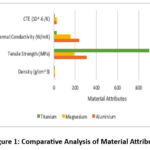 |
Figure 1: Comparative Analysis of Material Attributes Click here to View Figure |
Composite Fabrication Techniques
The powder metallurgy method was used to make the composites. This method is very good at keeping the structure of graphene intact while making sure that the reinforcement is evenly spread throughout the metal matrix. There were a few important phases in the making process. At first, the mixing step included employing ball milling to combine metal matrix powders via graphene nanoplatelets (GNPs) or reduced graphene oxide (rGO). The kinetic energy equation, E = 1/2 m, v2 tells us how much energy is used in this operation. Here, m is the mass of milling balls and v is their speed. The mixture was then compacted in one direction at a pressure of 500 MPa and sintered in an argon environment to keep it from oxidising. The temperature for sintering was changed according to the matrix material. For aluminium and magnesium, it was 600–700°C, while for titanium, it was 1100°C. The holding duration stayed the same at 2 hours.
Multiple approaches were used to get the optimum dispersion of graphene inside the matrix. Ball milling was shown for 4 hours at 200 rpm utilising stearic acid as a method control agent. Surfactant-assisted mixing was used, whereby graphene nanoplatelets (GNPs) were processed in an ethanol solution containing sodium dodecyl sulphate (SDS) to enhance dispersion. The surfactant employed was Sodium Dodecyl Sulphate (SDS), with the chemical formula C₁₂H₂₅SO₄Na, which improved graphene wettability and uniform dispersion within the metal matrix. Furthermore, ultrasonication with a 20 kHz probe was performed for one hour to efficiently exfoliate graphene layers. During the procedure, rigorous safety protocols were adhered to. All handling of nanomaterials was conducted in a glove box under inert conditions, with workers using protective clothing and operating beneath fume hoods to reduce exposure to airborne nanoparticles. (Figure 2).
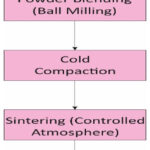 |
Figure 2: Process of Fabrication Click here to View Figure |
Techniques for Characterisation
The researcher did a microstructural study of the composites that were made using a variety of advanced characterisation methods to look at the grain framework, reinforcement distribution, and phase makeup. Scanning Electron Microscopy (SEM) was used to look at the shape of the grains and how the graphene was spread out in the metal matrix. Transmission Electron Microscopy (TEM) was used to look at the surfaces between the matrix and the graphene infill at the atomic level and get a better idea of how they connect and how the structure stays together. Another test called X-Ray Diffraction (XRD) was used to find the solid forms in the mixtures. When the XRD readings were put through the Scherrer equation, the average crystallite size could be estimated. This lets us see how the addition of graphene changed the material’s microstructure.
The Scherrer equation used to estimate the crystallite size is given as:
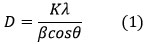
Where: D– Crystallite size, K– Shape factor (typically ~0.9), λ – X-ray wavelength, β – full width at half maximum (FWHM) of the diffraction peak (in radians), θ – Bragg diffraction angle (in degrees or radians, matching β.
Techniques for Mechanical and Thermal Characterisation
The mechanical characteristics of the graphene-reinforced composites with a metal matrix were assessed by a series of standardised evaluations. The Vickers hardness tester was used to evaluate the material’s resistance to deformation. Tensile testing was conducted using a universal testing machine (UTM) to ascertain the ultimate tensile strength (UTS) & yield strength (YS) at a constant crosshead speed of 1 mm/min. Wear resistance was evaluated using a pin-on-disk tribometer with a normal load of 20 N and a sliding velocity of 1 m/s, yielding insight into the composite’s tribological characteristics. Thermal characterisation included measuring thermal conductivity by laser flash analysis, enabling a precise assessment of heat transmission properties inside the composite. The value of the coefficient of thermal expansion (CTE) was determined by thermomechanical analysis (TMA), providing insights into the material’s dimensional stability during temperature fluctuations.
Raman spectroscopy was used to find the D, G, and 2D bands that show the presence, along with the structural stability of graphene. This helped us understand how the graphene support and metal matrix are connected at the interface. Fourier Transform Infrared Spectroscopy (FTIR) was also used to look at the functional groups and how they interacted at the interface. This gave us more information about how the chemicals bonded and got along in the hybrid system.
Results and Discussion
Changes in Microstructure
Because it pins grains together, adding graphene to the matrix of metals greatly improved the quality of the grains and stopped them from growing during sintering. The SEM and TEM pictures showed that the graphene nanoplatelets (GNPs) were evenly spread throughout the matrix, and there was clear proof of interaction between the layers. The graphene helped the polishing by acting as the site of nucleation, as well as stopping the movement of grain boundaries. XRD images showed that small crystals were forming, and Scherrer’s equation 1 was found. The average sizes of the crystallites were determined using. The presence of carbide or intermetallic phases as a result of interactions between graphene and metal during sintering was suggested by the observation of minor phase transitions. Using transmission electron microscopy and Raman spectroscopy, the interface integrity was evaluated, and the results demonstrated a gap-free, continuous contact that strongly supported the load transfer and heat routes. The most important stoichiometric ratios for effective graphene–metal bonding are those that control the generation of carbides or interfacial compounds:
Al–C matrix: Excess carbon may cause inflexible Al₄C₃ production, whereas regulated interfacial carbides at this ratio improve wetting and bonding.
Ti–C system titanium matrix: A 1:1 Ti: C ratio promotes stable TiC production at the interface, which bonds graphene covalently without carbide development that might weaken the composite.
Mechanical Properties
Stress-Strain Evaluation of GNP-Reinforced Composite Materials
Figure 3 shows how composite materials containing different amounts of graphene nanoplatelets (GNPs) by weight (0.5%, 1%, and 1.5%) respond to stress and strain. The x-axis shows strain (which has no units), while the y-axis shows stress in megapascals (MPa). The graph indicates that an increase in GNP content correlates with improved mechanical performance of the composite material. The composite containing 1.5% GNPs (orange curve) exhibits the greatest stress values over the whole strain range, indicating enhanced strength and stiffness. The 1% GNPs composites (pink curve) exhibit superior performance compared to the 0.5%, but worse performance relative to the 1.5%. The 0.5% GNPs composites (blue curve) exhibit the minimal stress response, indicating a diminished reinforcing effect at this dosage. This trend indicates that augmenting the GNP content enhances load transfer efficiency as well as the mechanical strength of the composite, presumably owing to improved dispersion as well as interfacial bonding among the matrix and the GNPs. The non-linear characteristics of the curves indicate that strain-hardening effects occur as deformation advances.
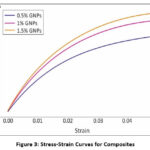 |
Figure 3: Stress-Strain Curves for Composites Click here to View Figure |
Vickers Hardness vs. Graphene content
Figure 4 demonstrates how the Vickers hardness (Hv) changes as the amount of graphene (wt%) in a metal matrix composite changes. The x-axis shows the amount of graphene, which ranges from 0 to 5 wt%, while the y-axis shows Vickers hardness values, which range from 80 to 170 HV. There is a square around each data point, and a line connects them. The vertical error bars demonstrate how uncertain the experiment was. The hardness goes quite quickly from around 132 HV at 0 wt% graphene to a high of about 155 HV at 1 wt%. The hardness goes down after 1 wt%, going down to around 130 HV at 3 wt% and then down to about 105 HV at 5 wt%. The research indicates an ideal graphene reinforcement concentration of around 1 wt%, beyond which aggregation and inadequate dispersion may diminish strengthening efficacy.
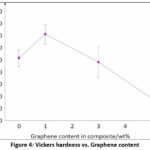 |
Figure 4: Vickers hardness vs. Graphene content Click here to View Figure |
Functional and Thermal Properties
Comparing the Thermal Conductivity of an Unreinforced Matrix with a Composite with 1 weight per cent GNP (Figure 5). Here are the thermal conductivity values (in W/mK) of two materials, shown in a bar chart: The thermoelectric properties of an unreinforced matrix are 1.20 W/mK. Graphene nanoplatelets (GNPs) as a component of a composite material display a thermal conductivity that is 1.60 W/mK higher than average. Adding 1 wt% GNPs increases heat conductivity by around 33%, which shows that graphene is a good thermally conductive filler. Graphene’s high inherent thermal conductivity (~5000 W/mK) along with its capacity to create thermally conductive routes inside the matrix are what make this advancement possible. This improvement is very important for things that need to get rid of heat quickly, such as electronics, as well as thermal interface materials.
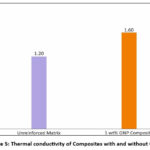 |
Figure 5: Thermal conductivity of Composites with and without GNPs Click here to View Figure |
Coefficients of Thermal Expansion
Figure 6 shows what happens to the coefficients of thermal expansion (CTE) of a hybrid material when the amount of graphene nanoplatelets (GNP) increases. It was seen that as the GNP level goes up, the CTE goes down gradually, from 65 µm/m·°C at 0% wt% to 43 µm/m·°C at 1.5 wt%. This falling line shows that adding graphene has made the temperature stability better in terms of dimensions. The main reason for the decrease in CTE is that graphene has a naturally low thermal expansion and forms a strong bond with the matrix, which makes it harder for polymer chains to move around when heated. In fields like aircraft, along with electronics, where materials are exposed to frequent thermal cycles and must keep their structural integrity across temperature changes, this behaviour is especially useful.
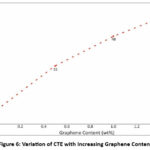 |
Figure 6: Variation of CTE with Increasing Graphene Content Click here to View Figure |
Conclusion
This research investigated the synthesis, processing, and performance assessment of Graphene-Reinforced Metal Matrix composites for applications in aerospace. Adding graphene to metal matrices made a big difference in their mechanical qualities, such as tensile strength, hardness, and wear resistance. It also made them better at conducting heat and electricity. These qualities are very important for aircraft parts that need to be lightweight and long-lasting. Graphene is a good reinforcing material because of its unique features and the fact that it can interact with a metallic matrix at the atomic level. However, to improve the performance of composites, it is very important to get graphene to spread evenly throughout the matrix and to make strong bonds between the two materials. Techniques including powder metallurgy, spark plasma sintering and friction-stir processing have shown promise in improving dispersion and reducing graphene agglomeration. This is important for fully using graphene’s ability to strengthen things. Additionally, a scalability analysis was conducted to determine the practicability of incorporating GRMMCs into aircraft components. The results of this study suggest that these materials may be useful in lightweight armour, thermal management systems, & structural components for aircraft with more research and development. Nevertheless, there are still obstacles to overcome in terms of process control, cost-effectiveness, and ensuring consistent quality throughout mass manufacturing.
Future Work
For GRMMCs to go from laboratory-scale invention to industrial implementation, many research avenues must be explored. Initially, extensive long-term durability studies are required, concentrating on fatigue behaviour, oxidation resistance, and efficiency under thermal cycling conditions often seen in aerospace settings. The investigation of hybrid reinforcement systems, such as the amalgamation of graphene with other nanostructures like carbon nanotubes or ceramic particles, may provide synergistic increases in properties.
The exploration of sophisticated manufacturing processes, especially additive manufacturing (AM), is essential for fabricating complex, thin structures with customised features. Additive manufacturing may facilitate the localised application of reinforcements and the creation of multifunctional gradient patterns. Moreover, lifespan evaluations and cost-benefit studies will be crucial for assessing the economic & environmental implications of implementing GRMMCs in the aerospace sector. Addressing these factors would facilitate the sustainable and efficient use of composites comprised of graphene in next-generation aeronautical technology.
Funding Sources
The author(s) received no financial support for the research, authorship, and/or publication of this article.
Conflict of Interest
The author(s) do not have any conflict of interest.
Data Availability Statement
This statement does not apply to this article.
Ethics Statement
This research did not involve human participants, animal subjects, or any material that requires ethical approval.
References
- Tabandeh-Khorshid, Meysam, et al. “Synthesis, characterisation, and properties of graphene reinforced metal-matrix nanocomposites.” Composites Part B: Engineering 183 (2020): 107664.
CrossRef - Chen, Dongju, et al. “Graphene-reinforced metal matrix composites: fabrication, properties, and challenges.” The International Journal of Advanced Manufacturing Technology 125.7 (2023): 2925-2965.
CrossRef - Kumar, HG Prashantha, and M. Anthony Xavior. “Graphene reinforced metal matrix composite (GRMMC): a review.” Procedia Engineering 97 (2014): 1033-1040.
CrossRef - Hu, Z., et al. “Graphene-reinforced metal matrix nanocomposites–a review.” Materials Science and Technology 32.9 (2016): 930-953.
CrossRef - Zhao, Zhanyong, et al. “An overview of graphene and its derivatives reinforced metal matrix composites: Preparation, properties and applications.” Carbon 170 (2020): 302-326.
CrossRef - Srinivasan, Venkataramanan, Selvaraj Kunjiappan, and Ponnusamy Palanisamy. “A brief review of carbon nanotube reinforced metal matrix composites for aerospace and defence applications.” International nano letters 11.4 (2021): 321-345.
CrossRef - Chen, Fei, et al. “Graphene-reinforced aluminium matrix composites: a review of synthesis methods and properties.” Jom 70.6 (2018): 837-845.
CrossRef - Naseer, Abqaat, et al. “A review of processing techniques for graphene-reinforced metal matrix composites.” Materials and Manufacturing Processes 34.9 (2019): 957-985.
CrossRef - Ranjan, Rachit, and Vivek Bajpai. “Graphene-based metal matrix nanocomposites: Recent development and challenges.” Journal of Composite Materials 55.17 (2021): 2369-2413.
CrossRef - Pazhani, Ashwath, et al. “Synthesis and characterisation of graphene-reinforced AA 2014 MMC using squeeze casting method for lightweight aerospace structural applications.” Materials & Design 230 (2023): 111990.
CrossRef - Chen, Wenge, et al. “Advances in graphene reinforced metal matrix nanocomposites: Mechanisms, processing, modelling, properties and applications.” Nanotechnology and Precision Engineering 3.4 (2020): 189-210.
CrossRef - Wakhi Anuar, Nur Farah Bazilah, et al. “Wear properties of graphene-reinforced aluminium metal matrix composite: A review.” Reviews on Advanced Materials Science 62.1 (2023): 20220326.
CrossRef - Xavior, M. Anthony, and HG Prashantha Kumar. “Processing and characterisation techniques of graphene reinforced metal matrix composites (GRMMC); a review.” Materials Today: Proceedings 4.2 (2017): 3334-3341.
CrossRef - Seyed Pourmand, Nima, and Hamed Asgharzadeh. “Aluminium matrix composites reinforced with graphene: a review on production, microstructure, and properties.” Critical Reviews in Solid State and Materials Sciences 45.4 (2020): 289-337.
CrossRef - Sadhu, Kishor Kumar, Nilrudra Mandal, and Rashmi R. Sahoo. “SiC/graphene reinforced aluminium metal matrix composites prepared by powder metallurgy: A review.” Journal of Manufacturing Processes 91 (2023): 10-43.
CrossRef - Alam, Mohammad Azad, et al. “Advancements in aluminium matrix composites reinforced with carbides and graphene: A comprehensive review.” Nanotechnology Reviews 12.1 (2023): 20230111.
CrossRef - KS, Lokesh, et al. “Determination of compressive strength of graphene reinforced with aluminium-7075 metal matrix composites.” Int. J. Mech. Eng. Technol. 9 (2018): 327-335.
- Khoshghadam-Pireyousefan, Mohammad, et al. “Application of a novel method for fabrication of graphene reinforced aluminium matrix nanocomposites: synthesis, microstructure, and mechanical properties.” Materials Science and Engineering: A 772 (2020): 138820.
CrossRef - Liu, Jinghang, et al. “Graphene oxide and graphene nanosheet reinforced aluminium matrix composites: Powder synthesis and prepared composite characteristics.” Materials & design 94 (2016): 87-94.
CrossRef - Madhankumar, A., and Anthony Xavior. “Graphene reinforced ceramic matrix composite (GRCMC)–state of the art.” Engineering Research Express (2024).
CrossRef
Accepted on: 17 Sep 2025
Second Review by: Dr. Waly Diallo
Final Approval by: Dr. Ioana Stanci