Exploring the Metal Sensing Capability of Tetrazole Hydrazide Schiff Base
 , Ameena Husain2, Sunitha Munagala3, Zaakiya Maryam osmani2, Goli Bhargavi2and P S S Indira Priya Darshini2
1Department of Chemistry, RBVRR Women’s College, Narayanaguda, Hyderabad, Telangana, India
2Department of Chemistry, VCIWU, Koti, Hyderabad, Telangana, India
3Govt polytechnic, Nalgonda Hyderabad, Telangana, India
Corresponding Author E-mail: anupamagudi62@gmail.com
DOI : http://dx.doi.org/10.13005/ojc/420114
Download this article as:

Tetrazole ring based salicylaldehyde Schiff base, 2-Hydroxy Phenyl Methylidene-2-1H-Tetrazol-5yl-Acetohydrazide (TSB) was prepared by Microwave assisted synthesis and characterized by Mass, UV-Vis, Infrared, H1-NMR and TG-DTA techniques. Thermogravimetric analysis suggested its explosive property. Its metal sensing capability was investigated against 14 different metal ions (Ba2+, Cd2+, Co2+, Fe2+, K+, Mn2+, Ni2+, Pb2+, Zn2+, Na+, Mg2+, Al3+, Cu2+ and Hg2+). The results were analyzed by Visual, UV-Vis and Fluorescence spectral techniques. Visual analysis showed pale yellow colored TSB + Fe solution in contrast to all other colorless TSB + metal solutions. Considerable hyperchromic shift occurred for Pb and Fe in UV-Vis spectra. Bathochromic shift and Quenching were seen for these two cations in addition to Na & Mg in Fluorescence spectrum. Therefore, TSB has the propensity to function as an efficient metal sensor for Pb, Fe, Na and Mg.
KEYWORDS:Bathochromic shift; Explosive; Fe2+; 2-Hydroxy phenyl methylidene-2-1H-Tetrazol-5yl-Acetohydrazide (TSB); Hyperchromic shift; Pb2; Quenching
Introduction
The tetrazole ring was first prepared by a Swedish scientist named Bladin, in 1885.This nitrogen rich heterocycle behaves as a polydentate ligand1 having an N-acyl hydrazone scaffold. Such scaffolds are useful to medicinal chemists during drug discovery and development processes.2 This scaffold is also bioisosteric with amide bond.3 This ring has found versatile applications as competent ligands and energetic materials.4 Its resistance to metabolic degradation makes it a promising contender for many studies including biological activity studies.5 This heterocyclic ring is highly preferred for preparing efficient luminescent substances, due to intra ligand n→π* and π→π* transitions. The photochemistry of tetrazole ring is influenced by the extended groups attached to it.6
Azomethines are well recognized Scaffolds for their multifunctional applications. TSB contains multiple donor sites for coordinating with metal ions (Fig 1). These include Phenolic (-OH), azomethine (-C=NH), carbonyl group (C=O) and Pyrrole type -NH of tetrazole ring. This ring -NH is allosteric with -COOH.3,7-9 The role of Schiff bases as metal sensors has gained popularity in recent past due to their color properties, multifunctionality, stability, solubility and coordination ability.10-12 Musa Kamaci13 has reported in detail, the role of poly azomethine urethanes as efficient fluorescent Cr3+ chemo sensor.
Numerous analytical practices have been established and reported for metal ion detection, like Voltammetry, Gravimetry, Chromatography, Colorimetry, ICP-MS, Flame photometry etc.14-21 Some of these techniques are facile, with easy-to-handle instruments, whereas others may require exhausting multistep procedures. In current investigation we have used UV-Vis and Fluorescence techniques for exploring the metal sensing propensity of TSB.
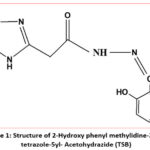 |
Figure 1: Structure of 2-Hydroxy phenyl methylidine-2-1H- tetrazole-5yl- Acetohydrazide (TSB) Click here to View Figure |
Experimental
Materials and Methods
All the chemicals were procured from Merck. The solvents used were distilled and then used for the experimental purpose. IR spectrum was recorded on Brucker FT-IR spectrometer (4000-400 cm-1 range). Proton NMR spectra of ligands were recorded on Brucker 400MHz Ultrashield Spectrometer by using solvent DMSO-d6. LCMS Spectra were recorded on 2010A SHIMADZU instrument. Metal sensor experiments were done on Shimadzu UV-Vis spectrometer (model1800) and Shimadzu Spectrofluorimeter (RF 5301 PC).
Microwave assisted synthesis of TSB
2-(1H-Tetrazol-5-yl) acetohydrazide (1 eq) and salicylaldehyde (4 eq) were suspended in 6 mL methanol. The reaction mixture was heated by microwave irradiation (pmax = 100 W, ramp time=1 minute, hold time = 2 minutes). This product was cooled to room temperature then stirred in ice-salt bath for 30 minutes. The resultant bright yellow TSB ligand was separated and purified with water and alcohol, and then dried in oven. Product yield is 85 %. Melting Point: 248-2500 C (reported 2500– 2510 C) (Scheme 1).22
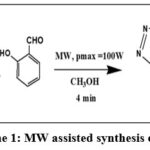 |
Scheme 1: MW assisted synthesis of TSB Click here to View Scheme |
Preparation of the Stock Solutions
A 0.1mM solution of TSB was prepared in DMF. The aqueous solutions of metal cations (0.1mM) such as Ba2+, Cd2+, Co2+, Fe2+, K+, Mn2+, Ni2+, Pb2+, Zn2+, Na+, Mg2+, Al3+, Cu2+ and Hg2+ were prepared in deionized water by using their chloride, nitrate or sulphate salts.
Metal Sensor Studies
A 0.1mM solution of TSB in DMF was mixed with metal cation (0.1mM) solutions (Ba2+, Cd2+, Co2+, Fe2+, K+, Mn2+, Ni2+, Pb2+, Zn2+, Na+, Mg2+, Al3+, Cu2+ and Hg2+) in deionized water in 1:1 M ratio. The results were analyzed visually and spectrophotometrically. The pH was maintained between 6-11 as this was found to be most effective pH range for detection of metal ions.
Results and Discussion
Physical properties of TSB
The ligand TSB exists as stable yellow solid at room temperature. It was soluble in methanol, DMSO and DMF.
Characterization of TSB
It was characterized by Mass spectrometry, Electronic, Infrared and H1-NMR spectral techniques and TG-DTA.
Mass Spectral Data of TSB
The LCMS of the TSB showed signal at 247 [M+2] m/Z consistent with its calculated weight i.e. 245 (Fig 2).
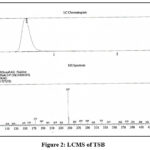 |
Figure 2: LCMS of TSB Click here to View Figure |
IR Spectral Studies
In IR spectrum of TSB, weak -O-Hstr band appearing in the range 3000-2500 cm-1 is attributable to intramolecular H-bonded phenolic –OH. The -CH2– group vibrations observed as weak bands at 2848 cm-1 and 2947 cm-1 are due to asymmetric and symmetric stretching respectively. Bands at 1392 &1322 cm-1 (range 1390-1330 cm-1), 1262 and 1204 cm-1(range 1260-1180 cm-1) are probably due to coupling of O-H bending and C-O stretching modes of vibrations of phenolic moiety. In the spectrum νC=O appeared as intense band at 1676 cm-1 (literature 1674 cm-1) and the νC=N appeared at 1610 cm-1 (literature 1604 cm-1).22 The appearance of strong C-Hoop bending vibration between 770-730 cm-1 confirms presence of ortho substituted benzene in TSB. (Fig 3, Table 1).
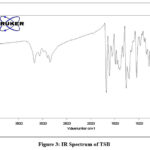 |
Figure 3: IR Spectrum of TSB Click here to View Figure |
Table 1: IR spectral data of TSB
| Ligand | N-Hstr | O-Hstr | C-Hstr
-CH2– |
C=Ostr | C=N
Azomethine |
C-Ostr | C-Hoop |
| TSB | 3200 | 3173 | 2848 | 1676 | 1610 | 1262 | 742 |
UV-Visible Spectral Studies of TSB
TSB displays three signals between 290 – 360 nm. High intensity band at 293 nm arises due to allowed π→π* transitions, low absorbance band at 340 nm appears owing to forbidden n→π* transitions and band at 356 nm arises from intramolecular charge transfer transitions (Fig 4, Table 2).
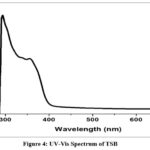 |
Figure 4: UV-Vis Spectrum of TSB Click here to View Figure |
Table 2: UV-Vis spectral data of TSB
| Ligand | Solvent | Absorption region
(nm) |
Band assignment |
|
TSB |
DMF |
293
341 356 |
π→π*
n→π* CT |
H1-NMR Analysis of TSB
H1-NMR of TSB was recorded DMSO-d6, duplication of peaks was observed for NH, N=CH, CH2 and aryl protons (Fig 5 (a)). The CH2 group gave two, equal intensity, singlets at δ4.1 & δ4.5. The -NH also gave two singlets of unequal intensities at δ11.7 & δ12.1 [23]. The signals from -OH & -NH disappeared upon D2O exchange (Fig 5 (b)). The aryl protons appeared in the region δ7.4-7.6. The azomethine protons appeared at δ8.4 & δ8.43. The data is recorded in Table 3.
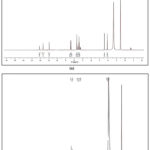 |
Figure 5: NMR spectra of TSB in solvent DMSO-d6 (a) 1H-NMR (b) D2O. Click here to View Figure |
Table 3: H1-NMR data (δ) of TSB in solvents DMSO-d6
| Solvent | -CH2– | N=CH | CONH(D2O) | Aromatic protons | -OH(D2O) |
| DMSO | 4.4, 4.1 | 8.4, 8.43 | 11.7, 12.1 | 7.4-7.6 | 11.0 |
TGA-DTA analysis of TSB
TGA-DTA analysis was executed for nitrogen rich tetrazole ring-based TSB to determine the existance of explosive property, if present. These results are tabulated in Table 4.
TGA-DTA thermogram of TSB showed five events of weight loss (Fig 6). Initial endothermic weight loss at 221.80C may be attributed to its melting, followed by another endothermic loss at 265.80C. Subsequent exothermic weight losses were observed at 285.20C and a major loss at 578.8 0C. Lastly one minor endothermic loss occurred at 727.0 0C. The Tendo→exo at 265.80C indicates explosive decomposition of TSB.1 This explosive behavior may be attributed to presence of electron withdrawing azomethine, carbonyl groups and electron donating ring & hydrazide nitrogen within the same molecule.
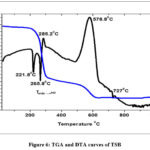 |
Figure 6: TGA and DTA curves of TSB Click here to View Figure |
Table 4: TGA-DTA data of TSB
| Ligand | Temperature (0C) | Loss in weight
Found (cal) % |
Probable composition of expelled groups |
|
TSB C10H10N6O2 |
221.8 | 7.7 (7.8) | OH, H2 |
| 265.8 | 39 (38.9) | C5H7NO | |
| 285.2 | 25.2 (24.8) | C4N | |
|
578.8 |
Weight loss is negative due to explosive decomposition |
4N |
Metal Sensing Studies
Visual Method
Upon mixing yellow colored 0.1 mM TSB with colorless 0.1 mM cation solutions of 14 different metals, all the solutions turned colorless except TSB + Fe2+, which appeared pale yellow (Fig 7). Therefore, TSB is found to be an efficient visual sensor for Fe2+.
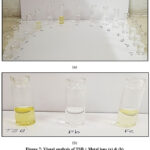 |
Figure 7: Visual analysis of TSB + Metal ions (a) & (b). Click here to View Figure |
UV-Vis Sensor Studies
The metal sensing ability of TSB was investigated by recording the absorbance of TSB + 14 different metal solutions mixed in 1:1 ratio. The nascent TSB excitations were observed at λmax 300 & 353 nm having ϵmax of 0.244 and 0.129 respectively. These may be ascribed to π→π* and n→π* transitions respectively. After mixing TSB with metal solutions, no significant variations were detected for most metal solutions, except Pb2+ and Fe2+ (Fig 8). Addition of these two metals led to distinct hyperchromic shift with isosbestic points. Thus, TSB functions as an effective UV-Vis sensor for Fe and Pb detection.
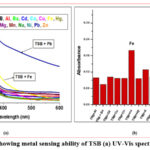 |
Figure 8: Graphs showing metal sensing ability of TSB (a) UV-Vis spectrum (b) Bar Graph Click here to View Figure |
Fluorescence Sensor Studies
The fluorescence studies of TSB showed two strong emissions at 419 nm and 438 nm when excited at 350 nm. The intensities were 62.3 and 85.6 respectively. Addition of metal ions resulted in bathochromic shift of approximately 5-7 nm with quenching. These may be due to coordination of the azomethine group, phenolic -OH, ring -NH and C=O groups with the metal ions. Quenching was maximum for Fe + TSB (Intensity 18.4) solution. Though most of the emissions overlapped, clear bands were visible for Na, Mg, Pb & Fe (Fig 9).
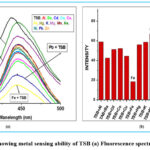 |
Figure 9: Graphs showing metal sensing ability of TSB (a) Fluorescence spectrum (b) Bar Graph Click here to View Figure |
Practical utility
Lead is a well-known toxicant. Sources of lead pollution include urban soil waste, poor quality paints and dyes, factory chimneys, melting and casting of ores, wastes from storage battery industries, metal plating and related industries, fertilizers, pesticides and gasoline additives etc. Exposure to unhealthy levels of lead has been interrelated to anemia, kidney ailments, reproductive problems in adults, learning difficulties in children including speech and behavioral issues.
Iron is most widely used metal and has found many applications in motor industry, steel industry, machines, pipelines, military equipment, appliances etc. But years of iron ore mining has led to pollution of air, surface and ground water, flora and fauna.14 Iron based nanoparticles released in water bodies are toxic to bacteria, algae, fish and plants [24]. Salt has been used as an effective deicer, as it causes freezing point depression. But years of use of millions of tons of salt has endangered the flora and fauna of fresh water bodies and contaminated drinking water wells. Harsha et al have incorporated a polymer-imidazole based sensor on a glass slide and used it as a simple yet cost effective Cu2+ detector.11
The 11th and 12th Principle of green chemistry, as quoted by Prof Paul Anastas, states “Monitor chemical reactions in real-time as they occur to prevent the formation and release of any potentially hazardous and polluting substances” and “Choose and develop chemical procedures that are safer and inherently minimize the risk of accidents. Know the possible risks and assess them beforehand”, respectively.
The above-mentioned concerns (and many not mentioned here) signify the need for cheap, facile and yet sensitive metal sensors and also serious conscious efforts by individuals and organizations to protect earth from indiscriminate pollution.
Conclusions
2-Hydroxy Phenyl Methylidine-2-1H- tetrazole-5yl- Acetohydrazide (TSB) was prepared by Microwave method and characterized by Mass Spectrometry, UV-Vis, Infrared and H1-NMR spectral techniques. TG-DTA analysis was performed to discover the explosive nature of this nitrogen rich heterocycle. Metal sensing ability of TSB against 14 different cations (Ba2+, Cd2+, Co2+, Fe2+, K+, Mn2+, Ni2+, Pb2+, Zn2+, Na+, Mg2+, Al3+, Cu2+ and Hg2+ ) was analyzed by visualization with naked eye, absorption changes and emission changes. All TSB + M solutions appeared colorless except TSB + Fe, which appeared pale yellow. Considerably distinct absorption bands appeared for TSB + Fe and TSB + Pb in UV-Vis spectrum. Noticeable decrease in fluorescence intensity was observed for Na, Mg, Pb and Fe when mixed with TSB. Hence it can be summarized that the presence of donor sites like, ring N-H, C=O, CH=N and phenolic OH groups make TSB an efficient ligand for coordinating with metals. It can detect Fe ions upon visual mixing, detect Fe and Pb using UV Visible spectrophotometer and Na, Mg, Pb and Fe using spectrophotofluorimeter.
Acknowledgement
Authors would like express gratitude to Management of RBVRR Women’s College, Hyderabad, for providing Seed Money for Minor Research Project to carry out this work and also acknowledge the management for establishing Central Research Instrumentation Laboratory in the College with CPE Funds, Schimadzu Spectrofluorometer (RF 5301 PC) and UV-VIS spectrophotometer (Schimadzu model 1800). Authors are also grateful to CFRD, Osmania University, Hyderabad (NMR). Research Lab-1, VCIWU, Hyderabad, for the facilities provided.
Funding Sources
The author(s) received no financial support for the research, authorship, and/or publication of this article.
Conflict of Interest
The author(s) do not have any conflict of interest.
Data Availability Statement
This statement does not apply to this article.
Ethics Statement
This research did not involve human participants, animal subjects, or any material that requires ethical approval.
References
- Wurzenberger, M. H. ; Gruhne, M. S. ; Lommel, M. and Stierstorfer, J. Propellants, Explosives, Pyrotechnics. 2022, 46, 207–213. https://doi.org/10.1002/prep.202000179
CrossRef - Yamazaki, D. ; Rozada, A. M. ; Barea, P. ; Reis, E. C. ; Basso, E. A. ; Sarragiotto, M. H. ; Seixas, F. A. and Gauze, G.F. Bioorganic & Medicinal Chemistry. 2021, 32, 115991. https://doi.org/10.1016/j.bmc.2020.115991
CrossRef - Pedreira, J. G.; Nahidino, ; Kudolo, M.; Pantsar, T.; Berger, B.T. ; Forster, M.; Knapp, S.; Laufer S. and Barreiro, E. J.Journal Of Medicinal Chemistry. 2020, 63, 7347-7354. https://doi.org/10.1021/acs.jmedchem.0c00508
CrossRef - Kofen, M.; Lommel, ; Wurzenberger, M. H. H.; Klapötke T. M. and Stierstorfer, J. 2022, 28, e202200492. https://onlinelibrary.wiley.com/doi/pdf/10.1002/chem.202200492
CrossRef - Narang, R.; Narasimhan, and Sharma, S. Current Medicinal Chemistry. 2012, 19, 569-612. http://dx.doi.org/10.2174/092986712798918789
CrossRef - Pagacz-Kostrzewa, M.; Krupa, and Wierzejewska, M. Journal of Physical Chemistry A. 2014, 118, 2072−2082. https://doi.org/10.1021/jp5001804
CrossRef - Rìger, N.; Roatsch, M.; Emmrich, T.; Franz, H.; Schìle, R.; Jung, M. and Link, A. Chem Med Chem, 2015, 10, 1875 – 1883.https://doi.org/10.1002/cmdc.201500335
CrossRef - Ornstein, P. L.; Schoepp, D. D.; Arnold, M. B.; Jones, N. D.; Deeter, J. B.; Lodge, D. and Leander, J. D. Journal of Medicinal Chemistry. 1992, 35, 3111-3115. https://pubs.acs.org/doi/10.1021/jm00095a004
CrossRef - Lunn, W.H.W.; Schoepp, D. D.; Calligaro, D. 0.; Vasileff, R. T.; Heinz, L. J.; Salhoff, C. R. and O’Malley, P. J. Journal of Medicinal Chemistry. 1992, 35, 4608-4612. https://doi.org/10.1021/jm00102a015
CrossRef - Anupama B. Journal of Indian Chemical society. 2020, 97, 721-724, https://indianchemicalsociety.com/portal/uploads/journal/May-2.pdf
- Harsha, K. G.; Appalanaidu, E.; Rao, B. A.; Baggi, T. R. and Rao, V. J. Russian Journal of Organic Chemistry. 2020, 56, 158–168. https://link.springer.com/article/10.1134/S1070428020010248
CrossRef - Tomer, N.; Goel, A. ; Ghule V. D and Malhotra, R. Journal of Molecular Structure. 2021, 1227, 129549 https://doi.org/10.1016/j.molstruc.2020.129549
CrossRef - Musa, K. Journal of Fluorescence. 2023, 33, 53-59. https://doi.org/10.1007/s10895-022-03037-7
CrossRef - Gleekia, A.M.G.D.; Pradhan, D. S. and Sahu, H. B. Conference: Geominetech Symposium: New Equipment New Technology – Management and Safety in Mines and Mineral Based Industries, Bhubaneswar, India. 2016, Volume: IV No.2/Q2 https://www.researchgate.net/publication/304580575_IMPACTS_OF_IRON_ORE_ MINING_ON_WATER_QUALITY_AND_THE_ENVIRONMENT_IN_LIBERIA
- Fu, J.; Li, B.; Mei, H. Chang, Y. and Xu, K. Spectrochemical Acta Part A: Mol. Biomol. Spectrosc. 2020, 227, https://doi.org/10.1016/j.saa.2019.117678
CrossRef - Liu, L.W.; Zheng, H. L.; Xu, B. C.; Xiao, L.; Chigan, Y. and Zhangluo, Y.L. 2018, 179, 86–91. https://dx.doi.org/10.1016/j.talanta.2017.10.003
CrossRef - Eang, P.; Fu, J. X.; Yao, K.; Chang, Y. X.; Xu, K. X. and Xu, Y. Q. Actuators B Chem. 2018, 273, 1070–1076. https://doi.org/10.1016/j.snb.2018.07.028
CrossRef - Li, Q.; Zhang, Z. and Wang, Z. Chim. Acta. 2014, 845, 7–14. https://doi.org/10.1016/j.snb.2017.01.149
CrossRef - Li, S.Y.; Zhang, D. B.; Wang, J. Y.; Lu, R. M.; Zheng, C. H. and Pu, S. Z. Actuators. B. 2017, 245, 263–272. https://doi.org/10.1016/j.jallcom.2020.154357
CrossRef - Dong, Y.; Zhou, M. and Zhang, L. Alloys Compd. 2020, 827, 154357. https://doi.org/10.1016/j.jallcom.2020.154357
CrossRef - Yamini Y.; Alizadeh, N. and Shamsipur, M. Chim. Acta. 1997, 355, 69–74. https://doi.org/10.1016/S0003-2670(97)81613-3
CrossRef - Rìger, N.; Fassauer, G. M.; Bock, C.; Emmrich, T.; Bodtke, A. and Link, A. Mol Divers. 2017, 9-27. PMID: 28028725 https://doi.org/10.1007/s11030-016-9711-x
CrossRef - Munir, R.; Javid, N.; Zia-ur-Rehman, M.; Zaheer, M.; Huma, R.; Roohi, A. and Athar, M. M. 2021, 26, 4908. https://www.mdpi.com/1420-3049/26/16/4908#
CrossRef - Lei, C.; Sun, Y.; Tsang, D. C. W. and Lin, D. Environmental pollution, 2017, 232, 10-30 https://doi.org/10.1016/j.envpol.2017.09.052
CrossRef
 PlumX:
  Views: 1073 Views
  PDF Downloads: 1239
 Accepted on: 13 Sep 2025
Second Review by: Dr. Bashir Ahmad Dar
Final Approval by: Dr. Naeem Uddin Siddiqui


ISSN Online: 2231-5039