A Short Study on Enhancing 3D Printing with Boron Nitride: A New Frontier in Materials Science
 , Manisha Singhal2, Nidhi Chaudhary3 and Hament Panwar4*
1Department of Chemistry, Radhey Hari Government (P.G.) College, Kashipur, Udham Singh Nagar, U.K., India
2Department of Chemistry, Raghunath Girls (P.G.) College, Meerut, U.P., India
3Department of Chemistry, Applied Sciences, Meerut Institute of Engine Meerut, U.P. India
4Department of Chemistry, Harsh Vidhya Mandir (P.G.) College, Raisi, Haridwar, U.K., India.
Corresponding Author E-mail:drhp.hvm@gmail.com
Download this article as:
ABSTRACT:In the current study, we have focused on the futuristic potential of the compound Boron Nitride (BN), apart from its high temperatures and resistance to chemical reactions. Presently, BN is actively engaged in the integration of 3D printing with other state-of-the-art technologies, for example, VR (virtual reality), robotics, and AI (artificial intelligence), which is gaining momentum daily. Herewith, efforts are made to elicit the role of BN in 3D printing in this short study.
KEYWORDS:BN; Crystalline forms; 3D designing; Multistep synthesis
Introduction
The economy of a nation depends on its industry sector and how they are performing. Rapid growth in population needs the rapid industrial revolution to better manage the gap between need and supply. To attain the rapid advancement, it is imperative to conduct research and development (R&D) of cleaner technologies with more intelligent, efficient, cost-effective, and high-quality production processes [1]. The process of creating a 3D object from a CAD (Computer-Aided Design) or else digital 3D model is called as additive manufacturing, or 3D printing [2-4]. By depositing the raw material layer by layer, the additive manufacturing or 3D printing process produced 3D things that were either filled or else hollow. [5]. Brickwork, which entails building structures with connected or unconnected pieces, for example, brick walls, is the most prevalent example of AM. Subtractive manufacturing is the process of creating some components by removing the raw material, that includes when cutting wood into an object. CNC (Computer numerical control) is utilized on several machines, for example, lathes and machining centers, to carry out subtractive manufacturing operations.
Chemical science and 3d designing
One can find versatile applications of 3D designing in the following aspects of laboratories as well as industries, viz.-
Reaction ware for inorganic and organic multistep synthesis in conjunction with catalysts, reagents, or else control of shape to achieve an intended outcome, printed-in: catalysts as well as in- situ characterization.
Modification in properties of the materials.
Solvent compatibility.
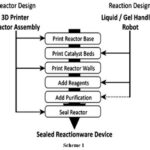
In context of chemical science, there are numerous ways that 3D printing could fundamentally alter manufacturing operations, including how functional devices are designed, manufactured, and operated [6-7]. Impact of 3D designing is well famed in custom tools, reactors, and producing chemicals, it is causing a big impact on chemical synthesis and industry, where computer designing and 3D printing of custom reactors/reaction ware demonstrate concept’s utility [8-10] due to ease and affordability of 3D designing. Philip et al. designed a reactor (Scheme-1) [11-12] to control multistep synthesis in Diels– Alder cyclization [13-15] to enhance efficacy of the synthesis.
 |
Scheme 1 |
Chemistry
Chemistry of boron nitrides
Boron nitrides (BN) is a colourless, chemically stable crystal or white powder (Image-1) [16]. Molar mass of it is 24.82g/mol and insoluble in the water but soluble in the alkaline molten salts along with nitrides, for example, NaOH, Na2CO3, KOH, Mg3N2, LiOH, NaNO3, Li3N. Melting point of BN is 2973 °C while density is 2.1 g/cm3 for hexagonal BN (h-BN) and 3.45 g/cm3 for cubic BN (c-BN) .Because of its modest absorption in the visible along with near UV wavelength region, BN is optically transparent. However, in the deep far UV range, it has a high absorption peak. Having chemical formula BN, boron nitride is a refractory compound of nitrogen and boron that is resistant to both heat as well as chemicals.
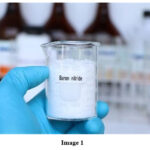 |
Image 1 Click here to View Image |
One can find it in several crystalline forms which are isoelectronic to a carbon lattice with a comparable structure. Diamond-like cubic BN (c-BN), hexagonal BN (h-BN), as well as Hurtzite BN (w-BN), are the well-known crystalline forms of BN (Image -2 & 3) [17-18]., a covalent solid composed of equal numbers of boron along with nitrogen atoms during the network. BN can be used as a dielectric, substrate; filler in nanocomposites because of its remarkable mechanical, thermal stability [19] and electrochemistry [20-21]. With weak van der Waals interactions among interlayers along with strong covalent connections among boron and nitrogen, hexagonal form of boron nitride resembles graphite in structure (honeycomb configuration). Numerous workers [22–23] reported high k anisotropy, that makes boron nitride an outstanding thermally conductive material. The strength of B-N bonds of BN resulted in mechanical and remarkable chemical resistance. BN also claimed the good biocompatibility with its utilization in several medical fields [23].
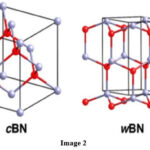 |
Image 2 Click here to View Image |
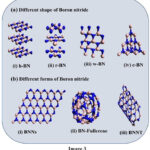 |
Image 3 Click here to View Image |
Discussion and Result
BN in 3D printing
BN is utilized in a variety of composite materials created for specific 3D printing applications, and its incorporation can greatly improve the quality and functionality of 3D-printed structures. For example, composites made from boron nitride and polymers enable the production of mechanically durable, self-sustaining constructions. Because of their exceptional physical flexibility along with elasticity and high BN concentration, these structures require little post-treatment [24]. Thermally conductive composites based on boron nitride are essential for microelectronic devices that demand effective heat transfer and degeneracy. Electrical one atom thickened insulation, fabrication for h-BN was found by Levendorf et al. [25]. Beyond their applications in thermal managing, these materials are also well-suited for 3D bioprinting, owing to their cytocompatibility. In personal cooling devices, BN-incorporated poly (vinyl alcohol) (PVA) fibers demonstrated compacted structure, appropriate orientation, and even distribution, improving tensile strength, thermal conductivity, along with consistent heat control. 3D-printed fabrics with BN-PVA composites exhibited heat conduction that was 1.5 times better than that of PVA textiles as well as twice as good as cotton fabrics. Moreover, BN-PVA fabrics explored around 55 percent improved cooling efficiency in contrast with that of materials comprised of standard cotton [24].
Challenges with BN
The main technical challenge of 3D printing with BN is its utilization limitation to R & D. Strength of B-N bonds is reported as a functional challenge [23]. Limited research work is the hurdle with 3D designing of BN. It is found that the presence of high quantity of boron nitride in a composite increases its thermal conductivity, but on other hand, it causes a loss in ductility. Thus, possibilities with the composite suffer, mostly in the case of high mechanical strength instruments, such as the encapsulation of medical devices [23]. Sometimes, actual results are found to vary from the theoretical assumptions. As distributions, dispersion, and interaction of BN with other nano components during 3D printing are thought-provoking during the manufacturing.
Possibilities with BN
To overcome the aforementioned restrictions and conduct further static research on the application of BN in 3D printing, considerable work is needed.
Acknowledgement
We express our gratitude to Professor Sangit Kumar from the Department of Chemistry at the Indian Institute of Science Education and Research in Bhopal, India, for his invaluable suggestions and support throughout our endeavours.
Funding Sources
The author(s) received no financial support for the research, authorship, and/or publication of this article.
Conflict of Interest
The author(s) do not have any conflict of interest.
Data Availability Statement
This statement does not apply to this article.
Ethics Statement
This research did not involve human participants, animal subjects, or any material that requires ethical approval.
References
- Almada-Lobo, F. J Inn Manag. 2016, 3 (4), 16.
CrossRef - Bonsa, R. H.; Abraham, D. W. Res Eng. 2022, 14 (6), 100478.
- Gao, W.; Zhang, Y.; Ramanujan, D.; Ramani, K.; Chen, Y.; Williams, C.B.; Wang, C.C. L.; Shin, Y. C.; Zhang, S.; Zavattieri, P. D. Computer-Aided Des. 2016, 69, 65.
CrossRef - Ngo, T. D.; Kashani, A.; Imbalzano, G.; Nguyen, K.T. Q.; Hui, D. Compos (B) Eng. 2018, 143, 172.
CrossRef - Bell C. Introduction to 3D Printing 2014, 3, 52. doi:10.1007/978-1- 4302- 6808-6_1.
CrossRef - Di, W.; Vaibhav, D.; Valentin, A. B.; Kenny, L.; Cyrille, B. Chem Sci. 2024, 15 (46), 19345.
CrossRef - Geissler, M.; Xia, Y. Adv. Mater. 2004, 16, 1249.
CrossRef - Pearce, J.M. Science 2012, 337, 1303.
CrossRef - Symes, M.D.; Kitson, P.J.; Yan, J.; Richmond, C.J.; Cooper, G.J.T.; Bowman, R.W.; Vilbrandt, T.; Cronin, L. Nat. Chem. 2012, 4, 349–354, 2012.
CrossRef - Kitson, P. J.; Rosnes, M.H.; Sans, V.; Dragone, V.; Cronin, L. Lab Chip 2012, 12, 3267.
CrossRef - Kitson, P. J.; Symes, M.D.; Dragone, V.; Cronin, L. Chem Sci. 2013, 4, 3099.
CrossRef - Kitson, P. J.; Glatzel, S.; Wei, C. W.; Lin, C.-G.; Song, Yu-Fei; Cronin, L. Nat Prot. 2026, 11, 920.
CrossRef - Nicolaou, K. C.; Snyder, S. A.; Montagnon, T.; Vassilikogiannakis, G. Angew Chem. 2002, 41, 1668.
CrossRef - Kagan, H. B.; Riant, O. Chem. Rev. 1992, 92, 1007.
CrossRef - Mandal, P. K.; McMurray, J. S. J Org Chem. 2007, 72, 6599.
CrossRef - Dam, S. 2023, 26, https://www.azonano.com/article.aspx?Article ID=6559.
- Phuong, V. 2018, 10. https://www.researchgate.net/publication/333745352 Optical _spectroscopy_of_boron_nitride_heterostructures.
- Boron Nitride Nanostructures, https://shop.nanografi.com/blog/uses-of-boron-nitride- bn-nanopowdernanoparticles/.
- Elssa, G.; Jomon, J.; Poornima, V. P.; Henri, V.; Soney, C. G.; Saithalavi, A. Nano-Struc. Nano-Obj. 2024, 40 (12), 101372.
CrossRef - Rocha, R. G.; Stefano, J. S.; Cardoso, R. M.; Zambiazi, P. J.; Bonacin, J. A.; Richter, E. M.; Munoza, R. A. A. Talanta 2020, 219 (11), 121289.
CrossRef - Dandan, S.;Zhipeng, S.; Dehong, Y.; Xiangfen, J.; Jie, T.; Xuebin, W. Eco Energy 2023, 1, 215.
- Julia, V. B.; Daniil, A. C.; Oleg, N. D.; Andrey, A. T.; Alexey, P. S.; Nikolay, V. S.; Mikhail, A. T.; Zakhar, I. P.; Dmitry, G. K.; Stanislav, A. E.; Alexander, A. S. Polymers 2023, 15 (5), 1214.
- Do, NBD.; Imenes, K.; Aasmundtveit, KE.; Nguyen, H.-V.; Andreassen, E. Polymers 2023, 15 (6), 1552.
CrossRef - Xin Li; Lei Y.; Xiaolong C.; Fang J. Composites (A) App Sci Manufac. 2022, 161 (10), 107104.
- Levendorf M.; Kim C.; Brown L.; Pinshane Y. H.;Robin W. H.;David A. M.; Jiwoong P. Nature 2012, 488 (7413), 627.
CrossRef
Accepted on: 03 Oct 2025
Second Review by: Dr. Neha Sharma
Final Approval by: Dr. Ioana Stanciu