Effect of Oxidation of Soybean Oil Used in Biodegradable Lubricant

University of Bucharest, Faculty of Chemistry, Department of Physical Chemistry, Elisabeta Blvd, Bucharest, Romania.
Corresponding Author E-mail:istanciu75@yahoo.com
DOI : http://dx.doi.org/10.13005/ojc/410538
Download this article as:

Soybean oil is a promising base stock for biodegradable lubricants because of its renewable origin, high lubricity, and low environmental impact. However, its application is limited by poor oxidative stability. The unsaturated fatty acids in soybean oil are highly susceptible to oxidation, especially under elevated temperatures and in the presence of oxygen, metal catalysts, or light. Oxidation initiates free-radical chain reactions that lead to the formation of hydroperoxides, aldehydes, ketones, and polymeric compounds. These degradation products adversely affect lubricant performance by increasing acidity, viscosity, and sludge formation, while reducing lubricity and service life. Consequently, oxidation can cause corrosion, deposit buildup, and failure of lubricated components. To address this limitation, chemical modifications such as epoxidation, transesterification, and the incorporation of antioxidants are commonly applied to improve stability. Understanding the mechanisms and effects of oxidation in soybean oil is essential for developing durable, high-performance biodegradable lubricants.
KEYWORDS:Biodegradable lubricants; Dynamic viscosity; Soybean oil;; Temperature;
Introduction
Soybean oil, derived from the seeds of the soybean plant (Glycine max), is a widely used vegetable oil. It ranks among the most commonly consumed cooking oils and is the second most used vegetable oil overall. Beyond culinary uses, refined soybean oil also functions as a drying oil, serving as a base for products like printing inks (soy-based ink) and oil paints.
The growing concern over environmental sustainability and the depletion of petroleum resources has intensified the search for renewable and biodegradable alternatives to conventional lubricants. Vegetable oils, particularly soybean oil, have emerged as attractive candidates due to their abundance, biodegradability, high lubricity, and low toxicity. However, one of the primary challenges limiting their widespread application is poor oxidative stability.
The high content of unsaturated fatty acids in soybean oil makes it prone to oxidation under thermal and mechanical stress. This oxidative degradation produces hydroperoxides, aldehydes, acids, and polymeric compounds that alter the physicochemical properties of the oil. As a result, critical lubricant characteristics such as viscosity, acidity, lubricity, and shelf life are negatively affected. These changes can cause sludge formation, corrosion, deposit buildup, and premature equipment wear, reducing the overall reliability of biodegradable lubricant systems.
Understanding the mechanisms and consequences of soybean oil oxidation is therefore essential for developing effective stabilization strategies, such as chemical modification, antioxidant incorporation, or blending with more stable base fluids. Improving oxidative resistance is key to enhancing the durability and performance of soybean-oil-based lubricants while maintaining their environmental advantages.1-8
Soybean oil is extracted from soybeans, a plant originally from China that was introduced and adapted to our country in 1931 and is now grown extensively. The seeds contain 17–20% oil, which can be obtained either through cold pressing or by solvent extraction using gasoline, after which the solvent is removed from the oil by distillation. Similar to most vegetable oils, soybean oil mainly consists of glycerides with fatty acids containing one or more double bonds, classifying it among the non-drying oils.
Experiment details
The rheometer apparatus was used to study how the viscosity of soybean oil changes with temperature and shear rate. The experiment durations of 5 and 10 hours. Measurements of dynamic viscosity were then taken across.. In all cases of oxidation or test temperature the dynamic viscosity of soybean oil decreased as the shear rate increased.
Results and Discussion
Soybean oil was subjected to oxidation at 110 °C and 120 °C for 5 and 10 hours, respectively. For these oxidized samples, dynamic viscosity was measured in relation to both, with the results presented in Figures 1 and 2. The dependence of dynamic viscosity on shear rate was illustrated at test temperatures of 30 °C and 90 °C. In all cases—regardless of oxidation duration or test temperature.
At both oxidation temperatures, dynamic viscosity increased significantly. However, as the temperature rose, the difference between oxidized and unoxidized samples decreased.
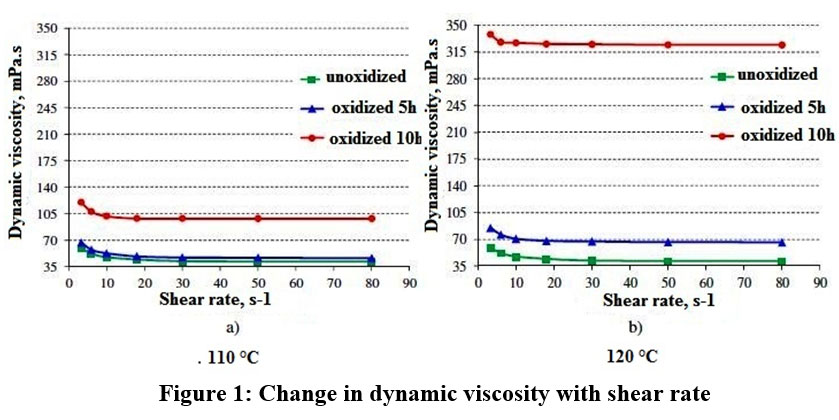 |
Figure 1: Change in dynamic viscosity with shear rate |
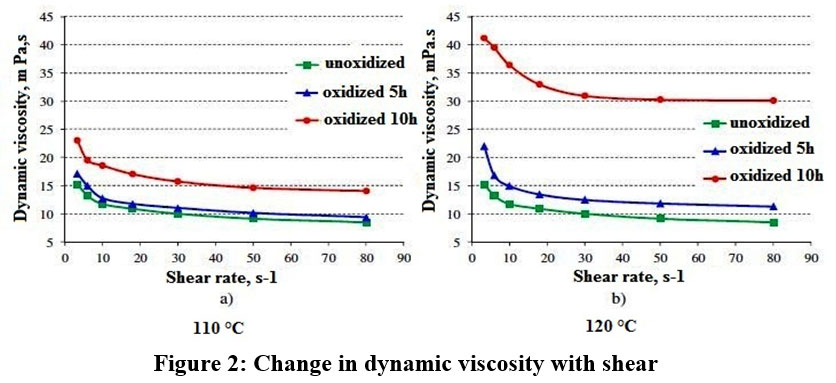 |
Figure 2: Change in dynamic viscosity with shear |
Figures 3 and 4 illustrate the relationship between dynamic viscosity and temperature for soybean oils oxidized at 110 °C and 120 °C for 5 and 10 hours, respectively, measured at shear rates of 3.3 s⁻¹ and 80 s⁻¹. In all cases—regardless of oxidation temperature, oxidation time, or shear rate—the viscosity decreased as the testing temperature increased.
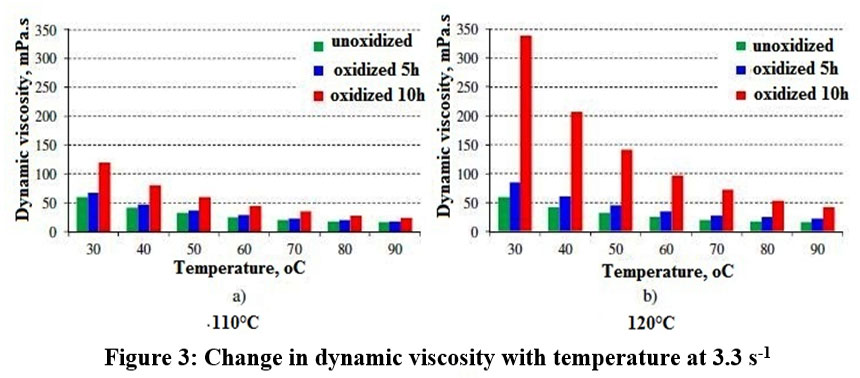 |
Figure 3: Change in dynamic viscosity with temperature at 3.3 s-1 |
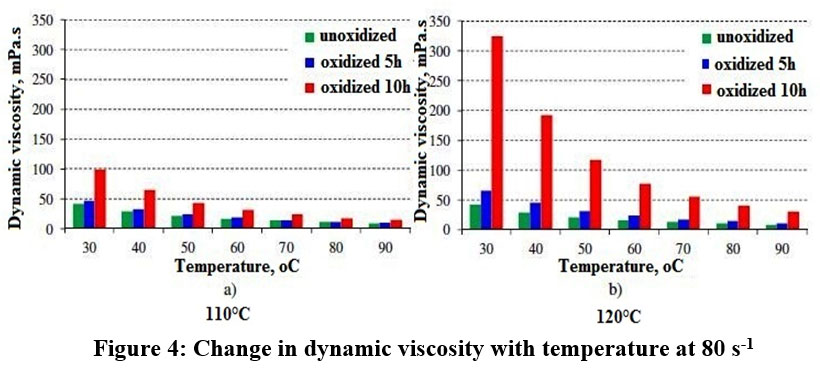 |
Figure 4: Change in dynamic viscosity with temperature at 80 s-1 |
Oxidizing soybean oil at 110 °C and 120 °C leads changes its with temperature. These pronounced increases are particularly evident in oils subjected to oxidation. Figs. 5, 6, and 7 illustrate highlight effects soybean oil samples (unoxidized, oxidized for 5 hours, and oxidized for 10 hours at 110 °C and 120 °C, respectively).9–18
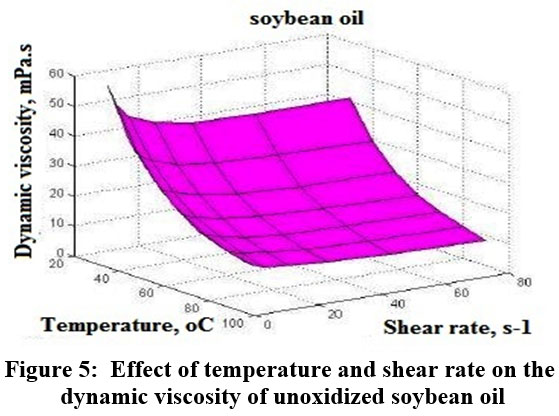 |
Figure 5: Effect of temperature and shear rate on the dynamic viscosity of unoxidized soybean oil. |
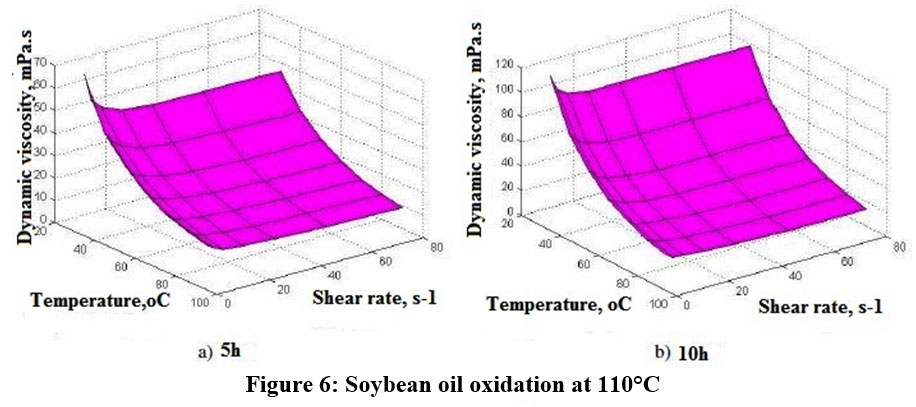 |
Figure 6: Soybean oil oxidation at 110°C |
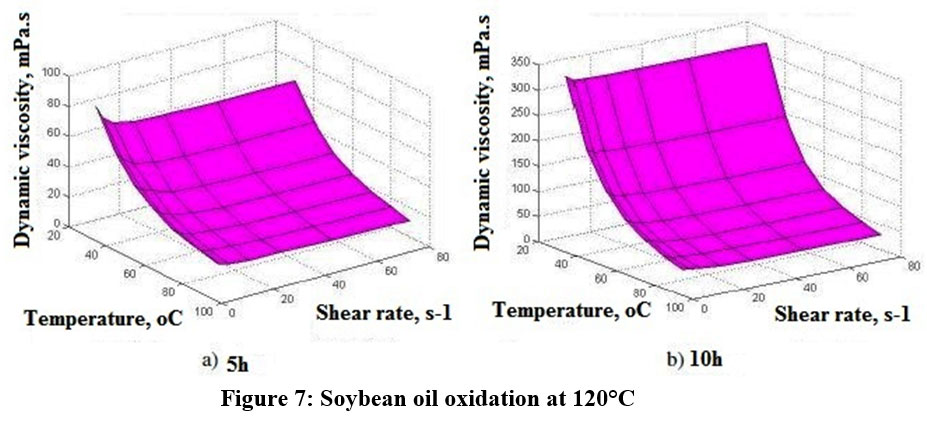 |
Figure 7: Soybean oil oxidation at 120°C |
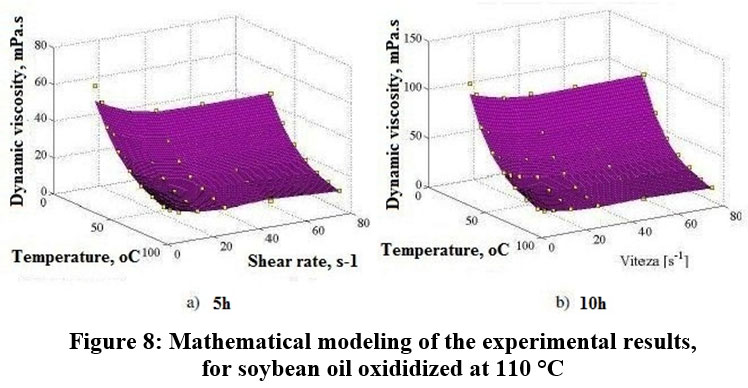 |
Figure 8: Mathematical modeling of the experimental results, for soybean oil oxididized at 110 °C. |
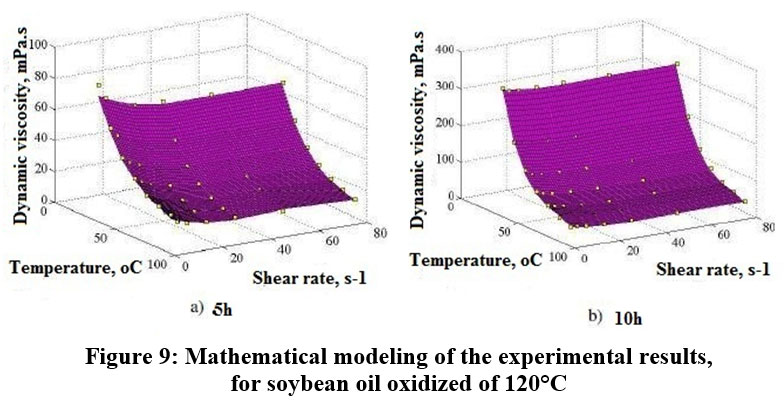 |
Figure 9: Mathematical modeling of the experimental results, for soybean oil oxidized of 120°C |
 
Figures 8 and 9 display the experimental data points along with the fitted mathematical models for oxidized soybean oil.
Conclusions
Oxidation significantly limits the practical use of soybean oil as a base stock for biodegradable lubricants. Its high degree of unsaturation makes it prone to forming varnish and polymeric degradation products, which increase viscosity and acidity while reducing lubricity and thermal stability. Therefore, improving oxidative resistance through chemical modification, antioxidants, or blending with more stable oils is vital to enhance the long-term performance of environmentally friendly lubricants
Reference
- Penciu S., Beldescu A., Studiul potenţialului de export al României: Uleiuri Vegetale, Centrul Român pentru Promovarea Comerţului şi Investiţiilor Străine, 2012.
- Bradford P.G., Awad A.B., 2007, Molecular Nutrition and Food Research, 51,.161–170.
CrossRef - Szydłowska-Czerniak A., Bartkowiak-Broda I., Karlovic I., Karlovits G., Szlyk E., 2011, Food Chemistry, 127, 556–563.
CrossRef - Strocchi A., 1982, Journal of Food Science, 47(1), 36-39.
CrossRef - Ostlund Jr R. E., Racette S. B., Okeke A., & Stenson W. F., 2002, The American journal of clinical nutrition, 75(6), 1000-1004.
CrossRef - Stanciu I., 2019, Journal of Science and Arts, 3(48), 703-708.
- Stanciu I., 2019, Journal of Science and Arts, 4(49), 938-988
CrossRef - Stanciu I., 2011, Journal of Science and Arts, 1, 55-58.
CrossRef - Meneghetti S.M.P., Meneghetti M.R., Wolf C.R., Silva E.C., Lima G.E., Coimbra M.D. A., … & Carvalho, S.H.,2006, Journal of the American oil chemists’ society, 83(9), 819-822.
CrossRef - Stanciu I., 2018, Journal of Science and Arts, 18(2), 453-458.
- Sheibani A., Ghotbaddini-Bahraman, N. A. S. E. R., & Sadeghi, F. A. T. E. M. E. H., 2014, Oriental Journal of Chemistry, 30(3), 1205-1209.
CrossRef - Stanciu I. 2023. Some methods for determining the viscosity index of hydraulic oil, Indian Journal of Science & Technology, 16(4), 254-258
CrossRef - Stanciu 2023, Rheological behavior of corn oil at different viscosity and shear rate, Oriental Journal of Chemistry, 39(2), 335-339
CrossRef - Stanciu I. 2023, Rheological characteristics of corn oil used in biodegradable lubricant, Oriental Journal of Chemistry, 39(3), 592-595
CrossRef - Stanciu I. 2023, Effect of temperature on rheology of corn (Zea mays) oil, Oriental Journal of Chemistry, 39(4), 1068-1070
CrossRef - Stanciu I., 2021, Oriental Journal of Chemistry, 37(1), 247-249
CrossRef - Stanciu I., 2021, Oriental Journal of Chemistry, 37(2), 440-443
CrossRef - Stanciu I., 2021, Oriental Journal of Chemistry, 37(4), 864-867.
CrossRef
 PlumX:
  Views: 468 Views
  PDF Downloads: [download_data id='98011' data='download_count']
 Accepted on: 11 Oct 2025