Chemical Composition of SAE 10W Oil without Additives

University of Bucharest, Faculty of Chemistry, Department of Physical Chemistry, Elisabeta Blvd, Bucharest, Romania.
Corresponding Author E-mail:istanciu75@yahoo.com
DOI : http://dx.doi.org/10.13005/ojc/410225
Download this article as:

To determine the chemical composition of the SAE 10W oil, we used thin layer chromatography as a method using the IATROSCAN new MK-5 chromatograph. From the data presented SAE 10W oil. The SAE 10W oil used is therefore predominantly paraffinic, containing 75% saturated hydrocarbons.
KEYWORDS:Additives; Compositions; Oil; TLC-FID
Introduction
Thin Layer Chromatography analytical technique is essential for understanding the oil’s quality, detecting potential contaminants, and ensuring it meets specified performance standards. Thin Layer Chromatography (TLC) is a simple and widely used technique in chemistry to separate and analyze compounds. TLC is based on the principle of adsorption chromatography. The stationary phase (solid phase) is a thin layer of adsorbent material (typically silica gel or alumina) spread on a flat surface, such as a glass plate. The mobile phase (solvent or solvent mixture) moves through the stationary phase by capillary action, carrying the sample components along. A TLC plate (glass, plastic, or aluminum sheet coated with silica gel or alumina). A solvent or mixture of solvents is used. The mixture of compounds to be separated. A closed container to allow solvent vapors to saturate the plate. To visualize compounds that absorb UV light. Used to visualize compounds if they do not fluoresce or are not visible under UV light 1-3.
The components of the mixture having different solubilities and strength of adsorption are distributed differently between the solvent and the stationary phase. The more strongly a component is adsorbed to the stationary phase, the less time it will spend in the mobile phase and the more slowly it will migrate towards the upper end of the plate.4-7
If the stationary phase is a liquid deposited on the surface of an adsorbent, thin layer chromatography is partitioning.
Material and Methods
A chromatogram of SAE 10W motor oil provides a visual representation of its chemical composition by displaying the separation of its individual components based on their interactions with a chromatographic medium.
The determination of the composition of the SAE 10W oil produced by INCERP S.A. was carried out by thin-layer chromatography using the IATROSCAN new MK-5 chromatograph equipped with a flame ionization detector (FID), produced by Iatron Laboratories Inc., Japan, a fully automated thin-layer chromatography system (TLC), which allows performing quantitative analyses. As a solvent for SAE 10W oil, dichloromethane was used, the concentration of the solution being 0.1%. At the start, a quantity of mineral oil solution of 1 μL was injected with the help of a microsyringe.
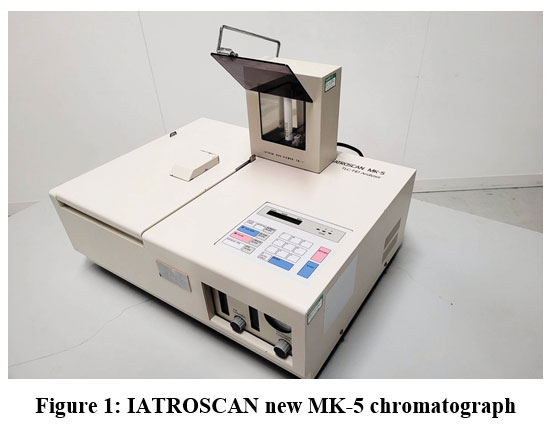 |
Figure 1: IATROSCAN new MK-5 chromatograph. |
Results and Discussion
The 10 columns (known as Chromarods) with which the chromatograph is equipped are made of quartz bars on which silica gel has been sintered as a stationary phase, the layer having a thickness of 75 μ.
Then the columns, together with their support, were inserted into the developing tank provided with a mixture of solvents for the separation of the components. They were dried and put in the eluted chamber (rod holder). On the substrate that no longer contains solvent, the components of the sample are located at fixed distances Rf (retention factor),, depending on the size of the interaction with the stationary phase.
The mobile phase, which must be made up of solvents or mixtures of solvents with different increasing polarities, was made up of n-hexane as a non-polar solvent, toluene as a very weakly polar solvent, respectively dichloromethane/toluene mixture in the ratio 95/5 (v/v) as solvent with higher polarity. This was introduced in the mentioned order, so that the elution of the components is done in the following order: saturated hydrocarbons, aromatic hydrocarbons, resins8-20.
It can be seen from the figure that the peak with the shortest retention time prevails – with the maximum at 0.148 min – which corresponds to saturated hydrocarbons, followed by the one with the maximum at 0.229 min corresponding to aromatics and the one at 0.370 min attributed to resins.
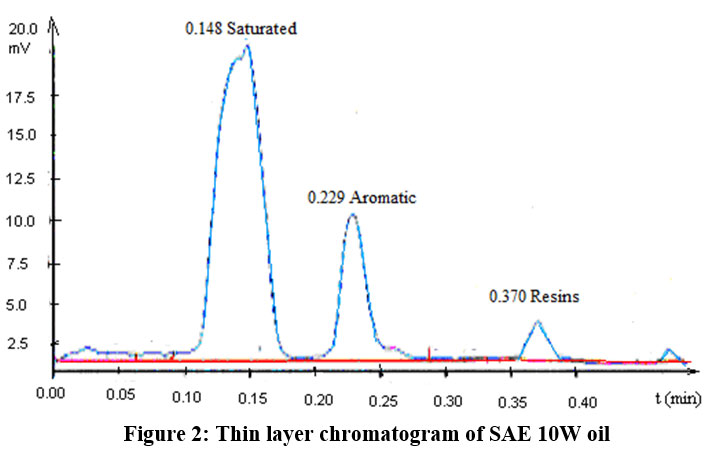 |
Figure 2: Thin layer chromatogram of SAE 10W oil. |
Using normalization as a calculation method, the percentage composition from table 1 was obtained for SAE 10W oil.
Table 1: Hydrocarbon composition of SAE 10W oil and their nature
| Retention time, min | Area | Area, % | Hydrocarbs |
| 0.147 | 23101 | 75.018 | Saturated |
| 0.229 | 6329 | 20.554 | Aromatic |
| 0.370 | 1363 | 4.427 | Resins |
The SAE 10W oil used is therefore predominantly paraffinic, containing 75% saturated hydrocarbons.
Conclusions
SAE 10 W oil contains 75.02% paraffinic hydrocarbons, 20.55% aromatics and 4.23% resins, has a viscosity index of 90, a viscosity-temperature coefficient of 0.901 and a viscosity-density constant of 0.808, both specific to predominantly paraffinic oils.
Reference
- Cerny J., Strnad Z., and Sebor G., 2001, Tribology International, 34(2), 127-134.
CrossRef - Passoni, Douglas de Jesus, Marcos Tadeu T. Pacheco, and Landulfo Silveira Jr., 2020, Instrumentation Science & Technology, 49(2), 164-181.
CrossRef - Kim, Yuna, et al., 2013, Forensic science international, 230(1-3), 58-67.
CrossRef - Reddy K.S.V.K., et al., 2014, Chinese Journal of Engineering, 2014, 1-5.
CrossRef - Ritchie A., Boese D., & Young A. W., 2016, SAE International Journal of Engines, 9(2), 832-840.
CrossRef - Bagi S., Bowker R., & Andrew R., 2016, SAE International Journal of Fuels and Lubricants, 9(1), 239-259.
CrossRef - Kuti O. A., Yang S. Y., Hourani N., Naser N., Roberts W. L., Chung S. H., & Sarathy S. M., 2015, Fuel, 160, 605-613.
CrossRef - Stanciu I., 2019, Journal of Science and Arts, 3(48), 703-708.
- Rashid U., Anwar F., & Knothe G., 2009, Fuel Processing Technology, 90(9), 1157-1163.
CrossRef - Stanciu I., 2019, Journal of Science and Arts, 4(49), 938-988.
- Saxena D.K., Sharma S.K., & Sambi S.S., 2011, ARPN Journal of Engineering and Applied Sciences, 6(1), 84-89.
- Stanciu I., 2011, Journal of Science and Arts, 1, 55-58.
CrossRef - Stanciu I., 2018, Journal of Science and Arts, 18(2), 453-458.
- Stanciu I. 2023. Some methods for determining the viscosity index of hydraulic oil, Indian Journal of Science & Technology, 16(4), 254-258
CrossRef - Stanciu 2023, Rheological behavior of corn oil at different viscosity and shear rate, Oriental Journal of Chemistry, 39(2), 335-339
CrossRef - Stanciu I. 2023, Rheological characteristics of corn oil used in biodegradable lubricant, Oriental Journal of Chemistry, 39(3), 592-595
CrossRef - Stanciu I. 2023, Effect of temperature on rheology of corn (Zea mays) oil, Oriental Journal of Chemistry, 39(4), 1068-1070
CrossRef - Stanciu I., 2021, Oriental Journal of Chemistry, 37(1), 247-249
CrossRef - Stanciu I., 2021, Oriental Journal of Chemistry, 37(2), 440-443
CrossRef - Stanciu I., 2021, Oriental Journal of Chemistry, 37(4), 864-867.
CrossRef
 PlumX:
  Views: 266 Views
  PDF Downloads: 797
 Accepted on: 17 Apr 2025
Second Review by: Dr. Tirsoaga. A
Final Approval by: Dr. Abdelwahab Omri