Enhanced RP-HPLC method for Simultaneous Quantification of Five Pharmacologically Different Active Pharmaceutical Ingredients
 , Pralhad Rege2* and Vijaykumar Chavan1
1Department of chemistry, Ramnarain Ruia Autonomous College, Mumbai, Maharashtra, India.
2Department of chemistry, St. Xavier’s College, Mumbai, Maharashtra, India.
Corresponding Author E-mail: harishb1983@yahoo.com
Download this article as:
ABSTRACT:This research primarily focuses on newly developed method by reverse phase high performance liquid chromatography (RP-HPLC) for quantification and simultaneous estimation for five different active pharmaceutical ingredients (APIs) with different pharmacological activities like antihistamine, anticlotting, antiretroviral, iron chelators and antihypertensive. The method effectively separates five different APIs in single gradient method with reduction run time thereby minimizing solvent consumption and waste generation. Chromatographic separation was achieved using Inertsil ODS-3V C18 (5.0 µm), length 250mm, ID 4.6 mm column with eluent of phosphoric acid (0.1%) (A) and acetonitrile (B) using gradient program at 1.0 ml/min flow rate. Five APIs were well separated and quantified at wavelength 254 nm with column temperature controlled at 35°C. The method validation was performed with specificity, precision, accuracy, robustness, ruggedness and solution stability found within acceptable limits. (98% to 102%) Linearity for all five APIs showed appreciable correlation relationship more than 0.999, confirming the method reliability across the working range. The validated method provides significant role in sustainable pharmaceutical analysis with a robust analytical tool for regulatory submissions, quality control release and commercial batch testing throughout the APIs manufacturing processes. The method simplicity, accuracy and minimal waste generation make it highly valuable for continuous production monitoring, quality assurance and regulatory submission in pharmaceutical operations.
KEYWORDS:API; Assay; Method development; Quantification; Validation
Introduction
The growing demand for antihistamines, anticlotting, antiretroviral, iron chelators and antihypertensive drugs due to increased R&D investments and market growth, analytical methodology has gained importance. Determination of API play important role in pharmaceutical reliability, safety and efficacy of drug administration to patients. Assay analysis plays a crucial role in synthesis and quality check. The mass balance of compounds can be achieved by quantification of API analysis. Several active pharmaceutical ingredients such as Bilastine, Lercanidipine, Rivaroxaban, Dolutegravir and Deferasirox with different pharmacological activities has been explored1-5. Several assay methods have been established to evaluate the combination of two pharmaceutical agents. Existing analytical methods in the literature are largely confine to simultaneous assay of two or more drugs belonging to a single therapeutic class including antimalarial, antihypertensive, antidiabetic etc. Simultaneous quantification of diverse pharmacological activities APIs provides reduction in analysis time, solvent consumption and reduce cost. A single method for five APIs assay quantification overcomes the traditional methods involve separate chromatographic runs for individual API generating large volume of organic solvent waste and time consuming. Furthermore, application of newly developed assay method can be applied to formulation dosage form and biological matrices. The method focuses on minimizing waste generation to supports quality control testing, stability studies and product lifecycle management.6 However an RP-HPLC method for quantification of five different active pharmaceutical ingredients with different pharmacological activities has not been established. Literature review revealed different analytical methodologies for assay quantification like HPTLC, UV-spectrophotometry, HPLC & HPLC-MS has been put forward for Bilastine7-8, Lercanidipine9-10, Rivaroxaban11, Dolutegravir12 and Deferasirox13. Among these techniques, RP-HPLC method is accurate, simple and consistent technique for ease of quantification with reproducible results14-23. Initially isocratic method for separation of five APIs using RP-HPLC was analyzed using Zorbax Agilent C-18 column with mobile phase (phosphate buffer: acetonitrile) (65:35 v/v) was performed. But isocratic method failed to achieve effective resolution between different APIs. However, method was modified with gradient composition using ortho-phosphoric acid and acetonitrile as eluent A and eluent B respectively with Inertsil C-18 column was employed. The optimized method successfully resolved the five different APIs with well resolved peaks. Method validation was performed, evaluating specificity, linearity, accuracy, method precision, ruggedness, robustness, and solution stability.
Materials and Methods
Instruments
The results from the development and validation of the HPLC method were analysed using Agilent Technologies 1260 Infinity-II system, equipped with Photodiode array (PDA) detector. Data processing and quantification of assay results for five actives pharmaceutical ingredients (API) were carried out using Agilent Open LAB data analysis software. (build version 2.203.3.59)
Solvents and reagents
In preparing of mobile phase the solvent system used to carry through the sample through chromatographic column, high purity water was utilized. This water was obtained using Millipore water purification system, ensures removal of impurities, ions and contaminates that could interfere with chromatographic separation and detection process. For chromatographic testing and analysis, two key chemical reagents ortho phosphoric acid and acetonitrile were procured from Merck. These reagents were selected to ensure the reliability and reproducibility of analytical results. For the method development and validation studies, working standard of Bilastine, Rivaroxaban, Dolutegravir, Deferasirox and Lercanidipine were procured from BLD Pharmatech Ltd. (India) These working standard serves as reference material to establish and validate the analytical method, ensuring quantification of each compound with and specificity and precision.
Preparation of solutions
Preparation of diluent
Water: Acetonitrile 20:80 (v/v) use as diluent.
Standard preparation
Weighed accurately about 50 mg each of Bilastine, Rivaroxaban, Dolutegravir, Deferasirox and Lercanidipine working standards to volumetric flask 25 ml. Sonicate to dissolve for preparing 2000 µg/mL stock solution. Further dilute 1.0 ml to 20 ml (100 µg/mL) to obtain the working standard solution. Filter and inject.
Test preparation
Test samples were prepared by weighing 50 mg to 25 mL volumetric flask, adding approximately 15 ml of diluent, sonicating for 5-10 minutes, cooling, and diluting to volume. Further dilute 1.0 ml to 20 ml with diluent to obtain test solution. (100 µg/mL) If the solution is unclear then filter and inject.
Preparation of linearity solutions
Weighed accurately about 50 mg each of Bilastine, Rivaroxaban, Dolutegravir, Deferasirox and Lercanidipine to volumetric flask 25 ml. Sonicate to dissolve for preparing 2000 µg/mL linearity stock solution (A). From stock solution A pipetted out 0.5 ml (50 µg/mL),0.8 ml (80 µg/mL),1.0 ml (100 µg/mL),1.2 ml (120 µg/mL) and 1.5 ml (150 µg/mL) transferred to different 20 ml volumetric flask and dilute up to the mark with diluent. Filter and inject in triplicate for each level.
Preparation of accuracy solutions at 80%, 100% and 120 %:
Test spike preparation: (80%)
Weigh accurately 40.0 ± 5.0 mg of sample transferred to volumetric flask 25 ml. Sonicate to dissolve. Further diluted 1.0 ml to 20 ml with diluent. Inject in triplicate.
Test spike preparation: (100%)
Weigh accurately 50.0 ± 5.0 mg of sample transported to volumetric flask 25 ml. Sonicate to dissolve. Diluted 1.0 ml to 20 ml with diluent. Inject in triplicate.
Test spike preparation: (120%)
Weigh accurately 60.0 ± 5.0 mg of sample in volumetric flask 25 ml. Sonicate to dissolve. Diluted from 1.0 ml to 20 ml with diluent. Inject in triplicate.
Preparation of Method Precision and Intermediate Precision (Ruggedness) solutions
Weighed accurately six individual sample preparation about 50 mg each and transferred to volumetric flask 25 ml. Sonicate to dissolve for preparing 2000 µg/mL stock solutions. Further dilute 1.0 ml to 20 ml (100 µg/mL) to obtain the sample solution. Filter and inject. % RSD found to be less than 2%.
Robustness
Robustness was conducted on different composition of mobile phase, column flow rate and temperature. The sample concentration (100 µg/mL) was prepared and analysed on different mobile phase composition ±10% (0.1%), flow rate 0.9 ml/min and 1.1 ml/min, column temperature 30°C and 40°C. % Assay Bilastine, Lercanidipine, Rivaroxaban, Dolutegravir and Deferasirox were determined to be within the range 98% to 102 %.
Solution Stability
Solution Stability was assessed at different time intervals initial, 12 hrs and 24 hrs for sample concentration (100 µg/mL). % Assay Bilastine, Lercanidipine, Rivaroxaban, Dolutegravir and Deferasirox were determined to be within the range 98% to 102 %.
Chromatographic Conditions
All chromatographic analyses were conducted using high-performance liquid chromatography (HPLC) system (Agilent Technologies 1260 Infinity II, USA). Separation of all analytes was achieved on Inertsil 3V C18 analytical column (5.0 µmx4.6 mm x 250 mm; Part no. 23B0394504). A gradient elution program was employed, utilizing orthophosphoric acid (85%) as buffer component and acetonitrile as organic modifier. The mobile phase was delivered at constant flow rate of 1.0 ml/min. Ultraviolet photodiode array (PDA) detection was performed at 254 nm for quantification and column oven temperature was operated at 35°C throughout the analysis.
Results
Characterization of Bilastine, Rivaroxaban, Dolutegravir, Deferasirox and Lercanidipine.
Different sophisticated analytical instruments were used for the characterization before proceeding for method development and validation. These included:
- Fourier Transform Infrared Spectroscopy (FTIR) by Bruker (Identification of functional groups)
- Reverse phase High Performance Liquid Chromatography (RP-HPLC) by Agilent (%Purity APIs)
- Liquid Chromatography-Mass Spectroscopy (LCMS) by Agilent (Mass identification)
- Thermal Gravimetric Analysis (TGA) by Perkin Elmer (Inorganic residue content)
- Differential Scanning Calorimetry (DSC) by Perkin Elmer (Melting point and thermal analysis)
- Finally, the characterized active pharmaceutical ingredients (APIs) along with respective IUPAC name in Table-1
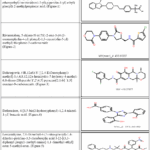 |
Table 1: Characterized active pharmaceutical ingredients (APIs) along with respective IUPAC name Click here to View Table |
Column selection and separation
Among the solvents evaluated, acetonitrile: water (80:20) v/v selected for this study demonstrated excellent solubilizing capacity for all five compounds like Bilastine, Rivaroxaban, Dolutegravir, Deferasirox and Lercanidipine producing strong response with well-defined symmetrical peak shapes. Based on these outcomes, mixture of acetonitrile: water (80:20) v/v was considered as diluent throughout the research study. To identify the most suitable stationary phase for chromatographic separation, different columns were screened like Eclipse zorbax, Waters acquity, Koramsil and Inertsil. After evaluation Inertsil C-18-3V column was selected for better separation and good detector response. A key advantage of this column lies in its advanced end-capping technology, effectively neutralizes residual silanol groups on silica surface, thereby minimizing peak tailing and improving overall chromatographic performance. The column temperature was operated at 35°C to avoid shift in retention time. Separation was achieved using gradient composition of ortho-phosphoric acid (buffer as A) and acetonitrile (organic modifier as B) at column flow rate 1.0 ml/min. Under optimized chromatographic conditions, five analytes eluted in following order with their corresponding retention times: Bilastine (8.1mins), Lercanidipine (11.8 mins), Rivaroxaban (12.8 mins), Dolutegravir (14.1mins), and Deferasirox (18.0 mins). The chromatographic system demonstrated excellent performance, with all peaks showing tailing factor (≥ 2.0), theoretical plates more the 2000 and resolution between Bilastine and Lercanidipine (≥ 2.0). These results collectively confirm that the developed method meets all acceptance criteria as presented in (Figure:1).
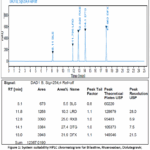 |
Figure 1: System suitability HPLC chromatogram for Bilastine, Rivaroxaban, Dolutegravir, Deferasirox and Lercanidipine. Click here to View Figure |
Optimization of HPLC parameters
Accurate quantification using HPLC methodology is fundamental to ensuring the purity and quality assessment of active pharmaceutical ingredients (API). In initial phase of method development, relatively straightforward and widely accessible analytical techniques such as UV-Visible spectrophotometry, TLC and HPTLC were explored and evaluated. However, despite their simplicity and routine applicability these techniques proved inadequate in delivering precise quantification of five targeted compounds like Bilastine, Rivaroxaban, Dolutegravir, Deferasirox and Lercanidipine.To overcome the limitations, more advanced and sensitive detection technique was employed. High performance liquid chromatography with photodiode array (PDA) detection technique was explored during early method development stages. This technique demonstrated a significant and consistent detector response at 254 nm, suitable for simultaneous quantification of all five APIs. Based upon these findings, the chromatographic conditions were further optimized to achieve precise and reproducible quantification of Bilastine, Rivaroxaban, Dolutegravir, Deferasirox and Lercanidipine. (Table 2).
Table 2: Optimized HPLC chromatographic condition
|
Equipment |
Agilent 1260 Infinity-II HPLC |
||
|
Column Dimensions |
Inertsil 3V ODS C18 (5.0 µm x250 mm x 4.6 mm) (S/N 23B0394504) | ||
| Wavelength |
254 ± 4 nm |
||
|
Flow |
1 ml/min (Gradient flow). | ||
| Column temperature |
35±2°C |
||
|
Injector volume |
10 µl | ||
| Gradient run time |
25 mins |
||
|
Eluent A |
0.1 % orthophosphoric acid in water (v/v) | ||
| Eluent B |
Acetonitrile (100%) |
||
|
Diluent |
Acetonitrile: Water (80:20) (v/v) | ||
| Gradient program: |
|
||
|
Time (mins) |
% Eluent A | % Eluent B | Column flow rate (ml/min) |
| 0 .01 | 85 | 15 |
1.0 |
|
2.0 |
85 | 15 | 1.0 |
| 5.0 | 65 | 35 |
1.0 |
|
15.0 |
25 | 75 | 1.0 |
| 20.0 | 25 | 75 |
1.0 |
|
21.1 |
85 | 15 | 1.0 |
| 25.0 | 85 | 15 |
1.0 |
Method validation
Newly developed HPLC method followed by validation parameters like specificity, linearity, accuracy, method precision, ruggedness and robustness. This validation process established the methods suitability and reliability for its intended analytical application.
Specificity
Bilastine, Lercanidipine Rivaroxaban, Dolutegravir and Deferasirox peaks were well resolved, without any interference at respective retention time. Six times system suitability solution was analysed at 100 µg/mL to check %RSD ≥ 2.0. Summarized in Table 3 & Table 4 as given below:
Table 3: Five distinct active pharmaceutical ingredients were characterized by different retention time.
|
Name |
Retention time (mins) |
| Bilastine |
8.1 |
|
Lercanidipine |
11.8 |
| Rivaroxaban |
12.8 |
|
Dolutegravir |
14.1 |
| Deferasirox |
18.0 |
Table 4: System suitability solution for five different APIs with relative standard deviation values.
|
System suitability |
% Bilastine | % Lercanidipine | % Rivaroxaban | % Dolutegravir | % Deferasirox |
| Test spike 100 % 1-1 | 611 | 1139 | 2791 | 3055 |
3572 |
|
Test spike 100 % 1-2 |
614 | 1143 | 2802 | 3066 | 3585 |
| Test spike 100 % 1-3 | 614 | 1144 | 2801 | 3067 |
3586 |
|
Test spike 100 % 1-4 |
614 | 1143 | 2801 | 3067 | 3586 |
| Test spike 100 % 1-5 | 612 | 1154 | 2794 | 3059 |
3577 |
|
Test spike 100 % 1-6 |
612 | 1141 | 2795 | 3061 | 3578 |
| Mean | 613 | 1144 | 2797 | 3063 |
3581 |
|
SD |
1.2 | 5.3 | 4.4 | 5.0 | 5.7 |
| % RSD | 0.2 | 0.5 | 0.2 | 0.2 |
0.2 |
Linearity
The analytical method demonstrated appreciable linearity for Bilastine, Lercanidipine, Rivaroxaban, Dolutegravir and Deferasirox through five-point calibration curve between concentrations from 50 to 150 µg/mL. Linear regression curves yielded slope, intercept, and correlation coefficient value greater than 0.999. Mentioned in Table 5-9.
Table 5: Linearity levels of Bilastine
|
Linearity Level |
Injection-1 | Injection-2 | Injection-3 | Average |
| 50.2 | 295.6 | 295.6 | 295.6 |
295.6 |
|
80.3 |
469.6 | 470.5 | 470.4 | 470.2 |
| 100.4 | 606.6 | 606.8 | 606.7 |
606.7 |
|
120.5 |
731.1 | 731.9 | 731.6 | 731.5 |
| 150.6 | 918.7 | 913.1 | 913.5 |
915.1 |
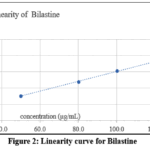 |
Figure 2: Linearity curve for Bilastine Click here to View Figure |
Table 6: Linearity levels of Lercanidipine
|
Linearity Level |
Injection-1 | Injection-2 | Injection-3 | Average |
| 50.9 | 556.7 | 556.4 | 557.3 |
556.8 |
|
81.4 |
906.9 | 920.1 | 920.3 | 915.8 |
| 101.8 | 1142.5 | 1142.4 | 1130.5 |
1138.5 |
|
122.2 |
1378.8 | 1378.2 | 1381.4 | 1379.5 |
| 152.7 | 1678.1 | 1672.1 | 1671.5 |
1673.9 |
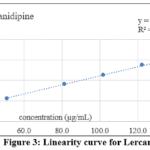 |
Figure 3: Linearity curve for Lercanidipine Click here to View Figure |
Table 7: Linearity levels of Rivaroxaban
|
Linearity Level |
Injection-1 | Injection-2 | Injection-3 | Average |
| 49.9 | 1347.9 | 1345.6 | 1346.7 |
1346.7 |
|
79.8 |
2246.5 | 2249.9 | 2250.1 | 2248.8 |
| 99.8 | 2759.8 | 2760.8 | 2764.1 |
2761.6 |
|
119.8 |
3326.8 | 3327.5 | 3333.1 | 3329.1 |
| 149.7 | 4166.3 | 4138.4 | 4137.2 |
4147.3 |
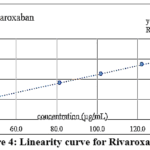 |
Figure 4: Linearity curve for Rivaroxaban Click here to View Figure |
Table 8: Linearity levels of Dolutegravir
|
Linearity Level |
Injection-1 | Injection-2 | Injection-3 | Average |
|
50.4 |
1489.4 | 1487.9 | 1489.3 |
1488.9 |
| 80.6 | 2454.1 | 2457.6 | 2458.7 |
2456.8 |
|
100.8 |
3027.1 | 3028.1 | 3033.2 | 3029.5 |
| 121.0 | 3664.2 | 3665.1 | 3670.4 |
3666.6 |
|
151.2 |
4591.5 | 4562.6 | 4561.8 |
4572.0 |
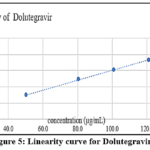 |
Figure 5: Linearity curve for Dolutegravir Click here to View Figure |
Table 9: Linearity levels of Deferasirox
|
Linearity Level |
Injection-1 | Injection-2 | Injection-3 | Average |
| 50.7 | 1736.9 | 1734.2 | 1735.3 |
1735.5 |
|
81.1 |
2865.9 | 2869.4 | 2458.7 | 2731.3 |
| 101.4 | 3534.1 | 3535.1 | 3540.3 |
3536.5 |
|
121.7 |
4280.7 | 4281.1 | 4286.8 | 4282.9 |
| 152.1 | 5335.1 | 5320.9 | 5320.4 |
5325.5 |
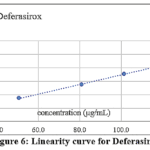 |
Figure 6: Linearity curve for Deferasirox Click here to View Figure |
Accuracy
Accuracy was performed at 80%, 100% and 120% levels in triplicate to obtain recovery between 98 % to 102 % for Bilastine, Lercanidipine, Rivaroxaban, Dolutegravir and Deferasirox. Mentioned in Table 10-14.
Table 10: Accuracy of Bilastine
|
Accuracy at 80 % Level |
Amount added | Amount found | % Recovery | Mean |
| 474.1 | 79.8 | 79.7 |
99.8 |
99.7 |
|
473.7 |
79.8 | 79.3 | 99.3 | |
| 472.8 | 79.8 | 80.0 |
100.2 |
|
|
Accuracy at 100 % Level |
Amount added | Amount found | % Recovery | Mean |
| 613.1 | 99.4 | 100.3 |
100.9 |
100.2 |
|
613.8 |
99.4 | 99.2 | 99.8 | |
| 614.1 | 99.4 | 99.5 |
100.1 |
|
|
Accuracy at 120 % Level |
Amount added | Amount found | % Recovery | Mean |
| 738.3 | 119.8 | 120.7 |
100.8 |
101.3 |
|
737.4 |
119.8 | 121.4 | 101.4 | |
| 739.1 | 119.8 | 121.9 |
101.8 |
Table 11: Accuracy of Lercanidipine
|
Accuracy at 80 % Level |
Amount added | Amount found | % Recovery | Mean |
| 929.6 | 79.8 | 79.8 |
100.0 |
99.8 |
|
928.8 |
79.8 | 79.7 | 99.9 | |
| 927.1 | 79.8 | 79.6 |
99.7 |
|
|
Accuracy at 100 % Level |
Amount added | Amount found | % Recovery | Mean |
| 1144.3 | 99.4 | 101.0 |
101.6 |
100.2 |
|
1159.1 |
99.4 | 98.7 | 99.3 | |
| 1158.8 | 99.4 | 99.1 |
99.7 |
|
|
Accuracy at 120 % Level |
Amount added | Amount found | % Recovery | Mean |
| 1393.6 | 119.8 | 119.2 |
99.5 |
100.5 |
|
1392.1 |
119.8 | 121.6 | 101.6 | |
| 1392.5 | 119.8 | 120.2 |
100.4 |
Table 12: Accuracy of Rivaroxaban
|
Accuracy at 80 % Level |
Amount added | Amount found | % Recovery | Mean |
| 2273.0 | 79.8 | 79.6 |
99.7 |
99.9 |
|
2272.0 |
79.8 | 79.0 | 99.0 | |
| 2266.0 | 79.8 | 80.7 |
101.1 |
|
|
Accuracy at 100 % Level |
Amount added | Amount found | % Recovery | Mean |
| 2804.0 | 99.4 | 99.9 |
100.5 |
100.1 |
|
2803.0 |
99.4 | 99.0 | 99.6 | |
| 2802.0 | 99.4 | 99.4 |
100.0 |
|
|
Accuracy at 120 % Level |
Amount added | Amount found | % Recovery | Mean |
| 3364.0 | 119.8 | 120.2 |
100.3 |
99.7 |
|
3359.0 |
119.8 | 118.9 | 99.3 | |
| 3366.0 | 119.8 | 119.1 |
99.5 |
Table 13: Accuracy of Dolutegravir
|
Accuracy at 80 % Level |
Amount added | Amount found | % Recovery | Mean |
| 2481 | 79.8 | 79.8 |
99.9 |
99.2 |
|
2479 |
79.8 | 78.9 | 98.8 | |
| 2475 | 79.8 | 79.0 |
99.0 |
|
|
Accuracy at 100 % Level |
Amount added | Amount found | % Recovery | Mean |
| 3069.0 | 99.4 | 100.0 |
100.6 |
100.0 |
|
3069.0 |
99.4 | 99.0 | 99.6 | |
| 3070.0 | 99.4 | 99.4 |
100.0 |
|
|
Accuracy at 120 % Level |
Amount added | Amount found | % Recovery | Mean |
| 3691.0 | 119.8 | 120.6 |
100.7 |
100.1 |
|
3687.0 |
119.8 | 118.7 | 99.1 | |
| 3697.0 | 119.8 | 120.2 |
100.4 |
Table 14: Accuracy of Deferasirox
|
Accuracy at 80 % Level |
Amount added | Amount found | % Recovery | Mean |
| 2904 | 79.8 | 79.3 |
99.3 |
99.7 |
|
2902 |
79.8 | 79.8 | 100.0 | |
| 2897 | 79.8 | 79.7 |
99.8 |
|
|
Accuracy at 100 % Level |
Amount added | Amount found | % Recovery | Mean |
| 3592 | 99.4 | 99.9 |
100.5 |
100.0 |
|
3589 |
99.4 | 99.0 | 99.6 | |
| 3588 | 99.4 | 99.4 |
100.0 |
|
|
Accuracy at 120 % Level |
Amount added | Amount found | % Recovery | Mean |
| 4324 | 119.8 | 120.8 |
100.9 |
100.8 |
|
4319 |
119.8 | 120.1 | 100.3 | |
| 4326 | 119.8 | 121.1 |
101.2 |
Method Precision
Analysing six different preparations of sample solution at 100 % (100 µg/ml) were analysed for method precision. Resulting % RSD for Bilastine, Lercanidipine, Rivaroxaban, Dolutegravir and Deferasirox were 0.3,0.4,0.8,0.7 & 0.5 respectively. Mentioned in Table 15.
Table 15: Method precision
|
Method Precision |
% Bilastine | % Lercanidipine | % Rivaroxaban | % Dolutegravir | % Deferasirox |
| Test spike 100 % 1-1 | 99.4 | 99.6 | 99.2 | 99.4 |
99.2 |
|
Test spike 100 % 1-2 |
98.8 | 100.3 | 101.0 | 100.6 | 100.3 |
| Test spike 100 % 1-3 | 99.4 | 99.6 | 99.6 | 98.6 |
99.5 |
|
Test spike 100 % 1-4 |
99.5 | 100.0 | 99.1 | 99.9 | 99.7 |
| Test spike 100 % 1-5 | 98.7 | 99.1 | 98.7 | 99.0 |
98.7 |
|
Test spike 100 % 1-6 |
99.3 | 99.5 | 99.0 | 99.4 | 99.1 |
| Mean | 99.2 | 99.7 | 99.4 | 99.5 |
99.4 |
|
SD |
0.3 | 0.4 | 0.8 | 0.6 | 0.5 |
| % RSD | 0.3 | 0.4 | 0.8 | 0.7 |
0.5 |
Intermediate Precision (Ruggedness)
Analysing six different preparations of sample solution at 100 % (100 µg/ml) across different instruments, different analysts and different days. Resulting % RSD for Bilastine, Lercanidipine, Rivaroxaban, Dolutegravir and Deferasirox were 0.2,0.4,0.2,0.2 & 0.2 respectively. Mentioned in Table 16.
Table 16: Intermediate Precision
|
Method Precision |
% Bilastine | % Lercanidipine | % Rivaroxaban | % Dolutegravir | % Deferasirox |
| Test spike 100 % 1-1 | 99.6 | 98.6 | 99.6 | 99.7 |
99.6 |
|
Test spike 100 % 1-2 |
99.8 | 100.1 | 99.8 | 99.9 | 99.9 |
| Test spike 100 % 1-3 | 99.2 | 99.4 | 99.2 | 99.3 |
99.2 |
|
Test spike 100 % 1-4 |
99.6 | 99.7 | 99.5 | 99.6 | 99.6 |
| Test spike 100 % 1-5 | 99.6 | 99.6 | 99.5 | 99.6 |
99.5 |
|
Test spike 100 % 1-6 |
99.2 | 99.5 | 99.3 | 99.2 | 99.3 |
| Mean | 99.5 | 99.5 | 99.5 | 99.5 |
99.5 |
|
SD |
0.22 | 0.4 | 0.2 | 0.2 | 0.2 |
| % RSD | 0.2 | 0.4 | 0.2 | 0.2 |
0.2 |
Robustness
Robustness was demonstrated by deliberately changing three critical parameters like mobile phase composition (± 10% mobile phase A), flow rate (± 10%) and column temperature (± 10%). The resulting % RSD for Bilastine, Lercanidipine, Rivaroxaban, Dolutegravir and Deferasirox remained within specified limits. Mentioned in Table 17
Table 17: Robustness
|
Method Precision |
% Bilastine | % Lercanidipine | % Rivaroxaban | % Dolutegravir | % Deferasirox |
| Change in Temperature 30° C | 99.4 | 99.6 | 99.4 | 99.5 |
99.5 |
|
Change in Temperature 40° C |
99.4 | 99.1 | 99.1 | 99.1 | 99.2 |
| Flow rate 0.9 ml/min | 99.5 | 98.9 | 98.9 | 98.8 |
98.9 |
|
Flow rate 1.1 ml/min |
99.5 | 99.3 | 98.9 | 99.5 | 98.6 |
| Change in Mobile Phase +10 % | 99.5 | 98.9 | 99.3 | 100.9 |
98.6 |
|
Change in Mobile Phase -10 % |
99.9 | 100.0 | 99.8 | 99.8 | 99.8 |
Solution Stability
Solution Stability is demonstrated by analysing sample solution at 100 % (100 µg/mL) for initial, 12 hrs & 24 hrs. No significant change observed. Mentioned in Table 18
Table 18: Solution Stability
|
Method Precision |
% Bilastine | % Lercanidipine | % Rivaroxaban | % Dolutegravir | % Deferasirox |
| Test solution Initial | 98.7 | 100.2 | 98.6 | 100.0 |
98.9 |
|
Test solution After 12 hrs |
98.9 | 99.1 | 98.9 | 100.4 | 99.2 |
| Test solution After 24 hrs | 99.8 | 99.2 | 100.0 | 101.3 |
100.3 |
Table 19: Summary of HPLC method validation parameters as mentioned below
|
Parameters |
Results | ||||
| Bilastine | Lercanidipine | Rivaroxaban | Dolutegravir |
Deferasirox |
|
|
Method suitability |
|
||||
|
Peak resolution between Bilastine & Lercanidipine ( ≥ 2.0) |
NA | 26.3 | NA | NA | NA |
| Tailing Factor (≥ 2.0) | 0.8 | 1.0 | 1.0 | 1.0 |
1.1 |
|
Theoretical Plates (≥ 1500) |
38916 | 123395 | 92325 | 104076 | 150904 |
| Linearity calibration range (ppm) | 80 to 150 | 80 to 150 | 80 to 150 | 80 to 150 |
80 to 150 |
|
Correlation of coefficient (R2) (greater than 0.999) |
0.9998 | 0.9998 | 0.9998 | 0.9997 | 0.9991 |
| Precision % RSD (≤ 2.0) | 0.3 | 0.4 | 0.8 | 0.7 |
0.5 |
|
Ruggedness % RSD (≤ 2.0) |
0.2 | 0.4 | 0.2 | 0.2 | 0.2 |
| Robustness % RSD (≤ 2.0) |
|
||||
|
Temperature (30 ° C) |
0.5 | 0.3 | 0.3 | 0.3 | 0.3 |
| Temperature (40 ° C) | 0.3 | 0.1 | 0.2 | 0.2 |
0.1 |
|
Column 0.9 ml/min flow rate |
0.05 | 0.1 | 0.2 | 0.1 | 0.1 |
| Column 1.1 ml/min flow rate | 1.2 | 0.1 | 0.2 | 0.8 |
0.2 |
|
Orthophosphoric acid in water 0.1 % v/v (+10 %) |
0.4 | 0.6 | 0.5 | 0.5 | 0.2 |
| Orthophosphoric acid in water 0.1 % v/v (-10 %) | 0.2 | 0.2 | 0.9 | 0.2 |
0.2 |
|
Solution Stability (Initial, 12, 24 hrs) % RSD (≤ 2.0) |
0.5 | 0.5 | 0.6 | 0.5 |
0.6 |
Conclusion
A novel RP-HPLC method was developed that enables robust and accurate simultaneous estimation and quantification of Bilastine, Lercanidipine, Rivaroxaban, Dolutegravir and Deferasirox. The new established RP-HPLC method was simple, selective, and cost-effective for routine analysis, continuous batch release and regulatory submission. The method achieved detection limits with linearity, method precision, accuracy, robustness and ruggedness within specified acceptance criteria. Thus, new developed quantification method offers valuable analytical tool in manufacturing processes and can be implemented to generate accurate and reliable results with sustainable approach.
Acknowledgement
The author wishes to thank Department of Chemistry Ramnarain Ruia Autonomous College and NSRL laboratory Department of chemistry St. Xavier’s College, Mumbai for providing unconditional analytical support to carry out this research study work.
Funding Sources
The author(s) received no financial support for the research, authorship, and/or publication of this article.
Conflict of Interest
The author(s) do not have any conflict of interest.
Data Availability Statement
This statement does not apply to this article.
Ethics Statement
This research did not involve human participants, animal subjects, or any material that requires ethical approval.
Authors’ Contributions
- Harish Bhandarkar: data collection, data investigation characterization, method development, validation and manuscript drafting.
- Vijaykumar Chavan: ideation, supervision, drafting, reviewing and editing.
- Pralhad Rege: ideation, supervision, reviewing, drafting, and editing.
References
- Çelebier, M.; Reçber, T.; Koçak, E.; Altinöz, S. RP-HPLC Method Development and Validation for Estimation of Rivaroxaban in Pharmaceutical Dosage Forms. Braz. J. Pharm. Sci. 2013, 49 (2), 359–366.
CrossRef - Holm, R.; Elder, D. P. Analytical Advances in Pharmaceutical Impurity Profiling. Eur. J. Pharm. Sci. 2016, 87, 118–135.
CrossRef - Cusato, J.; Allegra, S.; Silvia De Francia; Davide Massano; Antonio Giulio Piga; D’Avolio, A. Role of Pharmacogenetics on Deferasirox AUC and Efficacy. Pharmacogenomics 2016, 17 (6), 571–582.
CrossRef - Bhavar, G. B. High-Performance Liquid Chromatographic and High-Performance Thin-Layer Chromatographic Method for Quantitative Estimation of Dolutegravir Sodium in Bulk Drug and Pharmaceutical Dosage Form. Sci. Pharm. 2016, 84 (2), 305–320.
CrossRef - Bonde, C.; Bonde, S.; Gawad, J. K. Application of Quality by Design for Development and Validation of RP-HPLC Method for Lercanidipine Hydrochloride. Asian J. Chem. 2017, 29 (12), 2785–2793.
CrossRef - Attimarad, M.; Venugopala, K. N.; Sreeharsha, N.; Chohan, M. S.; Shafi, S.; Nair, A. B.; Pottathil, S. A Rapid HPLC method for the concurrent determination of several antihypertensive drugs from binary and ternary formulations. Separations 2021, 8 (6), 86.
CrossRef - Din M, S. E.; F, I.; SH, S.; Aziz H, A. E. Spectrophotometric Methods for Simultaneous Determination of Rivaroxaban and Clopidogrel in Their Binary Mixture. Pharm. Anal. Acta.2017, 09 (01).
CrossRef - Mandake, G. R.; Patil, I. S.; Patil, O. A.; Nitalikar, M. M.; Mohite, S. K. UV Spectroscopy Analysis and Degradation Study of Rivaroxaban. Asian J. Res. Pharm. Sci. 2018, 8 (2), 57.
CrossRef - SK. Mastanamma, M.; Jyothi, J. A.; P. Saidulu, S.; M. Varalakshmi, V. Development and Validation of RP-HPLC Method for the Simultaneous Estimation of Lamivudine, Tenofovir Alafenamide and Dolutegravir Bulk and Their Combined Dosage Form. Pharm. Methods.2018, 9 (2), 49–55.
CrossRef - Malik, A.; Firke, S. D.; Patil, R. R.; Shirkhedkar, A. A.; Surana, S. J. Determination of Iron Chelating Agents by Analytical Methods: A Review. Critical Reviews in Analytical Chemistry 2019, 50 (3), 254–264.
CrossRef - Rathod, S. M.; Patel, P. U. Development and Validation of RP – HPLC Method for Estimation of Lamivudine and Dolutegravir Sodium in Synthetic Mixture. Res. J. Pharm. Technol. 2020, 13 (6), 2864–2864.
CrossRef - Sharma, S.; Hatware, K.; Bhadane, P.; Patil, K. Chemistry, Pharmacokinetics, Pharmacodynamics and Analytical Methods of Bilastine, a Histamine H1 Receptor Antagonist: An Update. Mini reviews in medicinal chemistry 2021, 21 (20), 3183–3190.
CrossRef - R Saravanan; T. Somanathan; D. Gavaskar; M. Tamilvanan. Analytical Method Development and Validation of Stability Indicating Assay Method of Analysis for Dolutegravir/Lamivudine/Tenofovir Disoproxil Fumarate Tablets Using High Performance Liquid Chromatography. Res. J. Pharm. Technol. 2021, 14 (5), 2434–2439.
CrossRef - Beltagi, A. M.; Lashin, I. A.; Essa, W. A.; Hathoot, A. A.; M. Abdel Azzem. Evolution and Effectiveness of HPLC Technique for Rapid Estimation of an Antiallergenic Agent Bilastine. Asian J. Pharm. Anal. 2021, 57–62.
CrossRef - Ettaboina,S.; Nakkala K.; Chathalingath, N. Development and Validation of Rapid RP-HPLC Method for Determination of Deferasirox in Bulk and Tablet Dosage Forms. Asian J. Pharm. Anal. 2022, 12 (2), 73–77.
CrossRef - Thakare B; Mittal, A.; Charde M; Umbarkar R; Kohle, N.; Chandra, P.; Kadam, M. Development and Validation of Stability-Indicating Assay UHPLC Method for Simultaneous Analysis of Dolutegravir, Lamivudine and Tenofovir Disoproxil Fumarate in Bulk and Pharmaceutical Formulation. Res. J. Pharm. Technol. 2022, 15 (9), 4061–4066.
CrossRef - Martini, P. R. R.; Dos Santos Porto, D.; Ribeiro Motta, P.; Bajerski, L.; Donadel Malesuik, M.; Soldateli Paim, C. Bilastine: Stability-Indicating a Method Using Environmentally Friendly by Reversed-Phase High-Performance Liquid Chromatography (RP-HPLC). DAR. 2022, 6 (1), 13–20.
CrossRef - Jain, P.; Thota, A.; Saini, P. K.; Raghuvanshi, R. S. Comprehensive Review on Different Analytical Techniques for HIV 1- Integrase Inhibitors: Raltegravir, Dolutegravir, Elvitegravir and Bictegravir. Critical Reviews in Analytical Chemistry 2022, 54 (2), 401–415.
CrossRef - Hajdys, J.; Piotr Fularski; Klaudia Leszto; Majchrowicz, G.; Stabrawa, M.; Ewelina Młynarska; Rysz, J.; Franczyk, B. New Insights into the Nephroprotective Potential of Lercanidipine. Int. J. Mol. Sci. 2023, 24 (18), 14048–14048.
CrossRef - Ajitha Azhakesan; Kishore Kumar Pasupuletti; Narendra Pentu. A Critical Review of Analytical Methods for Quantification of Rivaroxaban in Biological Samples and Pharmaceutical Formulations. J. Appl. Pharm. Sci. 2024, 15 (2).
CrossRef - Laddika Lakshmi Hari Sahitya; Dr. P. Uma Devi; Dr. P. V. Madhavi Latha. Method Development and Validation for the Simultaneous Estimation of Bilastine and Montelukast in Bulk and Pharmaceutical Dosage Forms by Reversed-Phase High-Performance Liquid Chromatography (RP-HPLC). J. Transl. Res. Life Sci.2025, 1 (5), 1–10.
CrossRef - Trivedi, R.; Suhagia, B. Development and Validation of Deferasirox-Related Substance Method in Solid Dosage Forms Using HPLC. Int. J. Appl. Pharm. 2025, 17 (2), 281–292.
CrossRef - Raju, M. D.; Palivela, P. K.; Rayinuthala, Y. A Reverse Phase High Performance Liquid Chromatography-Photo Diode Array Estimation of Probenecid and Sulopenem Etzadroxil in bulk and pharmaceutical dosage form and characterization of degradants by using liquid chromatography mass spectrometry. Int. J. Appl. Pharm 2026, 18 (1), 250–262.
CrossRef - ICH Stability Testing of New Drug Substances and Products Q1A (R2), International Conference on Harmonization (2003).
- ICH Validation of analytical procedures: Text and methodology Q2 (R1), International Conference on Harmonization (2005).
- ICH, Impurities in new drug substances Q3A (R2), International Conference on Harmonization (2006).
Accepted on: 27 Jun 2026
Second Review by: Dr. Naresh Batham
Final Approval by: Dr. Ravindra M Kumbhare


ISSN Online: 2231-5039