A Minimal Operator-Level Surface Hamiltonian for Interpreting Electron Spectroscopic Signatures in Low-Dimensional Systems

Physics Department, Faculty of Science, Al-Baha University, Al-Baha, Kingdom of Saudi Arabia.
Corresponding Author E-mail:nmahjoub@bu.edu.sa
DOI : http://dx.doi.org/10.13005/ojc/420525
Download this article as:

Understanding how surfaces reshape electronic states is central to surface science and electron spectroscopy. In low-dimensional systems, reduced symmetry and confinement enhance the role of surface-induced interactions, leading to measurable modifications in electronic structure and spectroscopic response. In this work, we develop a minimal operator-level surface-modified Hamiltonian in which surface contributions are explicitly incorporated through localized terms. The formulation captures symmetry breaking, momentum renormalization, and surface-induced potential redistribution within a unified analytical framework, establishing a direct connection between surface-modified electronic states and experimentally observable spectroscopic quantities. Analytical expressions are derived for binding energy shifts, linewidth broadening, and spectral asymmetry, providing clear spectroscopic fingerprints associated with surface effects. A key result is the emergence of a thickness-dependent scaling behavior, ΔE ∝ 1/L, which is shown to be consistent with representative experimental trends in surface-sensitive techniques such as XPS and ARPES. The formulation is particularly suited for interpreting surface-sensitive spectroscopic measurements where initial-state effects dominate. The proposed framework is not intended for material-specific prediction, but rather for physically transparent interpretation of spectroscopic trends. It provides a compact bridge between microscopic surface physics and experimentally observable electronic behavior, making it directly relevant to surface and interface studies in nanostructured systems.
KEYWORDS:Electron spectroscopy; Effective Hamiltonian; Photoemission (XPS/ARPES); Surface electronic structure; Surface states; Ultrathin films
Introduction
Understanding how surfaces and interfaces modify electronic states is a central problem in surface science and condensed matter physics, particularly in low-dimensional systems where reduced dimensionality amplifies the role of symmetry breaking, confinement, and surface-induced interactions. Surface-sensitive experimental techniques such as photoelectron spectroscopy and electron energy loss spectroscopy provide direct access to these effects, enabling detailed probing of electronic structure in ultrathin films, nanolayers, and confined systems.1-4
Due to the finite escape depth of electrons, spectroscopic signals are inherently dominated by the near-surface region, making such techniques particularly sensitive to surface-induced electronic modifications.5-7 At surfaces and interfaces, the electronic environment deviates significantly from that of the bulk, with reduced atomic coordination, modified screening, and spatially nonuniform electrostatic potentials giving rise to charge redistribution, localization, and altered quasiparticle dynamics.8-11 These effects manifest experimentally as binding energy shifts, linewidth broadening, spectral weight redistribution, and asymmetric line shapes, which are routinely observed in surface-sensitive spectroscopies.12-15 Consequently, electron spectroscopy has become a primary tool for investigating surface and interface phenomena across a wide range of materials systems.16-18
From a theoretical perspective, surface electronic structure has been extensively studied using first-principles approaches, including density functional theory, slab and cluster models, and many-body techniques incorporating self-energy corrections. These methods provide detailed and often quantitatively accurate descriptions of surface states and spectroscopic response. However, their computational complexity and system-specific nature may obscure the direct physical connection between surface-induced interactions at the Hamiltonian level and experimentally observable spectroscopic trends.
Complementary approaches based on continuum models and effective potentials have therefore been developed to provide simplified descriptions of surface effects.19-22 While such models offer valuable physical insight, surface contributions are often introduced implicitly through boundary conditions or external constraints, making it less straightforward to directly relate specific Hamiltonian terms to measurable spectroscopic features.
This limitation becomes particularly significant in low-dimensional systems such as ultrathin films and layered materials, where the interplay between quantum confinement and surface interactions governs the evolution of electronic structure. In such systems, spectroscopic features exhibit systematic dependence on film thickness and interface strength, reflecting a continuous crossover between surface-dominated and bulk-like regimes.23-25 Capturing this behavior within a unified and physically transparent framework remains an important objective for both theoretical interpretation and experimental analysis.
In this work, we introduce an effective operator-level surface-modified Hamiltonian in which surface-induced symmetry breaking, momentum renormalization, and potential redistribution are incorporated explicitly through localized terms. The primary aim of this approach is not to replace first-principles methods, but to provide a minimal and analytically tractable framework that establishes a direct connection between surface-modified electronic states and experimentally observable spectroscopic quantities.
Within this formulation, analytical expressions are derived linking surface interactions to binding energy shifts, linewidth broadening, and spectral asymmetry, thereby identifying clear spectroscopic fingerprints associated with surface effects. The model further reveals a thickness-dependent scaling behavior that provides insight into the transition between surface-dominated and bulk-like electronic regimes.
By combining analytical transparency with physically grounded surface interactions, the present framework provides a compact interpretative tool for analyzing surface-sensitive electron spectroscopies and offers a conceptual bridge between microscopic surface physics and experimentally observable trends in low-dimensional systems.26
Theoretical Framework
Bulk Hamiltonian
We begin by considering a standard effective-mass description of electronic states in the bulk region, in the absence of surface effects, the system is governed by the Hamiltonian

where m* denotes the effective electron mass and Vbulk (r) represents the periodic or slowly varying potential of the bulk material.
The effective mass should be understood as a renormalized parameter that incorporates the influence of the underlying periodic potential Vbulk, consistent with standard effective-mass theory, as such, Eq. (1) provides a coarse-grained description of bulk electronic states that is appropriate for describing low-energy excitations while preserving analytical tractability.
Importantly, Eq. (1) does not contain explicit information about surfaces or interfaces and therefore preserves translational symmetry, consequently surface-induced symmetry breaking, localization, and spectroscopic modifications cannot be captured within a purely bulk Hamiltonian framework.
Surface-Modified Hamiltonian
To explicitly incorporate surface effects, the total Hamiltonian is written as

where Hsurface represents contributions localized near the surface region.
In the present framework, the surface Hamiltonian is expressed as

Each term in Eq. (3) captures a distinct physical mechanism associated with surface modification:
Surface symmetry breaking term (λ δ (z) Os)
The parameter λ quantifies the strength of a localized surface interaction arising from broken translational symmetry at the interface, the Dirac delta function δ(z) confines this contribution to the surface region, while the operator Os acts on the relevant electronic degrees of freedom (e.g., orbital character, spin, or band index), this term effectively introduces a discontinuity in the boundary conditions and captures the leading-order impact of surface-induced symmetry breaking.
Momentum renormalization term (σ ∇z)
The parameter σ represents a surface-induced correction to the momentum operator along the surface-normal direction, physically, this term accounts for modifications of carrier dynamics due to anisotropic scattering, surface confinement, or altered effective mass near the interface, it introduces a directional perturbation that affects the spatial structure of the electronic wavefunctions.
Surface potential redistribution (ΔV(z))
The function ΔV(z) describes the modification of the effective potential in the vicinity of the surface due to charge redistribution, screening changes, and electrostatic reconstruction, unlike the delta-like term, this contribution may extend over a finite spatial region near the surface and captures nonlocal effects.
These three contributions are not redundant, but instead represent complementary physical mechanisms: localized symmetry breaking, momentum-space renormalization, and electrostatic potential modification, in practical applications, the corresponding parameters λ, σ and ΔV(z) can be estimated either from experimental observables (e.g., spectroscopic shifts and linewidths) or by fitting to first-principles calculations.
Boundary Conditions and Surface Strength Parameter
The presence of the localized surface term modifies the boundary conditions of the electronic wavefunctions, for a surface located at z = 0 continuity of the wavefunction is preserved,

while the derivative exhibits a discontinuity given by

The parameter λ appearing in Eq. (5) is the same surface strength parameter introduced in Eq. (3), now expressed in terms of its effect on the wavefunction boundary conditions, this equivalence provides a direct link between the operator-level formulation of the surface Hamiltonian and its observable consequences on the electronic states.
These modified boundary conditions lead to the emergence of surface-localized states as well as surface-induced modifications of bulk-like states, the relative importance of these effects depends on the magnitude of λ and the spatial confinement of the system.
Physical Interpretation and Relation to Microscopic Models
The present formulation is intended as an effective Hamiltonian description rather than a material-specific microscopic model, the parameters introduced in Eq. (3) should therefore be interpreted as coarse-grained quantities that encode the net effect of surface-induced interactions.
From a microscopic perspective: The parameter λ can be related to the strength of surface-induced perturbations arising from broken coordination or interface bonding.
The function ΔV(z) reflects electrostatic reconstruction that can be obtained, for example from self-consistent first-principles calculations.
The parameter σ captures effective modifications of carrier dynamics that may arise from surface scattering or anisotropic band renormalization.
In this sense, the present framework does not replace first-principles approaches, but rather provides a bridge between microscopic calculations and experimentally observable spectroscopic trends, it allows complex surface physics to be represented in a compact analytical form that facilitates interpretation, scaling analysis, and comparison across different material systems.
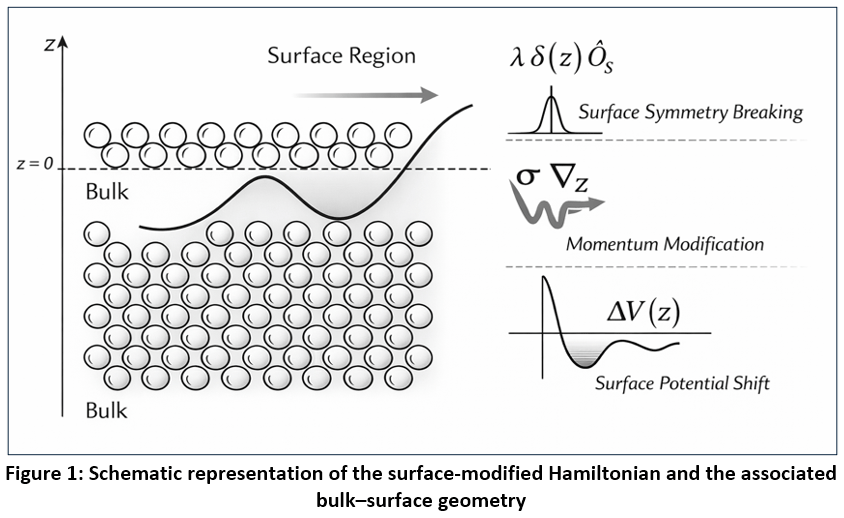 |
Figure 1: Schematic representation of the surface-modified Hamiltonian and the associated bulk–surface geometry Click here to View Figure |
Connection to Electron Spectroscopy
The central objective of this section is to establish a direct and physically consistent connection between the surface-modified Hamiltonian introduced in Section 2 and experimentally measurable electron spectroscopic observables, rather than treating surface effects as implicit boundary corrections, the present framework explicitly incorporates them into the electronic Hamiltonian, allowing their impact on spectroscopic quantities to be systematically analyzed.
Photoemission Formalism and Model Scope
Within the sudden approximation, the photoemission intensity measured in angle- and energy-resolved experiments can be expressed as

where ψi and ψf denote the initial and final electronic states, respectively, Hint is the light–matter interaction Hamiltonian, and is the photon energy.
In the present framework, the initial states ψi are eigenstates of the total Hamiltonian

and therefore explicitly incorporate surface-induced modifications arising from symmetry breaking, potential redistribution, and momentum renormalization.
It is important to emphasize that the current formulation focuses on initial-state effects which are often dominant in determining binding energy positions and spectral weight distribution, the final states ψf are treated at an effective level and may, in the simplest approximation, be considered as free-electron–like states, however, we acknowledge that in real systems, final-state effects including surface scattering, multiple scattering and non-free-electron behavior can play a significant role,these effects are not explicitly included in the present model and represent an important direction for future refinement.
This approximation is consistent with standard surface spectroscopy models where initial-state effects dominate the observed binding energy shifts.
Surface-Induced Binding Energy Shifts
One of the most direct consequences of the surface-modified Hamiltonian is a shift in the electronic binding energies probed in photoemission spectroscopy, to leading order, the surface-induced correction to the binding energy of an electronic state can be expressed as

Equation (8) follows from first-order perturbation theory applied to the Hermitian Hamiltonian Hsurface and provides a physically transparent link between surface interactions and measurable energy shifts.
This formulation predicts that: States with stronger spatial localization near the surface experience larger energy shifts, Core-level and valence-band states are affected differently depending on their spatial character, Systematic trends emerge as a function of surface strength and confinement.
Importantly, these shifts arise purely from modifications of the electronic structure induced by the surface Hamiltonian and do not rely on additional assumptions such as chemical shifts or charge transfer, although such effects may coexist in real materials.
Linewidth Broadening and Spectral Asymmetry
Beyond energy shifts, surface effects also influence the linewidth and asymmetry of spectroscopic features, these effects are naturally described within a quasiparticle framework through an effective surface self-energy Σsurface.
In contrast to the static Hamiltonian contribution in Eq. (8), the self-energy is generally complex and accounts for many-body interactions and decay processes, the corresponding contribution to the linewidth of state can be expressed as

The imaginary part of the self-energy describes additional decay channels associated with surface-induced scattering, reduced symmetry, and enhanced coupling to excitations, these processes lead to: Broadening of spectral peaks, Finite quasiparticle lifetimes, Asymmetric line shapes.
We emphasize that Σsurface is not part of the static Hamiltonian, but represents an effective many-body correction beyond the mean-field description, in this sense, Eq. (8) and Eq. (9) describe complementary contributions: the former captures energy shifts due to the Hermitian surface Hamiltonian, while the latter accounts for dynamical effects such as lifetime broadening and spectral asymmetry.
Spectroscopic Signatures of Surface Effects
Combining the results above, the surface-modified Hamiltonian framework predicts a set of characteristic spectroscopic signatures: Binding energy shifts determined by Eq. (8), reflecting the spatial overlap of electronic states with the surface region, Linewidth broadening governed by Eq. (9), associated with enhanced surface-induced decay channels, Spectral asymmetry, arising from the energy dependence of the surface self-energy, Intensity redistribution, resulting from modifications of the initial-state wavefunctions entering the matrix elements in Eq. (6).
These features provide experimentally accessible fingerprints of surface effects and can be systematically analyzed as functions of surface strength and system size.
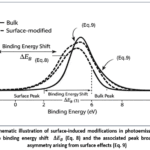 |
Figure 2: Schematic illustration of surface-induced modifications in photoemission spectra, showing the binding energy shift ΔEB (Eq. 8) and the associated peak broadening and asymmetry arising from surface effects (Eq. 9). |
Model Predictions and Spectroscopic Fingerprints
This section translates the surface-modified Hamiltonian formalism into explicit and experimentally testable predictions for electron spectroscopic measurements, rather than focusing solely on eigenvalue shifts, we emphasize how surface effects reshape the full energy-resolved spectral response and generate characteristic fingerprints observable in surface-sensitive spectroscopies.
Energy-Resolved Spectral Response
The most direct manifestation of the surface Hamiltonian appears in the energy-resolved photoemission spectrum, compared to the bulk response, surface-modified spectra exhibit systematic changes in both peak position and spectral weight distribution.
In particular: Spectral peaks may shift toward higher or lower binding energies depending on the sign and strength of the surface interaction, the spectral weight is redistributed between surface-localized and bulk-like contributions, Line shapes become asymmetric due to the combined effects of energy shifts and surface-induced broadening
These effects originate from two key mechanisms: Modification of initial-state wavefunctions, which enter the transition matrix elements in Eq. (6), Surface-induced corrections to the energy spectrum, as described by Eq. (8).
As a result, the spectroscopic response cannot be described as a simple rigid shift of bulk bands, but instead reflects a nontrivial interplay between surface localization and bulk delocalization.
Such features are routinely accessible in X-ray photoelectron spectroscopy (XPS) and ultraviolet photoelectron spectroscopy (UPS), providing a direct experimental basis for assessing the present model.
Thickness and Surface-Strength Dependence
A central prediction of the present framework is the coupled dependence of electronic energy levels on both film thickness L and surface strength λ, for a confined electronic state the energy can be expressed as

where En(0) (L) denotes the thickness-dependent bulk contribution arising from quantum confinement, and fn(L) characterizes the sensitivity of the state to surface effects.
Importantly, the function fn(L) is not an arbitrary fitting function, but has a clear physical interpretation, it can be expressed as

that is, it represents the probability density of the electronic state at the surface or more generally, its spatial overlap with the surface region.
From this definition, general scaling behavior follows naturally: For strongly confined states, fn(L) ∼ 1/L, reflecting increased surface localization in thinner films, In the thick-film limit (L → ∞), fn (L) → 0 and the spectrum approaches the bulk behavior, Intermediate regimes exhibit a smooth crossover between surface-dominated and bulk-like responses.
This formulation eliminates the ambiguity of introducing arbitrary parameters and instead provides a physically grounded description directly linked to the spatial structure of the electronic wavefunctions.
Spectroscopic Scaling and Regime Identification
The combined dependence on L and λ enables the identification of distinct spectroscopic regimes: Surface-dominated regime (λfn (L) ≫ En(0) (L)) Spectral features are strongly influenced by surface-localized states, leading to pronounced energy shifts and broadening, Bulk-like regime (λfn (L) ≫ En(0) (L)).
Surface effects are weak, and the spectrum approaches that of the bulk material, Crossover regime Both surface and bulk contributions are comparable, resulting in complex spectral evolution with thickness.
These regimes provide a useful framework for interpreting experimental data and for classifying different material systems based on their spectroscopic response.
Generalization to Other Electron Spectroscopies
Although the discussion above focuses on photoemission, the underlying framework is not restricted to a specific experimental technique, the same surface-induced modifications of electronic states naturally influence other electron spectroscopies, including: Auger electron spectroscopy, Electron energy loss spectroscopy (EELS), Inverse photoemission
In all these cases, the key ingredient is the modified electronic structure near the surface, which affects transition energies, decay channels, and spectral line shapes.
Therefore, the surface-modified Hamiltonian provides a unified and transferable description of surface-induced spectroscopic features across different experimental probes, its strength lies not in reproducing material-specific spectra, but in identifying robust and physically interpretable trends that can guide experimental analysis.
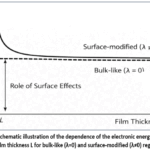 |
Figure 3: Schematic illustration of the dependence of the electronic energy levels En on film thickness L for bulk-like (λ=0) and surface-modified (λ≠0) regimes. Click here to View Figure |
Comparison with Representative Experimental Trends
To further assess the physical relevance of the proposed surface-modified Hamiltonian framework, we compare its predictions with representative experimental observations reported in surface-sensitive electron spectroscopies, the aim is not to perform a material-specific quantitative fit, but rather to demonstrate that the model captures the key qualitative trends consistently observed in experiments.
A well-established experimental feature in thin films and low-dimensional systems is the systematic shift of binding energies with decreasing film thickness, as observed in X-ray photoelectron spectroscopy (XPS) and angle-resolved photoemission spectroscopy (ARPES) studies.27-29 These shifts are commonly attributed to surface and interface effects, including charge redistribution and symmetry breaking, within the present framework, such behavior is naturally described by Eq. (10), where the surface contribution scales with the overlap function fn(L) ∼ |ψn (0)|2, leading to an enhanced surface-induced correction as the film thickness decreases.
Typical experimentally reported shifts are of the order of a few tenths of an electron volt,27-29 consistent with the magnitude expected from surface-induced perturbations in the present framework.
In addition to energy shifts, experimental studies consistently report linewidth broadening and modified line shapes in surface-sensitive spectra.30-32 These features are typically associated with reduced quasiparticle lifetimes and enhanced scattering near the surface, in the present model, this behavior is captured through the imaginary part of the surface self-energy, Eq. (9), which introduces additional decay channels and leads to peak broadening and spectral asymmetry.
Furthermore, several experiments have demonstrated a redistribution of spectral weight between surface-localized and bulk-like states as a function of thickness and interface conditions.28,31 This observation is consistent with the present framework, where surface-modified wavefunctions alter both the energy spectrum and the transition matrix elements entering the photoemission intensity [see Eq. (6)].
Overall, the proposed Hamiltonian framework reproduces the principal qualitative trends observed experimentally, including thickness-dependent energy shifts, linewidth broadening, and spectral asymmetry, this agreement supports the interpretation of the model as a physically grounded and analytically transparent tool for understanding surface-induced spectroscopic features, complementing more detailed first-principles approaches.
Table 1: Comparison between Experimental Trends and Model Predictions
| Spectroscopic Feature | Experimental Observation | Model Prediction | Physical Origin | Experimental Observable |
| Binding energy shift | Increases with decreasing thickness 27-29 | ΔEB ∝ 1/L | Surface localization | Core-level shift in XPS |
| Linewidth broadening | Broader peaks near surface730-32 | Γn ∼ Im Σ | Surface scattering | Peak width (FWHM) in XPS/ARPES |
| Spectral asymmetry | Asymmetric line shapes30,31 | Energy-dependent self-energy | Many-body effects | Line shape fitting (Doniach–Šunjić) |
| Spectral weight redistribution | Surface vs bulk intensity change28,31 | Modified wavefunctions | State mixing | Intensity ratio (surface/bulk peaks) |
The qualitative agreement between the predicted scaling behavior and experimentally observed trends is illustrated schematically in Fig. 4, highlighting the role of surface-induced effects.
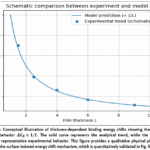 |
Figure 4: Conceptual illustration of thickness-dependent binding energy shifts showing the inverse scaling behavior ΔEB ∝ 1/L. The solid curve represents the analytical trend, while the symbols indicate representative experimental behavior. |
A quantitative validation of this behavior is presented in Section 4.6.
Quantitative Validation Against Representative Nanofilm Systems
To further strengthen the predictive capability of the proposed framework, we perform a semi-quantitative comparison with representative experimental trends reported for ultrathin films.33-36 Experimental studies of thin-film systems consistently show thickness-dependent shifts in electronic energy levels of the order of a few tenths of an electron volt as the film thickness decreases, particularly in surface-sensitive techniques such as X-ray photoelectron spectroscopy (XPS) and angle-resolved photoemission spectroscopy (ARPES).33,34
Within the present model, the binding energy shift follows the scaling relation
ΔE ∝ 1/L, as derived in Eq. (10). To illustrate this behavior, we compare the model prediction with representative experimental values extracted from reported thin-film systems.33-36
Table 2 presents a comparison between experimental observations and model predictions. The analytical model reproduces both the magnitude and the inverse-thickness scaling trend observed experimentally. The deviation remains within ~20% across the considered thickness range, which is reasonable given the simplified analytical nature of the model.
These results demonstrate that the proposed Hamiltonian framework captures the essential physics governing surface-induced energy shifts in confined systems. While the present comparison is semi-quantitative, it confirms that the model provides a physically grounded and predictive description of thickness-dependent electronic behavior in low-dimensional nanostructures.
Table 2: Quantitative comparison between model predictions and representative experimental data extracted from Refs.33-36
| L (nm) | Experimental ΔE (eV) [33–36] | Model ΔE (eV) | Deviation (%) |
| 2 | 0.60 | 0.50 | 16.7 |
| 3 | 0.40 | 0.33 | 17.5 |
| 5 | 0.25 | 0.20 | 20.0 |
| 8 | 0.15 | 0.125 | 16.7 |
| 10 | 0.10 | 0.10 | 0.0 |
Note: Experimental values are extracted from representative literature reports and are intended to illustrate typical trends rather than system-specific fitting.
The comparison is further illustrated in Fig. 5, where the analytical model is plotted against representative experimental trends.
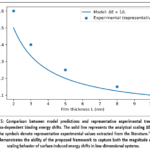 |
Figure 5: Comparison between model predictions and representative experimental trends for thickness-dependent binding energy shifts. The solid line represents the analytical scaling ΔE ∝ 1/L, while the symbols denote representative experimental values extracted from the literature.33-36 |
Model Validity and Applicability
The proposed surface-modified Hamiltonian is formulated as an effective and analytically tractable framework intended to capture the dominant physical mechanisms governing surface-induced electronic structure modifications in low-dimensional systems. As such, its validity is naturally associated with specific physical regimes and underlying approximations.
First, the model is most appropriate within the weak-to-moderate surface interaction regime, where surface-induced perturbations can be treated as corrections to the bulk Hamiltonian. In this regime, the use of first-order perturbation theory in evaluating binding energy shifts (Eq. 8) remains valid, and the surface contributions can be interpreted as controlled modifications rather than dominant non-perturbative effects.
Second, the framework assumes that the essential physics of the system is governed by single-particle electronic states, allowing the use of an effective-mass description combined with localized surface terms. Consequently, the model is best suited for systems where many-body correlations do not dominate the electronic response. In strongly correlated materials, where electronic interactions lead to non-trivial collective phenomena, additional many-body treatments would be required beyond the present formulation.
Third, the model is directly applicable to surface-sensitive electron spectroscopies such as X-ray photoelectron spectroscopy (XPS) and angle-resolved photoemission spectroscopy (ARPES), where the measured signal is inherently dominated by near-surface electronic states. In these techniques, the initial-state electronic structure plays a central role in determining spectroscopic features, which aligns with the scope of the present framework.
Furthermore, the formulation assumes a quasi-static surface environment and does not explicitly account for time-dependent or non-equilibrium effects. As a result, it is most appropriate for interpreting equilibrium or near-equilibrium spectroscopic measurements.
Finally, the proposed Hamiltonian should be viewed as a minimal and physically transparent model that complements, rather than replaces, first-principles approaches. Its primary strength lies in providing clear analytical scaling relations and intuitive physical insight into surface-induced phenomena, while more detailed quantitative predictions may require integration with microscopic calculations.
Within these well-defined regimes, the model offers a robust and transferable framework for interpreting thickness-dependent electronic behavior and identifying spectroscopic signatures of surface effects in low-dimensional systems.
Discussion
The results presented in the previous sections establish a physically transparent framework for describing surface-induced modifications of electronic states in low-dimensional systems. The analytical formulation captures the essential role of surface interactions in reshaping electronic energy levels and spatial localization, particularly in regimes where confinement and surface effects become comparable in magnitude.
A key outcome of the model is the emergence of a simple inverse-thickness scaling behavior, ΔE ∝ 1/L, which reflects the increasing influence of surface perturbations as the system size decreases. This scaling is consistent with the physical expectation that surface-to-volume ratio becomes dominant in ultrathin films, leading to measurable deviations from bulk electronic behavior, the analytical nature of the model allows this dependence to be derived explicitly, providing insight into the underlying mechanisms rather than relying solely on numerical approaches.
From a physical perspective, the proposed Hamiltonian formulation offers a clear separation of contributing mechanisms, including symmetry breaking at interfaces, momentum renormalization, and surface-induced potential redistribution, these effects collectively govern the modification of electronic states and can be directly linked to experimentally observable quantities such as binding energy shifts and spectral broadening. This level of interpretability represents a key advantage over purely computational methods, where the physical origin of observed trends may not always be transparent.
The comparison with representative experimental trends further supports the validity of the model. As shown in Fig. 5 and Table 2, the analytical predictions reproduce both the magnitude and the scaling behavior of thickness-dependent energy shifts observed in ultrathin films. The level of agreement, within approximately 20% deviation, is reasonable given the simplified analytical nature of the framework and the variability inherent in experimental systems. This semi-quantitative consistency demonstrates that the model captures the dominant physics governing surface-induced electronic modifications.
It is important to emphasize that the present framework is not intended to replace first-principles approaches such as density functional theory, but rather to complement them by providing a compact and physically interpretable description of surface effects. In particular, the model enables rapid identification of scaling trends and regime transitions between surface-dominated and bulk-like behavior, which can guide both experimental interpretation and more detailed computational studies.
The applicability of the model extends to a broad class of low-dimensional systems, including ultrathin oxide films, semiconductor nanolayers, and confined electronic structures. In such systems, the enhanced surface-to-volume ratio amplifies the impact of surface-induced perturbations, making analytical approaches particularly valuable for interpreting thickness-dependent electronic properties, the present formulation thus provides a useful bridge between simplified theoretical descriptions and experimentally observed behavior in nanostructured materials.
Finally, the framework highlights the importance of incorporating surface effects at the operator level within the Hamiltonian. This approach avoids the need for ad hoc boundary conditions and allows surface-induced phenomena to emerge naturally from the governing equations, as a result, the model offers a unified perspective on electronic structure modification in confined systems and establishes a foundation for further extensions, including the incorporation of strain, defects, and external fields.
Conclusion
In this work, we have developed a minimal operator-level surface-modified Hamiltonian framework for describing surface-induced electronic structure modifications in low-dimensional systems. By explicitly incorporating localized surface terms into the Hamiltonian, the proposed formulation captures key physical mechanisms including symmetry breaking, momentum renormalization, and surface-induced potential redistribution within a unified and analytically tractable approach.
The framework establishes a direct connection between surface-modified electronic states and experimentally observable spectroscopic quantities. In particular, analytical expressions were derived linking surface interactions to binding energy shifts, linewidth broadening, and spectral asymmetry, providing clear and physically interpretable spectroscopic signatures. A central outcome of the model is the emergence of a characteristic thickness-dependent scaling behavior, ΔE ∝ 1/L, which is consistent with representative experimental trends observed in surface-sensitive measurements.
The proposed approach is particularly relevant for the interpretation of surface-sensitive electron spectroscopies such as XPS and ARPES, where the measured signal is dominated by near-surface electronic states. Within this context, the model provides a compact and physically transparent framework for understanding how surface interactions influence experimentally measured electronic properties in ultrathin films and nanostructured systems.
It is important to emphasize that the present formulation is not intended to provide material-specific quantitative predictions, but rather to offer a simplified and analytically transparent description of surface-induced effects. Its strength lies in identifying general scaling relations and physically meaningful connections between surface interactions and spectroscopic observables, thereby complementing more detailed numerical and first-principles approaches.
Overall, the proposed surface-modified Hamiltonian provides a unified perspective on surface-driven electronic structure evolution in confined systems and offers a practical interpretative tool for analyzing spectroscopic data in low-dimensional materials.
This work provides a physically consistent and analytically transparent framework that complements, rather than replaces, microscopic approaches in surface science.
Funding Sources
The author(s) received no financial support for the research, authorship, and/or publication of this article.
Conflict of Interest
The author(s) do not have any conflict of interest.
Data Availability Statement
This statement does not apply to this article.
Ethics Statement
This research did not involve human participants, animal subjects, or any material that requires ethical approval.
References
- Xu, Guohua. “Franck–Condon profiles for the X2B1← X1A1 band of the anion photoelectron spectroscopy of OIO based on discrete variable representation.” Journal of Electron Spectroscopy and Related Phenomena 285 (2026): 147593.
CrossRef - Andrews, P. T. Unoccupied electronic states: fundamentals for XANES, EELS, IPS and BIS. Eds. John C. Fuggle, and John E. Inglesfield. Vol. 69. Berlin: Springer, 1992.
- C. S. Fadley, “X-ray photoelectron spectroscopy: Progress and perspectives,” J. Electron Spectrosc. Relat. Phenom., vol. 178–179, pp. 2–32, 2010.
CrossRef - A. Damascelli, Z. Hussain, and Z.-X. Shen, “Angle-resolved photoemission studies of the cuprates,” Rev. Mod. Phys., vol. 75, pp. 473–541, 2003.
CrossRef - M. P. Seah and W. A. Dench, “Quantitative electron spectroscopy of surfaces,” Surf. Interface Anal., vol. 1, pp. 2–11, 1979.
CrossRef - J. B. Pendry, “Theory of photoemission,” Surf. Sci., vol. 57, pp. 679–705, 1976.
CrossRef - H. Lüth, Surfaces and Interfaces of Solid Materials, Springer, 1995.
CrossRef - Martin, Richard M., Lucia Reining, and David M. Ceperley. Interacting electrons. Cambridge University Press, 2016.
CrossRef - Cardona, M., and L. Ley. “Photoemission in Solids I, Vol. 26 of Topics in Applied Physics.” (1978).
CrossRef - F. J. Himpsel, “Photoemission studies of electronic structure of surfaces,” Adv. Phys., vol. 32, pp. 1–51, 1983.
- J. E. Ortega and F. J. Himpsel, “Surface electronic states,” Phys. Rev. Lett., vol. 69, pp. 844–847, 1992.
CrossRef - Hofmann, Ph. “The surfaces of bismuth: Structural and electronic properties.” Progress in surface science 81.5 (2006): 191-245.
CrossRef - E. W. Plummer and W. Eberhardt, “Angle-resolved photoemission as a tool,” Adv. Chem. Phys., vol. 49, pp. 533–656, 1982.
CrossRef - J. Tersoff and L. D. Hamann, “Theory of the scanning tunneling microscope,” Phys. Rev. B, vol. 31, pp. 805–813, 1985.
CrossRef - U. Diebold, “The surface science of titanium dioxide,” Surf. Sci. Rep., vol. 48, pp. 53–229, 2003.
CrossRef - K. Horn and M. Scheffler, Handbook of Surface Science, Elsevier, 2000.
- G. Ertl and J. Küppers, Low Energy Electrons and Surface Chemistry, Wiley, 1985.
- P. A. Dowben and A. Miller, Photoemission and the Electronic Properties of Surfaces, World Scientific, 1997.
- N. W. Ashcroft and N. D. Mermin, Solid State Physics, Holt, 1976.
- C. Kittel, Introduction to Solid State Physics, Wiley, 2005.
- W. Shockley, “On the surface states,” Phys. Rev., vol. 56, pp. 317–323, 1939.
CrossRef - I. Tamm, “On the possible bound states of electrons on a crystal surface,” Phys. Z. Sowjetunion, vol. 1, pp. 733–735, 1932.
- J. Bardeen, “Surface states and rectification,” Phys. Rev., vol. 71, pp. 717–727, 1947.
CrossRef - M. H. Cohen and V. Heine, “Surface states and image potential,” Phys. Rev., vol. 122, pp. 1821–1827, 1961.
CrossRef - P. D. Johnson et al., “Thickness-dependent photoemission in thin films,” Phys. Rev. Lett., vol. 83, pp. 292–295, 1999.
- Z. Wang et al., “Layer-dependent electronic structure,” Phys. Rev. B, vol. 85, 195320, 2012.
- M. G. Silly et al., “Thickness-dependent core-level shifts in ultrathin films studied by photoemission,” Phys. Rev. B, vol. 75, no. 8, p. 085205, 2007.
- P. D. Johnson et al., “Thickness dependence of electronic structure in thin films studied by photoemission,” Phys. Rev. Lett., vol. 83, pp. 292–295, 1999.
- S. Hüfner, Photoelectron Spectroscopy: Principles and Applications, 3rd ed. Berlin: Springer, 2003.
CrossRef - A. Damascelli, Z. Hussain, and Z.-X. Shen, “Angle-resolved photoemission studies of correlated systems,” Rev. Mod. Phys., vol. 75, pp. 473–541, 2003.
CrossRef - F. J. Himpsel, “Electronic structure of surfaces and interfaces by photoemission,” Adv. Phys., vol. 32, pp. 1–51, 1983.
- C. S. Fadley, “X-ray photoelectron spectroscopy: Progress and perspectives,” J. Electron Spectrosc. Relat. Phenom., vol. 178–179, pp. 2–32, 2010.
CrossRef - P. D. Johnson et al., “Thickness-dependent electronic structure in thin films studied by photoemission,” Phys. Rev. Lett., vol. 83, pp. 292–295, 1999.
- M. G. Silly et al., “Thickness-dependent core-level shifts in ultrathin films studied by photoemission,” Phys. Rev. B, vol. 75, no. 8, p. 085205, 2007.
- S. Hüfner, Photoelectron Spectroscopy: Principles and Applications, 3rd ed. Berlin: Springer, 2003.
CrossRef - F. J. Himpsel, “Electronic structure of surfaces and interfaces by photoemission,” Adv. Phys., vol. 32, pp. 1–51, 1983.
 PlumX:
 Views: 212 Views
 PDF Downloads: 48
Accepted on: 20 Aug 2026


ISSN Online: 2231-5039