Synthesis and Characterization of Benzalacetone Derivatives Evaluated by In Vitro Antidiabetic Studies and In Silico Molecular Docking
 , Prabhjot Kaur2, Neera Raghav2, Pooja Ranjan3, Nitika Mor1*and Heena Dahiya1
1Baba Mastnath University, Rohtak, Haryana, India
2Kurukshetra University, Kurukshetra, Haryana, India
3Hindu Girls College, Sonipat, Haryana, India
Corresponding Author E-mail:mor.nitika@rediffmail.com
Download this article as:
ABSTRACT:This study reports the synthesis and characterization of a series of benzalacetone, dibenzalacetone, and their derivatives, aimed at exploring their potential as pharmacological leads. The compounds were prepared via crossed aldol condensation and structurally confirmed using 1H-NMR and FTIR spectroscopy along with melting point analysis. Their biological activities were evaluated, focusing on serum protein protecting activity, trypsin, and α-amylase inhibition studies. Molecular docking studies were employed to complement the experimental findings and elucidate the binding interactions with bovine serum albumin (BSA, PDB ID: 4f5s), trypsin (PDB ID: 1AVW), and α-amylase (PDB ID: 1DHK). Among the synthesized derivatives, compound 4c exhibited the highest inhibitory activity against trypsin (76%) and BSA (72%), while compound 4d demonstrated the strongest inhibition of α-amylase (73%). Docking analysis confirmed that protein–ligand binding was mainly driven by hydrogen bonding, van der Waals, and electrostatic interactions, supporting the observed biological activities.
KEYWORDS:Amylase Inhibition; Benzalacetone; Molecular Docking; Serum Protein Protective Properties; Trypsin Inhibition
Introduction
Chalcones represent a versatile class of naturally occurring and synthetically accessible compounds that have attracted significant attention in recent decades due to their diverse biological and pharmacological properties. Structurally, they are open-chain flavonoids characterized by the presence of two aromatic rings linked through a three-carbon α,β-unsaturated carbonyl system (fig.1). This conjugated framework not only imparts unique chemical reactivity but also underpins their broad spectrum of biological activities, including anti-inflammatory, anticancer, antimicrobial, antioxidant, and antimalarial effects.1-3
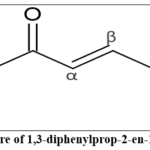 |
Figure 1: Structure of 1,3-diphenylprop-2-en-1-one (Chalcone) Click here to View Figure |
The presence of both electrophilic (C=O) and nucleophilic (C=C) centers in their structure allows for facile chemical modifications, enabling researchers to design derivatives with enhanced potency and selectivity. This structural flexibility has made chalcones a fertile ground for drug discovery, particularly in the development of agents targeting cancer, infectious diseases, and chronic inflammatory conditions.4-8 Thus, chalcones have long been recognized as valuable lead molecules in medicinal chemistry.9-14 Chalcones demonstrate remarkable promise in combating cancer, diabetes, and inflammation, while also exhibiting antioxidant, antiviral, and antimicrobial properties. Both natural and synthetic derivatives provide versatile scaffolds for drug development, supporting applications in neuroprotection, Alzheimer’s disease, leishmaniasis, viral infections, and other therapeutic areas.15-19
In the present study, synthesis of α, β- unsaturated carbonyls like benzalacetone, dibenzalacetone and their derivatives have been done. The structures of all synthesized compounds were confirmed through characterization techniques including 1H NMR, IR spectroscopy, and melting point analysis. After synthesis and characterization, all synthesized compounds were assessed for their biological activities, including serum protein protecting activity, as well as trypsin and amylase inhibition studies. Additionally, molecular docking studies were also conducted to evaluate the interactions of these compounds with bovine serum albumin, trypsin, and α-amylase proteins.
Experimental
Materials Required
Benzaldehyde (98.5%, SDFCL), p-chlorobenzaldehyde (98.0%, CDH), p-bromo benzaldehyde (99.0%, CDH), p-methyl benzaldehyde (97%, CDH), acetone (99.0%, SDFCL), sodium hydroxide (97.0%, SDFCL), ethyl alcohol (99.9%, CSS), Chloroform, Bovine Serum Albumin solution (2.5% w/v), trypsin (Sigma Aldrich), 0.1 M phosphate buffer, N α-Benzoyl-DL-Arginine β-Naphthylamide hydrochloride (BANA, Sigma Aldrich), α-Diastase (Himedia), butanol, 1% Dinitro salicylic acid (DNS, CDH).
ABB, 3000 MB Spectrophotometer was used for FTIR spectral studies. A Bruker AVANCE 400 spectrometer was used to predict 1H-NMR spectra using DMSO-d6 as a solvent and TMS as an internal solvent.
Methods
Synthesis of Dibenzalacetone
General Procedure
Dibenzalacetone (3a) and its analogues were synthesized by using crossed aldol condensation. Benzaldehyde (1) and acetone (0.039 moles) (2) in an 2:1 ratio were combined in ethanol as the solvent, and sodium hydroxide was introduced gradually as the base catalyst under constant stirring. The flask was corked tightly and kept it on magnetic stirrer for continuous shaking for 30 minutes. The precipitation reaction yielded a solid product (3a), which was filtered, washed with cold distilled water, and recrystallized by ethyl alcohol. Other derivatives were synthesized by reacting substituted benzaldehydes with acetone following the same procedure (Scheme 1).
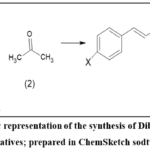 |
Scheme 1: Schematic representation of the synthesis of Dibenzalacetone and its Derivatives; prepared in ChemSketch sodtware. Click here to View Scheme |
Synthesis of Benzalacetone
General Procedure
Benzalacetone (4a) and its derivatives were synthesized followed by the same procedure mentioned above, crossed aldol condensation. Benzaldehyde (1) and acetone (2) were added in the 1:1 equimolar ratio (in moles) using ethyl alcohol as a solvent and a base NaOH as a catalyst which was added slowly with constant stirring. The flask was sealed tightly and placed it on magnetic stirrer for continuous shaking for 30 minutes. The reaction produced product (4a), which was filtered, washed with cold distilled water, and recrystallized using ethanol. Other derivatives were obtained by reacting substituted benzaldehydes with acetone following the same procedure (Scheme 2). The physical data of the synthesized compounds 3, &4 are summarized in Table 1.
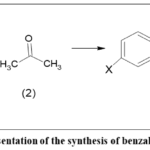 |
Scheme 2: Schematic representation of the synthesis of benzalacetone and its derivatives Click here to View Scheme |
Table 1: Physical data of Dibenzalacetone (3a) and Benzalacetone (4a) and their derivatives
|
Sr. No. |
Name of Compounds | m.pt.°C | %age Yield |
| 3a | Dibenzalacetone | 60 |
78 |
|
3b |
4,4’-dichlorobenzalacetone | 109 | 69 |
| 3c | 4,4’-dibromobenzalacetone | 98 |
75 |
|
3d |
4,4’-dimethylbenzalacetone | 136 | 72 |
| 4a | Benzalacetone | 40 |
71 |
|
4b |
4,4’-dibromodibenzalacetone | 196 | 73 |
| 4c | 4,4’-dimethyldibenzalacetone | 163 |
77 |
|
4d |
4,4’-dichlorodibenzalacetone | 148 |
72 |
Serum Protein Protecting Activity
The well-established procedure was used to determine the serum protein protecting activities.18 The stock solutions of 10-5M of synthesized samples were prepared in ethanol. 0.6 mL of each sample solution was mixed with 0.4 mL BSA solution (2.5% w/v). The mixture was stirred for 30 minutes and heated for 10 minutes to precipitate out the denatured protein at 72 °C. The resulting mixture was centrifuged at 10,000×g rpm. The protein concentration was determined by measuring absorbance at 540 nm. The result at zero minute of interaction time was taken as a control and all values were compared against the control. Each experiment was conducted in triplicate, and the average value was used for analysis. The Serum Protein Protecting (SPp) activity was calculated by the eq.1 follows as:
Serum Protein Protecting Activity = (As-Ac)/Ac ×100 (eq.1)
where Ac and As refers to the absorbance of the control and samples respectively.
Trypsin activity
Method reported by Lakhia et al. after some modifications was used to check the trypsin inhibition.19 [19]. Initially, the stock solution of 10-6 M synthesized compounds were prepared in ethanol and suitable volume of the above prepared solution was added in the reaction mixture having 50 µL of 1mg/mL trypsin solution (2500 units) in 0.1 M phosphate buffer having pH 7.4. After an incubation period of 30 minutes, 20 µL of the substrate benzoyl-DL-arginine-β-naphthylamide (BANA) was introduced into each sample to initiate the enzymatic reaction. The reaction led to the formation of a β‑naphthylamine–GBC complex, which was subsequently extracted in butanol and absorbance was recorded at 520 nm. The % inhibition was determined by following equation:
T𝑟𝑦𝑝𝑠𝑖𝑛 𝐼𝑛ℎ𝑖𝑏𝑖𝑡𝑖𝑜𝑛 (%) = (𝐴𝑐−𝐴𝑠)/𝐴𝑐 𝑥 100 (eq.2)
Where As = Absorbance of sample; Ac = Absorbance of control and all the experiments were executed in triple sets for each sample and the mean value with ±SD was reported.
Amylase activity
α-Amylase activity was calculated by using the method reported earlier.19 Initially, 10-6 M stock solution of each synthesized sample was made in ethanol. Suitable volume of this stock solution was incubated with 13 units of amylase enzyme in 0.1M phosphate buffer of pH 7.0 for 30 min. Further, 1mL starch solution as substrate was added into the reaction mixture and incubated at room temperature for 10 minutes. The reaction was monitored by the addition of 2 mL of 1% DNS reagent and then stopped by heating the reaction mixture in boiling water bath. Thereafter, the samples were cooled at RT and diluted by adding 10 mL of distilled water. The absorbance was measured at 540 nm against the blank prepared already mentioned in the reported method. The inhibition was calculated by eq.3 as follows:
Amylase Inhibition (%) = (𝐴𝑐−𝐴𝑠)/𝐴𝑐 𝑥 100 (eq.3)
Where As = Absorbance of sample; Ac = Absorbance of control and all the experiments were executed in triple sets for each sample and the mean value with ±SD was reported.
Molecular docking studies
iGemDock software was used to execute the molecular docking studies to evaluate the protein-ligand interactions. Compounds as ligand were used after minimization of energies; it was saved in MDL Mol format for further studies. Active sites of enzymes were sourced from the Protein Data Bank (http://www.rcsb.org/) as 1dhk.pdb, 1avw.pdb, and 4f5s.pdb for α-amylase, trypsin, and serum albumin respectively.20,21 After loading the prepared protein and ligand, a standard docking method with the parameters (generations=80, screening population size=300, radius= 8A° and number of solutions=10) was performed. DS visualizer was used to visualize the output files obtained from iGEMDOCK that represented the best pose with release of the maximum energy.
Results and Discussion
The current research work focuses on the synthesis of α, β-unsaturated compounds by cross aldol condensation, their characterisation by melting point, IR and NMR analysis and evaluation for their biological activity like serum protein protecting activity, trypsin and amylase inhibition studies. Moreover, the molecular docking studies have been done on the synthesized compounds to validate the results of in-vitro biological activities.
Synthesis and characterization analysis
The reaction was carried out with acetone and benzaldehyde in the presence of ethyl alcohol as a solvent and a base NaOH as a catalyst by continuous stirring on magnetic stirrer for about 30 minutes. The obtained product was purified by ethyl alcohol. The end product was monitored using Thin Layer Chromatography (TLC) by using cyclohexane as the developing solvent. A single spot with an Rf value of 0.44 was found by TLC examination indicating the purity of synthesized compound. Purity of the solid was further examined by melting point on melting point apparatus. The resulting product was further characterized by FTIR and 1H-NMR analysis. The physical data of the synthesized compounds are summarized in Table 2.
The IR spectrum of the synthesized α, β- compounds displayed carbonyl group stretching in the range of 1643cm-1 to 1651cm-1. The 1H-NMR spectra were quite helpful to elucidate the structure of chalcones. It showed characteristic singlet at δ 2.3 and δ 7.0 – 7.8 for 6 protons of methyl group and aromatic protons of compound 4c (4,4’-dimethyldibenzalacetone) respectively.
Table 2: IR Spectral data of Dibenzalacetone and its derivatives
|
Sr. No. |
Name of Compound | Wavenumber (cm-1) | |||
| CH aliphatic | CH aromatic | CO carbonyl |
C=C aromatic |
||
|
3a |
Dibenzalacetone | 2918 | 3031 | 1651 | 1491 |
| 3b | 4,4’-dichlorobenzalacetone | 2921 | 3042 | 1641 |
1489 |
|
3c |
4,4’-dibromobenzalacetone | 2921 | 3035 | 1640 | 1482 |
| 3d | 4,4’-dimethylbenzalacetone | 2908 | 3028 | 1642 |
1480 |
|
4a |
Benzalacetone | 2920 | 3030 | 1651 | 1494 |
| 4b | 4,4’-dibromodibenzalacetone | 2920 | 3040 | 1650 |
1490 |
|
4c |
4,4’-dimethyldibenzalacetone | 2915 | 3030 | 1643 | 1480 |
| 4d | 4,4’-dichlorodibenzalacetone | 2928 | 3050 | 1648 |
1486 |
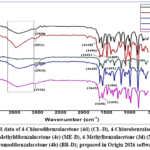 |
Figure 2: IR data of 4-Chlorodibenzalacetone (4d) (CL-D), 4-Chlorobenzalacetone (3b) (CL-B), 4-Methyldibenzalacetone (4c) (ME-D), 4-Methylbenzalacetone (3d) (ME-B) and 4-bromodibenzalacetone (4b) (BR-D); prepared in Origin 2026 software. |
Table 3: 1H-NMR data of Dibenzalacetone and its derivatives
|
Sr. No. |
Name of Compound | Chemical Shift (δ) in (ppm) | |||
| Aromatic Hydrogen | α- Hydrogen | β- Hydrogen |
Methyl Hydrogen |
||
|
3a |
Dibenzalacetone | 7.2-7.4 | 7.10 | 7.05 | |
| 3b | 4,4’-dichlorobenzalacetone | 7.35-7.54 | 6.8 | 7.45 |
2.32 |
|
3c |
4,4’-dibromobenzalacetone | 7.40(d),7.54(d) | 6.69 | 7.45 | 2.38 |
| 3d | 4,4’-dimethylbenzalacetone | 7.0-7.2 | 6.70 | 7.30 |
2.34, 2.54 |
|
4a |
Benzalacetone | 8.0 | 7.2 | 7.1 | 2.6 |
| 4b | 4,4’-dibromodibenzalacetone | 7.4-7.57 | 7.31 | 7.30 |
|
|
4c |
4,4’-dimethyldibenzalacetone | 7.3-7.5 | 7.06 | 7.02 | 2.37 |
| 4d | 4,4’-dichlorodibenzalacetone | 7.4-7.57 | 7.31 | 7.30 |
|
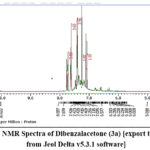 |
Figure 3: NMR Spectra of Dibenzalacetone (3a) [export the graphs from Jeol Delta v5.3.1 software] Click here to View Figure |
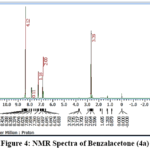 |
Figure 4: NMR Spectra of Benzalacetone (4a) Click here to View Figure |
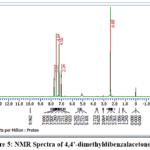 |
Figure 5: NMR Spectra of 4,4’-dimethyldibenzalacetone (4c) Click here to View Figure |
Molecular docking analysis
The molecular docking studies of all 8 synthesized compounds were analysed by iGemDock software. The intermolecular interactions of these compounds with trypsin (1avw), α-amylase (1dhk), and BSA (4f5s) were examined individually. The synthesized molecules exhibited interactions including H-bonding, Van der Waals forces and ionic interactions with proteins. The findings indicated that compound 4c (4,4’-dimethyldibenzalacetone) exhibited a greater negative binding energy about -93.1369 & -111.131 kcal/mol for trypsin and BSA respectively compared to the other synthesized compounds, as shown in Table 4. Hence, based on these results, we can suggest that there is strong intermolecular attractions of the drug molecules with trypsin & BSA, because of higher conjugation of electrons in the molecule.22-24 Furthermore, the best docking pose along with the 2D and 3D amino acid interaction profiles illustrated in table4 that validate these observations. However, compound 4d (4,4’-dichlorodibenzalacetone) demonstrated the highest level of amylase inhibition, and showed lowest energy about -83.3472 kcal/mol; though only slightly greater than that of compound 4c. This effect can be attributed to the ring substituents that enhance conjugation and thereby increase the compound’s stability.
Biological activities
Alpha-amylase and trypsin enzymes are involved in digestion of food, as well as inflammation (directly or indirectly)25 that leads to different kinds of illnesses. The findings indicated that compound 4c (4,4’-dimethyldibenzalacetone) exhibited a greater inhibition about 76% & 72% for trypsin and BSA respectively compared to the other synthesized compounds, signifying its enhanced stability as shown in fig.6. However, compound 4d (4,4’-dichlorodibenzalacetone) demonstrated the highest level of amylase inhibition about 73%. This effect can be attributed to the ring substituents that enhance conjugation and thereby increase the compound’s stability.
These findings revealed that these synthesised derivatives are the potent inhibitors of digestive enzymes like alpha-amylase, trypsin; and potential molecules for BSA protection which is used as preliminary testing for determining the anti-inflammatory activities Overall, we can say that these derivatives can play the significant role as potent inhibitors for digestive enzymes and anti-inflammatory targets.
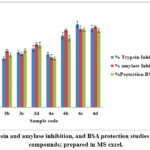 |
Figure 6: Trypsin and amylase inhibition, and BSA protection studies of synthesized compounds; prepared in MS excel. Click here to View Figure |
Table 4: Energy (kcal/mol) profile of each ligand with different enzymes
| Trypsin | Amylase | BSA | |||||||
| Ligand | Total Energy | VDW | HBond | Total Energy | VDW | HBond | Total Energy | VDW |
HBond |
|
3a |
-83.8495 | -79.251 | -4.598 | -77.8398 | -70.8848 | -6.955 | -99.0451 | -97.1539 | -1.891 |
| 3b | -65.937 | -62.4851 | -3.452 | -59.7207 | -52.778 | -6.943 | -72.9522 | -67.0459 |
-5.906 |
|
3c |
-67.3736 | -63.8736 | -3.5 | -58.9937 | -51.9937 | -7 | -72.7686 | -69.2686 | -3.5 |
| 3d | -70.5438 | -65.2704 | -5.273 | -60.008 | -53.008 | -7 | -73.1854 | -69.6854 |
-3.5 |
|
4a |
-68.3201 | -62.32 | -6 | -56.2628 | -49.3909 | -6.872 | -67.6136 | -64.1136 | -3.5 |
| 4b | -85.958 | -82.458 | -3.5 | -82.1273 | -75.2899 | -6.837 | -109.317 | -109.317 |
0 |
|
4c |
-93.1369 | -90.6369 | -2.5 | -83.1722 | -76.1722 | -7 | -111.131 | -111.131 | 0 |
| 4d | -89.628 | -83.628 | -6 | -83.3472 | -76.4965 | -6.851 | -109.252 | -109.252 |
0 |
VDW stands for van der Waals interactions and H-Bond indicates Hydrogen bonding.
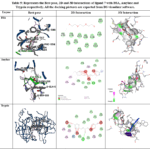 |
Table 5: Represents the Best pose, 2D and 3D interactions of ligand 7 with BSA, Amylase and Trypsin respectively. All the docking pictures are exported from DS visualizer software. Click here to View Table |
Conclusion and future scope
This study emphasizes the streamlined synthesis and subsequent biological evaluation of synthesized dibenzylacetone and benzylacetone derivatives. The synthetic approach is based on aldol condensation reactions utilizing readily available starting materials, including benzaldehyde, its derivatives, and acetone. All synthesized compounds were characterized through Fourier-transform infrared (FTIR) spectroscopy and proton nuclear magnetic resonance (1H-NMR) analysis. The percentage yield was reported in range of 69 to 78% of all 8 synthesised compounds. All the synthesized compounds were subjected to biological evaluation. Compound 4c (4,4′‑dimethyldibenzalacetone) showed maximum serum protein protecting activity as well as maximum trypsin inhibition, while compound 4d (4,4′‑dichlorodibenzalacetone) exhibited maximum inhibition against α-amylase. Also, the molecular docking studies corroborated the experimental findings, showing that compound 4c exhibited the greatest stability with trypsin and bovine serum albumin (BSA), whereas compound 4d demonstrated the strongest inhibition of α‑amylase. These results confirm that the synthesized derivatives act as potent inhibitors of both α‑amylase and trypsin, while also displaying significant efficacy in stabilizing BSA.
Based on the current findings, future research should focus on validating the promising results from the in‑vitro antidiabetic assays through in‑vivo studies in suitable animal models to better understand the pharmacological relevance of benzalacetone derivatives under physiological conditions. In addition, extended pharmacological profiling is required to assess toxicity, bioavailability, and metabolic stability, which will be critical for establishing their safety and therapeutic potential at the clinical level. Finally, exploring structural modifications of benzalacetone derivatives may yield analogues with enhanced potency and selectivity, and this rational design approach, combined with experimental validation, could accelerate the development of novel drug candidates for diabetes management.
Funding Sources
The author(s) received no financial support for the research, authorship, and/or publication of this article.
Conflict of Interest
The author(s) do not have any conflict of interest.
Data Availability Statement
This statement does not apply to this article.
Ethics Statement
This research did not involve human participants, animal subjects, or any material that requires ethical approval.
Informed Consent Statement
This study did not involve human participants, and therefore, informed consent was not required.
Authors Contribution
- Sudesh performed experimental work of synthesis and characterisations, data interpretations and writing the original manuscript;
- Prabhjot Kaur examined In-Vitro biological studies,
- Neera Raghav is highly acknowledged for providing lab facilities.
- Pooja Ranjan is co-corresponding author and reviewed the manuscript;
- Nitika Mor is the corresponding author and reviewed the final manuscript.
References
- Tukur, A. R.; Habila, J. D.; Ayo, R. G. O.; Lyun, O. R. A. Journal of Chemical Reviews, 2022, 4(2), 100–119.
- Dhaliwal, J. S.; Moshawih, S.; Goh, K. W.; Loy, M. J.; Hossain, M. S.; Hermansyah, A.; Kotra, V.; Kifli, N.; Goh, H. P.; Dhaliwal, S. K. S.; Yassin, H.; Ming, L. C. Molecules, 2022, 27, 7062.
CrossRef - Ali, S. N.; Khan, M. A.; Khan, A. R.; Hassan, F. African Journal of Biomedical Research. 2025, 28,
- Gummagol, N. B.; Yaraguppi, D. A.; Patil, S. B.; Patil, P. S.; Patil, N. R.; Ayachit, N. H. Journal of Molecular Structure. 2025, 1320, 139586.
CrossRef - Mahapatra, D. K., Bharti.; Bharti, S. K.; Asati, V. (2015). European journal of medicinal chemistry. 202598, 69-114.
CrossRef - Ouyang, Y.; Li, Juanjuan.; Chen, Xinyue.; Fu, Xiaoyu.; Sun, Si.; & Wu, Qi. 2021, 11(6), 894.
CrossRef - Constantinescu, T.; Lungu, C. N. International journal of molecular sciences. 2021, 22(21), 11306.
CrossRef - Pingaew, R.; Saekee, A.; Mandi, P.; Nantasenamat, C.; Prachayasittikul, S.; Ruchirawat, S.; Prachayasittikul, V. European Journal of Medicinal Chemistry. 2014,85, 65-76.
CrossRef - Insuasty, B.; Ramírez, J.; Becerra, D.; Echeverry, C.; Quiroga, J.; Abonia, R.; Cobo, J. European Journal of Medicinal Chemistry. 2015,93, 401-413.
CrossRef - Zhuang, C.; Zhang, W.; Sheng, C.; Zhang, W.; Xing, C.; Miao, Z. Chemical reviews. 2017, 117(12), 7762-7810.
CrossRef - Adhikari, S.; Nath, P.; Deb, V. K.; Das, N.; Banerjee, A.; Pathak, S.; Duttaroy, A. K. Frontiers in Pharmacology. 2025,16, 1570385.
CrossRef - Nematollahi, M. H.; Mehrabani, M.; Hozhabri, Y.; Mirtajaddini, M.; Iravani, S; Heliyon. 2023, 9 (10), e20428.
CrossRef - Shakhatreh, M. A. K.; Al-Smadi, M. L.; Khabour, O. F.; Shuaibu, F. A.; Hussein, E. I.; Alzoubi, K. H. Drug design, development and therapy. 2016, 10, 3653-3660.
CrossRef - Mazumder, R.; Ichudaule, Ghosh, A.; Deb, S.; Ghosh, R. Topics in Current Chemistry. 2024,382(3), 22.
CrossRef - Handayani, S.; Arty, I. S. Journal of Physical Science. 2008, 19(2), 61-68.
- N. L; Allen. P. Jr. Organic Syntheses, 1923, 3, 17.
CrossRef - Morsy, N. M.; Hassan, A. S. European Journal of Chemistry. 2022,13(2), 241-252.
CrossRef - Goyal, K.; Kaur, R.; Goyal, A.; Awasthi, R. Journal of Applied pharmaceutical science. 202111(1), 001-014.
CrossRef - GÖKSU, S.; ÇELİK, H.; Secen, H. An efficient synthesis of alnustone, a naturally occurring compound. Turkish Journal of Chemistry. 2003, 27(1), 31-34.
- Møller, M. S.; Svensson, B. Frontiers in Molecular Biosciences, 2022, 9, 868568.
CrossRef - Gulwe, A. B.; Chidera, E. S.; Kayode, A. O.; Ambhore, A. N. Journal of Population Therapeutics and Clinical Pharmacology 2023, 30(3), 787-793.
- Raghav, N.; Mor, N. Bioorganic Chemistry. 2020,104, 104177.
CrossRef - Lakhia, R.; Verma, N. K.; Raghav, N.; Pundeer, R. Journal of Molecular Structure. 2023, 1291, 135884.
CrossRef - Zinjarde, S. S.; Bhargava, S. Y.; Kumar, A. R. BMC complementary and alternative medicine, 2011, 11(1), 1-10.
- Malik, A.; Raghav, N.; Mor, N. Chemistry & Biology Interface. 2025, 14(3), 54-67.
Accepted on: 10 Apr 2026
Second Review by: Dr. Masood khan
Final Approval by: Dr. Ravindra M Kumbhare


ISSN Online: 2231-5039