Harnessing Artificial Intelligence for Rational Drug Design and Precision Delivery: Bridging Computational Intelligence with Chemical Innovation
 , Arumugam Pillai Kanni Raj
Department of Chemistry, Vel Tech RangarajanDr.Sagunthala R&D Institute of Science and Technology, Chennai, Tamil Nadu, India.
Corresponding Author Email: vtd1657@veltech.edu.in
DOI : http://dx.doi.org/10.13005/ojc/420426
Download this article as:

Artificial-intelligence (AI) is transforming the pharmaceutical industry by simplifying data-driven innovations in drugs’ research and delivery systems. This paper examines and views the newinnovations in combining the use of AI into harmonized medication design and targeted delivery systems. AI-driven models speed-up molecular design, predict pharmacokinetic outcomes, and improve the nanocarrier preparations, reducing the costs and time associated to conventional experimental techniques. Furthermore, AI contentsmake use of computational chemistry and synthesis-based science, improving medicinal effectiveness, precision, and controlled release. It highlights ethical implications and the interaction between computational intelligence and chemical innovation as a means to advance next-generation intelligent therapies and precision medicine. Also, it analyzes AI-driven molecular design with synthetic level reports, emphasizing explainable AI, digital twin platforms, and translations that characterize the next generation of precision pharmaceuticals, distinguishing it from previous narrative reviews.
KEYWORDS:Artificial Intelligence; Computational Chemistry; Deep Learning; Drug Design; MachineLearning; Precision Drug Delivery
Introduction
Artificial-intelligence (AI), with machine-learning (ML) and deep-learning (DL), have revolutionized and also brought in new innovations in drug discovery and delivery by improving analysis of chemical and biological data for target identification and optimization. Olden-days methods of drug design approaches mostly rely on empirical experimentation, which is hard, expensive, and have the tendency to increase failure rates during clinical translation. AI methods provide the examination of many chemical and biological datasets in analyzing and prediction of molecular interactions, identifying potential therapeutic targets, and refine lead compounds with exceptional precision. Use of complex algorithms like graph neural networks, variationalautoencoders, and reinforcement learning, researchers can model pharmacokinetic behavior, toxicity, and binding affinity, by changing and improving drug discovery from a manual process to a computation-guided discipline.1-3
In drug synthesis and targeted delivery, traditional ways are increasingly replaced by predictive and adaptive AI-driven modeling systems that increase encapsulation ability, releasing kinetics, and biocompatibility. AI guided nanoarchitect frameworks incorporating bioinformatic profiling with machine learning driven surface engineering to make a stimuli-responsive nanocarriers. These smart systems can improve targeted delivery accuracy and also add actual optimization through digital twin technologies and screening. These computational methods combine molecular design and formulation science, increasing the transition from lab pattern to clinical application.9,10,16
AI-based pharmaceutical techniques have a lot of potentiality, but also face a lot of problems of not having enough data, algorithms that are biased, and rules that makes it difficult to understand and validate models. These limits are reduced by different disciplines of research collaborations and the development of explainable AI. Combining computer intelligence, chemistry, and materials science indicates the start of a novel rational drug design and precision delivery. This is step forward from a trial-and-error methods to a smart, flexible, and long-lasting pharmaceutical innovation.4,6,8
This review brings together a concrete framework in which artificial intelligence stands as a vital intelligence layer that connects many rational drugs design with precise drug delivery. The AI-based framework works as a new system, unlike traditional linear ways. It makes use of ML and DL models to improve chemical design, optimization, biological response, and clinical feedbacks. By bringing together computational chemistry, formulation science, and patient’s specific data, this new concept or idea shows how AI reshapedbroken pharmaceutical workflows into flexible, data-driven therapeutic systems.
Materials and Methods
Preferred Reporting Items for Systematic Reviews and Meta Analyses (PRISMA)
This review work was done using the PRISMA 2020 guidelines. An organized literature searches were performed in PubMed, Scopus, Web of Science, ScienceDirect, and Google Scholar to highlight and critical studies related to artificial intelligence assisted rational drug design and precision drug delivery. Predefined keywords and Boolean operators, including artificial intelligence, machine learning, drug design, and computational modeling, were used. The processes of study identification, screening, eligibility assessment, and inclusion were documented using a PRISMA flow diagram.
Drug design review using AI Methods and a Comparison to Traditional Methods
Eligible articles for review were considered only if the articles are peer-reviewed research articles and review papers published in English language. Topics of the articles selected are on AI-driven drug discovery, molecular modeling, formulation development, and targeted or controlled drug delivery systems, with emphasis on cancer therapy. In all these topics, advantages of AI methods over traditional methods are compared. This analysis excludes non-peer-reviewed articles, conference abstracts without full text, editorials stuffs, duplicates, and irrelevant studies. AI assisted drug design and drug delivery design of this review work is given as a diagram in Figure 1.
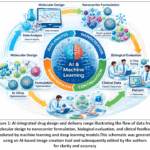 |
Figure 1: AI-integrated drug design and delivery range illustrating the flow of data from molecular design to nanocarrier formulation, biological evaluation, and clinical feedback, mediated by machine learning and deep learning models. |
Results and Discussion
Scope, Novelty and Distinction of This Review
Quite a number ofrecent evaluations have focused on artificial intelligence in either drug discovery or pharmaceutical formulation separately. On the other hand, there exists a research gap in learning how AI concurrently integrates rational medication design with precision drug delivery within a cohesive translational framework. This review fills the existing gap by merging molecular-level AI models with formulation and delivery intelligence, evaluating model limitations, regulatory obstacles, and translational associated problems, and finally outlining prospective future directions, including digital twins and explainable AI. This review advances from mere descriptive summaries to a systems-level perspective on AI-driven pharmaceutical innovation.
Overview of Drug Design and Delivery
Contemporary medication design and delivery have evolved from empirical or experimental testing to rational and targeted approaches informed by computational, nanotechnology-based, and biological advancements. Precision medicine impacts molecular modeling and bioactivity relationship assessments to find new molecules with improved molecular selectivity and reduction in toxicity. New innovations in nanotechnology have changed therapeutic delivery, especially through liposomal and polymeric nanocarriers that provide homeostatic release, improved in bioavailability, and sequence combined with specific targeting. Biopolymer-based systems which are also smart systems, including chitosan and cyclodextrin nanoparticles, enhanced drug solubility and reduce some of the effects in cancer treatment. Also, nanocarriers are being engineered to pass through physiological barriers, including the bloodbrain barrier (BBB), for treatments targeting the central nervous system. Similarly, conventional bioactive chemicals, such as those sourced from Astragali Radix, are currently being comprehensively examined through AI-driven drug design to connect ethnopharmacology with contemporary medicinal chemistry. Collectively, these breakthroughs signify a convergence of computers, materials science, and biomedicine aimed at precision therapies12-14.
Fundamentals of AI, ML and DL in Drugs Discovery
AI, through / along with its branches ML and DL, constitutes the computational foundation of contemporary drug development, evolving it from a sequential, and experimental procedure into a predictive, and also data-driven model. In drugs’ development, ML and DL models, such as artificial neural networks and graph neural networks, facilitate pattern detection in intricate chemical datasets, assisting in target identification, lead optimization, and ADMET prediction. As AI is combined with computational biology and chemo-informatics, it also improved drug value, target validations, and virtual screening, indicatinga prototype change through intelligent, rational, and pharmaceutical discovery which follows the guided ethics11,17,18.
AI in Rational Drug Design
AI have transformed rational drug design by integrating innovative modeling and predictive analytical techniques throughout phases of molecular development. In modern drug design, AI-driven models improve the prediction of compoundtargeted interactions, binding affinities, and pharmacokinetic profiles, enabling the early prioritization of promising candidates. Techniques which include support vector machines (SVM), random forests, and reinforcement learning progressively employed to bring about novel chemical changes, predict toxicity, and optimize therapeutic selectivity. Deep generative models and graph neural networks can create novel compounds with specific biological activity, decreasing the cost and duration of experimental synthesis and screening. Moreover, AI-driven systems combinedwith genomic, proteomic, and chemo-informatics data to improve precision medicine techniques, correlating molecular characteristics with individual biological states. By incorporating chemistry and computers, AI facilitates the shift from unexpected discovery to systematic drug design, resulting in safe and effective therapies while reducing developmental inefficiencies6,8,17,18.
Table 1: Assessment of commonly used artificial-intelligence and machine-learning models in drugs’ discovery, emphasizing their input representations, key strength, major limitation, and typical application stages across the drug design pipeline.
|
AI Model |
Input Representation | Key Strength | Major Limitation | Application Stage |
| SVM | Molecular descriptors | Robust with small datasets | Limited scalability |
Early screening |
|
Random Forest |
Physicochemical features | High interpretability | Feature engineering required | ADMET prediction |
| GNN | Molecular graphs | Captures structural topology | Data-hungry |
Lead optimization |
|
VAE |
Latent chemical space | Novel molecule generation | Limited control over outputs | De novo design |
| Reinforcement Learning | Reward functions | Target-driven optimization | Reward bias |
Scaffold refinement |
Comparison of Traditional Drug Design Vs. AI-Enhanced Approaches
The clear difference between traditional method of drug discovery methodologies and those improved using artificial intelligence (AI) stands out based on development timelines, financial structures, and control. The technique of making a new drug candidate and to sell it takes more than 10 years and costing millions to billions of dollars. On the other hand, AI-assisted drug discovery makes use of ML, DL, and computational modeling to optimize and speeding each phase of the process. AI algorithms have the will to analyze many datasets, identifying the structure-activity relationships, and also predict pharmacokinetic, toxicity profiles, enhancing precision when compared to traditional methodologies2,11.
Comparative analyses show that AI frameworks increase the accuracy of molecular docking by 25%, reducing the duration of discovery processes by 40%, and decreasing the costs by approximately 60%. Moreover, AI-systems which include virtual screening, de novo molecule design, and reinforcement learning, significantly combine the efficacy of lead optimization and drug repurposing efforts. Unlike the old methods which is predominantly relies with trial and error, AI methodologies offer a predictive, data-based basis which fosters enhanced efficiency, reduces experimental dismissal, and provides personalized therapeutic development12,15,18.
Although AI-based drug discovery has reduced both thedevelopment times and costs, these advancements are somehow dependent on contextual factors. Improvements in performance vary significantly across therapeutic areas, the quality of data utilized, and the methodologies employed for validation. Models that are developed using biased or incomplete datasets often exhibit deficiencies in their ability to generalize beyond previously established norms. Furthermore, innovations in the accuracy do not necessarily correlate with clinical success now, citing the imperative for prospective validation and standardized benchmarking before the wholesale replacement of traditional methodologies by AI-driven frameworks5,7,9.
AI in Targeted and Precision Drug Delivery Systems
AI predictive modeling makes use of the optimization of nanocarrier characteristics like size, surface charge, and release kinetics by improving targeting precision and therapeutic effectiveness. Artificial intelligence techniques, more especiallyML and DL, facilitate predictive modeling of nanoparticle behavior, bio-distribution, and interactions between drugs and their carriers, thereby reducing the dependence on rigorous experimental trials. Methods like artificial neural networks (ANN) and convolutional neural networks (CNN) predict the ideal physicochemical features, including nanoparticle dimensions, morphology, and surface charge, very vital for targeted medication delivery. AI makes use of properties in nanocarrier design for regulated and stimuli-responsive release, using intelligent systems that adapt dynamically to physiological conditions. Furthermore, the use of green carbon dot (GCD) nanotechnology and artificial intelligence enables the development of environmentally sustainable, biocompatible, and responsive drug delivery systems that merge sustainability with accuracy. By making use of computational predictions and experimental validation, AI-based systems facilitate novel medicine by customizing dosage and delivery methods to individual patient profiles, hence enhancing efficacy and safety across therapeutic areas1,3,18.
Translational Barriers in AI-Designed Drug Delivery Systems
Despite the optimistic predictions generated through in-silico methodologies a significant number of AI-engineered nanocarriers resulted in failures during the stages of preclinical or clinical translation. The primary obstacles encompass challenges related to scaling, variability between production batches, incomplete biological modeling, and a lack of adequate consideration for immune responses. AI models frequently focus on optimizing physicochemical parameters within many idealized settings, resulting in overlooking the small and complex nature of the in vivo environment. In order to tackle these challenges, it is necessary to bring in new hybrid testing strategies that is in agreement with the computational predictions and experimentation and testing with regulatory standards2,6,14.
Table 2: Comparison of selected AI-driven pharmaceutical industry case studies, summarizing the scope of AI integration, reported time savings, development stages, and associated limitations affecting clinical translation.
|
Organization |
AI Contribution | Time Reduction | Development Stage | Key Limitation |
| Exscientia | De novo molecular design | ~70% | Phase I |
Limited clinical generalization |
|
Insilico Medicine |
Target discovery + design | ~60% | Phase II | Data dependency |
| BenevolentAI | Drug repurposing | ~50% | Clinical trials |
Dataset bias |
Bridging AI and Chemical Innovation: Case Studies of AI-Driven Drug Development
Modernpractical studies in the industrial sector demonstrated that AI molecular design and optimization procedures decrease the time required for theearly-stage drug discovery processes. By combining in-silico simulations with in-vitro and in-vivo experimental models, AI improves translational reliability, speeding up the optimization of compounds, and cutting down on some unnecessary experiments that are not of importance. AI innovative based molecular dynamics and quantum chemistry simulations enable the atomiclevel interpretation of drug and receptor interactions and reaction mechanisms, which is improving the accuracy of binding energy predictions. Exscientia’s AI-engineered DSP-1181 and In-silico medicine’s candidate for fibrosis treatment are the two important case studies that shows how AI can shorten time it takes to discover new drugs from years to months. Advanced frameworks that integrate model-informed drug development (MIDD) with AI enable the real-time optimization of dosing regimens and pharmacokinetic profile. The use of digital twin technologies and automated synthesis programs also helps inimproving reproducibility and dynamic design. These innovations established a connection between virtual computational methodologies and empirical validation, which transform pharmaceutical research into an intelligent, data-driven, and iterative framework that guide the development of safe and effective therapeutics 1,3,7,8,13.
Challenges and Limitations of AI in Drugs’ Design and Delivery
The regulatory approval of artificial intelligence (AI)-driven pharmaceutical methodologies continuously increases the hinges on the transparency and interpretability of the models. Implementing understandable AI techniques, such as features of attribution and mechanistic validation, is crucial to understanding regulatory confidence. Without clear decision-making frameworks, AI models can remain limited to many exploratory research projects rather than progressing to clinical uses.
In spite ofthe revolutionary potential, the use of AI within the areas of drug design and delivery encounters many technical, ethical, and regulatory drawbacks. A primary limitation pertains to the complexity of AI algorithms, more especially those based on deep learning, which function as “black boxes,” depicting their decision-making process as challenging to interpret and to scientifically validate. This limit in transparency delays regulatory endorsement and reduces trust among healthcare professionals and researchers. Moreover, problems that are surrounding data quality and characteristic biases serve as significant barriers; the majority of AI models depend on extensive, heterogeneous biomedical datasets that may harbor sampling biases or inadequately represent specific demographic groups. Insufficient data diversity has the role of undermining model generalizability and resulting in erroneous predictions concerning drug effectiveness or patient reactions. Furthermore, challenges associated with data privacy, security, and intellectual property rights continue to cause vital and sufficient delays in the integration of AI within pharmaceutical development sectors. Ethical problems relating to patients’ consent, algorithmic accountability, and also data ownership necessitate thorough examination to facilitate responsible AI usage. Defeating these problems will demand interdisciplinary cooperation, the establishment of standardized data governance frameworks, and the adoption of understandable AI methodologies that enhance transparency, reproducibility, and equitable innovation in drug discovery and delivery2,4,5,10,16.
Future Prospects and Ethical Considerations
In the next 5 to 10 years, the way AI helps in finding new drugs is expected to change from using the old data to trained models using real-time learning frameworks to be adapted that will work well with clinical feedback systems. Digital twin platforms are setting the pace to enable the ongoing new changes of dosage routines and delivery methods, while the integration of explainable AI is expected to change into a regular basis rather than just a desirable attribute.
The ongoing fast and rapid integration of AI into a pharmaceutical design brings about agood opportunity and at the same time presenting a significant ethical and regulatory challenges. Data privacy, algorithmic bias, and the need for AI systems that make use of large biomedical data for predictions and optimizations to be open and honest are at the height of concerns. To gain the trust of patients and also for them to follow the rules, it is very important to make sure that patients give informed consents and that sensitive patient information is kept safe. Algorithm bias in AI systems can occur, often from datasets that cannot be presented or are incomplete, this continuesto threatens health differences and limits equal access to therapeutic health care systemsglobally. Ethical frameworks must address the “black-box” problems, which usually occur when decision-making processes are not clear, making it very difficult to understand and clinicians cannot interpret clearly. Furthermore, the fair use of AI requires strong data control and management cooperation between regulatory bodies, industry stakeholders, and academic institutions to ensure that new ideas are in line with fairness principles and to avoid discrimination. As AI technologies become more important every day to clinical trial methods and drug development patterns, it is important to follow the rules of clear authentication, explainable AI (XAI), and also ethical checking to make sure that computational progressesare in line with human healthcare systems 2,5,6,12.
The optimumuse of AI in drug design and delivery isincreasing rapidly because innovations in computational biology, quantum computing, and multiomics integration continue to drive pharmaceutical innovation. AI improves real-time modeling of drug-target interactions, prediction of toxicological evaluations, and also targeted and personalized therapeutic precision. The combined integrationDL methodologies and molecular dynamics simulations has the strength to revolutionize rational drug design by predicting many complex biochemical behaviors with atomic-level precision. The automation of synthetic processes and the creation of intelligent nanocarrier systems driven by AI brings about the advent of a new era in personalized drug delivery methods. However, as AI is becoming more common every day in the drug development process, it is of utmost importance to deal with many ethical issues like data privacy, algorithmic transparency, and fair access to AI-enhanced treatments. Regulatory bodies must ensure the adaptationand also to uphold the principles of explainable AI, impartial data governance, and in decision-making processes. Lastlythe ethical use of AI in pharmacology will depend much on finding right balance between encouraging new ideas and being responsible. This will bring about to new systems that are not only effective but also open, reliable, and in line with global health fairness4,8,14,17.
Conclusion
In summary, AI is revolutionizing pharmaceuticals’ new innovations by converting manysplit discoveries and delivery mechanisms into organized, adaptive contents. However, manyproblems continue toshow the areas of the data integrity, model transparency, and clinical application.The integration of AI, digital twins, and interdisciplinary collaboration continue to make AI a foundational element of cutting-edge personalized precision therapeutics. The expected success will not only rely solely on new algorithms but also on the establishment of ethical governance, regulatory coherence, and stringent experimental validation.
AI has stand not only as a pivotal agent of change in contemporary drug design and delivery but also in effectively linking computational advancements with biomedical discovery. Through complexML and DL methodologies, AI speedup molecular modeling, target identification, and predictive analytics that reduce the time and financial expenses associated with conventional drug development. The combined use of AI, nanotechnology and molecular communication has increased further precision drug delivery, enabling targeted therapeutic interference with reduced systemic toxicity. In the context of rational drug design, AI-based predictive models optimize the synthesis and modification of compounds, resulting in therapeutics that both are effectiveand safer.
Even with complex and prevailing challenges such as data bias and model interpretability, the enhancement of explainable AI and ethical conducts offers a promising outlook for transparent, equitable, and efficient drug discovery. Finally, the incorporation of AI into pharmaceutical research brings about the beginning of a new era in personalized and therapeutic medicine, where computational intelligence and human creativity collaborate to accelerate new and novel innovation and promote global health systems.
Acknowledgement
The authors acknowledge with thanks the valuable contributions of researchers whose works have been cited in this review. The authors would like to express appreciation to their university for providing them R&D support that facilitated the completion of this manuscript.
Funding Sources
The author(s) received no financial support for the research, authorship, and/or publication of this article.
Conflict of Interest
The author(s) do not have any conflict of interest.
Data Availability Statement
This statement does not apply to this article.
Ethics Statement
This research did not involve human participants, animal subjects, or any material that requires ethical approval.
Authors’ contributions
ShamsuddeenYahaya wrote the paper, ArumugamPillaiKanni Raj (PhD Guide of ShamsuddeenYahaya) corrected the paper.
References
- Albani, F.G.; Alghamdi, S.S.; Almutairi, M.M.; Alqahtani, T.; Drug Des. Dev. Ther.,2025,19, 5695–5707
CrossRef - Askr, H.;Elgeldawi, E.;Aboul Ella, H.; Elshaier, Y.A.M.M.; Gomaa, M.M.,Hassanien, A. E.; Artif. Intell. Rev.,2023, 56, 5975–6037.
CrossRef - Attar, J.; Shitole, A.; IJCRT,2025, 13(4), 54–60.
- Noriega, H. A.; Wang, X. S.; Front. Drug Discov.,2025, 5, 1628789.
CrossRef - Ferreira, F.J.N.; Carneiro, A.S.; ACS Omega,2025, 10(23), 23889–23903.
CrossRef - Gormley, A. J.; JCR,2024, 373, 23–30.
CrossRef - Jin, X.; Zhang, H.;Xie, X.; Zhang, M.; Wang, R.; Liu, H.; Yao, J.; Pharmaceuticals,2025, 18(3), 413.
CrossRef - Kamal, I.R.;Abd El-Atty, S.M.; El-Zoghdy, S.F.; Soliman, R.F.; Sci. Rep.,2025,15, 19068.
CrossRef - Khorsandi, D.;Farahani, A.;Zarepour, A.;Khosravi, A.;Iravani, S.;Zarrabi, A.; RSC Adv.,2025, 15(35), 27795–27815.
CrossRef - Liu, J.; Wang, T.; Dong, J.; Lu, Y.; J. Nanobiotechnology,2025,23, 146.
CrossRef - Mujawar, S.M.; Ugare, S.D.; Int. J. Pharm. Sci.,2025, 3(8), 250308277.
- Păduraru, L.;Panainte, A.D.;Peptu, C.A.;Apostu, M.;Vieriu, M.;Bibire, T.; Sava, A.;Bibire, N.; Pharmaceuticals,2025, 18, 564.
CrossRef - Panchpuri, M.;Painuli, R.; Kumar, C.; RSC Pharmaceutics,2025, 2(5), 882–914.
CrossRef - Paul, D.;Sanap, G.;Shenoy, S.;Kalyane, D.;Kalia, K.;Tekade, R. K.; Drug Discov. Today,2021, 26(1), 80-93.
CrossRef - Talib, A.M.; Al-Hgaish, A.M.; Atan, R.B.;Alshammari, A.; Alomary, F.O.; Yaakob R.; IEEE Access,2025, 13, 42045–42063.
CrossRef - Tanaka, M.;Szatmári, I.; Vécsei, L.; Pharmaceuticals,2025. 18, 607.
CrossRef - Vatansever, S.;Schlessinger, A.;Wacker, D.;Kaniskan, H.U.; Jin, J.; Zhou, M.M.; Zhang, B.; Med. Res. Rev.,2021, 41(3), 1427–1473.
CrossRef - Wang, K.; Huang, Y.; Wang, Y.; You, Q.; Wang, L.; RSC Med. Chem., 2024, 15(12), 3978-4000.
CrossRef
 PlumX:
  Views: 561 Views
  PDF Downloads: 106
 Accepted on: 06 Mar 2026
Second Review by: Dr. Sumit Kumar
Final Approval by: Dr. Naeem Uddin Siddiqui


ISSN Online: 2231-5039