Safer and Green Synthesis of Methylhydrazine Sulfate via Benzalazine Intermediate
 , Sandip Gangadhar Laware*and Sagar Nanasaheb Kharde
College of Pharmaceutical Sciences, Pravara Institute of Medical Sciences (Deemed to be University), Loni, Ahmednagar, Maharashtra, India
Corresponding Author E-mail:laware.sandip@gmail.com
DOI : http://dx.doi.org/10.13005/ojc/420415
Download this article as:

Methylhydrazine sulfate (MHS) is an important intermediate in pharmaceuticals, specialty chemicals, and aerospace applications. The conventional Organic Syntheses route involves benzene as solvent and ammonia, generating hazardous byproducts such as ammonium sulfate. In this study, a safer and operationally simpler modification is reported: benzene is replaced with xylene, and ammonia is eliminated by using 80% aqueous hydrazine hydrate. This avoids ammonium sulfate byproduct, reduces toxic hazards, and simplifies workup. Benzalazine was obtained in 91% yield (mp 92–94 °C), while MHS was isolated in 80% yield (mp 141–142 °C). Green chemistry evaluation indicated high material efficiency (atom economy 82.3%, E-factor 3.4, PMI 4.4). Product identity was confirmed by melting point, TLC, yield, and comparison with literature spectral data. The procedure is safer, greener, and particularly suitable for educational and small-scale laboratory applications.
KEYWORDS:benzalazine; byproduct-free; green chemistry; hydrazine hydrate; methylhydrazine sulfate; safer synthesis
Introduction
Methylhydrazine sulfate (MHS) is an important intermediate used in pharmaceuticals, fine chemicals, and aerospace propellant chemistry.1 The classical synthesis described in Organic Syntheses employs benzene as solvent and ammonia, resulting in the formation of ammonium sulfate as an undesirable inorganic byproduct [1]. Benzene is a well-established human carcinogen, while ammonia vapors are corrosive and hazardous, making the conventional route environmentally and occupationally unsafe.12,3
In recent years, increasing regulatory pressure and environmental awareness have driven the replacement of hazardous solvents and reagents with safer alternatives, in accordance with the principles of green chemistry.4,5 The substitution of benzene with less toxic aromatic solvents such as xylene and the elimination of ammonia through alternative nitrogen sources are well-aligned with these principles.6 The use of aqueous hydrazine hydrate instead of hydrazine sulfate further reduces solid inorganic waste generation and simplifies work-up procedures.7
Green chemistry evaluation tools such as atom economy, E-factor, and process mass intensity (PMI) are widely used to quantify the environmental impact of chemical processes.4,8 The present work applies these concepts to develop a safer and operationally simpler synthesis of methylhydrazine sulfate via a benzalazine intermediate.
Experimental
Materials
Benzaldehyde (AR grade), hydrazine hydrate (80%), dimethyl sulfate, and dry xylene were obtained from commercial suppliers and used without purification.
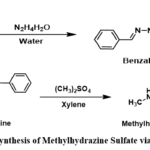 |
Scheme 1: Synthesis of Methylhydrazine Sulfate via Benzalazine Click here to View Scheme |
Synthesis of Benzalazine
A 5 L flask was charged with benzaldehyde (440 mL, 460 g, 4.35 mol) and water (2.2 L). Hydrazine hydrate (80%, 115.75 g, 113.5 mL, 1.85 mol) was added dropwise over 2 h with stirring. The mixture was refluxed for 2.5 h, cooled, and the yellow precipitate filtered, washed with methanol (60 mL × 4–5), and dried to yield benzalazine (354 g, 91%, mp 92–94 °C).
Note: Unlike the conventional method, ammonium sulfate is not formed as a byproduct.
Synthesis of Methylhydrazine Sulfate
Benzalazine (200 g) was suspended in dry xylene (400 mL) at 75 °C. Dimethyl sulfate (100 mL, 133 g, 1.05 mol) was added dropwise, maintaining 80–85 °C. Completion was monitored by TLC. After cooling, water (700 mL) was added, the aqueous layer separated and washed with xylene. Water was removed under vacuum, and the product filtered and washed with methanol to yield MHS (90 g, 80%, mp 141–142 °C, assay 99.6%).
Characterisation
The identity and purity of methylhydrazine sulfate were confirmed by melting point determination, thin-layer chromatography (TLC), and iodometric titration assay. The titration method employed is a well-established analytical procedure specifically suitable for hydrazine and substituted hydrazine derivatives due to their strong reducing properties. The observed melting point (141–142 °C) and the high purity obtained (99.6%) are consistent with reported literature values, confirming the successful formation of methylhydrazine sulfate. Comparison with reported IR and ¹H NMR spectral data available in the literature further supports the structural assignment.1,9
IR (lit. values): ν 3370 (br, N–H), 3240 (N–H), 2950 (C–H), 1620 (N–H bend), 1380 (CH₃ bend), 1220 & 1050 (S=O), 620 cm⁻¹ (SO₄²⁻).
¹H NMR (lit., D₂O): δ 2.865 ppm (s, 3H, –NHCH₃).
Assay of Methylhydrazine Sulfate
Procedure
Accurately weigh 0.5 g of the sample in a 250 mL conical flask and add 10 mL of distilled water. Neutralize the solution using 5% sodium bicarbonate solution (about 7.5 mL required). Add 1 N HCl to the mark using distilled water (approximately 42 mL total), mix, and homogenize.
Pipette out and transfer 25 mL aliquot of the above solution into an iodine flask containing 30 mL of 6 N HCl. Add 10 mL of chloroform and titrate against 0.1 M KIO₃ solution. Initially, the aqueous layer is brown, and at the endpoint, the yellow color appears. The chloroform (organic) layer is purple at first and becomes colorless after titration. After each drop near the endpoint, shake the flask vigorously (15–30 s) until the color disappears.
Calculation
Assay = (V × N of KIO₃ solution × 18.425) / W
Where:
V = burette reading (mL) (we got B.R.= 27.1)
N = normality of 0.1 M KIO₃ solution
W = weight of sample (g) (W taken was 0.501 g)
And we got percentage purity of Methyl Hydrazine Sulphate as 99.6%.
The assay was performed in triplicate and the relative standard deviation (RSD) was below 1.5%, indicating good analytical precision of the titration method.
The iodate titration method used in this study is commonly applied for quantitative determination of hydrazine derivatives due to their strong reducing properties and provides reliable estimation of purity.
Results and Discussion
Green Chemistry Metrics
The calculation and interpretation of atom economy, E-factor, and PMI were performed following established green chemistry methodologies reported in the literature.4,8,10
The present study demonstrates that simple procedural modifications can significantly improve the safety profile and environmental compatibility of classical synthetic routes without compromising product yield or purity.
Table 1: Green Chemistry Metrics
|
Metric |
Value | Significance |
| Atom economy (%) | 82.3 |
Efficient atom usage |
|
E-factor |
3.4 | Low waste generation |
| PMI | 4.4 |
Good material efficiency |
Safety and Environmental Comparison
The carcinogenic nature of benzene and the health hazards associated with hydrazine derivatives and dimethyl sulfate have been extensively documented in toxicological and regulatory reports.2,3,11-13 Replacement of benzene with xylene significantly reduces occupational risk while maintaining reaction efficiency.6
Table 2: Safety and Environmental Comparison
|
Parameter |
Classical Method [1] | Modified Method |
| Solvent | Benzene (carcinogenic) |
Xylene (lower toxicity) |
|
Ammonia usage |
Yes (toxic vapor) | No |
| Hydrazine form | Hydrazine sulfate |
Hydrazine hydrate (aqueous) |
|
Workup complexity |
Multi-step aqueous | Simplified |
| Byproduct | Ammonium sulfate |
None |
|
Environmental hazard |
High |
Moderate |
Yield and Reproducibility
Table 3: Yield and Reproducibility
| Product | Avg. Yield (%) | mp (°C) | Purity (%) |
| Benzalazine | 91 ± 1.2 | 92–94 | 99.2 |
| MHS | 80 ± 1.5 | 141–142 | 99.6 |
Mechanistic and Educational Relevance
Condensation of benzaldehyde with hydrazine hydrate yields benzalazine. Methylation with dimethyl sulfate affords methylhydrazine sulfate. The modifications eliminate toxic hazards, avoid ammonium sulfate byproduct, and provide a safer route useful for teaching laboratories.
Conclusion
The modified synthesis of methylhydrazine sulfate via benzalazine offers a safer, greener, and byproduct-free alternative to the classical procedure. It reduces hazards, simplifies purification, and provides high yields with strong educational relevance.
Acknowledement
Authors gratefully acknowledge the support from Pravara Institute of Medical Sciences for providing laboratory facilities.
Funding Sources
The authors declare that this research did not receive any specific grant from funding agencies in the public, commercial, or not-for-profit sectors. The work was carried out using the institutional laboratory facilities of Pravara Institute of Medical Sciences.
Data Availability Statement
All data generated or analyzed during this study are included in this published article. Additional experimental details and raw data are available from the corresponding author upon reasonable request.
Ethics Statement
This study does not involve any human participants, animals, or clinical samples. Therefore, ethical approval was not required for this research work.
Informed Consent Statement
Not applicable. This study did not involve human subjects or patient data.
Authors’ Contributions
- Prasad L. Gorde: Conducted experimental work, data collection, and preliminary drafting of the manuscript.
- Sandip G. Laware: Conceptualization, supervision, methodology design, data validation, manuscript review, and final approval.
- Sagar N. Kharde: Assisted in experimental procedures, green chemistry metrics evaluation, data analysis, and manuscript editing.
References
- Synth. Coll. Vol. 30 (1950). Methylhydrazine sulfate. Organic Syntheses, 30, 395–401. https://doi.org/10.15227/orgsyn.030.0395
- International Agency for Research on Cancer (IARC). (2018). Benzene. IARC Monographs on the Evaluation of Carcinogenic Risks to Humans, 120, 1–248. https://monographs.iarc.who.int/wp-content/uploads/2018/06/mono120.pdf
- Agency for Toxic Substances and Disease Registry (ATSDR). (2019). Toxicological profile for hydrazines. U.S. Department of Health and Human Services. https://www.atsdr.cdc.gov/toxprofiles/tp100.pdf
- Anastas, P. T., & Warner, J. C. (1998). Green chemistry: Theory and practice. Oxford University Press. ISBN: 9780198502340
- Anastas, P. T., & Kirchhoff, M. M. (2002). Origins, current status, and future challenges of green chemistry. Accounts of Chemical Research, 35(9), 686–694. https://doi.org/10.1021/ar010065m
CrossRef - Prat, D., Hayler, J., & Wells, A. (2014). A survey of solvent selection guides. Green Chemistry, 16(10), 4546–4551. https://doi.org/10.1039/C4GC01149J
CrossRef - Schirmann, J. P., & Bourdauducq, P. (2012). Hydrazine. In Ullmann’s Encyclopedia of Industrial Chemistry. Wiley-VCH. https://doi.org/10.1002/14356007.a13_177
CrossRef - Sheldon, R. A. (2017). The E factor 25 years on: The rise of green chemistry and sustainability. Green Chemistry, 19(1), 18–43. https://doi.org/10.1039/C6GC02157C
CrossRef - Bellamy, L. J. (1980). The infrared spectra of complex molecules (3rd ed.). Springer.
https://doi.org/10.1007/978-94-009-5860-3
CrossRef - Jiménez-González, C., Constable, D. J. C., & Ponder, C. S. (2012). Evaluating the “greenness” of chemical processes and products. Chemical Society Reviews, 41(1), 148–179. https://doi.org/10.1039/C1CS15193K
CrossRef - National Toxicology Program (NTP). (2021). Report on carcinogens: Hydrazine and hydrazine sulfate. U.S. Department of Health and Human Services. https://ntp.niehs.nih.gov/whatwestudy/assessments/cancer/roc
- Selva, M., & Perosa, A. (2008). Green chemistry metrics: A comparative evaluation of methylating agents. Green Chemistry, 10(4), 457–464. https://doi.org/10.1039/B718028A
CrossRef - National Institute for Occupational Safety and Health (NIOSH). (2016). Dimethyl sulfate: Immediately Dangerous to Life or Health (IDLH) documentation. https://www.cdc.gov/niosh/idlh/77781.html
 PlumX:
  Views: 492 Views
  PDF Downloads: 46
 Accepted on: 06 Mar 2026


ISSN Online: 2231-5039