RP-H.P.L.C Method Development and Validation for the Simultaneous Determination of Nivolumab and Relatlimab in Bulk and Injection Liquid Dosage Forms
 and Roopa Redamala2*
1Department of Chemistry, Telangana State Model School, Nalgonda, Telangana, India
2Department of Chemistry, MGU, Nalgonda, Telangana, India
Corresponding Author Email:: rooparedamala28@gmail.com
DOI : http://dx.doi.org/10.13005/ojc/420334
Download this article as:

Aim: To develop and validate a precise, accurate, and robust RP-HPLC method for the simultaneous quantification of Nivolumab and Relatlimab in bulk and injectable dosage forms. Materials and Methods: Chromatographic separation was achieved using a C18 column (150 × 4.6 mm, 5 µm) with ammonium acetate buffer and acetonitrile (60:40, v/v) as the mobile phase at a flow rate of 1.0 mL/min. Detection was performed at 221 nm with the column temperature maintained at 30°C. Both analytes were well resolved with retention times of 2.25 min (Nivolumab) and 2.75 min (Relatlimab). Results: The method exhibited excellent linearity over the tested concentration ranges, with correlation coefficients (R²) of 0.999 for both drugs. Recovery values ranged from 98–102%, confirming accuracy, while %RSD values below 2.0% demonstrated precision and method reproducibility. LOD and LOQ were 0.02 µg/mL and 0.07 µg/mL for Nivolumab, and 0.03 µg/mL and 0.09 µg/mL for Relatlimab, indicating high sensitivity. System suitability parameters, including theoretical plate counts >2000 and tailing factors <2, confirmed method efficiency. Robustness evaluation showed consistent performance under small variations in chromatographic conditions. Stability and forced degradation studies further verified that the method is stability-indicating. Conclusion: The developed RP-HPLC method is specific, sensitive, and reliable for routine quality control and simultaneous determination of Nivolumab and Relatlimab in pharmaceutical formulations.
KEYWORDS:Nivolumab; Relatlimab; RP-HPLC; Stability-indicating method; Validation
Introduction
Monoclonal antibodies (mAbs) have transformed cancer immunotherapy, with Relatlimab and Nivolumab recognized as significant immune checkpoint inhibitors. Relatlimab, the inaugural anti-LAG-3 (Lymphocyte Activation Gene-3, CD223) antibody, inhibits LAG-3 signaling to promote T-cell activation and cytokine production. It is a human IgG4 antibody frequently utilized alongside Nivolumab, a PD-1 (Programmed Death-1) receptor antagonist, to enhance anti-tumor immune responses. This combination therapy has received approval for various cancers, including melanoma and leukemia. Given their biological intricacy, precise and validated analytical methods are crucial to guarantee their quality, stability, and concentration in pharmaceutical formulations.1-4
Pharmaceutical analysis, a subdivision of analytical chemistry, encompasses the qualitative and quantitative assessment of drugs in bulk and formulations. It verifies drug identity, purity, potency, and stability—essential elements for safety and efficacy. As new therapeutics are continuously developed, it is imperative to establish validated analytical methods early to uphold product quality and regulatory adherence.5-6
Among the analytical techniques, High-Performance Liquid Chromatography (HPLC), especially Reversed-Phase HPLC (RP-HPLC), is the most commonly employed due to its simplicity, accuracy, and compatibility with biomolecules such as proteins and peptides. This study intends to develop and validate a dependable RP-HPLC method for the simultaneous estimation of Nivolumab and Relatlimab, in alignment with ICH guidelines, ensuring consistent quality, stability, and therapeutic efficacy.7-14
Nivolumab
Nivolumab (Figure 1) is an immunotherapy medication utilized in the treatment of various cancer types.It functions as a monoclonal antibody that obstructs the PD-1 (programmed death-1) receptor found on T cells.By blocking this pathway, nivolumab enhances the immune system’s ability to identify and combat cancer cells more efficiently.This drug is approved for treating cancers including melanoma, lung cancer, kidney cancer, liver cancer, bladder cancer, and Hodgkin lymphoma, among others.Nivolumab is typically administered through intravenous (IV) infusion.Common side effects may include fatigue, rash, diarrhea, and immune-related reactions that can impact organs such as the lungs, liver, or thyroid due to excessive immune system activation.
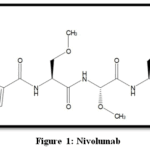 |
Figure 1: Nivolumab Click here to View Figure |
Relatlimab
Relatlimab (Figure 2) is a drug used in immunotherapy that specifically targets the LAG-3 (lymphocyte-activation gene 3) receptor found on T cells. By inhibiting LAG-3, it aids in restoring T-cell function and amplifying the immune system’s response to cancer cells.This medication is frequently administered in conjunction with nivolumab (marketed as the fixed-dose combination Opdualag) for the treatment of advanced melanoma and is currently under investigation for its efficacy in treating other types of cancer as well.Common adverse effects associated with this drug include fatigue, skin rashes, diarrhea, and immune-mediated inflammation affecting organs such as the liver or lungs.
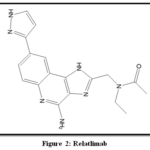 |
Figure 2: Relatlimab Click here to View Figure |
One of the effective analytical techniques for separating & estimating drug content is high-performance liquid chromatography. Several RP-H.P.L.C methods for determining the dosage forms of nivolumab, relatlimab, & a few other drugs, either individually or in combination, have been documented in the literature. The literature review revealed more cost-effective techniques; thus, in line with I.C.H guidelines (Q2 specification), a simple & economical stability-indicating simultaneous estimation of Nivolumab & Relatlimab using RP-H.P.L.C in pharmaceutical dosage forms must be developed & validated.
Materials and Reagents
Pure medications of nivolumab&relatlimab were acquired from AkrivisPharma PVT LTD. Acetonitrile &0.1% TFA of H.P.L.C quality was purchased from Rankem Chemical Division in India. With the use of 0.45µ Millipore filters (Rankem, India), pure milli-Q H20& sodium hydrogen phosphate are utilised.
Instrumentation and Chromatographic Conditions
The technique was created & confirmed using an automated sample injector along with a H20 H.P.L.C, model 2695 SYSTEM, which features a photo diode array detector. For the separation process, an Agilent C18 column (150 mm x 4.6 mm ID x 5µ) was employed. Acetonitrile served as M.P B in a 70:30 ratio, while 0.1% TFA was used as M.P A. The analysis was conducted in isocratic mode with an injection vol of 10 µL & a rate of flow of 1mL/min. The total run time was six minutes, & the column was maintained at a temp of 300C. Data collection was performed using Empower 3 software at a detection wavelength of 235 nm.
Preparation of Sols
Diluent: Mixed H20 & Acetonitrile in the 1:1v/v ratio
Preparation of buffer
0.1% Trifluoroacetic Acid Buffer: Precisely measure 0.1% TFA in a 1000 ml V.F, add roughly 900 ml of milli-Q H20, degas to sonicate, & then top up the vol with H20 before adjusting the pH to 2.8.
Preparation of Working Sol& Std of Working Sol
A precise measurement of 24 mg of Nivolumab & 8 mg of Relatlimab working Stds was conducted, followed by their transfer into clean, dry 50 ml V.Fs. Subsequently, 10 ml of diluent was introduced, & the mixture was sonicated for 10 minutes. Additional diluents were then incorporated to achieve the final vol of 160µg/ml for Relatlimab & 480µg/ml for Nivolumab.1ml of Std stock sol was transferred to 10ml V.F& made up with diluent.(48µg/ml Nivolumab&16µg/ml Relatlimab)
Preparation of Sample stock sol&Sample Working Sol
From a sample vial containing a total vol of 20 ml, 240 mg/20 ml equivalent weight of Nivolumab & 80 mg/20 ml equivalent weight of Relatlimab were carefully pipetted & transferred into a clean, dry 100 mL V.F. Approximately 50 mL of diluent was introduced, & the mixture was sonicated to ensure complete dissolution. The vol was subsequently adjusted with the same solvent, & the sample was filtered through a 0.45 micron injection filter using a syringe. Additionally, 1 ml of the stock sol was pipetted into a 10 ml V.F, followed by dilution with the diluent to reach the desired concentration. Nivolumab (2400µg/ml) was combined with Relatlimab (800µg/ml).0.2ml of Stdstock sol was transferred to 10ml V.F& made up with diluent.(48µg/ml Nivolumab & 16µg/ml Relatlimab)
Method Validation
In order to show that the H.P.L.C technique is suggested for routine analysis, it was validated for the simultaneous estimation of the drug substances Relatlimab &nivolumab in accordance with I.C.H criteria.
System suitability
The system suitability assessment was conducted for each validation parameter by injecting a system suitability sol that contained Nivolumab at 48 µg/ml & Relatlimab at 16 µg/ml. The system suitability chromatogram is presented in Figure 3, & the corresponding values are listed in Table 1.
Table 1: System suitability
|
Relatlimab |
Nivolumab | |||||
| RT(min) | TP | Tailing | RT(min) | TP | Tailing |
RS |
|
2.322 |
8656 | 1.24 | 3.235 | 5876 | 1.25 | 5.6 |
| 2.322 | 8646 | 1.24 | 3.240 | 5538 | 1.24 |
5.5 |
|
2.325 |
8646 | 1.25 | 3.244 | 5639 | 1.24 | 5.4 |
| 2.327 | 8645 | 1.24 | 3.249 | 5576 | 1.23 |
5.4 |
|
2.330 |
8706 | 1.23 | 3.256 | 5538 | 1.24 | 5.4 |
| 2.330 | 8745 | 1.24 | 3.260 | 5539 | 1.23 |
5.5 |
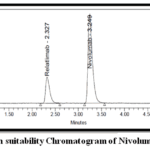 |
Figure 3: System suitability Chromatogram of Nivolumab&Relatlimab Click here to View Figure |
Specificity (Selectivity)
Verification of interference in the optimised approach. When using this method to measure the retention durations of these medications, we shouldn’t discover interfering peaks in the blank & placebo. Accordingly, this approach was described as particular. Table2 provides experimental data, whereas Figure 4 displays a representative chromatogram.
Table 2: Specificity data
|
Sample name |
R. T(mins) |
|
Nivolumab |
2.300 |
| Relatlimab |
3.200 |
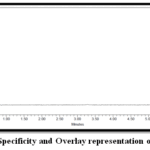 |
Figure 4: Specificity and Overlay representation of H.P.L.C Click here to View Figure |
Chromatogram of Nivolumab and Relatlimab
According to the chromatogram above, no interference was seen in the blank or placebo sols during the Nivolumab & Relatlimab retention periods. Good resolution is achieved in the separation of all compounds.
Samples were subjected to stress from acid, base, oxidation, heat, light, & H20 to assess the stability-indicating characteristics of the H.P.L.C method, Nivolumab, & Relatlimab. A photodiode-array detector was employed to analyze the degraded samples. Both Nivolumab & Relatlimab successfully passed the peak purity test, confirming the specificity of the developed method. The chromatographic profiles demonstrated well-resolved and symmetrical peaks without any co-eluting impurities, indicating the absence of interference from degradation products. These results confirm the reliability and stability-indicating nature of the of proposed RP-HPLC method, as illustrated in Figures 5 & 6.Table 3 outlines the criteria for forced degradation, whereas Table 4 presents the results.
Table 3: Forced degradation conditions for Nivolumab & Relatlimab
|
Stress condition |
Solvent | Temp(0C) |
Exposed time |
|
Acid |
2N HCL | 600c | 30 mins |
| Base | 2N NAOH | 600c |
30 mins |
|
Oxidation |
20% H2O2 | 600c | 30 mins |
| Thermal | Diluent | 1050c |
6 hours |
|
Photolytic |
Diluent | – | – |
| Hydrolytic | H20 | 600c |
|
The results showed that when the samples were exposed to acid, deterioration peaks appeared. The stress investigation showed that none of the degradants co-eluted with the active drug peaks.
Table 4: Degradation profile results
|
Degradation condition |
Nivolumab % Undegraded | Relatlimab % Undegraded |
| Acid | 94.50 |
94.22 |
|
Base |
93.70 | 91.35 |
| Oxidation | 98.60 |
97.39 |
|
Thermal |
98.97 | 97.68 |
| Photolytic | 99.65 |
98.99 |
|
Hydrolytic |
99.63 |
98.67 |
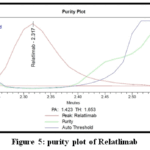 |
Figure 5: purity plot of Relatlimab Click here to View Figure |
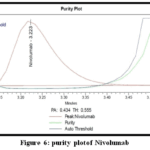 |
Figure 6: purity plotof Nivolumab Click here to View Figure |
L.O.D and L.O.Q
The detection limit refers to the extremely low concentration of an analyte in a sample that can be detected, although it may not always be quantified. Conversely, the limit of quantitation is defined as the minimum analyte concentration in a sample that can be accurately identified with an accepted level of precision & accuracy using a specific method. Figure 7 & 8 illustrates the pertinent representative chromatogram along with the L.O.D values for Nivolumab & Relatlimab, which have been obtained & are detailed in Table 5.
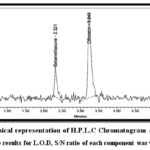 |
Figure 7: Typical representation of H.P.L.C Chromatogram of L.O.DSol.Based on above results for L.O.D, S/N ratio of each component was within the limit |
Table 5 lists the L.O.Q values for relatlimab & nivolumab, &Figure 7 & 8 displays the relevant typical chromatogram.
Table 5: Summary of Limit of Quantification and Limit of Detection
|
Sample |
L.O.Q | L.O.D | ||||
| Conc (µg/ml) | Peak area | S/N Ratio | Conc (µg/ml) | Peak area |
S/N Ratio |
|
|
Nivolumab |
0.16 | 47361 | 44.4 | 0.89 | 16185 | 8.2 |
| Relatlimab | 0.15 | 171324 | 89.5 | 0.05 | 59326 |
43.4 |
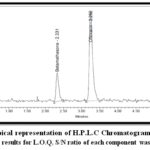 |
Figure 8: Typical representation of H.P.L.C Chromatogram of L.O.QSol. Click here to View Figure |
Based on above results for L.O.Q, S/N ratio of each component was within the limit
Linearity:By examining sols ranging from 25% to 150% of the specification limit, the linearity of the approach was shown for Nivolumab & Relatlimab (Table 6). Nivolumab& Relatlimab had a 0.999 correlation value. Good linearity is indicated by this (Figures 9.1 & 9.2).
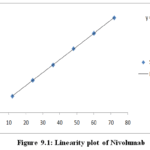 |
Figure 9.1: Linearity plot of Nivolumab Click here to View Figure |
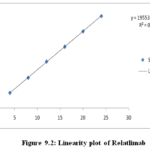 |
Figure 9.2: Linearity plot of Relatlimab Click here to View Figure |
Table 6: Linearity data
|
% Level |
Nivolumab | Relatlimab | ||
| Conc (µg/ml) | Area | Conc (µg/ml) |
Area |
|
|
25% |
2 | 24339 | 6 | 71177 |
| 50% | 4 | 49059 | 12 |
143162 |
|
75% |
6 | 73389 | 18 | 216223 |
| 100% | 8 | 97551 | 24 |
286184 |
|
125% |
10 | 122089 | 30 | 357659 |
| 150% | 12 | 144447 | 36 |
417545 |
Assay data
Festive-DEye/Ear Drops bearing the label claims Nivolumab 0.01% W/v, Relatlimab 0.03% w/v.Assay wasperformed with the above formulation. Average % Assay for Nivolumab &Relatlimab were 99.79%, &100.11% respectively. Assay data shown in Table7.
Preparation of Sample stock sol
The entire vol of the sample, which contained 0.01 mg w/v equivalent weight of Nivolumab & 0.03% w/v equivalent weight of Relatlimab, was pipetted out & transferred into a 25 mL clean, dry V.F. About 7 mL of diluent was added, & it was sonicated to dissolve it completely. The vol was then adjusted using the same solvent & filtered through a 0.45 micron injection filter using a syringe. In addition, pipette 1 ml of the stock sol into a 10 ml V.F, then use diluent to dilute it to the appropriate level. (Nivolumab 40 µg/ml with Relatlimab 120 µg/ml) 2ml of Stdstock sol was transferred to 10ml V.F& made up with diluent.(8µg/ml Nivolumab& 24µg/ml Relatlimab).
Table 7: Assay data of Nivolumab & Relatlimab
|
Std Area of Nivolumab |
Std Area of Nivolumab | % Assay of Nivolumab | Std Area of Relatlimab | Std Area of Relatlimab | % Assay of Relatlimab |
| 96587 | 96846 | 99.11 | 284456 | 287577 |
100.87 |
|
96787 |
96945 | 99.22 | 283646 | 284457 | 99.78 |
| 98765 | 96497 | 98.76 | 287556 | 286547 |
100.51 |
|
97654 |
96946 | 99.22 | 286467 | 287456 | 100.83 |
| 97654 | 96897 | 99.17 | 284578 | 287674 |
100.90 |
|
97645 |
96843 | 99.11 | 280457 | 282454 | 99.07 |
| 97515 | 96829 | 99.10 | 284527 | 286028 |
100.33 |
|
775.8 |
168.8 | 0.173 | 2461.2 | 2128.8 | 0.75 |
| 0.8 | 0.2 | 0.2 | 0.9 | 0.7 |
0.7 |
Accuracy: Sols comprising spiked samples of Relatlimab & Nivolumab at 50%, 100%, & 150% of the working strength were used to assess the method’s accuracy. Every sol was made three times & examined. Table8 showed the percentage recovery outcomes for each contaminant.
Table 8: %Recovery Accuracy data
|
%Level |
%Recovery | |
| 50% Level | Nivolumab |
Relatlimab |
|
100.73 |
100.95 | |
| 99.05 |
100.10 |
|
|
100.71 |
99.37 | |
| 100%Level | 100.14 |
100.90 |
|
99.94 |
100.86 | |
| 100.05 |
100.47 |
|
|
150%Level |
99.72 | 100.93 |
| 99.79 |
101.14 |
|
|
100.71 |
100.88 | |
| Mean% | 100.09 |
100.62 |
System Precision: Six replicate injections of a Working Sol at 100% of the specified limit concerning the working strength of nivolumab&relatlimab were analyzed to assess the system precision. A summary of the peak area results is presented in Table 9.
Table 9: System precision data
|
Injection |
Nivolumab | Relatlimab |
| 1 | 96587 |
284456 |
|
2 |
96787 | 283646 |
| 3 | 98765 |
287556 |
|
4 |
97654 | 286467 |
| 5 | 97654 |
284578 |
|
6 |
97645 | 280457 |
| Avg | 97515 |
284527 |
|
Std dev |
775.8 | 2461.2 |
| %R-S-D | 0.8 |
0.9 |
The % R-S-D for the peak areas of Nivolumab & Relatlimab, derived from six replicate injections of the Working Sol, remained within the accepted limit.
Method Precision
The Stddeviation of an observational population is one of the most often used statistical terms. When the number of outcomes in the set is less than one, the Std deviation is calculated by taking the square root of the sum of squares of the deviations of each individual result for the mean. The Stddeviation S can be found using
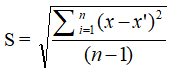
The units of the Stddeviation match those of the property being measured.
Variance (S2) is the square of the Stddeviation. The Stddeviation represented as a fraction of the mean, or S/x, is known as the relative Std deviation. Occasionally, it is stated as a percentage of the relative Stddeviation & multiplied by 100. It becomes a more trustworthy way to represent accuracy.

Through the analysis of a sample comprising Nivolumab & Relatlimab, the accuracy of the method was determined (six distinct sample preparations). Table 10 presents a summary of the gathered data.
Table 10: Method precision data
|
Injection |
Nivolumab | Relatlimab |
| 1 | 96846 |
287577 |
|
2 |
96945 | 284457 |
| 3 | 96497 |
286547 |
|
4 |
96946 | 287456 |
| 5 | 96897 |
287674 |
|
6 |
96843 | 282454 |
| Avg | 96829 |
286028 |
|
Std dev |
168.8 | 2128.8 |
| %R-S-D | 0.2 |
0.7 |
According to the results above, the percentage R-S-D of the method precision study for Relatlimab & Nivolumab was within the accepted range.
The accuracy that is attained within a single laboratory over a longer period of time (usually several months) & takes into account more variations than repeatability is known as intermediate precision. Specifically: various analysts, calibrants, reagent batches, columns, spray needles, etc. In the context of intermediate precision, these factors behave as random since they are not constant over a longer period of time, but they are consistent within a day (i.e., behave systematically within the daytimescale). The intermediate precision’s value (Table 11), represented as Std deviation (see the following section), is greater than the repeatability Std deviation since it accounts for additional influences.
Table 11: Intermediate precision data
|
Injection |
Nivolumab | Relatlimab |
| 1 | 260179 |
1367301 |
|
2 |
266587 | 1345728 |
| 3 | 268562 |
1372425 |
|
4 |
265616 | 1349532 |
| 5 | 267653 |
1382972 |
|
6 |
267317 | 1359080 |
| Avg | 265986 |
1362840 |
|
Std dev |
3013.5 | 14150.1 |
| % R-S-D | 1.1 |
1.0 |
Robustness
The chromatographic parameters were intentionally modified to assess the robustness of the current method. In order to evaluate the robustness of the method, a system suitability sol is prepared according to the methodology & injected into the H.P.L.C under various altered conditions to test the method’s capabilities, such as rate of flow (± 10%), column oven temp (± 5°C), &M.P (± 10%) from the original method conditions. No significant changes were observed when altering the flow, temp, M.P, & the system suitability also adhered to the methodology. The results regarding robustness are summarized in Table 12.
Table 12: Robustness results
|
Chromatographic condition |
Nivolumab (R-S-D) | Relatlimab (R-S-D) |
| Flow(-) | 0.3 |
0.3 |
|
Flow(+) |
0.4 | 0.5 |
| Temp(-) | 0.6 |
0.2 |
|
Temp(+) |
0.2 | 0.4 |
| M.P(-) | 0.5 |
0.3 |
|
M.P (+) |
0.3 |
1.6 |
Conclusion
A simple, precise, & accurate method was developed for the simultaneous estimation of analytes in tabluar form.To evaluate the system suitability characteristics, six injections of the Stdwere performed, & the results were significantly below the accepted limit (less than 2).A linearity assessment was carried out at levels ranging from 25% to 150%, yielding an R2 value of 0.999.Various validation parameters, such as robustness, precision, accuracy, L.O.D&L.O.Q, were found to be within accepted limits.For Nivolumab &Relatlimab, the recovery rates were recorded at were 99.79%, &100.11%,respectively.The method was found to be straightforward, sensitive, accurate, rapid, & cost-effective, with a runtime of eight minutes which is very less compared to existing procedures so it is more suitable.
Acknowledment
Appreciation to Spectrum Pharma Research Sols for generously supplying the pure samples of Nivolumab & Relatlimab utilized in this study. Their assistance was crucial for the successful execution of this research.
Funding Sources
The authors declare that no financial support was received for the research, authorship, or publication of this article.
Conflict of Interest
There are no conflicts of interest that need to be disclosed.
Ethical Approval
Ethical approval was not necessary for this study.
References
- Divya, Y.; Shaik, R.; Sudhakar, S. World Journal of Pharmaceutical Sciences. 2025, 13(01), 1-9.
- Manna, P.; Swarnalatha. Future Journal of Pharmaceuticals and Health Sciences. 2025, 5, 50-66.
CrossRef - Kaliboyina, R.P.; Kesava, R.T.K.V.; Venkateswara, R.A. International Journal of Pharmacy and Analytical Research. 2024, 13(4), 752-760.
- Kuna, M.; Manduri, N. S.; Bandi, V.R.D.B.; Patnala, B.V. IJSDR. 2024, 9(8), 694 – 704.
- Bogoju, K.; Ajitha M. International Research Journal of Modernization in Engineering Technology and Science. 2024, 11(6), 125-131.
- Georgina, V.L.; Paolo A.A, James L, Christopher L, Jean J.G, Dirk S. Journal of Clinical Oncology; 2024, 42(33), 3926-3934.
- Mohana, V. N.; Ramanjaneyulu, S.; Anil, K. T. Future Journal of Pharmaceutical Sciences. 2024, 10(1), 1-20.
- Kuna, M.; Manduri, N. S.; Bandi, V. R. D. B.; Patnala, B. V. IJSDR – International Journal of Scientific Development & Research. 2024, 9(8): 694-704.
- Prasad, K. R, Rao, D. K, Rao MAV. IJPAR JOURNAL. 2024, 13(4), 752–760.
- Sravya, K.; Hanumanth, V.; Ravi, K. P.; Padmavathi, Y.; Raghavendra B.N.; Asma, B, International Journal of Creative Research Thoughts. 2023, 11(9), 822-831.
- Bonam, S.; Siva, R. T.; Rama, S. K.; Pallapati, S. Analytical Chemistry Letters. 2023, 13(5), 528-538.
CrossRef - Aswin, K. N.; Chitra, M.; Vijayamithraj, R.; Senthil, K. N. International Journal of Pharmaceutical Research & Analysis. 2023, 13(2), 54-60.
- Rama, K.; Badikela.;Mondal.; Sumanta.; Chakraborty.; Subhadip. Journal of Pharmaceutical Negative Results. 2022, 13, 1020-1032.
CrossRef - Phillips, A. L.; Reeves, D. J. Annals of Pharmacotherapy. 2022, 57(6), 738-745.
CrossRef
Abbrevations
RP-H.P.L.C: Reverse Phase High Performance Liquid Chromatography
H.P.L.C: High Performance Liquid Chromatography
R.S.D: Relative Std deviation
L-O-D: Limit of Detection
L-O-Q: Limit of Quantification
Temp: Temp
Vol: Vol
TFA: Trifluoroacetic acid
μm: micrometer
nm: nanometer
0C: Degree Centigrade
mins: Minutes
I.C.H: International Council for Harmonisation
mL: milliliter
mm: millimeter
v/v: vol per vol
µg: microgram
Std: Std
dev: Deviation
FR: Rate of flow
MP:Mobile Phase
V.F: Volumetric flask
Sol:Solution
Conc: Concentration
 PlumX:
  Views: 848 Views
  PDF Downloads: 1005
 Accepted on: 17 Dec 2025


ISSN Online: 2231-5039