Weight Variation of Candy Samples in a Food Analysis Laboratory: A “Sweet” Laboratory Exercise to Demonstrate Accuracy and Precision

Natural and Applied Sciences Department, College of Arts and Sciences, Nueva Ecija University of Science and Technology, General Tinio St., Cabanatuan City, Nueva Ecija 3100 Philippines
Corresponding Author E-mail:dfreyes@ineust.ph.education
DOI : http://dx.doi.org/10.13005/ojc/420326
Download this article as:

Accuracy and precision are foundational concepts in analytical chemistry and food science education, yet undergraduate students frequently struggle to distinguish them in practical circumstances. This paper presents a mixed-methods study of a laboratory exercise in which 3rd Year undergraduate students enrolled in the Food Analysis course of the BS Food Technology curriculum determined the weight variation of six commercially available hard candy samples. Each group weighed 15 individual pieces and the mean, standard deviation (SD), percent relative standard deviation (%RSD), and percentage error relative to the declared weight were computed. Quantitative results demonstrated that all six candy samples yielded mean weights close to their declared values, with %errors ranging from -0.45% to 4.0% and %RSD values from 0.027% to 5.7%, all within the <8% acceptability limit for food analysis. Complementing the quantitative component, qualitative thematic analysis based on a six-phase framework from the discussion and conclusion sections of the laboratory reports was conducted. Five themes were identified: developing statistical literacy, distinguishing accuracy from precision, integrating physical observation with quantitative analysis, connecting results to real-world quality control, and critical and metacognitive engagement with data. The thematic analysis showed both the conceptual gains and persistent misconceptions arising from the laboratory exercise. Collectively, the quantitative and qualitative results affirm that this “sweet” candy-based gravimetric exercise is an accessible, effective, and engaging vehicle for developing analytical thinking skills in food science and analytical chemistry education.
KEYWORDS:Accuracy; Analytical Chemistry; Food Science; Gravimetric Analysis; Mixed-Methods; Precision; Science Education; Thematic Analysis
Introduction
Chemical analysis of food samples is an important tool for the determination of characteristics of food products relevant to product development, quality control, regulatory requirements, and research and development in the food industry1. Food analysis, as a subfield of analytical chemistry, relies on accuracy and precision to generate reliable data from the experiments2. Accuracy is defined as the closeness of measurements to the true value while precision is the closeness of measurements to one another3. These two are the most fundamental concepts and necessary skills in doing chemical analysis, since measurements with low accuracy and low precision yield unreliable results. As important analytical figures of merit, accuracy and precision are introduced in introductory chemistry and in analytical chemistry4. Likewise, students in an undergraduate food analysis curriculum must master the statistical tools necessary to validate data and measurements. Although these definitions are formally distinct, students, in particular those encountering quantitative laboratory experiments for the first time, routinely mix or misapply them. To address this persistent conceptual challenge, a call for laboratory exercises that provide students with direct, data-driven experience to compel them to operationalize and distinguish both concepts simultaneously.
Laboratory exercises that utilize familiar, everyday materials as sample matrices have been recognized as effective pedagogical tools5. These local, everyday materials are used for daily purposes or come from inorganic waste. These relatable materials can reduce cognitive load, increase student engagement, and help bridge the gap between abstract measurement concepts and their applied significance6,7. A classic analytical chemistry experiment using coins is an effective method for teaching measurements and statistical concepts such as measuring the mass of many coins and calculating averages and standard deviations, and comprehending bias introduced by measurement techniques8. This experiment provides hands-on experience with fundamental statistical tools relevant to analytical chemistry. However, a structured laboratory exercise specifically designed to simultaneously and comparatively evaluate accuracy and precision through gravimetric analysis of multiple commercial candy types, integrated within a food analysis curriculum, has not yet been documented.
This paper presents a mixed-methods study of a laboratory exercise in which the 3rd Year BS Food Technology students enrolled in Food Analysis weighed 15 pieces each of six different commercially available candies using an analytical balance and calculated average weight, standard deviation (SD), % relative standard deviation (%RSD), and % error relative to manufacturer-declared weights. Beyond the quantitative outcomes, this study employs thematic analysis9,10,11 of student-written laboratory report sections, specifically the discussion and conclusion sections. This is to examine the qualitative dimensions of student learning, such as how students demonstrate understanding of statistical concepts, distinguish between accuracy from precision, relate the data to real-world quality control standards, and engage with unexpected results. Furthermore, the mixed-methods design of this study reflects a growing recognition in science education research that quantitative performance metrics alone are insufficient to describe the depth and quality of student learning which qualitative methods can reveal through rich and contextual insights12. The objectives of this study are (1) to describe the quantitative results of the candy weight variation exercise across student groups, (2) to conduct a thematic analysis of student-written discussion and conclusion text to characterize patterns of conceptual understanding, (3) to identify both strengths and gaps in student reasoning about accuracy, precision, and statistical interpretation, and (4) to offer pedagogical recommendations for lab instructors implementing similar exercises in food analysis and analytical chemistry courses.
Materials and Methods
Participants and Setting
The exercise was conducted with 3rd Year BS Food Technology students enrolled in a Food Analysis laboratory course. Students were organized into six groups, each assigned a different commercially available hard candy. The exercise was completed within a standard laboratory period.
Materials
Six commercially available hard candies with declared weights ranging from 2.7 to 4.0 grams per piece were used and each candy type was assigned to one student group. Fifteen (15) pieces were randomly selected from a newly opened package per group. Additional materials included a calibrated ATX224 analytical balance (220 g capacity, 0.1 mg readability; Shimadzu Corporation, Japan), weighing papers, forceps, and a data laboratory sheet.
Research Design
This study adopts a convergent mixed-methods design13, 14 in which quantitative results and qualitative findings are collected in parallel and integrated at the level of interpretation. The quantitative data provide evidence of what students measured while the thematic analysis provides evidence on how students reasoned about and communicated their measurements.
Quantitative Procedure
Each group followed a standardized weighing procedure15. Briefly, the analytical balance was verified for calibration and leveled prior to use. A piece of weighing paper was then placed on the balance pan and tared to zero. Each candy piece was individually placed on the weighing paper, and its mass was recorded to the nearest 0.001 g. This weighing step was then repeated for all 15 candy pieces. The mean weight, SD, %RSD, and %error relative to the declared weight were calculated using Microsoft Excel.
Accuracy and precision are defined by different international scientific committees to characterize the analytical performance of a measuring system operating under a specific protocol16. Accuracy in quantitative analysis refers to the agreement between a measured value and a true or accepted reference value. At the same time, precision is the closeness of agreement between values obtained by replicate measurements following the same specified procedures. In this study, accuracy is assessed from the signed percentage error (%error), defined in Eq. 1. The signed %error retains directional information where a positive %error indicates that the measured mean weight exceeds the declared value. In contrast, a negative %error means the measured mean weight falls below the declared value.

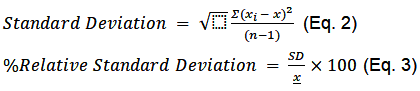
Precision is assessed using the SD and %RSD values. As defined, SD of a sample is a square root of the sum of the squared deviations from the mean divided by the degrees of freedom (n – 1) and used to quantify the dispersion of a small set of replicate measurements17. While %RSD, also called the coefficient of variation, is another way to express the SD as a percentage of the mean, making it easier to compare the precision of measurement with different magnitudes. SD and %RSD values are calculated using Eqs. 2 and 3, respectively. An %RSD of ≤8% is the acceptable value that confirms the repeatability and reproducibility of a specific analytical method18. Accuracy and precision are fundamentally independent: a dataset may be precise but biased (large signed error, low %RSD), accurate on average but variable (signed %error near zero, high %RSD), both accurate and precise, or neither.
Qualitative Component: Thematic Analysis
The qualitative component of this mixed-methods research drew on the student-written discussion and conclusion sections of the laboratory reports submitted by all six groups. These sections of the laboratory reports comprised the primary text corpus for the thematic analysis. The thematic analysis was conducted following the six-phase framework (Figure 1) as a foundation for conducting robust thematic analysis9,10,11. The phases consisted of familiarization with the data (Phase 1), generation of initial codes (Phase 2), identification of themes (Phase 3), review of themes (Phase 4), definition and naming of themes (Phase 5), and writing of the report (Phase 6). The student quotations used as representative evidence have been lightly corrected for spelling and grammatical errors to improve quality and readability, without changing the meaning of the statements.
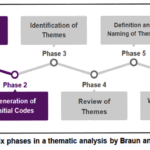 |
Figure 1: Six phases in a thematic analysis by Braun and Clarke9. Click here to View Figure |
Results and Discussion
Quantitative Results: Weight Analysis
Presented in Table 1 are the computed statistical parameters for each candy sample. All six candy samples produced mean weights within a reasonable range to their declared values, with %error values ranging from -0.45% to 4.0%, and %RSD values ranging from 0.027% to 5.7%. All %RSD values were below or equal the 8% acceptability limit for food analysis18.
Table 1: Summary of weight analysis results for the six candy samples (n = 15).
|
Candy Sample Number |
Mean Weight (g) | Declared Weight (g) | SD | %RSD | %Error |
| 1 | 3.0260 | 3.0 | 0.1614 | 5.3% |
0.87% |
|
2 |
2.8084 | 2.7 | 0.0508 | 1.8% | 4.0% |
| 3 | 2.7873 | 2.8 | 0.0439 | 1.6% |
-0.45% |
|
4 |
3.9117 | 4.0 | 0.0786 | 2.0% | -2.2% |
| 5 | 3.0499 | 3.0 | 0.0811 | 0.027% |
1.7% |
|
6 |
3.4509 | 3.5 | 0.1958 | 5.7% |
-1.4% |
Note: SD = standard deviation; %RSD = percent relative standard deviation. Signed %error = (Mean Weight – Declared Weight)/Declared Weight X 100. Positive values indicate overweight relative to the declared weight, while negative values indicate underweight. All %RSD values fall within ≤8%18.
The three groups with positive %error (Candy Sample Nos. 1, 2, and 5) produced mean weights exceeding their declared values. These excessive values can be referred to as product overfill. Food manufacturing companies tend to overfill due to strict requirements for packaging and filling of products19. Although overfill is generally not a regulatory violation20, it constitutes compliance with the requirement that the mean weight of a sample lot be at least as large as the declared net contents. However, the +4.0% deviation of the Candy Sample No. 2 represents the largest deviation from the declared value in the dataset and raised questions, as noted spontaneously by the students themselves, about whether their calculation was correct. While the other three groups obtained negative %error results (Candy Samples Nos. 3, 4, and 6). A negative signed %error indicates that the mean weight falls below the declared value, which can have consequences from a regulatory perspective. Candy Sample No. 4 has the largest negative deviation and a low %RSD, indicating a precise but systematically underweight product, which can be a particular concern from a consumer protection standpoint.
In terms of precision, %RSD values well below <8% threshold, confirming consistent and reliable use of the analytical balance across all six groups. Precision varied from exceptional (Candy Sample No. 5) to moderate (Candy Sample Nos. 1 and 6). The higher %RSD values in the candy samples are consistent with greater physical heterogeneity among sampled pieces. In contrast, the near zero %RSD of the Candy Sample No. 5 is a remarkably practical result that reflects highly uniform manufacturing outputs. It provides students with a fixed reference point for what ‘high precision’ looks like in practice. The Candy Sample No. 4, with a %RSD of 2.0% and a signed error of -2.2% represents the clearest empirical demonstration of the independence of accuracy and precision in the obtained dataset. The low %RSD indicates that the 15 candy pieces were very similar to one another, while the negative signed %error confirms that their common weight was systematically below the declared value. This observed combination of being precise but inaccurate, or precisely biased, demonstrates why precision and accuracy must be evaluated separately and is the kind of result that is difficult to convey through lecture but immediately intuitive when encountered in experimental data.
The diversity of quantitative results across the six candy samples used in the exercise effectively covered the conceptual space of accuracy-precision combinations. There were groups with both high accuracy and high precision (Candy Sample Nos. 3 and 5), groups with positive bias and varying precision (Candy Sample Nos. 1 and 2), and groups with negative bias and varying precision (Candy Sample Nos. 4 and 6), and Candy Sample No. 4 illustrates high precision with systematic negative bias. The observed diversity arising from the inherent manufacturing variation in commercial confectionery products is a key pedagogical strength of the exercise, as it provides authentic and varied empirical grounding without requiring artificial manipulation of experimental conditions.
Qualitative Results: Thematic Analysis
The thematic analysis of the six student laboratory reports yielded five themes. Table 2 presents each theme, its description, and representative student evidence from the corpus.
Table 2: Themes identified from the thematic analysis of student discussion and conclusion sections.
|
Theme |
Description | Representative Student Evidence |
| Theme 1: Developing Statistical Literacy | The students used and defined mean, SD, %RSD, and %error with different conceptual depth. Most groups correctly computed for all four parameters, though the quality of informative reasoning differed substantially across groups. |
“The standard deviation is less than plus or minus 2, indicating that the data we have implies that it is standard and expected because the spread of the data is modest.” “Standard deviation measures the closeness of result to mean value whereas relative standard deviation measures the degree of standard deviation.” |
|
Theme 2: Distinguishing Accuracy from Precision |
The most distinctive theme is directly aligned with the primary learning objective of the study. Most groups produced explicit and accurate distinctions between accuracy (%error) and precision (SD and %RSD). | “Our experiment with candies shows some great accuracy and a bit less precision.”
“The weights of the food samples are close to one another, indicating high precision. However, its accuracy is low because it is slightly far from its true value.” |
| Theme 3: Integrating Physical Observation with Quantitative Data | The highest-order reasoning was observed in the study. It explicitly connects visible candy defects to manufacturing causes and links these physical observations to their statistical variability, thereby demonstrating holistic and causal analytical thinking. |
“The holey candies are caused by insufficient cooling, while the broken candies are caused by transportation bumps, and the small candies are caused by insufficient feeding.” |
|
Theme 4: Connecting Results to Real-World Quality Control |
Multiple groups situated their findings within the regulatory frameworks of the food industry, invoking external standards and discussing implications for manufacturers and consumers, thereby reflecting applied analytical thinking. | “According to the National Institute of Standard and Technology (2018), the average weight of the sample must be at least as large as the net contents displayed on the label.”
“A %RSD of 1.8% indicates relatively low variability, suggesting that the analytical balance provides consistent and reliable measurements.” |
| Theme 5: Critical and Metacognitive Engagement with Data | Two groups demonstrated productive metacognitive engagement: one self-reported uncertainty about an unexpectedly large result; another independently identified a systematic negative bias in both instances, reflecting higher-order data reasoning. |
“We had a little doubt if it was correct because the answer we got was too big compared to what we expected.” “There is a slight negative bias in the measurements, as indicated by the mean value being slightly lower than the declared weight.” |
Note: Analysis conducted using the six-phase thematic analysis framework of Braun and Clarke9. Representative quotations are extracted directly from the student-submitted laboratory reports and lightly edited for readability.
Theme 1: Developing Statistical Literacy
All six groups demonstrated functional statistical literacy in calculating and reporting the four parameters. Depth of conceptual articulation varied, however, one group offered the most definitional reasoning, stating precise definitions of SD and %RSD as conceptual objects before applying them. This shows a higher-order engagement reflecting true understanding of why the tools work, not merely how to calculate them. Other groups, while computationally proficient, provided a thinner conceptual framing, reporting results with correct arithmetic but minimal informative discussion. This variability suggests that the exercise reliably elicits statistical practice, but that deeper conceptual articulation may require additional scaffolding, such as pre-lab definitional prompts or post-lab explanatory writing tasks.
Theme 2: Distinguishing Accuracy from Precision
Aligned directly with the primary learning objective, this theme appeared across all six reports. The clearest and most accurate distinction came from the Candy Sample No. 1 and Candy Sample No. 4 groups, where, in the context of the signed %error, the students were able to correctly identify that their data were precise (low %RSD) but inaccurate (negative signed %error). This shows the precision-accuracy dissociation that the signed formulation makes transparent. One statement in the lab report, “the weights of the food samples are close to one another, indicating high precision. However, its accuracy is low because it is slightly far from its true value.” Further, lab instructors can directly address using the signed %error framework to highlight that a low %error can co-occur with a high %RSD.
Theme 3: Integrating Physical Observation with Quantitative Analysis
The Candy Sample No. 1 group demonstrated the most sophisticated reasoning in the corpus by explicitly connecting visible candy defects to specific manufacturing failure modes and linking these observations to their statistical outcomes. This multimodal reasoning, moving from physical observation to manufacturing mechanism to statistical implication, thus explains why the Candy Sample No. 1 showed a positive signed %error (+0.87%) despite having a high %RSD (5.3%). Their observation was that the defects introduced weight variability but did not systematically reduce the mean below the declared value. This type of integrative causal reasoning is a hallmark of expert analytical practice21 and is rarely explicitly targeted in undergraduate food analysis instruction.
Theme 4: Connecting Results to Real-World Quality Control
Four of six groups situated their results within the regulatory frameworks for the food industry. The group that worked on Candy Sample No. 2 explicitly cited the NIST20 net content requirements. This is particularly appropriate given that this group’s positive signed error (+4.0%) represents the largest overfill in the dataset. Students correctly recognized that while overfill does not constitute underfill non-compliance, it raises questions about weight consistency. The signed %error framework amplifies the value of this regulatory connection, because it allows students to immediately recognize which groups produced results below the declared value (negative %error) and which might therefore be more directly implicated by underfill provisions of the NIST standard.
Theme 5: Critical and Metacognitive Engagement with Data
Two groups demonstrated productive metacognitive engagement. The group that worked on Candy Sample No. 2 self-reported uncertainty about their %error calculation, noting the result was larger than expected. In the context of signed %error, this reaction is information. The group reported +4.0%, the largest positive deviation, and their self-doubt reflects a healthy scientific instinct to question anomalous results rather than accept them uncritically. The group that worked on Candy Sample No. 6 independently identified the directionality of their bias, noting that the mean was below the declared weight. This observation directly corresponds to their negative signed %error of -1.4%. The self-directed identification of a systematic negative bias of this group, without explicit prompting, represents the most advanced engagement with signed error in the dataset. Further, it illustrates how the signed formulation naturally invites directional interpretation that the absolute formulation prevents. Figure 2 illustrates the themes formulated in the study.
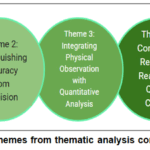 |
Figure 2: Emerging themes from thematic analysis conducted in the study. Click here to View Figure |
Limitations
Several limitations of this study should be considered. First, the sample size is small since only six student groups participated, each analyzing 15 candy pieces. While this sample was sufficient for a classroom-based investigation and produced meaningful inter-group variation, it precludes broad statistical generalization of the quantitative findings across candy types or manufacturers. A larger sample size in terms of the number of student groups and the number of candy pieces per group would improve the robustness of the statistical estimates22. Second, the study was conducted at a single university within a single course. The students were third year undergraduate students with prior laboratory experience. Their conceptual starting points and engagement patterns may not be representative of students at other universities, at different course levels, or within different disciplinary contexts. Replication of the exercise in other settings such as other colleges and courses at other year levels would be necessary to assess the generalizability of the thematic findings. Third, the data from qualitative analysis are limited to the written discussion and conclusion sections of student-written laboratory reports. This text type captures the reasoning after the experiment but does not directly reflect in-the-moment thinking during data collection and analysis. Future studies incorporating pre- and post-lab reflection instruments provide a more complete picture of the conceptual processes the exercise engages. Lastly, as with all reflexive thematic analysis, the interpretative lens of a single analyst shapes the construction of themes. The themes presented here represent one theoretically grounded reading of the corpus, while alternative coding frameworks or additional analyst perspectives could surface different or complementary patterns23.
Pedagogical Implications and Future Implementation
The use of signed %error in this laboratory exercise offers three specific pedagogical advantages over the conventional absolute formulation. First, it makes the direction of inaccuracy explicit and interpretable. As such, the students can immediately see whether a candy type is overfilled or underfilled and reason about the implications for manufacturers and consumers. Second, it connects student calculations more directly to real-world regulatory frameworks that distinguish between overfill and underfill as distinct compliance categories. And lastly, when combined with %RSD, it enables a richer characterization of data quality, where in a group with low %RSD and a large positive signed %error (precise and consistently overfilled) is qualitatively different from a group with low %RSD and large negative signed %error (precise and consistently underfilled), a distinction that the absolute formulation collapses.
The thematic analysis further highlights several actionable recommendations. First, pre-lab definitional scaffolding, in which students are required to define SD, %RSD, and signed %error in their own words before entering the laboratory, may deepen conceptual articulation beyond computational proficiency. Second, a structured physical observation protocol that prompts students to classify and count defects before weighing may broaden the integrative reasoning observed in Theme 3 across more groups. Also, post-lab discussion comparing signed %error values across all six groups, where students will be asked which groups were above versus below the declared weight, and what regulatory implications are identified, would directly reinforce Themes 2 and 4. Finally, incorporating a formal reflection prompt asking students to identify one surprising aspect of their data may systematize the metacognitive engagement spontaneously observed in Theme 5.
For future assessment of learning outcomes, instructors are encouraged to administer a brief pre- and post-lab instrument containing conceptual items targeting the accuracy-precision distinction and the interpretation of signed deviation. Such instruments would enable more rigorous quantification of conceptual change attributable to the exercise and would allow comparison across student sections, institutions, and instructional modifications. The exercise is also readily adaptable for different education contexts. At the introductory level, the exercise can be simplified by removing the signed %error calculation and focusing only on mean and SD calculations. At the advanced level, the exercise can be extended to include discussions of sampling theory discussions or to expand sample sizes. The flexibility and simplicity of the candy matrix with numerous options at modest cost make it well-suited for adoption across diverse institutional settings.
Conclusion
This mixed-methods study evaluated a simple, low-cost, and easily implemented gravimetric laboratory exercise in which upper-level undergraduate students utilized an analytical balance to assess weight variation across six commercial candy types. A defining feature of the study was the transition from conventional absolute error to signed percentage error, yielded a directionally informative dataset that categorized samples as either overfilled or underfilled, effectively mirroring real-world regulatory and quality control scenarios. Quantitatively, all student groups demonstrated reliable instrument use with %RSD values below 8%. At the same time, the diverse outcomes in accuracy and precision offered a robust empirical basis for the primary learning objectives of the exercise. From a qualitative perspective, thematic analysis revealed five themes spanning outcomes from basic statistical calculations to sophisticated metacognitive engagement. This confirms that the exercise successfully helped the students to distinguish between accuracy and precision and fostered spontaneous connections to industrial standards. By demonstrating that a simple pedagogical shift to signed error can enrich both quantitative results and conceptual understanding, this study suggests that future research should incorporate formal pre- and post-assessments and broader student reflections to investigate further the link between directional data interpretation and professional regulatory frameworks. With these extensions, the candy weight variation exercise has the potential to serve as a simple, robust, and generalizable model integrating gravimetry, statistics, and regulatory literacy into undergraduate food science and analytical chemistry education.
Acknowledgement
The author expresses sincere gratitude to the Bachelor of Science in Food Technology 3A of Academic Year 2023-2024 for their contribution to the data collection phase of this study. The datasets generated during their laboratory sessions provided the foundational evidence for the analysis presented herein. The author would like to acknowledge Nueva Ecija University of Science and Technology for the administrative and financial support for this study.
Funding Sources
The author(s) received no financial support for the research, authorship, and/or publication of this article.
Conflict of Interest
The author(s) do not have any conflict of interest.
Data Availability Statement
The quantitative data and qualitative data presented in this study are available upon reasonable request from the corresponding author.
Ethics Statement
The study involved the secondary analysis of student-authored laboratory reports generated as part of a regular and compulsory food analysis laboratory activity. No experimental interventions were performed on human participants beyond standard educational laboratory practice. The study was conducted in full compliance with institutional policies on the ethical treatment of student-generated educational materials.
Informed Consent Statement
Informed consent for the publication of data derived from student laboratory reports was obtained in accordance with institutional guidelines governing the use of student-generated educational materials for research and scholarly publication. Individual student groups are identified only by a numerical label corresponding to their assigned candy type, with no reference to individual names, student identification numbers, or other identifying characteristics.
Author’s Contributions
Darwin F. Reyes – conceptualization, methodology design, data collection, data analysis, writing – original draft, writing – review and editing, project administration
References
- Castro, L. F.; Peuker, S.; Mott, J. J. Food Sci. Educ. 2021, 20(2), 78-87.
CrossRef - Patel, B. A. J. Chem. Educ.2022, 99(10), 3585-3589.
CrossRef - Stone, D. C. Anal. Bioanal. Chem. 2017, 409(7), 1719-1724.
CrossRef - Gao, R.; Lloyd, J. J. Chem. Educ. 2020, 97(2), 368-373.
CrossRef - Wahyuni, D.; Nahadi, N.; Riandi, R.; Nandiyanto, A. JEET. 2025, 38(IS3), 23-29.
CrossRef - Belisario, J. M.; Paglinawan, J. L. IJRIAS.2025, X(V), 263-270.
CrossRef - Limbu, S.; Rajbanshi, R.; Kumar, R. IJRES. 2025, 11(3), 724-744.
CrossRef - Bularzik, J. J. Chem. Educ. 2007, 84(9), 1456.
CrossRef - Braun, V.; Clarke, V. Qual. Res. Psychol. 2006, 3(2), 77-101.
CrossRef - Clarke, V.; Braun, V. J. Posit. Psychol. 2016, 12(3), 297-298.
CrossRef - Ahmed, S. K.; Mohammed, R. A.; Nashwan, A. J.; Ibrahim, R. H.; Abdalla, A. Q.; Ameen, B. M. M.; Khdhir, R. M. J. Med. Surg. Public Health. 2025, 6, 100198.
CrossRef - Yusnidar, Y.; Fuldiaratman, F.; Chaw, E. P. J. Ilm. Ilmu Terapan Univ. Jambi. 2024, 8(1), 76-89.
CrossRef - Creswell, J. W.; Plano Clark, V. L. Designing and Conducting Mixed Methods Research, 3rd ed.; Sage Publications: 2018.
- Dawadi, S.; Shrestha, S.; Giri, R. A. JPSE. 2021, 2(2), 25-36.
CrossRef - Shimadzu Corporation. Electronic Balance Instruction Manual: ATX Series, ATY Series, Manual No. 321-78001D; Shimadzu Corporation: 2016.
- Prenesti, E.; Gosmaro, F. Accred. Qual. Assur. 2014, 21(1), 33-40.
CrossRef - Miller, J. N.; Miller, J. C. Statistics and Chemometrics for Analytical Chemistry, 7th ed.; Pearson: 2018.
- Fauziah, A. N.; Kim, M. J.; So, B. R.; Son, J. E.; Jung, S. K. Prev. Nutr. Food Sci. 2024, 29(4), 504-511.
CrossRef - Wohner, B.; Pauer, E.; Heinrich, V.; Tacker, M. Sustainability. 2019, 11(1), 264.
CrossRef - National Institute of Standards and Technology. Handbook 133: Checking the Net Contents of Packaged Goods, 6th ed.; U.S. Department of Commerce: 2018.
CrossRef - Osborne, J. J. Sci. Teach. Educ. 2024, 25(2), 177-196.
CrossRef - Serdar, C.; Cihan, M.; Yücel, D.; Serdar, M. Biochem. Med. (Zagreb). 2020, 31(1), 010502.
CrossRef - Byrne, D. Qual. Quant. 2021, 56, 1391-1412.
CrossRef
 PlumX:
  Views: 835 Views
  PDF Downloads: 812
 Accepted on: 25 Apr 2026
Second Review by: Dr. Firdos Ahmed
Final Approval by: Dr. Winifred U. Anake


ISSN Online: 2231-5039