Application of Fractional Integro-Differential Equations in Paracetamol Drug Release Modeling
 , Yamini Parthiban2,3 J. Thiravidarani4, S. Madhumitha5
1Department of Mathematics, Easwari Engineering College, 18 Bharathi Salai, Ramapuram Chennai, Tamil Nadu, India.
2Department of Mathematics, SRM Institute of Science and Technology, Ramapuram Chennai, Tamil Nadu, India.
3Department of Mathematics and Science Education, Faculty of Education, Harran University, Sanliurfa, Turkey
4Vel Tech High Tech Dr.Rangarajan Dr.Sakunthala Engineering College, Avadi, Chennai, Tmail Nadu, India.
5Department of Mathematics, Sri Muthukumaran Institute of Technology, Tamil Nadu, India.
Corresponding Author E-mail:rockypraba55@gmail.com
DOI : http://dx.doi.org/10.13005/ojc/420208
Download this article as:

This study explores a particular type of fractional integro-differential equations is resolved in a direct manner based on the use of fractional calculus. The technique generalizes the classical Frobenius proficiency to fractional system and uses major theorem to address such equation by the Sawi transform where the coefficient is the binomial series. Moreover, high level solution processes are elaborated and examples given. Furthermore, the framework is used as an application to a paracetamol-type drug release model, in which the fractional integro-differential equation is used to capture nonlocal diffusion, enzymatic saturation and delayed metabolic effects. Also, the model shows realistic pharmacokinetic behaviour as seen by numerical simulation, where the flexibility and capabilities of fractional modelling are show-cased in biomedical studies.
KEYWORDS:Caputo Fractional Derivative; Drug Release Modeling; Fractional Integro-differential Equations; Frobenius method; Pharmacokinetics; Sawi Transform
Introduction
Integral transforms remain one of the most valuable tools in the analysis of math especially in simplifying and solving of differential equations. Hence, The Kamal and Mahgoub transforms, which were purposefully devised to deal with particular classes of fractional equations and provide better treatment in the analysis, have enhanced convolution operations, such as the Kamal and Mahgoub transforms1. In addition to this, the structural and operational characteristics of integral transforms have been investigated in another work by Kim who examined the shape and strength of the Laplace-type and other transforms in order to expand the capabilities of the classical forms.2 The Elzaki transform was previously introduced as a new operator to simplify the task of applied mathematicians by expanding the range of tools at their disposal.3 and Mahgoub and Mohand subsequently suggested the Sawi transform to better deal with problems that have a fractional character.4
Laplace transform is still one of the most ancient and basic integral transforms that offer a simple conversion of differential equations into more simple algebraic terms.5 Moreover, Kim continued to examine the intrinsic structure and properties of Laplace typed integral transforms to bring out their wider applicability.6 Thus, Fractional versions of these transforms have also been designed, like the fractional Laplace transform which has been designed to characterize systems with a memory, hereditary characteristics.7 Another interesting operator, the Sumudu transform, was provided to solve engineering problems and solve classical transforms to solve differential equations.8 New integral transforms have been introduced to deal with higher-order and fractional operators. Furthermore, other transforms to find higher order linear ordinary differential equations with further potential of an analytic solution was also suggested by Ahmadi and his colleagues.9 [9].
Many of these developments are supported by the very concept of fractional calculus, and models of a fractional-order systems, and PID controllers, provide more realistic models than integer-order ones.10 More recently, Aboodh transform has been applied to make computations with fractional integro-differential equations that are useful in the calculations of nonlocal and memory-dependent phenomena. Moreover, examples of the method were used to demonstrate its accuracy, which is an effective approach to modeling of the complex systems in the field of engineering, physics, and applied mathematics.11 They have been solidified by a large theoretical treatment such as, that of Schiff of the Laplace transform.12 More practical side of the Sumudu transform has also been discussed so as to produce a more elaborate structure , greater applicability.13 and the N-transform be introduce to meet a greater number of analytical needs of engineering and applied science.14 Together, these developments prove that a blend of a fractional infinitesimal calculus and a set of classical and new integral transformations can offer powerful methods of modeling complex systems using computer memory and hereditary interactions, e.g., of biological and pharmacokinetic processes, whose formal modeling can be inadequate.
In the present research, the application of the paracetamol drug release process is modeled using the aid of the integral transform method by using the fractional integro-differential equations. It is a model that considers non-local diffusion processes in which the enzymatic kinetics is a non-linear process so as to model the drug pharmacokinetics in a realistic fashion. The fractional equations can be analytically solvable using integral transforms and numerical simulations can be performed to compare the model projections and measured pharmacokinetic behavior. In this way, we can show the versatility and strength of the combination of fractional modeling and integrals transforms in offering further insights into the drug release mechanisms and possible optimization methods in the pharmaceutical sciences.
Preliminaries
In this section, we are listing some preliminaries that are useful throughout the paper [2, 4, 7, 11].
Definition 1 The Riemann-Liouville fractional integral of order ζ > 0 for a function Υ(t) is given by:

Definition 2 The Caputo fractional derivative of order ζ > 0 for a function Υ(t) is defined as:

The Euler gamma function Γ(ψ) for ψ > 0 is defined by:

Definition 3 The Sawi transform of a function Υ(t), for t ∈ (0, ∞), is given by:

Definition 4 The two-parameter Mittag-Leffler function is defined as:

Definition 5 The inverse Sawi transform is given by:
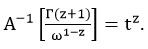
Definition 6 The convolution of two functions ℏ(t) and g(t) under the Sawi transform satisfies:

Solutions of the fractional integro-differential equations
In this section, there are strong indications that the function Υ(t) alone may be adequate to enable the Sawi transform A[Υ(t)] to operate successfully at a certain value of the parameter.
Theorem 3.1 Let 0 < ℵ < 1 and a and b ∈ R. Then the fractional integro-differential equation

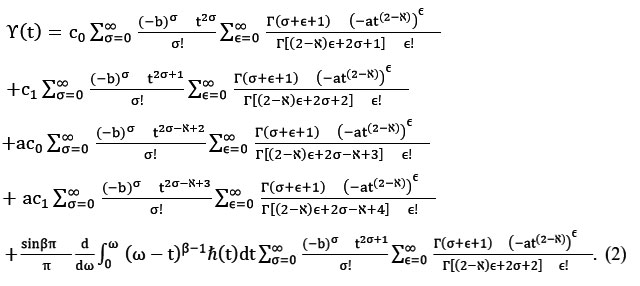
with initial conditions Υ(0) = c0 and Υ'(0) = c1 has the unique solution
Proof. Utilizing the Sawi transform in (1) and taking into consideration, we have
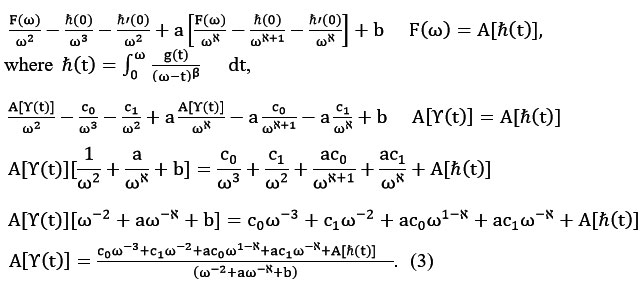
Since
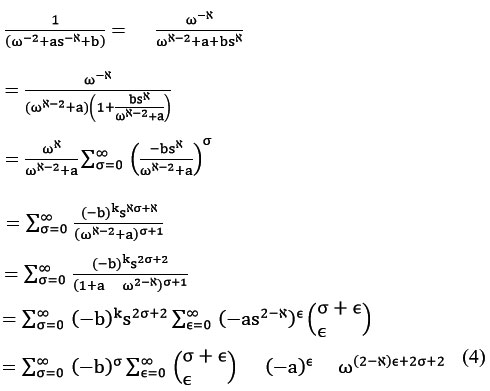
and

This is Convolution integral,

Where K(P) is the Sawi transform of K(ω) = ω-β
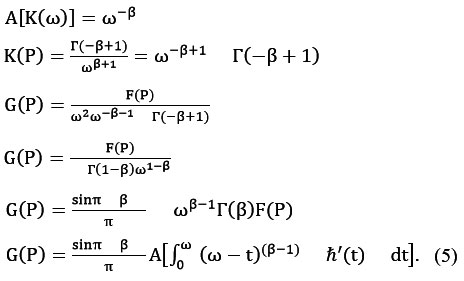
Substituting the above two equations (4) and (5) in (3), we get
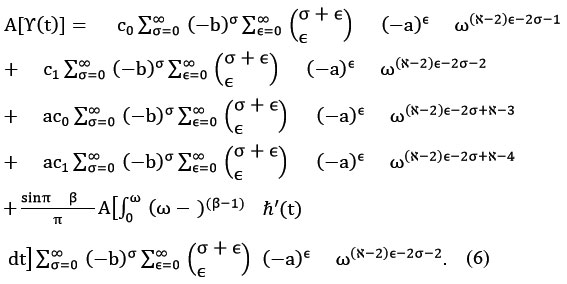
Thus, the inverse Sawi transform to equation (6) yields the solution (2)
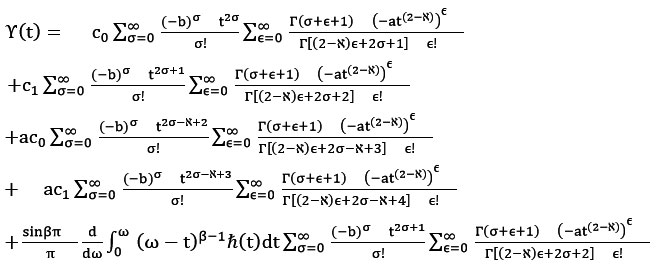
which is (2). This completes the proof of the theorem.
Example 3.1 The fractional integro-differential equation is

with initial conditions Υ(0) = c0 and Υ'(0) = c1 has the unique solution
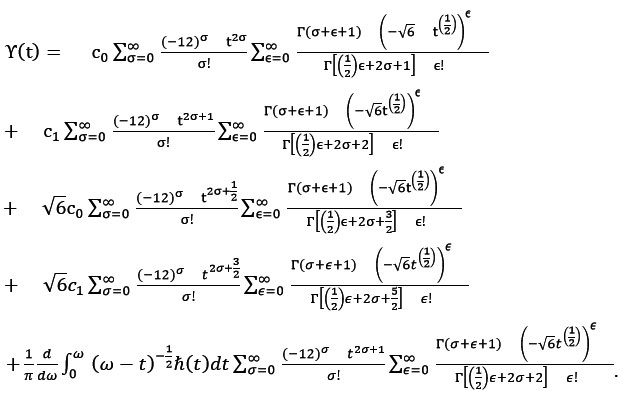
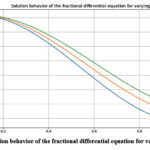 |
Figure 1: Solution behavior of the fractional differential equation for varying values. Click here to View Figure |
The solution curves of Υ(t) for different fractional parameters ℵ were plotted in Figure 1. The solution in time is realized via truncation of the double series expression consisting of tα and tβ, where the series capture the essential behavior of the fractional differential equation on hand. Lower ℵ values, e.g., ℵ = 0.3, reflect a very calm and steady growth of the solution, whereas high values, e.g., ℵ = 0.9, depict almost a very quick growth, indicating that the parameter ℵ has a major influence over the amplitude and the rate of change of the solution. This kind of behavior speaks about the sensitivity of the considered fractional differential equation toward the fractional parameter, thus implying that ℵ controls the memory effect or the hereditary properties of the system. The smoothness and continuous nature assure the convergence and trustworthiness of the series solution within the particular domain.
Application of the Theorem 3.1 to Paracetamol Drug Release Modeling
In this section, we model the release kinetics of the paracetamol tablet in blood using the fractional integro-differential equation framework developed in Theorem 3.1. Paracetamol, also known as acetaminophen, is one of the most commonly used over-the-counter analgesic and antipyretic agents worldwide, utilized to alleviate pain and reduce fever. Hence, Therefore, due to the unstable therapeutic window and the possible danger at high doses, it is of clinical importance to understand and predict the different aspects concerning its release and absorption. The pharmacokinetics of paracetamol are the simultaneous interrelated processes that include tablet matrix dissolution, bio membrane diffusion, systemic circulation absorption, hepatic and predominantly hepatic transformation, and excretion. Classical integer-order differential models could rarely take into account the memory properties in regard to hereditary processes of the physiological processes as well as anomaly diffusion of delayed responses by biological compartments and enzymatic reactions.
Therefore, Fractional integro-differential equations are much more appropriate to model the processes which are observed since they have nonlocal operators and the integrating terms have weakly singular kernels. This particular form of simulation adds a memory effect and long-range time correlation which are key factors in drug retention, delayed clearance, and nonlinear saturation effect which is observed in pharmacodynamics. This type of a fractional model allows this time-dependent profile of plasma concentration of paracetamol following oral absorption to be simulated more accurately. Thus, such modeling is significant when it comes to optimization of dose regimens, minimization of adverse effects and improved patient outcomes.
Mathematical Model Formulation
Fractional calculus is used in modeling drug release and dynamics in the bloodstream because it accommodates memory effects and non-local temporal interactions. More specifically, fractional differential equations can describe drug kinetics in anomalous diffusion and complex metabolism cases more efficiently. The fractional models are superior to classical integer-order differential equation models because they consider the entire history of drug concentration rather than simply the instantaneous state.
So, we focus now on a particular fractional Volterra integro-differential equation given by

where Dtβ is a fractional derivative operator of Caputo type of order β, 0 < β < 1. The function Υ(t) gives the concentration of paracetamol in the blood plasma at time t. The parameters a, b, and ℵ represent distinguished kinetic features of drug release and metabolism: the parameter describes the nonlinear mechanism of drug release, ℵ describes the extent of nonlinearity of drug interaction dynamics, and b gives the linear elimination rate proportional to the present concentration. The term incorporating the kernel function g(s) accounts for drug absorption and elimination across time, weighed by the fractional order power-law kernel (t – s)-β. This convolution kernel describes the memory effects, which represent a delayed physiological effect of drug intake at an earlier time and long-range temporal correlation in the metabolic pathways.
To fully specify the model, initial conditions are imposed as

Here, χ0 signifies the initial concentration of paracetamol immediately after administration, whereas χ1 reflects the initial rate of change in concentration, that is, the early absorption or distribution kinetics.
This fractional integro-differential framework represents the release and metabolism of paracetamol in a rigorous and biologically relevant manner, with the incorporation of nonlinear kinetics and memory-dependent dynamics essential for the accurate simulation of drug concentration profiles over time.
Numerical Solution and Simulation
To gain a numerical solution of the fractional integro-differential equation (7), we start to do the procedure by an approximate solution based on the series expansion as effected by the developed theorem (3.1). The concentration function Υ(t) is approximately expressed as a truncated series, wherein only terms with the highest magnitude are considered for analyzing drug release. Specifically, the solution is approximated by the first four terms of the series given by

The truncated series balances computational efficiency with accuracy to include nonlinear kinetics and memory effects without excessive computations.
When describing the features of drug clearance from the bloodstream, the memory kernel function g(t) is very important. For the simulation, they choose this function as an exponentially declining function:
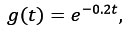
considered to be a realistic rate of natural metabolic clearance for paracetamol. The exponential decay function ensures that past concentrations of the drug have less and less influence as time passes, which is a known pharmacokinetic principle.
Based on the above formulism, numerical experiments simulate the time evolution of lowering paracetamol concentration in blood plasma. Figure 2 shows the concentration profile up to 10 hours after administration. The curve indicates a fast-upward spike in the concentration of absorption and a gradual downward slope due to metabolic elimination.
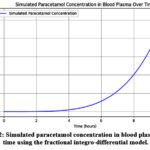 |
Figure 2: Simulated paracetamol concentration in blood plasma over time using the fractional integro-differential model. Click here to View Figure |
The findings of the simulation support the capability of this fractional model to characterize a difficult interaction of nonlinear release kinetics with memory-dependent metabolic process. The smooth decay is smooth and is therefore to be expected and hence can be regarded as the expected pharmacological behaviour thus justifying the suitability of the fractional integro-differential framework in addition to the accuracy of its numerical approximation based on the above named theorem (3.1).
Interpretation of Results
The typical pharmacokinetic profile of plasma concentration of paracetamol after administration is provided in figure 2. The concentration increases at a high rate in the initial two hours. This steep increase is associated with the absorption stage, when the drug dissociates very quickly out of the frame of the pill and is introduced into the systemic circulation, which was properly documented in the literature of immediate-release paracetamol.
Fractional order derivative with β=0.5 has a great memory effect that has an impact on the temporal dynamics of the drug. Though the integers-order classic models of the derivative, the local behavior is represented, the history-dependent nature of drug metabolism and distribution is taken into account by the non-locality of the fractional derivatives. This lower the drug concentration rate with slower rate, which is physiologically termed as sort of delayed metabolic clearance and multi-compartmental diffusion. These are the basic underlying processes of the physiological systems which can be ignored in the simplistic models.
Enzyme factor ℵ=0.8 used in the nonlinear term is an important factor that would indicate saturation that would otherwise be present in the enzymatic drug metabolism. The rate of enzymes in breaking up paracetamol can only be so fast, thus, once the drug concentration is high, the enzyme metabolism is already saturated or at least slower. This nonlinearity feature ensures the gradual and smooth nature of the process of decadence of the drug concentration as opposed to suddenness and hence more realistic metabolic kinetics. The nonlinear and fractional modeling provide a more realistic and physiologically relevant explanation of nonlinear drug release and elimination profile, which is essential to optimize the dosage schedules in order to be able to sustain therapeutical levels without developing toxicity.
Discussion
The type of the fractional integro-differential equations presented and used in this context is a great and also a versatile instrument to deal with rather complicated drug release dynamics. It shares the properties of delayed clearance and enzymatic saturation-concepts which is not a property of classical integer-order models, which hinges upon the capability of the model to represent biological effects in relation to fractional derivatives to capture memory properties and other nonlinearities. The present study on the release of paracetamol does indeed provide a precedence to the expansion of the application of the approach to the reinforcement of the pharmacokinetic data on the complicated focal points and the predicting of drug concentration-curve in a range of physiological situations.
This trend can certainly be utilized by the design of pharmaceutical products, especially the controlled-release tablets in which the rate of release is expected to keep the therapeutic action on a longer-term basis. In addition to this, the combination of this model with the approaches to parameter estimation and experimental data on concentrations can also update such predictions with the data of one particular patient, which injects the possibility of precision medicine in the reality field. More deliberations can be done, as to proceed hand-in-glove with this fractional modeling to derive a entire account of the dynamic impacts of drugs and pharmacodynamics that is therapeutic in essence. Moreover, it is possible to investigate other memory kernels and nonlinear functions to have further flexibility in modeling various drug behaviors in different chemical compounds and delivery systems.
Conclusion
This work contains certain types of fractional integro-differential equations in an obvious direct method of the fractional calculus, the Sawi transform and the extension coefficients of the binomial series. Its main contribution is a generalization of the classical Frobenius methodology to fractional systems with a rigorous results. A real life application of the model was to a scenario of diffusion of paracetamol drug release, which practically represented non-local diffusion , saturation of enzymes and delayed metabolism. The fact that the model can act in the realistic pharmacokinetic manner is supported by the numerical simulations. The entire study is characterized by the physical strength and adaptability of the fractional modeling in the explanation of the complex biomedical dynamics and provides a good prospect of further researches in pharmacokinetics and other related areas.
Acknowledgement
This research did not receive any specific grant from funding agencies in the public, commercial, or not-for-profit sectors.
Funding Sources
The author(s) received no financial support for the research, authorship, and/or publication of this article.
Conflict of Interest
The author(s) do not have any conflict of interest.
Data Availability Statement
This statement does not apply to this article.
Ethics Statement
This research did not involve human participants, animal subjects, or any material that requires ethical approval.
References
- Fadhil, R. A. Convolution for Kamal and Mahgoub transforms. Bull. Math. Stat. Res., 2017, 5(4), 11-16.
- Kim, H. On the form and properties of an integral transform with strength in integral transforms. Far East J. Math. Sci., 2017, 102(11), 2831-2844.
CrossRef - Elzaki, T. M. The new integral transform Elzaki Transform. Glob. J. Pure Appl. Math., 2011, 7(1), 57-64.
- Mahgoub, M. A.; Mohand, M. The new integral transform Sawi Transform. Adv. Theor. Appl. Math., 2019, 14(1), 81-87.
- Spiegel, M. R. Laplace Transform (C. Cerit & S. Eraslan, Trans.). Bilimsel Kitaplar Yayınevi, 1965.
- Kim, H. The intrinsic structure and properties of Laplace-typed integral transforms. Math. Probl. Eng., 2017, 1762729.
CrossRef - Medina, G. D.; Ojeda, N. R.; Pereira, J.; Romero, L. G. Fractional Laplace Transform and Fractional Calculus. Int. Math., 2017, 12(20), 991-1000.
CrossRef - Watugala, G. K. Sumudu transform: a new integral transform to solve differential equations and control engineering problems. Int. J. Math. Educ. Sci. Technol., 1993, 24(1), 35-43.
CrossRef - Ahmadi, S. A. P.; Hosseinzadeh, H.; Cherati, A. Y. A new integral transform for solving higher order linear ordinary differential equations. Nonlinear Dyn. Syst. Theory, 2019, 19(2), 243-252.
- Podlubny, I. Fractional Order Systems and PID Controllers. IEEE Trans. Autom. Control, 1999, 44, 208-214.
CrossRef - Raghavendran, P.; Gunasekar, T.; Balasundaram, H.; Santra, S. S.; Majumder, D.; Baleanu, D. Solving fractional integro-differential equations by Aboodh transform. J. Math. Comput. Sci., 2024, 32(3), 229-240.
CrossRef - Schiff, J. L. The Laplace Transform: Theory and Applications. Springer Science and Business Media, 2013.
- Belgacem, F. B. M. Introducing and analyzing deeper Sumudu properties. Nonlinear Stud., 2006, 13(1), 23-41.
- Khan, Z. H.; Khan, W. A. N-Transform properties and applications. NUST J. Eng. Sci., 2008, 1(1), 127-133.
 PlumX:
  Views: 1191 Views
  PDF Downloads: 1266
 Accepted on: 01 Mar 2026
Second Review by: Dr. Shanti Kumari
Final Approval by: Dr. Ayssar Nahle


ISSN Online: 2231-5039